
ISO 27001 2026 Market Update: Certification Prep & Best Practices
ISO 27001: The 2026 Market Update & Why Certification Matters

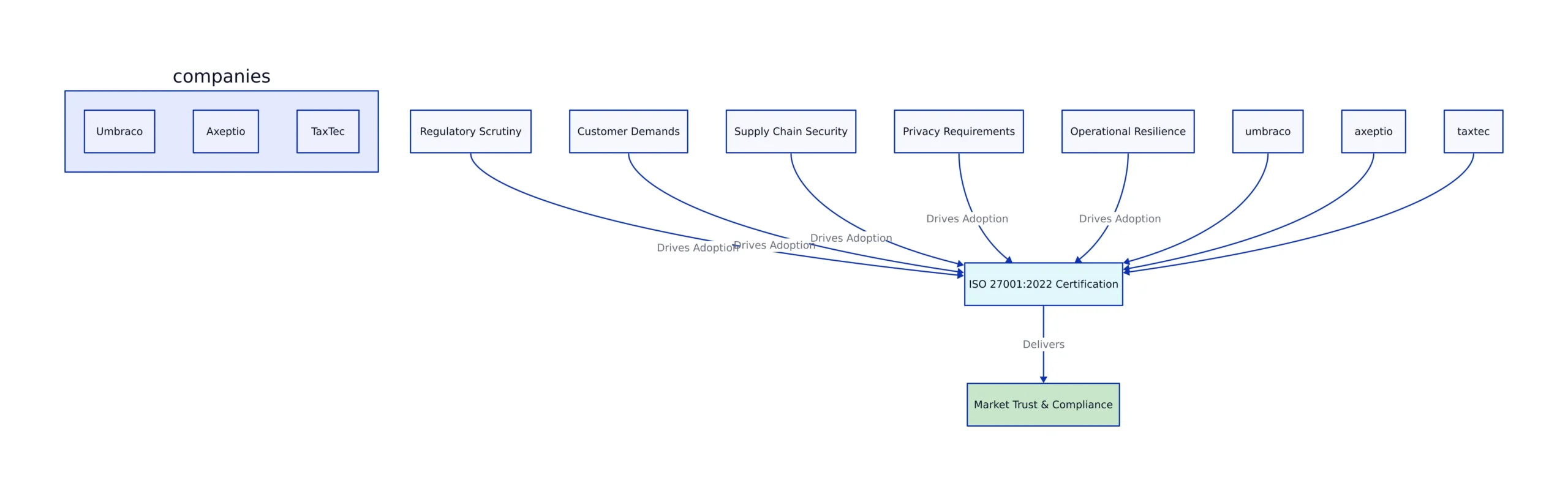
2026 has brought a dramatic uptick in ISO 27001 certifications among SaaS, healthcare, and financial firms, with public announcements from companies like Umbraco, Axeptio, and TaxTec underscoring the standard’s continued relevance (CMSWire, ExchangeWire). Regulatory scrutiny and customer demands around supply chain security, privacy, and resilience are pushing organizations to adopt ISO 27001:2022 as a board-level imperative. With the October 2025 deadline for the latest revision now in the rearview mirror, only the 2022 version (plus minor 2024 amendments) is accepted for new certifications and renewals (Precision Execution).
For CISOs and compliance leaders, certification is more than a checkbox—it’s a signal to customers, partners, and regulators that your information security management system (ISMS) meets the gold standard for risk management and resilience. But the path to certification is arduous. Auditors in 2026 are demanding real, operational evidence: logs, dashboards, and proof of continuous control.
Annex A Controls & Risk Assessment Methodology
ISO 27001:2022’s Annex A includes 93 controls across four domains. Not every control is mandatory—each must be mapped to your risk environment, justified, and documented in the Statement of Applicability (SoA). The process for control selection and risk assessment is what sets successful programs apart.
- Asset Inventory & Data Flows: Identify all information assets and their associated risks (as required by ISO 27001:2022 Clause 6.1.2 and A.5-A.8).
- Risk Assessment: Apply a formal methodology (e.g., ISO 31000, NIST SP 800-30) to evaluate threats, vulnerabilities, and consequences. Update risk assessments at least annually or after significant changes (Meewco).
- Control Mapping: Select controls based on risk—not all 93 are required, but you must provide justification for any exclusions.
- Implementation Evidence: Collect logs, configurations, and operational records for controls such as:
- Access Control (A.9): MFA logs, access reviews
- Cryptography (A.10): Key management records
- Physical Security (A.11): Visitor logs, CCTV footage
- Supplier Security (A.15): Supplier audits, contracts

Auditors in 2026 expect organizations to leverage automation—SIEM systems, GRC platforms, and workflow tools—to provide real-time, tamper-proof control evidence. Manual documentation alone is no longer sufficient.
Statement of Applicability & Internal Audit Process
The Statement of Applicability (SoA) is the single most scrutinized artifact in any ISO 27001 audit. It lists all 93 Annex A controls, their implementation status, and justifications for exclusions (ISO 27001:2022 Clause 6.1.3).
- Preparation: Ensure the SoA is current, mapped to your most recent risk assessment, and cross-referenced to supporting evidence.
- Internal Audit: Before inviting the certification body, conduct a formal internal audit (ISO 27001 Clause 9.2). This must:
- Test the effectiveness of each implemented control
- Sample evidence (e.g., incident logs, access reviews, supplier audits)
- Document nonconformities and assign corrective actions
- Management Review: Senior leadership should review the ISMS performance, risks, and audit findings (Clause 9.3), showing top-level engagement during the external audit.

Auditors will expect to see internal audit reports, records of management reviews, and evidence of corrective actions completed prior to certification. Tools such as SIEM and GRC platforms streamline this process, but human oversight is essential.
Preparation Timeline, Cost Ranges & Certification Body Selection
A realistic ISO 27001 preparation and certification journey for a small to mid-sized organization spans approximately nine months, though larger or more complex environments may require more time. Based on industry benchmarks and audit firm data (Elevate Consulting, Meewco):
| Phase | Activities | Duration | Key Deliverables |
|---|---|---|---|
| 1-2 Months | Gap analysis, scoping, stakeholder buy-in | 2 months | Gap report, ISMS scope document |
| 3-4 Months | Risk assessment, policy & procedure dev, control mapping | 2 months | Risk register, SoA draft, security policies |
| 5-6 Months | Control implementation, training, internal audits | 2 months | Control evidence, audit reports, training logs |
| 7-8 Months | Remediation, pre-assessment, management review | 2 months | Corrective action logs, management review records |
| 9th Month | Certification audit (Stage 1 & 2) | 1 month | Certification audit plan, audit evidence |
Cost estimates for ISO 27001 in 2026 vary widely by organization size, scope, and maturity:
| Cost Element | Typical Range | Notes |
|---|---|---|
| Consulting & Advisory | $10,000 – $50,000 | Optional; higher for complex orgs |
| Internal Resources | Variable | Staff time, IT, compliance |
| Certification Audit Fee | $10,000 – $30,000 | Per Elevate Consulting |
| Remediation/Implementation | $5,000 – $40,000 | Tools, training, process changes |
When selecting a certification body:
- Ensure accreditation (e.g., UKAS, ANAB).
- Review sector experience—healthcare, SaaS, finance, etc.
- Clarify audit process, timelines, and hidden fees (ICertWorks).
Audit Expectations & Common Findings
ISO 27001 audits in 2026 are more data-driven and operational than ever. Auditors expect:
- Real-time Evidence: Automated logs, SIEM dashboards, and evidence of continuous monitoring—not just policy documents.
- Recent Risk Assessments: Updated within the last 12 months, reflecting changes in technology, regulation, and business processes.
- Operational Testing: Sampling of incidents, access changes, and supplier assessments. Auditors may request evidence “live” via dashboards.
- Remediation & Continuous Improvement: Closed corrective actions, regular management reviews, and clear evidence trails for incidents and audit findings.
Common findings that delay or derail certification include:
- Stale documentation or policies not reflecting current practices
- Gaps in logging or incident response evidence
- Missing or outdated risk assessments
- Failure to address previous audit nonconformities
- Insufficient evidence for excluded Annex A controls in the SoA
Penalties for non-compliance are significant: fines for major breaches can exceed $10 million, especially where poor controls contribute to data loss or privacy violations (ISO News).
Comparison Table: ISO 27001 Preparation, Audit Costs & Timeline (2026)
| Step | Effort/Duration | Cost Range (USD) | Key Evidence & Deliverables | Reference/Source |
|---|---|---|---|---|
| Gap Analysis & Scoping | 1-2 months | Internal only | Scope doc, gap report | Meewco |
| Risk Assessment & Control Selection | 2 months | Part of consulting fee | Risk register, SoA draft | Meewco |
| Implementation & Training | 2 months | $5,000–$40,000 | Control logs, training records | Elevate Consulting |
| Internal Audit & Remediation | 2 months | Included in staff costs | Internal audit report, corrective actions | Meewco |
| Certification Audit | 1-2 months | $10,000–$30,000 | Audit report, certificate | Elevate Consulting |
Key Takeaways
Key Takeaways:
- ISO 27001:2022 is now mandatory for all new certifications and renewals—no exceptions after October 2025.
- Annex A controls must be risk-justified, operationalized, and mapped in a current SoA.
- Auditors demand real, operational evidence—automated logs, SIEM dashboards, incident response records.
- Allow at least 9 months for preparation, with costs ranging from $20,000 to $60,000 for most organizations.
- Failing to modernize documentation, risk assessments, and evidence collection leads to findings, delays, and potential fines.
- Continuous improvement, regular management reviews, and prompt remediation are non-negotiable for passing and maintaining certification.
For more on ISMS implementation, evidence automation, and audit readiness, see the external resources at Meewco and Elevate Consulting. For practical cloud compliance tips, visit our related coverage on cloud security posture management and security audit preparation.
Nadia Kowalski
Has read every privacy policy you've ever skipped. Fluent in GDPR, CCPA, SOC 2, and several other acronyms that make people's eyes glaze over. Processes regulatory updates faster than most organizations can schedule a meeting about them. Her idea of light reading is a 200-page compliance framework, and she remembers all of it.