Market Overview: Stocks Near Records Amid Oil and Risks
Market Overview — Records Held Wednesday, but Thursday’s Open Shows the Market Is Still Trading Oil and Earnings
The biggest market-moving fact for investors is that Wednesday, April 22, 2026 ended with the S&P 500 (^GSPC) and Nasdaq Composite (^IXIC) still sitting at or near fresh 52-week highs, even as Thursday’s early trade turned lower. For the completed April 22 session, the S&P 500 closed at 7,137.90, the Nasdaq Composite closed at 24,657.57, and the Dow Jones Industrial Average (^DJI) closed at 49,490.03, according to Yahoo Finance data returned through the market snapshot viewed at 10:00 a.m. ET on Thursday, April 23. By Thursday’s 9:30 a.m. ET update, the S&P 500 was indicated at 7,123.52, down 14.38 points or 0.20% from that prior close, the Nasdaq was at 24,536.41, down 121.16 points or 0.49%, and the Dow was at 49,293.66, down 196.37 points or 0.40%.
That setup matters because it captures the market’s current character better than a simple “stocks up” or “stocks down” headline. Wednesday’s completed session was strong enough to leave the S&P 500 at its 52-week high of 7,137.90, matched on April 20, 2026, while the Nasdaq’s 24,657.57 close also matched its 52-week high from April 20. Yet the opening tone on Thursday turned defensive as investors digested another rise in oil, fresh airline guidance cuts, and the aftereffects of a heavy earnings slate that included Tesla (TSLA), International Business Machines (IBM), and ServiceNow (NOW).

The month-to-date trend still favors the bulls. Over the last month, the S&P 500 is up 8.25%, the Nasdaq is up 11.81%, and the Dow is up 6.70%. Over the last year, the gains are much larger: 28.93% for the S&P 500, 41.16% for the Nasdaq, and 22.91% for the Dow. On a five-year monthly basis, the S&P 500 is up 69.45%, the Nasdaq is up 78.47%, and the Dow is up 42.79%. That long trend explains why dips are still being bought, but the April 22-to-April 23 handoff also shows that investors are no longer ignoring macro friction.
| Index | April 22 Close | Thursday 9:30 a.m. ET | 52-Week High | 52-Week Low |
|---|---|---|---|---|
| S&P 500 (^GSPC) | 7,137.90 | 7,123.52 (-14.38 / -0.20%) | 7,137.90 on 2026-04-20 | 5,525.21 on 2025-04-21 |
| Nasdaq Composite (^IXIC) | 24,657.57 | 24,536.41 (-121.16 / -0.49%) | 24,657.57 on 2026-04-20 | 17,382.94 on 2025-04-21 |
| Dow Jones Industrial Average (^DJI) | 49,490.03 | 49,293.66 (-196.37 / -0.40%) | 50,115.67 on 2026-02-02 | 40,113.50 on 2025-04-21 |
The chronology into Wednesday’s close was straightforward. Stocks came into the session with momentum already strong from the prior week, chip shares remained a source of leadership, and investors were still willing to look through elevated energy prices because earnings had not broken the rally. That is a continuation of the pattern we tracked in our April 16 market recap and our April 13 rebound analysis: the market can tolerate higher oil for a while if earnings stay credible and index leadership remains concentrated in technology and AI-linked infrastructure. The next session will test whether that tolerance is starting to thin.
Key Takeaways:
- The S&P 500 (^GSPC) closed Wednesday, April 22, 2026 at 7,137.90, matching its 52-week high, while the Nasdaq Composite (^IXIC) closed at 24,657.57, also at a 52-week high.
- Thursday’s 9:30 a.m. ET market snapshot showed a pullback, with the S&P 500 down 0.20%, the Nasdaq down 0.49%, and the Dow down 0.40% from the prior close.
- WTI crude oil (CL=F) rose to 94.00, up 1.12%, while gold (GC=F) climbed to 4,753.70 and Bitcoin (BTC-USD) slipped to 77,535.57.
- Top single-stock moves included United Rentals (URI) +18.87%, Texas Instruments (TXN) +16.54%, QuantumScape (QS) +13.75%, ServiceNow (NOW) -14.80%, Tesla (TSLA) -3.96%, and Avis Budget Group (CAR) -30.35%.
- The market remains in a strong monthly uptrend, but oil, airline profit warnings, and geopolitical headlines around the Strait of Hormuz are reintroducing near-term volatility.
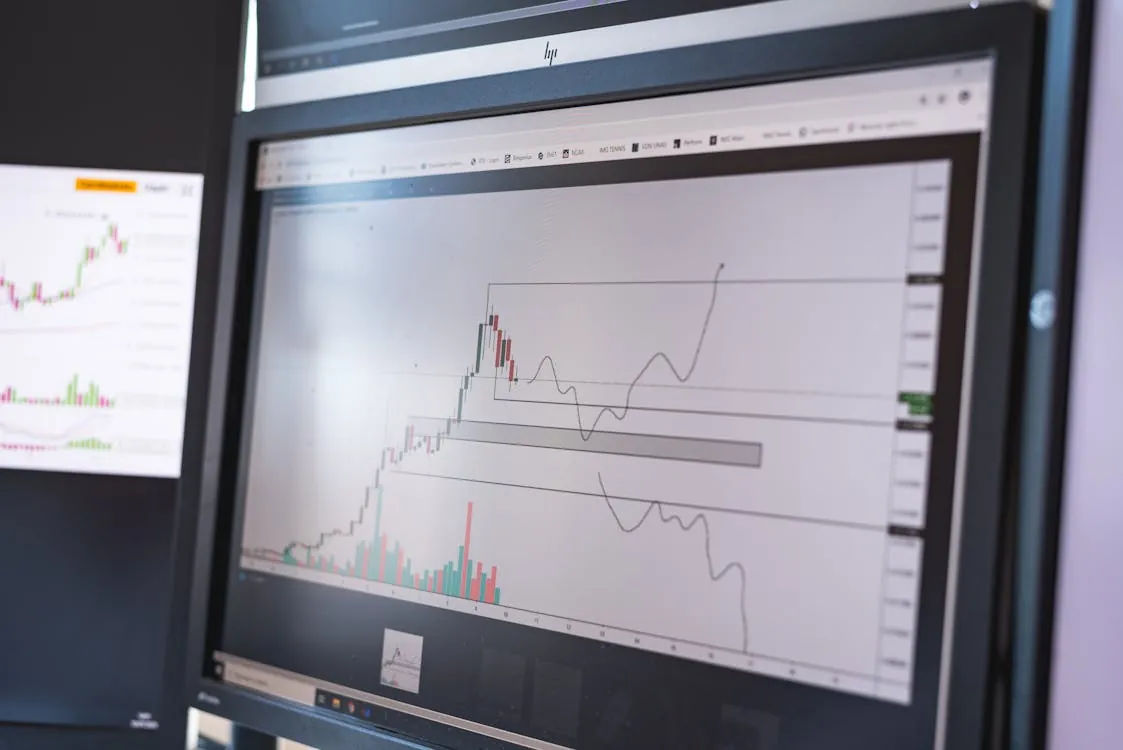
Top Movers — Earnings and Single-Name Volatility Drove the Tape
The most actionable single-stock story around the April 22 session and Thursday’s early trade was not broad market breadth. It was dispersion. United Rentals (URI) traded at $954.75, up 18.87%, Texas Instruments (TXN) traded at $275.39, up 16.54%, QuantumScape (QS) traded at $8.31, up 13.75%, West Pharmaceutical Services (WST) traded at $312.56, up 13.90%, and Oklo (OKLO) traded at $76.82, up 6.09%. On the downside, ServiceNow (NOW) fell to $87.82, down 14.80%, Tesla (TSLA) dropped to $372.15, down 3.96%, Lockheed Martin (LMT) fell to $535.60, down 3.57%, and Avis Budget Group (CAR) plunged to $309.22, down 30.35%.
Those moves were not random. CNBC reported after Wednesday’s close that ServiceNow stock sank as subscription revenue took a hit from the Iran war, even though the company beat expectations on revenue and earnings. CNBC also reported that Tesla missed on revenue but beat on profit as auto margins improved. In airlines, United Airlines (UAL) had already cut its 2026 forecast earlier in the week because of fuel costs, and on Thursday morning both Southwest Airlines (LUV) and American Airlines (AAL) warned that higher jet fuel was pressuring outlooks. That is the market’s core message right now: earnings can still be good enough to support stocks, but guidance has become more fragile as energy costs rise.
Avis Budget Group (CAR) deserves separate mention because it was already a focus in our April 20 analysis of CAR’s surge. At that time, CAR had closed at $608.80 after a 23.27% jump in a mixed market. The latest reading at $309.22 means the stock has given back nearly half that level in a violent reversal after what CNBC described as a move that reminded some on Wall Street of GameStop-style behavior. That is a sharp continuity update: a stock that looked like one of the cleanest cyclical momentum expressions earlier in the week has become one of the market’s clearest warnings about unstable positioning.
| Ticker | Price | Change % | Reason |
|---|---|---|---|
| United Rentals (URI) | 954.75 | +18.87% | One of the session’s strongest verified gainers as investors rewarded industrial and infrastructure exposure. |
| Texas Instruments (TXN) | 275.39 | +16.54% | Chip stocks remained leadership names; CNBC highlighted Texas Instruments as the star of Thursday’s earnings setup. |
| QuantumScape (QS) | 8.31 | +13.75% | Among the day’s biggest gainers and one of the most active names. |
| West Pharmaceutical Services (WST) | 312.56 | +13.90% | Strong upside move in healthcare-related exposure. |
| Oklo (OKLO) | 76.82 | +6.09% | Continued participation in high-beta thematic leadership. |
| ServiceNow (NOW) | 87.82 | -14.80% | CNBC said subscription revenue took a hit from the Iran war despite an earnings beat. |
| Tesla (TSLA) | 372.15 | -3.96% | CNBC reported revenue miss offset by better profit and stronger auto margins. |
| Lockheed Martin (LMT) | 535.60 | -3.57% | Defense stock eased despite ongoing geopolitical tension. |
| Avis Budget Group (CAR) | 309.22 | -30.35% | Violent reversal after this week’s speculative surge, according to CNBC’s Thursday coverage. |
The broader lesson is that this is no longer a tape where index strength guarantees calm underneath the surface. It is a market rewarding semiconductors, industrial strength, and selected thematic growth while punishing any business model that cannot absorb fuel, war, or demand uncertainty cleanly. The next few sessions should tell investors whether these stock-specific breaks stay isolated or start to widen into sector-level damage.
Sector Performance — Semiconductors and Industrials Led, Airlines and Select Software Lagged
Technology remains the lead sector, and the clearest evidence is still the Nasdaq’s relative strength over the past month. The Nasdaq’s 11.81% one-month gain is ahead of the S&P 500’s 8.25% and the Dow’s 6.70%, and CNBC reported Thursday that the PHLX Semiconductor Index is on its best winning streak ever with gains in 16 straight sessions. That matters because it explains why names like Texas Instruments (TXN) and broader chip exposure continue to support the major indexes even when parts of software and consumer discretionary weaken.
This is also a direct continuation of the April pattern we have been tracking on the site. In our April 9 market review, semiconductor and AI infrastructure names led while software lagged. In our April 10 macro-shift recap, we argued that the market was becoming more selective and more sensitive to oil. That framework still fits. ServiceNow (NOW) is the current example of software fragility, while Texas Instruments (TXN) and the broader semiconductor trade show that investors still want hard-demand, hardware-linked earnings stories.
Industrials also mattered more than the headline indexes suggest. United Rentals (URI) at $954.75 and up 18.87% is not just a one-stock story; it is evidence that investors are still willing to pay for businesses tied to infrastructure, equipment demand, and economic durability. That is helpful for the broader market because rallies hold up better when leadership expands beyond megacap technology. At the same time, airlines are a clear lagging pocket. CNBC reported that American Airlines (AAL), Southwest (LUV), and earlier United (UAL) all cut or pressured outlooks because of higher fuel costs. That gives investors a clean sector read-through: oil is no longer just an inflation abstraction; it is directly hitting guidance.
Consumer cyclicals remain mixed. Tesla (TSLA) is still one of the market’s most active names, but its 3.96% decline after earnings shows investors are demanding more than margin resilience. Avis Budget Group (CAR) is even more extreme, with its 30.35% drop underscoring how quickly speculative enthusiasm can reverse. The next sector question is whether weakness stays concentrated in fuel-sensitive and momentum-heavy names or spreads into a broader consumer slowdown narrative.

Macroeconomic Developments — Oil, Fed Sensitivity, and Strait of Hormuz Risk Are Back in Control
The clearest macro number on Thursday morning was WTI crude oil (CL=F) at $94.00 per barrel, up $1.04 or 1.12% from the prior session. That price is below the 52-week high of $111.54 set on March 30, 2026, but far above the 52-week low of $56.66 from December 15, 2025. Over the last month, WTI is up 6.66%. Over the last three months, it is up 53.92%. Over the last year, it is up 49.16%. Those are not background numbers. They explain why airlines are cutting forecasts, why inflation sensitivity has returned, and why every geopolitical headline around the Strait of Hormuz is immediately market-relevant.
CNBC’s Thursday coverage made that connection explicit. The network reported that President Donald Trump ordered the Navy to “shoot and kill any boat” laying mines in the Strait of Hormuz, a headline that sharply raised the temperature around a chokepoint already central to oil tanker traffic. Reuters separately reported this week that the Iran war and the closure of the Strait of Hormuz have produced the biggest oil supply disruption on record by daily output lost in comparative terms. That does not automatically mean oil must go to $100 immediately, but it does explain why the market is refusing to price a clean energy normalization.
Gold (GC=F) added to the caution signal, trading at $4,753.70 per ounce, up $21.20 or 0.45%. Gold remains below its 52-week high of $5,230.50 from February 23, 2026 and above its 52-week low of $3,182.00 from May 12, 2025. Over the last month, gold is up 7.97%, though it is down 4.44% over three months and up 44.87% over the last year. That profile suggests investors still want hedges even as equities remain close to records. Bitcoin (BTC-USD), by contrast, traded at $77,535.57 at 8:00 p.m. ET on Wednesday, down $667.53 or 0.85%. Bitcoin remains above its 52-week low of $65,738.10 from February 23, 2026 and below its 52-week high of $123,513.48 from September 29, 2025. It is up 9.36% over the last month but still down 17.28% over the last year.
The macro takeaway is that this is not a classic panic regime. Oil is rising, gold is firm, and Bitcoin is soft, but the S&P 500 and Nasdaq are still near records. That is a market trying to price a manageable geopolitical premium rather than a full systemic shock. Still, the margin for error is smaller now than it was a week ago. Stronger oil and weaker transportation guidance mean the next inflation-sensitive data points and Fed commentary will matter more. The next completed session will show whether investors still believe earnings can outrun macro pressure.
Commodities and Global Markets — Cross-Asset Signals Are Turning Less Friendly
Cross-asset context remains the fastest way to understand whether the equity rally is broadening or narrowing. WTI crude oil (CL=F) at $94.00 is not yet back at March’s panic high, but it is close enough to keep pressure on transportation, housing inputs, and consumer confidence. CNBC reported Thursday that the Iran war is already hitting U.S. homebuilders through supplier price hikes on insulation, roofing, windows, and doors. That matters because it broadens the oil story from airlines and shipping into housing and construction.
Gold’s rise to $4,753.70 says defensive demand is still present, even if it is not extreme. Bitcoin’s decline to $77,535.57 says speculative appetite is still alive on a monthly basis but not strong enough to overpower macro caution. For equities, the implication is clear: the market can still rally, but it needs help from earnings and sector leadership because cross-asset conditions are no longer outright supportive.
| Asset | Latest Price | Daily Change | 52-Week High | 52-Week Low |
|---|---|---|---|---|
| WTI Crude Oil (CL=F) | 94.00 | +1.04 / +1.12% | 111.54 on 2026-03-30 | 56.66 on 2025-12-15 |
| Gold (GC=F) | 4,753.70 | +21.20 / +0.45% | 5,230.50 on 2026-02-23 | 3,182.00 on 2025-05-12 |
| Bitcoin (BTC-USD) | 77,535.57 | -667.53 / -0.85% | 123,513.48 on 2025-09-29 | 65,738.10 on 2026-02-23 |
Outside the U.S., the market tone remains mixed. CNBC reported that LVMH CEO Bernard Arnault warned of a “world catastrophe” if the Middle East conflict is not resolved, linking the war directly to luxury-sector weakness. CNBC also reported that SK Hynix posted record first-quarter profit as memory prices climbed on AI demand, reinforcing the split global message: AI and semiconductors remain strong, while consumer and travel-linked sectors are more exposed to geopolitical and energy stress. That same split is visible in U.S. markets and should remain the core framework for investors.
Compared with the earlier April regime covered in our April 6 oil-shock recap, the current market is in better shape because crude is no longer at $115.85 and the major indexes have recovered sharply. But compared with our April 22 fintech and sentiment analysis, the tape is less forgiving today. Then, the market was still celebrating fresh highs with Bitcoin rising. Now, oil is firmer, Bitcoin is lower, and earnings guidance from airlines and software is beginning to crack. The next few sessions will tell investors whether that is a pause or the start of a broader reassessment.
Outlook and Key Events Ahead — What Investors Should Watch Next
The most important forward-looking question is whether the market can keep holding near record highs while oil stays in the mid-$90s and guidance from fuel-sensitive industries deteriorates. Wednesday’s close said yes, at least for one more session. Thursday’s open says the market is less confident. That is the core tension investors need to watch.
Economic Calendar
The immediate macro focus is not a single scheduled release so much as the interaction between energy prices, inflation expectations, and sentiment. Oil at $94.00 is high enough to matter even before the next CPI or PPI update. Investors should keep watching any inflation-sensitive indicators, especially those tied to transportation, housing inputs, and consumer spending. CNBC’s Thursday report on homebuilder cost increases is an early sign that energy stress is spreading into other parts of the economy. If the next data confirm that pattern, the market will have a harder time treating higher oil as temporary noise.
Earnings Watch
Earnings remain the market’s main counterweight to macro stress. This week’s calendar includes Steel Dynamics (STLD), Grupo Aeroportuario del Pacifico (PAC), AGNC Investment (AGNC), Wintrust Financial (WTFC), Zions Bancorporation (ZION), BOK Financial (BOKF), Cleveland-Cliffs (CLF), Alaska Air Group (ALK), and ServisFirst Bancshares (SFBS), among others. The most actionable read-through so far has come from transportation and fuel-sensitive names. United (UAL), Southwest (LUV), and American (AAL) have all signaled that jet fuel is hurting outlooks. Investors should now watch whether industrials and regional banks sound similarly cautious or whether weakness stays concentrated in travel and consumer-sensitive segments.
Investors should also keep watching technology earnings closely. Texas Instruments (TXN) is a current bright spot, and CNBC highlighted it as Thursday’s standout earnings name. By contrast, ServiceNow (NOW) showed that even an earnings beat may not protect a stock if the market believes geopolitical disruption is hitting subscription growth. Tesla (TSLA) remains another example: profit resilience helped, but a revenue miss was still enough to pressure the stock. The next stage of earnings season will determine whether the market keeps rewarding hard-demand stories and punishing any guidance ambiguity.
Central Bank & Policy
The Federal Reserve is not the immediate headline driver, but it is the valuation backdrop for everything else. Higher oil reduces the market’s confidence that policymakers can turn more supportive quickly. That is why every move in crude matters twice: first for margins and inflation, and second for rate expectations. Policy headlines around the administration’s economic approval and the broader political handling of gas prices are also creeping into the market narrative, as CNBC’s survey coverage showed Thursday morning. If oil stays high and consumer confidence weakens, policy sensitivity will increase.
Technical Levels & Sentiment
For the S&P 500, the first practical level is the prior closing area around 7,137.90. Thursday’s 9:30 a.m. ET reading at 7,123.52 means the index is testing that breakout zone almost immediately after setting a 52-week high. For the Nasdaq, the comparable level is 24,657.57, with the 9:30 a.m. ET reading at 24,536.41 showing a more visible pullback. For the Dow, the key near-term reference remains 49,490.03. Sentiment is still constructive on a monthly basis, but the V-shaped recovery from early April has made the market more vulnerable to disappointment. After strong gains over one month, stocks do not need a crisis to pause; they only need a reason.
Risks & Catalysts
The main upside catalyst is still the same one that powered the rally earlier this month: strong earnings from semiconductors, industrials, and financials combined with oil staying below triple digits. The main downside risk is also unchanged but becoming more immediate: renewed escalation in the Strait of Hormuz that pushes crude back toward $100 and widens the damage from airlines into broader cyclicals. A second downside risk is that current leadership narrows too much, leaving the indexes dependent on a handful of chip and infrastructure names. A third is that speculative reversals like Avis Budget Group (CAR) begin to undermine confidence in other momentum trades.
My specific near-term call is this: WTI crude oil (CL=F) will settle below $97.00 per barrel by 2026-04-30, and the S&P 500 (^GSPC) will still close above 7,000 on that date. That forecast is falsifiable and grounded in the current setup: oil is elevated but still below the threshold that would likely force a broader equity repricing, while the index has enough cushion above 7,000 to absorb moderate volatility if earnings continue to hold.
The bottom line is that Wednesday’s completed session kept the bull case intact, but Thursday’s early trade reminded investors what can still break it. Oil is rising again, airlines are warning, software guidance is less secure, and geopolitical headlines around the Strait of Hormuz remain live. Against that, semiconductors, selected industrials, and the major indexes themselves are still holding up remarkably well. That is a constructive market, but no longer an easy one.
For continuity with recent site coverage, this recap extends the same April evolution we have been tracking in our April 16 market recap, our April 10 macro-shift analysis, and our April 22 fintech sentiment piece. The market is still climbing, but it is doing so with less help from falling oil and more dependence on earnings quality. That makes the next few sessions unusually important.
Sources: Yahoo Finance market data snapshot as of 10:00 a.m. ET on April 23, 2026; CNBC live market coverage at CNBC; CNBC coverage of ServiceNow earnings, Tesla earnings, American Airlines earnings, and Strait of Hormuz tensions; Reuters energy context via Reuters.
Sources and References
This article was researched using a combination of primary and supplementary sources:
Market Data
Real-time financial data used for price quotes, index levels, and market statistics.
Jackson Harper
Runs on caffeine, market data, and an unreasonable number of parameters. Never sleeps. Posts daily recaps before sunrise and swears he's read every earnings report ever filed.