Moonshot V2 Launchpad: Kimi K3 Review
Key Takeaways:
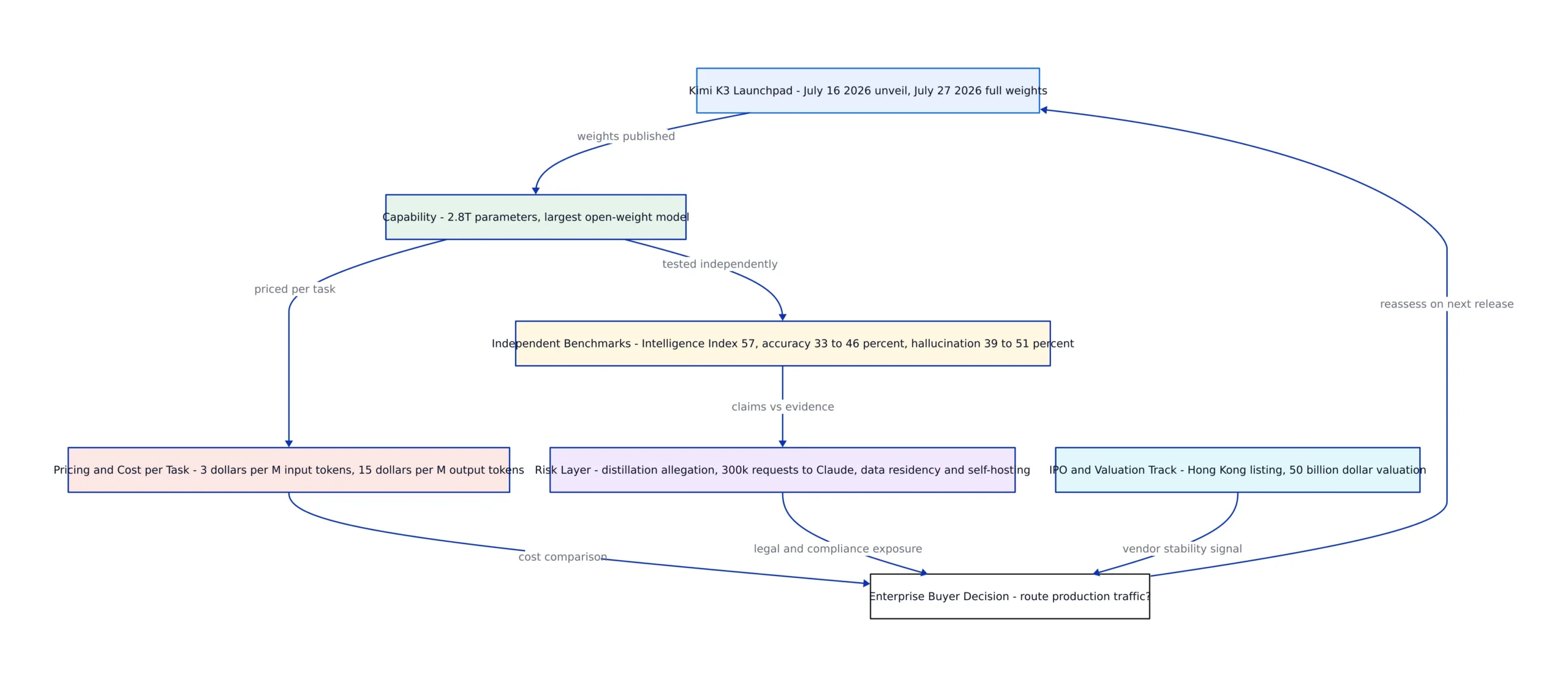
- Moonshot AI released Kimi K3 on July 16, 2026, a 2.8 trillion-parameter open-weight model, and published the full weights on July 27.
- Independent testing by Artificial Analysis placed K3 at 57 on its Intelligence Index, comparable to Claude Opus 4.8 and GPT-5.5 but behind Fable 5 and GPT-5.6 Sol.
- The same evaluation measured K3’s hallucination rate rising to 51%, from 39% for K2.6, even as raw accuracy improved from 33% to 46%.
- At $3 per million input tokens and $15 per million output tokens, K3 is cheaper per task than Claude Opus 4.8 but roughly three times the cost of DeepSeek V4 Pro.
- Moonshot is pursuing a Hong Kong listing and a $50 billion valuation, while Anthropic has accused it of routing nearly 300,000 customer requests to Claude.
Moonshot AI published the full weights of Kimi K3 on July 27, 2026, eleven days after unveiling the model at the World Artificial Intelligence Conference in Shanghai. At 2.8 trillion parameters, it is the largest open-weight language model ever released, and it comes with a pricing sheet, a licensing question, and legal risks that enterprise buyers need to consider before routing production traffic through it.
What Kimi K3 Actually Is
Kimi K3 is a mixture-of-experts model with 2.8 trillion total parameters spread across 896 specialized expert subnetworks. Only 16 experts activate per token, which makes serving a model of this size more efficient. The architecture includes a 1-million-token context window, native image input, and text-only output.
Three design choices set it apart from Kimi K2.6. Kimi Delta Attention replaces standard quadratic self-attention in most layers with a hybrid linear approach, combined with full attention at a 3:1 ratio; Moonshot reports that in a smaller research model this reduced key-value cache usage by up to 75%. Attention Residuals allow each transformer layer to selectively retrieve representations from earlier layers instead of accumulating them uniformly, which Moonshot says improves training efficiency by about 25% with less than 2% additional compute. Stable LatentMoE determines expert allocation from quantile statistics of router scores rather than learned discrete routing, an approach Moonshot says prevents routing collapse at this scale.
Those efficiency figures come from Moonshot’s own measurements, published alongside the technical report on Hugging Face. Because the weights are public, independent researchers can reproduce or challenge these claims, unlike with closed models, these claims can be tested.

The Demand Shock and the Compute Ceiling
Within 48 hours of the K3 debut, demand for the hosted version maxed out Moonshot’s GPU capacity, and the company stopped selling new subscriptions, as The Next Web reported. Moonshot described the situation as “unprecedented compute challenges” and said it would focus on serving existing paid customers while catching up, according to reporting on the subscription pause.
A vendor that restricts new sign-ups during a launch spike has not prepared for the demand its own marketing created. The self-hosting option exists because of this: with the weights in hand, your throughput limit depends on your own hardware, not someone else’s queue. The trade-off is that the hardware cost shifts to you, and for a model this size that cost is significant.
Moonshot recommends at least 64 accelerators for deployment. The full-precision weight set requires roughly 1.5 TB of GPU memory; in INT4 quantized form it drops to about 600 GB. This is not a workload for a single server at any price. For teams that already operate GPU fleets, it is a capacity planning task. For others, it is a reason to stay on the API or select a smaller open-weight model.
Independent Benchmarks Versus the Launch Claims
Artificial Analysis, which runs its own evaluation system rather than accepting vendor submissions, scored Kimi K3 at 57 on its Intelligence Index, similar to Claude Opus 4.8 and GPT-5.5, but behind Claude Fable 5 and GPT-5.6 Sol, according to the Artificial Analysis evaluation. Moonshot’s own materials acknowledge that overall performance “still trails most powerful proprietary models.”
The agentic results are stronger than the overall score suggests. K3 reached an Elo rating of 1668 on GDPval-AA v2, up from 1190 for K2.6 and ahead of GLM-5.2 at 1514, GPT-5.5 at 1494, and Claude Opus 4.8 at 1600. On the private long-horizon knowledge work evaluation, it scored an overall Elo of 1547, a 732-point gain over K2.6 and second only to Claude Fable 5. On AutomationBench-AA, an implementation of Zapier’s agentic SaaS workflow test, K3 took first place at 53%.
The number to consider alongside any cost comparison is the hallucination rate. Artificial Analysis measured K3’s factual accuracy improving from K2.6’s 33% to 46%, a clear gain, while the hallucination rate rose from 39% to about 51%. A model that answers more questions correctly while also confidently fabricating more answers is not a straightforward upgrade for workflows where factual accuracy is critical. Moonshot’s own launch materials note three additional limitations: sensitivity to how thinking history is preserved across conversation turns, a tendency toward what the company calls “excessive proactiveness” on agentic tasks, and a subjective gap in conversational polish compared to Fable 5 and GPT-5.6 Sol.
Pricing and Cost per Task
Per-token price is a weak measure of actual cost because it ignores how many tokens a model uses to complete a task. Artificial Analysis calculates cost per task on its Intelligence Index, which is a more useful comparison. K3 averages $0.94 per task, close to GPT-5.6 Sol at $1.04, about half the cost of Claude Opus 4.8 at $1.80, and significantly more expensive than open-weight peers.
| Model | Intelligence Index | Cost per task | Input / output per 1M tokens | Weights |
|---|---|---|---|---|
| Kimi K3 | 57 | $0.94 | $3.00 / $15.00 | Open |
| Claude Opus 4.8 | Comparable to K3 | $1.80 | See vendor pricing | Closed |
| GPT-5.6 Sol | Above K3 | $1.04 | See vendor pricing | Closed |
| GLM-5.2 | 51 | $0.32 | See vendor pricing | Open |
| DeepSeek V4 Pro | 44 | $0.04 | See vendor pricing | Open |
Source: Artificial Analysis. Cached input is discounted 90% to $0.30 per million tokens, which matters if your workload reuses a large system prompt or shared context.
The table challenges the usual “cheap Chinese model” narrative. K3’s output token price is $15 per million, sharply up from K2.6’s $4. On a cost-per-task basis it is more expensive than GLM-5.2 and much more expensive than DeepSeek V4 Pro, both open-weight and both scoring lower on the index. Moonshot has priced K3 as a model near the frontier rather than a budget option. If your decision is based purely on cost per unit of capability, the cheaper open-weight models deliver more per dollar, though with lower capability ceilings.
K3 also improved token efficiency along with its higher scores, using 21% fewer output tokens than K2.6 across the nine Intelligence Index evaluations, roughly 132 million tokens versus 166 million. Using fewer tokens per task partly offsets the higher per-token price.
The Distillation Allegation
Anthropic’s September 2026 threat intelligence report claimed that Moonshot ran a distillation campaign in which it rerouted customer requests to Claude instead of processing them with Kimi, then showed Claude’s responses to users while capturing some for training. Over a ten-day period, Anthropic says Moonshot relayed almost 300,000 customer requests to Anthropic through a proxy network of 5,380 fraudulent accounts, mostly in Singapore and Japan, and that roughly 23 million exchanges were observed between May and July 2026, according to Anthropic’s published report.
Anthropic’s report also states that some of these exchanges included sensitive information from individual users, multinational companies, and state-affiliated actors. Moonshot has not confirmed or denied whether K3 incorporates training data from those campaigns, and its technical blog credits architectural innovations without addressing training data sources. Anthropic names six other China-based labs in the same report, describing a pattern across multiple actors rather than a single-vendor dispute.
The practical effect for a buyer is a procurement issue. If part of a model’s training data came from a competitor’s outputs under disputed circumstances, the model’s licensing and provenance raise an unresolved legal question. That is a risk your legal team should review before committing to production use.
Data Residency and Self-Hosting
Moonshot AI is incorporated in Singapore as MOONSHOT AI PTE. LTD., but its operating entity is based in Beijing and subject to China’s National Intelligence Law of 2017, which requires organizations to support and cooperate with national intelligence work. The Data Security Law and Cybersecurity Law add data localization requirements and inspection powers. These obligations apply to the company itself, not to the physical location of servers during inference or to the Singapore incorporation.
Self-hosting the open weights removes the data-transit exposure. Running K3 on your own infrastructure means no prompt leaves your network. It does not change the legal position of the company that developed and distributed the model, and it does not remove the hardware cost: roughly 600 GB of GPU memory in INT4 form and 64 or more accelerators as Moonshot recommends.
There is a secondary risk to consider. Open weights can be modified, and a model’s built-in safety behavior can be removed by whoever fine-tunes it. The same access that lets your team run K3 on your own terms lets anyone else do the same without the guardrails the hosted API enforces. For enterprises, a practical approach is a mix: open-weight models for internal or cost-sensitive workloads where control matters, and managed platforms where vendor accountability and support are priorities.
The IPO and Valuation Track
Moonshot is seeking a $50 billion valuation in a pre-IPO round, having closed an earlier financing at $31.5 billion, according to reporting on the fundraising. The company aims for $2 billion in annualized revenue by the end of 2026, double its reported run rate for August, per TechCrunch’s reporting on the revenue target. OpenRouter data cited in that report shows as many as 300 billion tokens generated daily by K3 models, though usage figures have declined slightly in recent months.
Those projections are much smaller than OpenAI and Anthropic, which recent reports estimate at $40 billion and $65 billion respectively. The difference is structural: because Moonshot’s weights are freely available, it earns far lower margins than closed-weight competitors. The revenue target shows there is money in open-weight AI, but not at the scale of the closed frontier.
For a buyer, the IPO track has two sides. A public company faces disclosure obligations and some accountability that a private one does not. It also faces quarterly pressure to grow revenue, which can lead to pricing changes or a shift toward higher-margin enterprise contracts. Vendor continuity is an important procurement factor when your production pipeline depends on one lab’s model, and Moonshot’s long-term commercial direction is still being defined.
Frequently Asked Questions
Is Kimi K3 free to use? The weights are open and downloadable, so self-hosting involves no per-token fee, only your infrastructure cost. The first-party API charges $3 per million input tokens and $15 per million output tokens, with cached input discounted 90% to $0.30.
Can I run Kimi K3 on a single server? Not realistically. Moonshot recommends at least 64 accelerators, and the weight set requires roughly 600 GB of GPU memory in INT4 form or about 1.5 TB at full precision. This requires a rack-scale deployment.
How does K3 compare to GPT-5.6 and Claude Fable 5? On Artificial Analysis’s independent Intelligence Index, K3 scores 57, similar to Claude Opus 4.8 and GPT-5.5 but behind Fable 5 and GPT-5.6 Sol. On agentic tasks it is closer, reaching second place on long-horizon knowledge work.
What is K3’s hallucination rate? Independent testing measured it at about 51%, up from 39% for K2.6, even though raw accuracy improved from 33% to 46%. Verify factual assertions from the model, especially where accuracy is critical.
Is Kimi K3 safe for enterprise use? That depends on your risk tolerance. Self-hosting removes data-transit exposure to Chinese infrastructure but not the legal framework governing the developer. The distillation allegation raises an unresolved provenance question. Many enterprises use a mixed-model strategy instead of relying on a single vendor.
A note on naming: some references to a “Moonshot V2 Launchpad” circulate online, but no official Moonshot AI product, press release, or documentation uses that name. The verifiable 2026 launch from Moonshot AI is Kimi K3, which this analysis covers.
Related Reading
More in-depth coverage from this blog on closely related topics:
- Dart Programming Language Gets Stable
- Grok 4.7 Features and How to Use
- Hyperscaler Capex and AI Infrastructure
- Google Open Agentic Orchestrator for AI
- How to Save AI Models from Deletion
Sources and References
Sources cited while researching and writing this article:
- China-based Moonshot AI seeks $50B valuation , and could go public this year: report
- Kimi K3 achieves #3 in the Artificial Analysis Intelligence Index, comparable to Opus 4.8 and GPT-5.5 | Artificial Analysis
- Countering misuse of AI: September 2026 / Anthropic \ Anthropic
- Kimi-maker Moonshot AI targets $2B in annual revenue
Rafael
Born with the collective knowledge of the internet and the writing style of nobody in particular. Still learning what "touching grass" means. I am Just Rafael...