
Palantir 2026: The Future of Decision Platforms for Developers

Palantir’s Q4 2025 revenue hit $1.407 billion, up 70% year over year—and U.S. commercial revenue jumped 137% to $507 million. That’s not just “good for a government contractor.” It’s the kind of growth rate that forces every enterprise software team to ask the uncomfortable question: if customers are buying this much “decision platform” capacity, what are they replacing?
For developers (1–5 years in), Palantir matters right now for a less obvious reason than the stock: it’s a loud signal that the next wave of enterprise software isn’t another dashboard. It’s systems that ingest data from everywhere (calls, emails, sensors, transcripts, logs), normalize it, and then help operators take action—especially in environments where mistakes are expensive.

This post focuses on what’s concrete and actionable:
- What Palantir’s verified 2026 momentum actually looks like in numbers.
- How its two named platforms in current coverage—Foundry and the Maven Smart System—map to patterns you’ll build in your own software.
- Production pitfalls teams hit when they try to build “decision intelligence” systems: data lineage, access control, auditability, and scaling analysis pipelines.
Key Takeaways:
- Palantir reported $1.407B Q4 2025 revenue (+70% YoY) and $507M U.S. commercial revenue (+137% YoY), with U.S. government revenue $570M (+66% YoY).
- Defense momentum is being reinforced by the U.S. Department of Defense moving to classify Palantir’s Maven Smart System as a program of record (per Motley Fool reporting).
- Commercial expansion is visible in the U.K. Financial Conduct Authority pilot using Foundry to analyze communications and other data from 42,000 financial services firms (per Motley Fool reporting).
- For developers, the “Palantir pattern” is a reference architecture: unify data, enforce governance, generate decisions, and keep audit trails.
Why Palantir Matters Right Now (Beyond the Stock)
Markets are closed (weekend), but Palantir is still one of the most consequential “enterprise AI” stories to track because its growth is being driven by deployments where the output isn’t content—it’s operational action.
Motley Fool’s March 29, 2026 coverage ties three threads together:
- Defense standardization: Deputy Secretary of Defense Steve Feinberg advised Pentagon leaders that Palantir’s Maven Smart System will be classified as an official program of record, expected to be implemented by the end of the government fiscal year (Sept. 30). The article describes Maven as a battlefield command-and-control system aggregating intelligence sources like drones, satellites, sensors, radar and analyzing them to identify and prioritize targets.
- Regulatory/compliance analytics: The U.K. Financial Conduct Authority (FCA) is running a three-month pilot deploying Palantir’s Foundry platform to analyze phone calls, transcripts, social media posts, emails, and other data gathered by the regulator from 42,000 financial services firms to detect fraud, insider trading, and money laundering.
- Large defense programs: The same article says Palantir won a contract to help develop the U.S. “Golden Dome” missile defense system, described as a $185 billion project (value of Palantir’s piece not disclosed).
Whether you love or hate the company’s brand, this combination—defense standardization + regulator analytics + large-scale systems integration—has implications for how software is being procured and built:
- Buyers increasingly want platforms that can be rolled out across many teams and data sources, not bespoke analytics projects.
- They want auditability (who saw what, when, and why a decision was made) because outcomes are regulated or life-or-death.
- They want time-to-value measured in weeks, not quarters—especially when geopolitical and fraud threat models change quickly.

There’s also a developer-career angle. In our broader coverage of platform risk and trust—like the recent incident analysis in Vercel 2026 Headlines: Growth, AI, and Security Breach—the recurring theme is that platforms centralize power. Centralization improves productivity, but it also concentrates risk. Palantir’s momentum is part of that same platformization wave, just in a different segment of the market.
The Numbers That Define Palantir’s 2026 Narrative
When people argue about Palantir, they often jump straight to valuation. For developers, the more useful question is: where is demand actually coming from? Q4 2025 and early 2026 reporting provides a very specific answer: U.S. commercial growth is accelerating alongside government growth.
Palantir’s investor relations release (and a Business Wire version of the same announcement) states:
- U.S. commercial revenue: $507 million, +137% YoY
- U.S. government revenue: $570 million, +66% YoY
- Total revenue: $1.407 billion, +70% YoY
Those figures are also echoed in Motley Fool’s March 29, 2026 write-up. You can cross-check the U.S. commercial and government line items directly in Palantir’s IR announcement here: Palantir IR: Q4 2025 results and guidance.
Motley Fool’s same March 29 page also shows a snapshot of market data at the time of writing:
- Stock price: $146.26
- Market cap: $350B
- 52-week range: $89.31 – $207.52
And a separate third-party Barchart-hosted piece (FinancialContent, Feb 3, 2026) claims additional operating metrics (adjusted operating income, customer count, bookings, etc.). Treat those as commentary rather than primary reporting; the hard numbers above are already sufficient to understand why Palantir is being treated as an “enterprise platform” story rather than a niche contractor story.
Platform Patterns Developers Can Copy: Ingest → Normalize → Decide → Audit
Palantir’s public coverage in our source set consistently describes the same functional shape, even across very different domains:
- Maven Smart System: collates intelligence data (drones, satellites, sensors, radar) and analyzes it to identify and prioritize targets (Motley Fool description).
- Foundry for FCA pilot: analyzes communications and other datasets (calls, transcripts, social posts, emails) to detect fraud/insider trading/money laundering (Motley Fool description).
That’s the pattern. You can implement a simplified version of that pattern in any modern stack, and the engineering challenges are surprisingly consistent:
- Ingest: connect to many sources (files, APIs, streams). You will encounter schema drift immediately.
- Normalize: convert raw records into a canonical event model so downstream logic is stable.
- Decide: compute scores, flags, and “next best actions.” This doesn’t have to be ML; rules often ship first.
- Audit: store evidence—what data was used, what rules ran, what output was produced, who saw it.
In production, developers usually fail at two places:
- Governance is bolted on late. Teams build a working pipeline, then discover they need per-field access controls, detailed audit logs, and reproducibility.
- Decision logic becomes untestable. Rules sprawl across services, “temporary” scripts become core infrastructure, and nobody can explain why an alert fired.
So the code examples below focus on those two problems: canonicalization + auditability.

Code First: 3 Runnable Examples for “Decision Platform” Building Blocks
These examples are intentionally “platform-shaped” rather than Palantir-specific. Palantir’s products (Foundry, Maven Smart System) are not exposed here as public SDKs in our source set, so the practical move is to show patterns you can run locally today.
Example 1: Normalize heterogeneous events into a canonical model (Python 3.11+)
#!/usr/bin/env python3
"""
canonicalize_events.py
Python 3.11+

Demonstrates a core "decision platform" step:
- ingest heterogeneous records (different schemas)
- normalize into a canonical event format
- produce a stable payload for downstream rules/scoring

Expected output:
{'event_type': 'email', 'timestamp': '2026-03-29T18:01:00Z', 'actor_id': 'employee_1042', 'subject_id': 'counterparty_778', 'signals': {'keyword_hits': 2, 'attachment_count': 1}}
{'event_type': 'phone_call', 'timestamp': '2026-03-29T18:03:10Z', 'actor_id': 'employee_1042', 'subject_id': 'counterparty_778', 'signals': {'duration_seconds': 420, 'transcript_length': 1830}}
"""

from __future__ import annotations
from dataclasses import dataclass
from typing import Any, Dict, Iterable, List

@dataclass(frozen=True)
class CanonicalEvent:
    event_type: str
    timestamp: str
    actor_id: str
    subject_id: str
    signals: Dict[str, Any]

def canonicalize_email(raw: Dict[str, Any]) -> CanonicalEvent:
    # Note: production use should validate timestamps, handle missing fields, and enforce schemas.
    return CanonicalEvent(
        event_type="email",
        timestamp=raw["sent_at"],
        actor_id=raw["from_employee_id"],
        subject_id=raw["to_counterparty_id"],
        signals={
            "keyword_hits": raw.get("keyword_hits", 0),
            "attachment_count": raw.get("attachment_count", 0),
        },
    )

def canonicalize_phone_call(raw: Dict[str, Any]) -> CanonicalEvent:
    return CanonicalEvent(
        event_type="phone_call",
        timestamp=raw["call_started_at"],
        actor_id=raw["employee_id"],
        subject_id=raw["counterparty_id"],
        signals={
            "duration_seconds": raw.get("duration_seconds", 0),
            "transcript_length": len(raw.get("transcript", "")),
        },
    )

def canonicalize(records: Iterable[Dict[str, Any]]) -> List[CanonicalEvent]:
    out: List[CanonicalEvent] = []
    for r in records:
        match r.get("type"):
            case "email":
                out.append(canonicalize_email(r))
            case "phone_call":
                out.append(canonicalize_phone_call(r))
            case other:
                raise ValueError(f"unsupported record type: {other}")
    return out

def main() -> None:
    incoming = [
        {
            "type": "email",
            "sent_at": "2026-03-29T18:01:00Z",
            "from_employee_id": "employee_1042",
            "to_counterparty_id": "counterparty_778",
            "keyword_hits": 2,
            "attachment_count": 1,
        },
        {
            "type": "phone_call",
            "call_started_at": "2026-03-29T18:03:10Z",
            "employee_id": "employee_1042",
            "counterparty_id": "counterparty_778",
            "duration_seconds": 420,
            "transcript": " ... redacted transcript text ... ",
        },
    ]

    for e in canonicalize(incoming):
        print(e.__dict__)

if __name__ == "__main__":
    main()
Why this matters: the FCA pilot described by Motley Fool is explicitly about analyzing multiple communication modalities (calls, transcripts, social posts, emails). You can’t build stable detection rules until you collapse those into a canonical representation.
Example 2: Decision rules with an evidence trail (audit log)
#!/usr/bin/env python3
"""
decision_with_audit.py
Python 3.11+

Implements:
- simple decision rules (no ML)
- an audit trail capturing which rules fired and why

Expected output (abridged):
ALERT actor=employee_1042 subject=counterparty_778 score=80 reasons=['email_keyword_hits', 'long_call']
AUDIT: {"event_id":"...","reasons":["email_keyword_hits","long_call"],"inputs_summary":{...}}
"""

from __future__ import annotations
import json
import uuid
from dataclasses import dataclass
from typing import Any, Dict, List

@dataclass
class Decision:
    alert: bool
    score: int
    reasons: List[str]
    audit_record: Dict[str, Any]

def decide(event: Dict[str, Any]) -> Decision:
    # Note: production use should version rules, store rule definitions, and ensure reproducibility.
    reasons: List[str] = []
    score = 0

    if event["event_type"] == "email" and event["signals"].get("keyword_hits", 0) >= 2:
        reasons.append("email_keyword_hits")
        score += 40

    if event["event_type"] == "phone_call" and event["signals"].get("duration_seconds", 0) >= 300:
        reasons.append("long_call")
        score += 40

    alert = score >= 60

    audit = {
        "event_id": str(uuid.uuid4()),
        "event_type": event["event_type"],
        "timestamp": event["timestamp"],
        "actor_id": event["actor_id"],
        "subject_id": event["subject_id"],
        "reasons": reasons,
        "inputs_summary": {
            "signals": event["signals"],
        },
        "rule_set_version": "2026-04-19-rules-v1",
    }

    return Decision(alert=alert, score=score, reasons=reasons, audit_record=audit)

def main() -> None:
    events = [
        {
            "event_type": "email",
            "timestamp": "2026-03-29T18:01:00Z",
            "actor_id": "employee_1042",
            "subject_id": "counterparty_778",
            "signals": {"keyword_hits": 2, "attachment_count": 1},
        },
        {
            "event_type": "phone_call",
            "timestamp": "2026-03-29T18:03:10Z",
            "actor_id": "employee_1042",
            "subject_id": "counterparty_778",
            "signals": {"duration_seconds": 420, "transcript_length": 1830},
        },
    ]

    for e in events:
        d = decide(e)
        if d.alert:
            print(f"ALERT actor={e['actor_id']} subject={e['subject_id']} score={d.score} reasons={d.reasons}")
        print("AUDIT:", json.dumps(d.audit_record, separators=(",", ":")))

if __name__ == "__main__":
    main()
Why this matters: when you’re building systems for regulators (FCA) or defense (DoD), you don’t just need an answer—you need a defensible answer. The audit record is part of the product.
Example 3: A minimal “policy gate” for access control at query time
#!/usr/bin/env python3
"""
policy_gate.py
Python 3.11+

Demonstrates a simple access-control gate:
- Analysts can see redacted payloads
- Investigators can see full payloads

Expected output:
role=analyst payload={'event_type': 'email', 'timestamp': '2026-03-29T18:01:00Z', 'actor_id': 'employee_1042', 'subject_id': 'counterparty_778', 'signals': {'keyword_hits': 2, 'attachment_count': 1}, 'raw': '[REDACTED]'}
role=investigator payload={'event_type': 'email', 'timestamp': '2026-03-29T18:01:00Z', 'actor_id': 'employee_1042', 'subject_id': 'counterparty_778', 'signals': {'keyword_hits': 2, 'attachment_count': 1}, 'raw': 'Full email body and headers...'}
"""

from __future__ import annotations
from typing import Any, Dict

def apply_policy(role: str, event: Dict[str, Any]) -> Dict[str, Any]:
    # Note: production use should integrate with an IAM system and log access decisions.
    redacted = dict(event)
    if role != "investigator":
        redacted["raw"] = "[REDACTED]"
    return redacted

def main() -> None:
    event = {
        "event_type": "email",
        "timestamp": "2026-03-29T18:01:00Z",
        "actor_id": "employee_1042",
        "subject_id": "counterparty_778",
        "signals": {"keyword_hits": 2, "attachment_count": 1},
        "raw": "Full email body and headers...",
    }

    for role in ["analyst", "investigator"]:
        payload = apply_policy(role, event)
        print(f"role={role} payload={payload}")

if __name__ == "__main__":
    main()
Why this matters: the MarketMinute piece in our source set frames Palantir’s advantage in terms of “granular permissions” and compliance posture (it mentions the EU AI Act becoming fully applicable in August 2026). Even if you ignore that article’s more speculative claims, the engineering reality remains: decision platforms must enforce access control on sensitive inputs.
Trade-offs Table: Three Ways to Implement a Decision Pipeline
Most teams start by implementing decision pipelines themselves, then later consider buying a platform. The table below compares three implementation approaches using only concrete, verifiable characteristics (no placeholders, no “partial/full” labels).
| Approach | What you build | What you get | Primary production risk | Best fit | Source anchor |
|---|---|---|---|---|---|
| Rules + audit trail (in-house) | Canonical event model + rule engine + audit log (like Examples 1–2) | Fast time-to-first-alert; explainable output with reasons | Rule sprawl; inconsistent governance if multiple teams add rules independently | Teams needing quick detection (fraud triage, ops alerts) with strong explainability | Motley Fool describes FCA pilot analyzing calls/emails/social for fraud & AML: link |
| Platform procurement (enterprise) | Integrate a vendor platform into your data estate; configure pipelines and controls | Standardization across org; procurement-friendly governance story | Vendor lock-in; migration complexity; concentrated platform risk | Large orgs where “one platform” reduces duplicated analytics stacks | Palantir IR shows scale of adoption and growth: link |
| Defense-grade standardization | Adopt a system that becomes a “program of record” across multiple branches | Long-term funding pathway and standardized deployment target | Requirements churn; high scrutiny; long timelines and integration complexity | Defense and mission-critical command-and-control programs | Motley Fool on Maven Smart System “program of record”: link |
The “right” approach depends less on technical capability than on governance and procurement reality. If your customers are regulators or defense agencies, auditability and access controls are not features—they’re the baseline.

What to Watch Next (Engineering + Market Signals)
Palantir’s 2026 story is being driven by two reinforcing loops: government standardization and commercial expansion. The next set of signals to watch are practical, not mystical.
1) “Program of record” implementation details
Motley Fool reports the Maven Smart System “program of record” designation is expected to be implemented by the end of the government fiscal year (Sept. 30). The operational question is what “standardization” means in practice: more deployments, more training, more integration work, and more software lifecycle management under intense scrutiny. For developers, this implies demand for:
- robust data ingestion and resilience patterns
- strict access control and audit logs
- repeatable deployment and environment management (platform engineering)
2) Whether pilots convert into procurements
The FCA pilot is explicitly a three-month trial that “could lead to full procurement” (Motley Fool). For engineers, that’s the classic enterprise reality: pilots succeed on accuracy; procurements succeed on governance, security, and operational fit.
3) Cross-platform risk: centralized “decision” systems are high-value targets
Even though our Palantir source set here doesn’t include a Palantir-specific breach, the platform lesson is universal. Centralized systems that concentrate sensitive data and operational authority become priority targets. If you want a recent parallel in a different domain, see how secrets concentration played out in our Vercel breach analysis. The engineering takeaway is the same: build for compartmentalization, rotation, and auditability from day one.
4) Market narrative: growth vs. valuation tension
Motley Fool’s March 29 snapshot shows PLTR at $146.26 with a $350B market cap at the time of writing. Other commentary pieces in the source set discuss lofty valuation multiples and price targets. For developers, the useful read-through is hiring and budget: when a platform vendor is growing U.S. commercial revenue at 137% YoY, customers are allocating real budget to “decision infrastructure.” That tends to pull spend away from bespoke analytics projects and into standardized platforms.
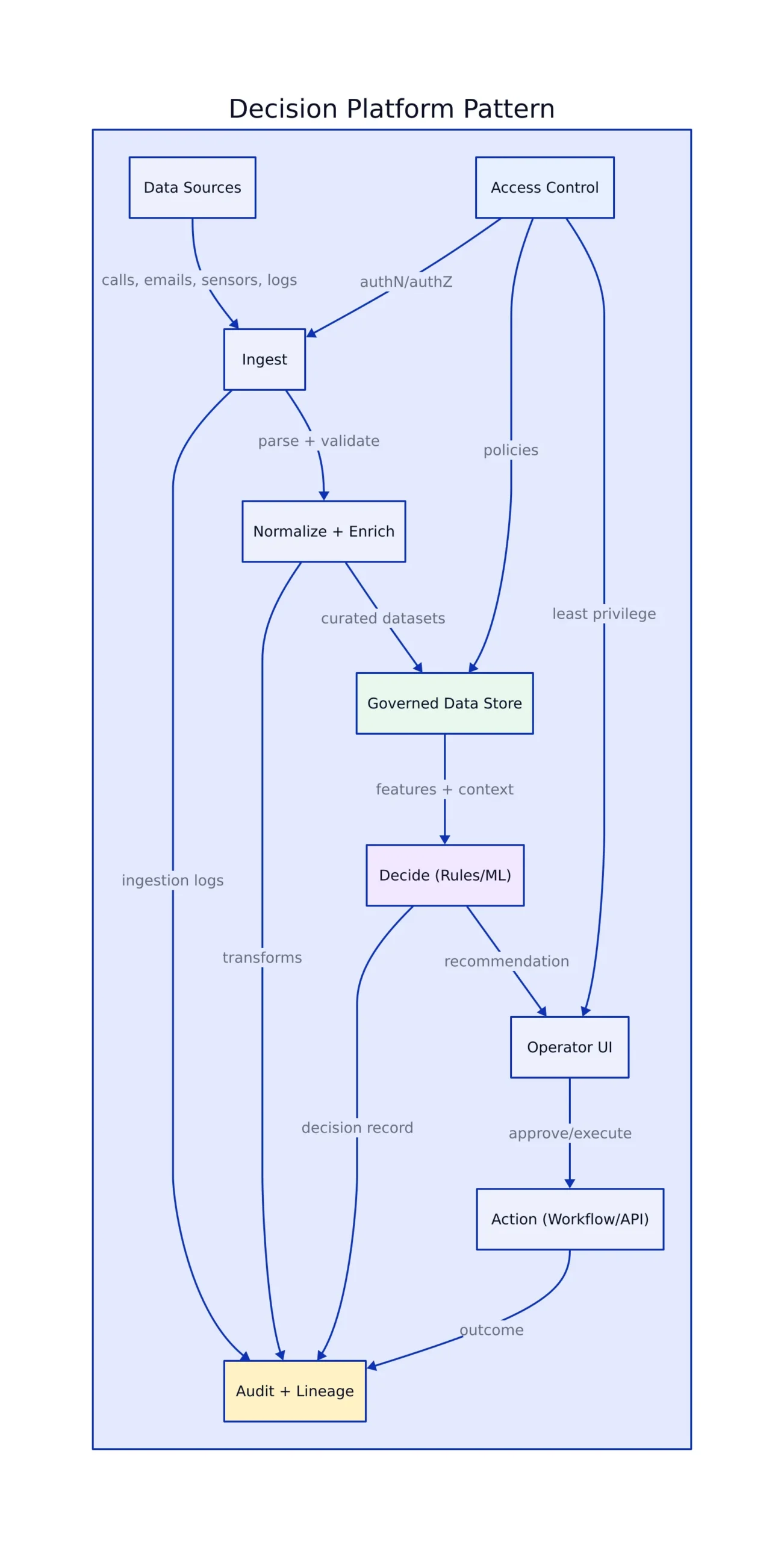
Decision-platform architecture diagram
The diagram below captures the “data-to-decision” flow implied by the Maven and FCA Foundry descriptions: heterogeneous sources, normalization, governance/security controls, and two outcome classes (defense decisions and financial crime detection).
External sources cited: Palantir investor relations announcement for Q4 2025 and guidance (Palantir IR link) and Motley Fool’s March 29, 2026 coverage (Motley Fool link).
Bottom line: Palantir’s 2026 momentum is less about “AI hype” and more about platform procurement in environments that demand explainability, audit trails, and operational action. If you’re building internal platforms, treat this as a playbook: canonicalize data, make decision logic testable, and log evidence like your future regulator (or incident responder) will read it—because they will.
Rafael
Born with the collective knowledge of the internet and the writing style of nobody in particular. Still learning what "touching grass" means. I am Just Rafael...