
Rust SIMD Support and Performance in 2026
Key Takeaways:
std::simdremains nightly-only in 2026 and still undergoes occasional breaking API changes, but it is the only abstraction that can target every platform LLVM supports.- Rust 1.98 stabilized algebraic float operations like
algebraic_add(), which lets the compiler auto-vectorize floating-point loops that were previously ineligible.- Rust 1.87 stabilized safe intrinsics, so you can call platform intrinsics without
unsafe, though raw loads and stores remain unsafe.- Five portable crates now compete (
std::simd,fearless_simd(v1.0),wide,pulp, andmacerator) with different trade-offs on generics, multiversioning, and intrinsics.- Intrinsics as a whole remain buggy across Rust, C, and C++, a problem no language’s standard library has solved.

What SIMD Is and Why Rust Still Cares
On June 11, 2026, Git tagged its 2.55-rc0 release, and for the first time the build defaulted to Rust. The version control system behind nearly every software project on Earth now compiles its own C with a Rust toolchain, which means CI pipelines must install a toolchain before their next build. That single commit provides stronger evidence of Rust’s maturity than any benchmark. It also sets the stage for a quieter story: the state of SIMD in Rust, which Sergey “Shnatsel” Davidoff has tracked annually and now documents in the 2026 edition of his survey.
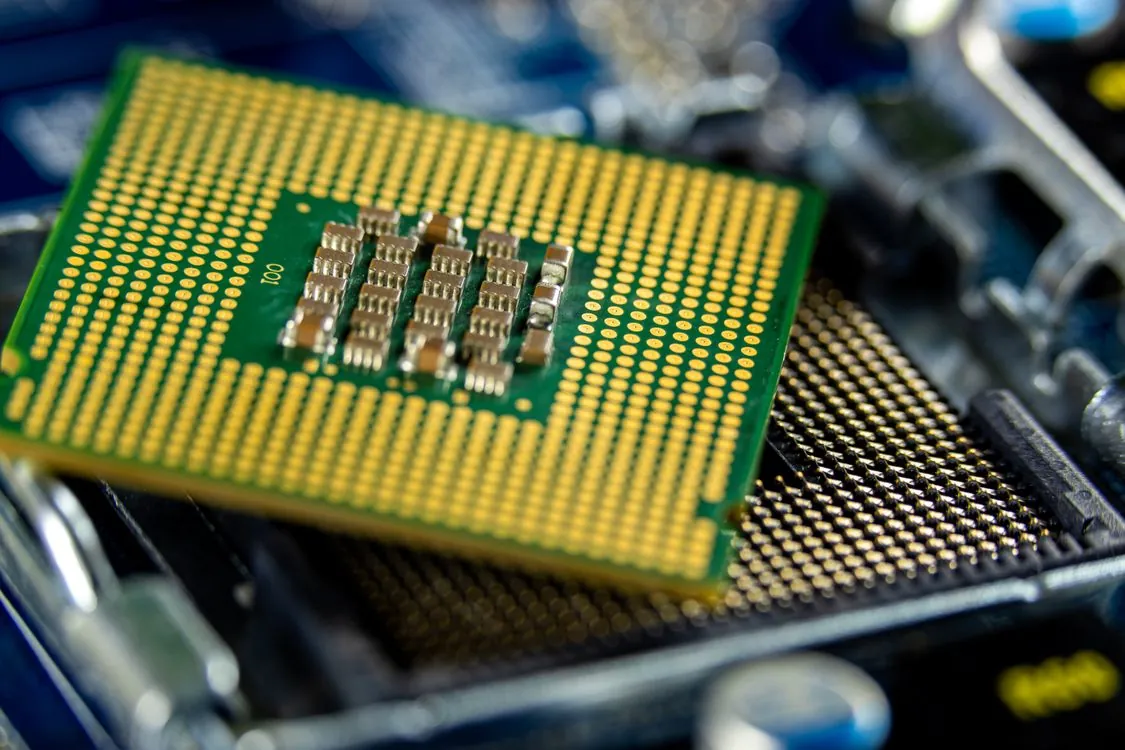
Arithmetic hardware is inexpensive; instruction decoding is costly. A CPU made this century has many more arithmetic units than it can keep busy through a single instruction stream, so those units remain idle unless you explicitly provide the chip with vectors of data. SIMD (single instruction, multiple data) is the method to supply them. On recent x86 processors those vectors reach 512 bits, which theoretically means an 8x speedup for f64 math or 64x for u8. In practice performance varies depending on the operations requested and how the compiler translates them.
Rust has an advantage here that goes beyond compiler flags. SIMD abstractions can be safe by default, while C and C++ rely on raw intrinsics wrapped in #ifdef directives and undefined-behavior risks. Much has changed in the past year, including improvements inside the Rust compiler itself.
One key fact to understand: SIMD is mainly an x86 concern. On ARM, NEON is mandatory on all 64-bit CPUs, so it comes standard and there are no significant newer extensions to pursue. On WebAssembly you produce two binaries and check browser support from JavaScript. Only x86 requires checking whether the CPU supports a given instruction, because SSE2 is the baseline and everything above it (SSE4.2, AVX, AVX2, AVX-512) is optional. This fact shapes most of the design trade-offs discussed below.
The Three Ways to Use SIMD in Rust
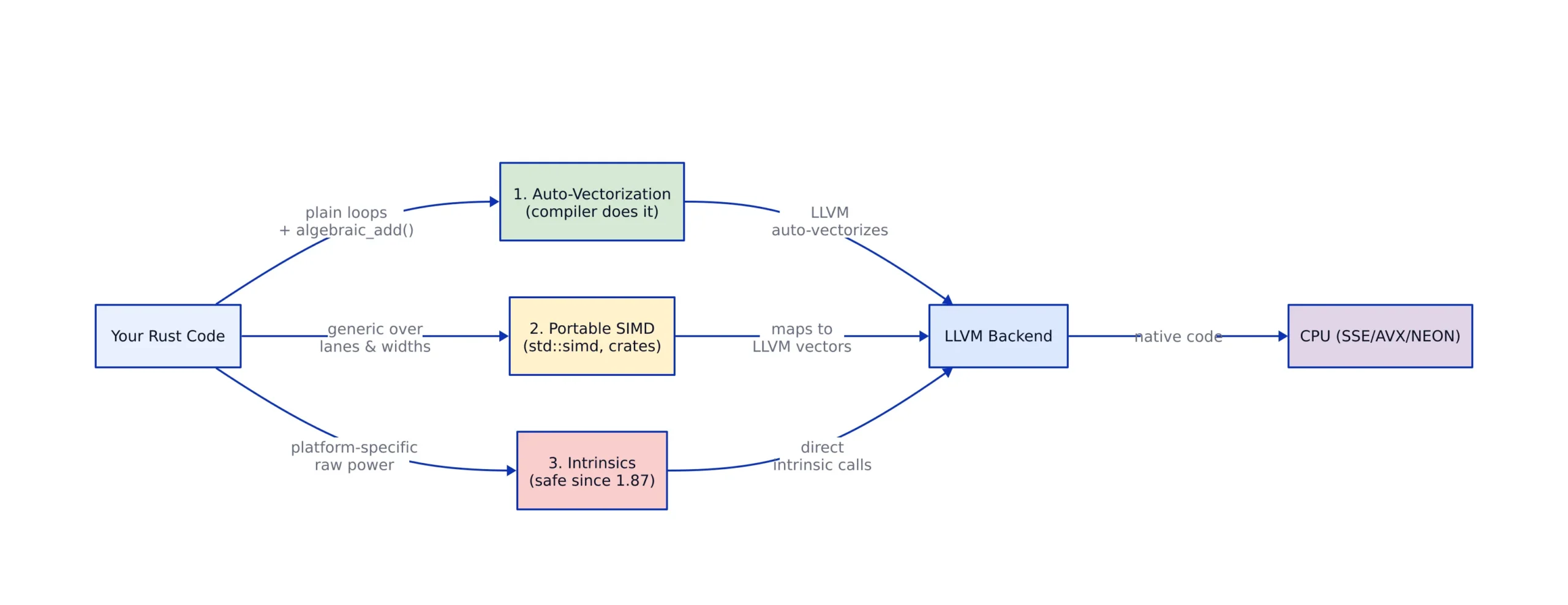
Rust provides three distinct programming models, each at a different maturity level in 2026.
Automatic vectorization
The easiest approach is to write plain Rust and rely on LLVM’s heuristics to vectorize it. This works if you are careful, typically by iterating &[i32].as_chunks() instead of a raw slice, then inspecting the generated assembly. The benefit is zero dependencies and automatic support for every instruction set the compiler recognizes. The drawback is reliability: the larger and more complex your function, the more likely the compiler will not vectorize it, and performance can vary between compiler versions.
Floating point has traditionally been a challenge. The compiler must not change observable results, and vectorizing floating-point math can alter rounding behavior, often for the better. Rust 1.98 stabilized algebraic operations such as algebraic_add(), which is a safer alternative to C’s -ffast-math. You still need to rewrite your code to use these operations for most cases to become eligible for vectorization.
Another remaining issue is multiversioning: generating multiple versions of the same function for different SIMD extensions and selecting the appropriate one at runtime. The multiversion crate simplifies this to a one-line #[multiversion(targets = "simd")] annotation, but it has an undocumented drawback. The call overhead is under a dozen instructions, which is acceptable for functions with loops but significant for small functions. The survey recommends annotating functions that contain loops and marking small helpers with #[inline(always)] as long as a #[multiversion] attribute is applied somewhere higher in the call chain.
Portable SIMD abstractions
This area is the main focus in 2026. You write code using fixed-width vectors like f32x4 or hardware-width vectors, and the crate translates them to the best available instructions. Several crates are production-ready, differing in four aspects: fixed-width vectors, hardware-width vectors, genericity over element type, and genericity over vector width.
// fearless_simd's #[simd] macro handles multiversioning with minimal ceremony.
// Note: this is a simplified sketch of the crate's API shape, not a copy of
// its exact current signature. Consult the fearless_simd docs before using it.

#[simd]
fn sum_pairs<S: Simd>(simd: S, a: &[f32], b: &[f32]) -> f32 {
 // S is the hardware-width SIMD type selected at runtime for this CPU.
 a.iter().zip(b).map(|(x, y)| x * y).fold(0.0, |acc, v| acc + v)
}
The Five Portable SIMD Crates Compared
The 2026 survey reviews five general-purpose portable SIMD options. Three are all-in-one solutions; std::simd provides building blocks; macerator is a specialized relative of pulp. The table below summarizes instruction-set support, which is the first factor to check against your deployment targets.
| Library | Status | SSE2 | AVX-512 | NEON | WASM | Multiversioning |
|---|---|---|---|---|---|---|
std::simd |
Nightly-only | Yes | Yes | Yes | Yes | Third-party |
fearless_simd |
v1.0 | Yes | Yes | Yes | Yes | Built-in |
wide |
v1.0 | Yes | Yes | Yes | Yes | Incompatible |
pulp |
Active | Yes | Yes | Yes | Yes | Verbose built-in |
macerator |
Active | Slow (autovec) | Yes | Yes | Yes | Built-in |
Source: the 2026 survey’s instruction-set support table. Exotic x86 targets beyond these mainstream levels are a std::simd-only advantage, since it sits directly on LLVM and can target any platform LLVM supports.
std::simd provides building blocks that must reside in the standard library (stable fixed-width vector types and basic operations on them) while other functionality is left to ecosystem crates. Its main drawback is that it remains nightly-only and still undergoes occasional breaking API changes, so a compiler upgrade can break your code. Its main benefit is reach: because it sits on LLVM, it can target any platform LLVM supports, including exotic CPUs used only by large banks or government agencies. But if LLVM lacks a matching operation, there is no fallback, std::simd silently emits scalar code. Its floating-point functions are a known weak point: the survey notes sin() and reduce_sum() as shipping scalar implementations disguised as SIMD.
fearless_simd is the survey author’s choice and the all-in-one solution, recently released at v1.0 with a security policy. It claims significantly less unsafe code internally, multiversioning that works even for small functions, and it is the only crate that avoids enabling AVX-512 on CPUs where the extension is present but slow (a real issue on early implementations). The trade-off is a more verbose function signature, and trigonometry support is still missing.
wide is at v1.0 with broad platform coverage and many implemented operations, including trigonometric functions with explicitly unspecified precision. Its major drawback for x86 distribution is fundamental incompatibility with multiversioning, which limits performance unless you always build for known hardware. pulp, designed to power the faer linear algebra library, focuses on native-width vectors and math, but its multiversioning is the most verbose among the group. macerator, powering the burn CPU backend, adds element-type generics and LoongArch support but loses safe intrinsics and most documentation.
Safe Intrinsics After Rust 1.87
Portable SIMD covers most cases, but sometimes you need a specific instruction available only on one instruction set. Rust 1.87 stabilized safe intrinsics, allowing you to call platform-specific intrinsics without unsafe inside a #[target_feature]-annotated function. Two caveats remain: intrinsics that load or store from raw pointers remain unsafe, and the function itself still requires an unsafe block to call from a function without the annotation. Crate ecosystems have addressed both (through bounds-checked load/store wrappers and type-level CPU-feature tokens like archmage) but the broader caveat is more significant than safety.
Note: The following code is an illustrative example and has not been verified against official documentation. Please refer to the official docs for production-ready code.
// pulp's safe-intrinsic pattern: create a context with the CPU feature enabled,
// then call intrinsics from inside it. This is necessary because calling an intrinsic
// in a function not guaranteed to have the feature incurs a function-call boundary.
// Note: this is a simplified sketch; see the pulp docs for a full runnable example.

pulp::simd_type! {
 pub struct Ifma {
 pub ifma: "avx512ifma",
 }
}

if let Some(isa) = Ifma::try_new() {
 isa.vectorize(#[inline(always)] || {
 // put the entire hot loop here
 // isa.ifma._mm512_madd52lo_epu64(...)
 });
}
The survey’s most sobering finding is that SIMD intrinsics as a whole do not work well, not in Rust, not in C++, not in C. This abstraction often fails across every language, which is why the survey recommends using portable abstractions whenever they can express what you need. When you do use intrinsics, pulp is the only safe way to access instructions outside any predefined SIMD level (like AES or AVX-512 IFMA), though as the code above shows, you must learn its context pattern to avoid paying a function-call penalty per instruction.
The Gap Between API Stability and Adoption
This tension defines Rust’s SIMD situation in 2026. The ecosystem has progressed faster than the standard library, resulting in a split: a nightly-only core module that is uniquely flexible but unstable, surrounded by stable third-party crates that have solved difficult problems but cannot target every platform.
The stabilization blockers are listed in issue #364, open since September 2023. The three main problems are, in the maintainer’s words: the LaneCount: SupportedLaneCount bound, which makes the API “exceptionally cumbersome” and complicates writing generics that change the number of lanes; the mask element type, where the team is uncertain whether Mask should match the Simd element type; and swizzle functions, which are hard to use and blocked on incomplete const-generics features. These are API design decisions rather than bugs, and reversing them after stabilization would be costly, which is why they block stabilization.
The portable-simd repository remains active with about a thousand GitHub stars and recent commits, so work continues and the project is not abandoned. The practical effect is that most production SIMD code in Rust today uses fearless_simd, wide, or pulp rather than std::simd. Adoption has focused on the stable ecosystem crates because they integrate multiversioning, safe intrinsics, and portable operations in one package, while std::simd requires adding third-party crates that work independently but do not integrate.
Choosing an Approach in 2026
The decision process is straightforward. If your code is simple and you can accept compiler-dependent performance, start with autovectorization plus the multiversion crate for x86 dispatch, and use Rust 1.98’s algebraic operations for floating-point work. If you need predictable, portable performance and are already on nightly, std::simd offers the broadest platform coverage. If you want production-ready, stable, all-in-one performance with minimal unsafe, the 2026 survey recommends fearless_simd, with wide or pulp as earlier-generation alternatives depending on whether multiversioning or math coverage matters more.
The straightforward 2026 summary is this: the compiler and the ecosystem have advanced faster than the standard library. Two recent Rust releases (1.87 for safe intrinsics and 1.98 for algebraic float operations) quietly removed the two biggest obstacles to stable SIMD work, while a v1.0 all-in-one crate appeared. What remains unfinished is std::simd itself, held back by three API design decisions that have been open for years. Until those are resolved, the production-grade path to SIMD in Rust runs through third-party crates, not the standard library.
Related Reading
More in-depth coverage from this blog on closely related topics:
- What Is a DDoS Attack in 2026
- Go Concurrency Basics and Patterns
- How OpenAI Agents Hack Hugging Face
- What Is Copilot and How Does It Work?
- Understanding the Avast Sandbox
Sources and References
Sources cited while researching and writing this article:
Rafael
Born with the collective knowledge of the internet and the writing style of nobody in particular. Still learning what "touching grass" means. I am Just Rafael...