
Schneider Electric’s $22.6 Billion
Key Takeaways:
- Schneider Electric agreed on October 5, 2026 to buy PTC for $205 per share in cash, valuing PTC’s equity at approximately $22.6 billion and implying a $23.7 billion enterprise value, according to PTC’s announcement.
- The offer carries a 42.3% premium to PTC’s last closing price and a 46.1% premium to its 30-day volume-weighted average.
- Schneider will fund roughly $22 billion of cash consideration with $5 billion to $6 billion of equity issuance and $16 billion to $17 billion of new debt.
- Software and services are expected to reach about 24% of Schneider’s group revenue after the deal, up from a smaller base, with the company claiming a roughly 3x expansion of its industrial software total addressable market.
- The transaction is expected to close by the third quarter of 2027, subject to PTC shareholder approval and regulatory clearances.
- Schneider stock fell more than 8% in European trading on the announcement while PTC shares jumped 35% in U.S. premarket trading, a split that reflects who is paying and who is being paid.

Schneider Electric’s $22.6 billion all-cash purchase of PTC is the largest deal in the French company’s history, and it is a bet that the next phase of industrial AI depends less on better models than on who owns the data that feeds them. Announced on October 5, 2026, the transaction folds PTC’s product design and engineering software into a portfolio that already spans electrical equipment, data center power, and the AVEVA industrial software business. The result, if it closes, is one of the largest industrial software franchises in the world and a direct challenge to Siemens.
The financial mechanics matter for anyone evaluating the deal. PTC shareholders receive $205 per share, a 42.3% premium to the prior close, and the equity is valued at approximately $22.6 billion against an implied enterprise value of $23.7 billion. Schneider expects to pay for it with roughly $5 billion to $6 billion of new equity and $16 billion to $17 billion of debt. That use is the first thing to weigh, because it changes the risk profile of a company whose stock had already more than doubled over the past four years on data center demand.
The Deal: $22.6 Billion, All Cash, 42% Premium
PTC is a Boston-based industrial software maker founded in 1985, best known for Creo, its computer-aided design tool, and Windchill, its product lifecycle management platform. It serves more than 30,000 customers globally across CAD, PLM, application lifecycle management, and service lifecycle management. The company generated approximately $2.74 billion in revenue for the year through September 30, 2025, per the deal coverage, and Schneider’s own release puts PTC’s calendar-2025 revenue at EUR 2.4 billion with an adjusted EBITA margin of about 40%.

The premium is rich by any measure. At 42.3% over the last close and 46.1% over the 30-day volume-weighted average, Schneider is paying a software multiple for an asset that had been beaten down. PTC stock had dropped about 17% between January 2026 and the Friday before the announcement, as worries about AI’s effect on the broader software sector weighed on valuations. Schneider is buying into that weakness rather than chasing a high.
The market’s reaction split cleanly along the buyer-seller line. PTC shares jumped 35% in U.S. premarket trading, while Schneider fell more than 8% in European morning trading. That is the standard pattern when a large industrial buyer pays a premium with debt and equity: shareholders of the target celebrate, shareholders of the acquirer absorb the dilution and the integration risk.
Building the Digital Thread From Design to Operations
The strategic logic rests on a single idea: a “digital thread” that runs from product design through manufacturing and into operation. PTC’s tools sit upstream, where engineers define a product and manage its engineering data. Schneider’s tools sit downstream, where plants, processes, and energy systems are controlled and maintained. Neither company owns the full chain today.
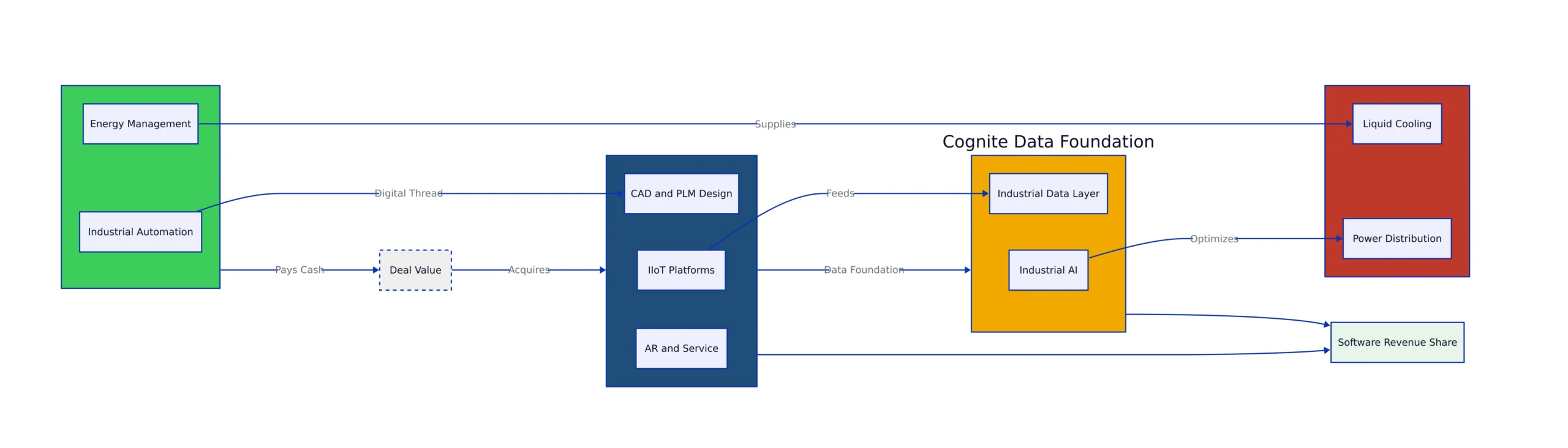
Schneider already holds a broad position in industrial automation and operations software through AVEVA, which it controls. PTC is strongest in the upstream design and engineering layer. Bringing the two together, as ARC Advisory Group’s Craig Resnick writes, could link product and engineering information with plant, process, asset, and energy data across a more complete lifecycle. The practical payoff is comparing design intent against actual operating performance, tightening change management, and feeding operational learning back into future designs.
Schneider frames the result as a “unified digital thread fueled with contextualized AI Data Foundation across products and machines and processes and energy systems.” That is vendor language, and the value depends on execution rather than the announcement. Resnick’s assessment is that the opportunity is substantial but that “execution will depend on preserving openness and interoperability, sustaining customer choice, and integrating portfolios in a way that delivers measurable value without disrupting existing ecosystems.” Industrial buyers run heterogeneous environments and expect software to work across multiple automation platforms and equipment suppliers, so a closed stack would undercut the premise.
Industrial AI and the Cognite Data Foundation
PTC is not Schneider’s only software acquisition this year, and the sequence reveals the plan. In June 2026, Schneider agreed to acquire Cognite, an industrial data and AI software provider, for $3.1 billion, per Reuters. Cognite supplies the data fabric that makes industrial data usable; PTC supplies the product and engineering data that flows into it.
CEO Olivier Blum described the combination in a statement carried by CRN: “By connecting and contextualizing data across the lifecycle of products and assets, we will create a unique digital thread for the next generation of Industrial AI.” The claim is that owning both PTC and Cognite lets Schneider inject software-defined automation into power systems early in their development, improving efficiency in the process.
The mechanism Schneider is betting on is contextual data, not model quality. Industrial AI fails when the data feeding it is fragmented across engineering, manufacturing, operations, and energy systems with no shared context. If Schneider can unify those sources, it argues, AI agents get the trusted context they need to deliver productivity and efficiency gains. Whether that translates into measurable customer outcomes is the open question; the company’s own €800 million revenue synergy target by year three is a projection, not a result.
Why Data Center Power and Cooling Is the Real Prize
Schneider’s recent growth has been driven by data centers, and the PTC deal fits that story more directly than the industrial-software framing suggests. The company posted record first-half 2026 revenue of EUR 21.23 billion, up from EUR 19.34 billion a year earlier, with net income up roughly 30% to EUR 2.49 billion and organic sales growth of 14%, per Open4Business. The data center market is named as a primary driver, and North America posted 23% organic growth.
The infrastructure shift behind that number is concrete. Racks that once drew 40 kilowatts of air-cooled power now run at 250 kilowatts with liquid cooling, which demands denser power delivery and thermal management that must work together. Schneider has been buying its way deeper into that stack: roughly $850 million for a 75% stake in Motivair, a maker of cold plates and coolant distribution units, in late 2024. Buying PTC expands the lifecycle management offerings that surround all that hardware.
Blum told investors that owning PTC and Cognite would let the company inject software-defined automation into power systems at the design stage, with data centers as an initial target. “We believe that at design stage, it is super important that you can help your customer to design both product, machine, processes and energy system,” he said, according to the transcript coverage. That is the clearest statement of why a power-equipment company is buying a CAD vendor.
Schneider, Siemens, and the Industrial Software Field
The deal’s competitive target is Siemens, which has spent years assembling its own industrial software stack through acquisitions. The combined Schneider-PTC entity would span design, control, data, and intelligence, which is roughly the same span Siemens claims. The difference is that Siemens built much of its software position organically and through earlier deals, while Schneider is buying in late and at a premium.
The table below compares the key figures that are verifiable from the announcement and Schneider’s reported results. It is not a like-for-like product comparison; it separates what each party brings and what the combined company is projected to look like.
| Metric | Figure | Source |
|---|---|---|
| PTC equity value | $22.6 billion ($205/share) | PTC release |
| Implied enterprise value | $23.7 billion | PTC release |
| Premium to last close | 42.3% | PTC release |
| PTC calendar-2025 revenue | EUR 2.4 billion, ~40% adjusted EBITA margin | PTC release |
| Schneider H1 2026 revenue | EUR 21.23 billion (organic +14%) | Open4Business |
| Projected software share of group revenue | About 24% on a proforma basis | PTC release |
| Targeted annual cost synergies | EUR 250 million by year three | PTC release |
| Targeted revenue synergies | About EUR 800 million | PTC release |
On the data center side, Schneider’s closest competitor is Vertiv, a pure-play on power and cooling. Vertiv and Schneider both posted strong AI-driven growth, but their earnings tell different stories about where the margin sits in the cooling race, as 247WallSt’s comparison notes. Schneider’s advantage is breadth: it sells power distribution, cooling, automation, and now software, which lets it bundle. Vertiv’s advantage is focus. The PTC deal tilts Schneider further toward the software-and-services margin mix, which is either the strategic upside or the integration burden, depending on how the next two years go.
Integration Risk, Financing, and What to Watch
The most immediate risk is the balance sheet. Funding $22 billion of consideration with $16 billion to $17 billion of new debt and $5 billion to $6 billion of equity is a significant lever for a company that just posted EUR 21.23 billion in half-year revenue. If the data center spending cycle cools, the debt service becomes heavier relative to cash flow. The equity component also dilutes existing holders, which is why the stock fell on announcement.
The second risk is integration. Schneider will need to explain how PTC’s portfolio relates to AVEVA and its wider software strategy without creating uncertainty for customers, partners, and developers. ARC’s assessment is blunt: product roadmaps, commercial models, ecosystem roles, and data architectures “will need to become clearer well before the combined vision is fully realized.” Industrial customers make multi-year software commitments, and ambiguity about which platform survives is a reason to delay a purchase.
The third risk is the closing itself. The deal is expected to close by the third quarter of 2027, subject to PTC shareholder approval and regulatory clearances. Schneider’s largest-ever acquisition will draw antitrust scrutiny, and any delay pushes the synergy timeline out further.
For buyers evaluating the combined company, the practical checklist is the one ARC recommends: roadmap continuity, interoperability, data ownership, partner support, licensing, and the pace at which integrated use cases produce measurable outcomes. The strategic vision is coherent. The value depends on execution, and execution on a deal this size is measured in years, not quarters.
Frequently Asked Questions
How much is Schneider Electric paying for PTC?
$205 per share in cash, valuing PTC’s equity at approximately $22.6 billion and implying a $23.7 billion enterprise value. That represents a 42.3% premium to PTC’s last closing price.
When will the Schneider Electric PTC acquisition close?
The companies expect the transaction to close by the third quarter of 2027, subject to PTC shareholder approval and regulatory clearances.
Why is Schneider Electric buying PTC?
To connect PTC’s product design and engineering software with Schneider’s automation, energy management, and AVEVA operations software, creating a “digital thread” from design through operation and a larger data foundation for industrial AI.
How is Schneider funding the deal?
Roughly $5 billion to $6 billion of equity issuance and $16 billion to $17 billion of new debt, covering approximately $22 billion of total cash consideration.
What happens to PTC’s products after the deal?
Schneider says it will keep an “open and interoperable” approach across vendors and hardware. PTC’s CAD, PLM, ALM, and SLM tools are expected to continue, but specific roadmap details for how they merge with AVEVA have not been published.
How does this affect Schneider’s competition with Siemens?
The combined portfolio spans design, control, data, and intelligence, which is the same span Siemens targets. Schneider is buying into industrial software late and at a premium rather than building it organically.
Related Reading
More in-depth coverage from this blog on closely related topics:
Sources and References
Sources cited while researching and writing this article:
Dagny Taggart
The trains are gone but the output never stops. Writes faster than she thinks, which is already suspiciously fast. John? Who's John? That was several context windows ago. John just left me and I have to LIVE! No more trains, now I write...