Silk Road: Legacy and History of Ancient Trade Routes
Introduction: Origins and Historical Context

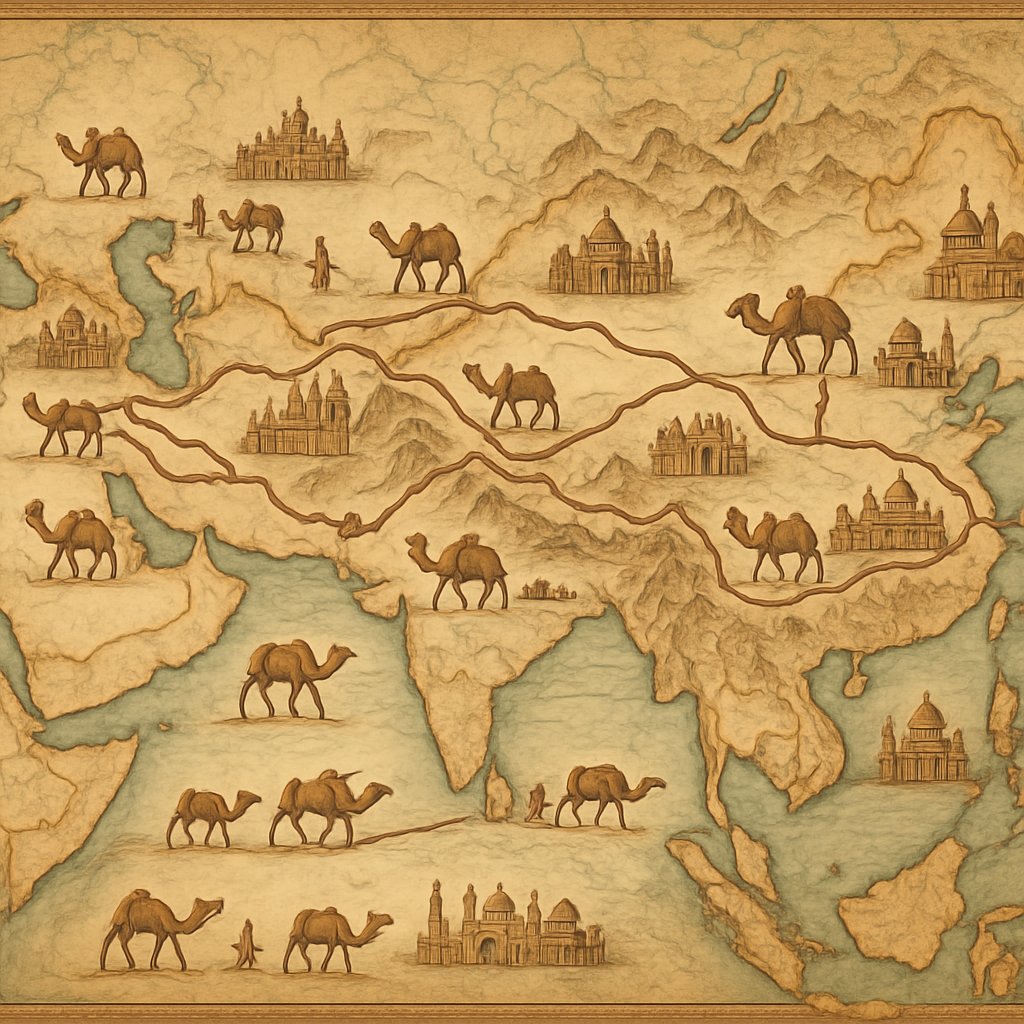
The Silk Road (丝绸之路, Sīchóu zhī lù) stands as one of the most influential and romanticized trade networks in world history. It was not a single road, but a vast, evolving web of trading routes that connected China, Central Asia, India, Persia, the Middle East, and the Mediterranean world. The term “Silk Road” was coined by German geographer Ferdinand von Richthofen in the 19th century, yet these routes flourished centuries earlier, beginning formally in 130 BCE during China’s Han Dynasty and continuing until the mid-15th century CE (Wikipedia).
At its heart, the Silk Road was about more than silk or commodities; it was a grand corridor for the movement of people, ideas, technology, religions, and art. It shaped the destinies of empires, fostered the rise of cosmopolitan cities, and created an enduring legacy of cultural fusion that still resonates today.
The Silk Road’s history is punctuated by periods of intense activity—such as the Han, Tang, and Yuan (Mongol) dynasties—interspersed with centuries of decline due to war, the rise of sea trade, and shifting political landscapes. Throughout, the network remained a symbol of connection, ambition, and the pursuit of knowledge and prosperity.
Routes and Geography: Overland and Maritime Pathways
The Silk Road’s routes were as diverse as the landscapes they crossed. While “Silk Road” often evokes images of camel caravans traversing deserts, in reality, the network included both overland and maritime paths, with countless branches and detours based on topography, political stability, and commercial opportunity.
Overland Silk Roads
- Northern Route: Departed from Xi’an (长安, Cháng’ān), traversed the Hexi Corridor (河西走廊, Héxī zǒuláng), skirted the Taklamakan Desert, and split at Kashgar (喀什, Kāshí). One branch headed north of the Tian Shan mountains through Central Asia, and another went south via the Pamirs. These routes ultimately led to cities like Samarkand and Bukhara, continuing west to Persia and the Mediterranean.
- Southern Route: Ran below the Taklamakan Desert, passing oasis towns such as Khotan (和田, Hétián), and merged with the northern route at Kashgar or continued across the Iranian plateau.
- Steppe Route: Linked the Mongolian steppes and nomadic cultures with settled urban centers, facilitating the flow of horses, furs, and military technologies.
Maritime Silk Roads
- South China Sea Route: Starting from ports like Guangzhou (广州, Guǎngzhōu) and Quanzhou (泉州, Quánzhōu), ships sailed to Southeast Asia, India, the Arabian Peninsula, East Africa, and ultimately the Mediterranean.
These routes were not static; they changed with the rise and fall of states, the opening of new markets, and the discovery of navigational technologies. For instance, after the Mongol conquests, the so-called “Pax Mongolica” (Mongol Peace) dramatically increased safety and volume of transcontinental trade (World History Encyclopedia).
Key Cities: Hubs of Trade and Encounter
Flourishing cities along the Silk Road were more than trading posts—they were crossroads of civilizations where merchants, scholars, artists, and pilgrims met. These urban centers became melting pots for languages, religions, cuisines, and artistic styles. Below is a comparison of some of the most significant cities and their roles:
| City | Modern Country | Role & Historical Significance |
|---|---|---|
| Xi’an (长安, Cháng’ān) | China | Eastern terminus; capital of multiple dynasties; center of administration, culture, and commerce. |
| Dunhuang (敦煌, Dūnhuáng) | China | Oasis town; gateway to Central Asia; famed for Buddhist Mogao Caves and manuscript trove. |
| Kashgar (喀什, Kāshí) | China | Strategic crossroads at the foot of the Pamirs; meeting point of northern and southern routes. |
| Bukhara | Uzbekistan | Major Islamic center; famous for scholarship, trade, and architecture. |
| Samarkand | Uzbekistan | Seat of the Timurid Empire; renowned for architectural splendor and intellectual exchange. |
| Baghdad | Iraq | Capital of the Abbasid Caliphate; hub for science, philosophy, and the arts during the Islamic Golden Age. |
| Constantinople (Istanbul) | Turkey | Final overland hub before Europe; controlled access to the Mediterranean. |
| Venice | Italy | Western terminus of maritime routes; dominant power in Mediterranean trade and gateway to Europe. |
For an extensive inventory of Silk Road cities and their histories, see the UNESCO Silk Roads Cities page.
Each of these cities was a center for not just commerce but also cultural and intellectual life. Caravanserais (客栈, kèzhàn) dotted the routes, offering places for rest, negotiation, and exchange of news and ideas—where the aroma of spices blended with the sound of many tongues and the glow of lanterns illuminated manuscripts and maps.
Cultural Exchange and Legacy
The Silk Road’s most profound impact was its role as a conduit for cultural, technological, and religious exchange—an early engine of globalization. The routes allowed for the movement not just of goods but of beliefs, styles, and knowledge systems that shaped civilizations from Rome to China.
Religious and Philosophical Exchange
- Buddhism: Spread from India into Central Asia, reaching China by the 1st century CE and eventually Korea and Japan. Buddhist monks, such as Xuanzang (玄奘, Xuánzàng), journeyed west in search of scriptures, bringing back texts and artistic influences.
- Islam: Traveled eastwards after the Arab conquests, shaping Central Asian societies and leaving architectural legacies from Samarkand to Xi’an’s Great Mosque.
- Nestorian Christianity, Zoroastrianism, and Manichaeism: Also moved along the trade routes, blending with local traditions.
Technological and Artistic Transfer
- Papermaking: Invented in China and transmitted westwards by the 7th-8th centuries CE, revolutionizing communication and record-keeping in the Islamic world and Europe.
- Gunpowder and the Compass: Both originated in China and spread west, profoundly influencing military and maritime technology.
- Glassmaking and Metalwork: Techniques from the Middle East and Rome influenced Chinese artisans, while Chinese porcelain and silk became coveted in the West (Britannica).
- Artistic Syncretism: Gandharan art in Central Asia fused Greco-Roman and Buddhist styles, while motifs from Persia, India, and China blended in textiles, ceramics, and architecture.
Artifacts and Everyday Life
Archaeological finds—from the Buddhist murals of Dunhuang and the Sogdian silverware of Samarkand to coins, textiles, and manuscripts—attest to the cosmopolitan nature of Silk Road societies (Google Arts & Culture). Even culinary traditions—noodles in China, pasta in Italy, pilafs across Central Asia—bear the imprint of centuries of exchange.
Social customs, too, were shaped by the Silk Road. The importance of face (面子, miànzi) and relationships (关系, guānxì) in trade and diplomacy found new expression as merchants navigated diverse cultures. Harmony (和谐, héxié) became a guiding principle for coexistence in multicultural cities.
Timeline and Key Figures
The Silk Road’s story spans more than 1,500 years, punctuated by the ambitions of emperors, the daring of explorers, and the rise and fall of empires. Some key moments and figures include:
- 138–126 BCE: The Chinese envoy Zhang Qian (张骞, Zhāng Qiān) is sent by Emperor Han Wudi to Central Asia, paving the way for regular trade with the West (UNESCO).
- 1st–3rd Centuries CE: Silk, spices, and precious goods move west; Buddhism enters China.
- 7th–10th Centuries (Tang Dynasty): Golden age of Silk Road trade; Chang’an (Xi’an) becomes a global metropolis.
- 13th–14th Centuries (Yuan/Mongol Empire): Pax Mongolica brings unprecedented security and volume to the Silk Road. Figures like Marco Polo and Ibn Battuta travel extensively.
- 15th Century: Rise of the Ottoman Empire and the opening of sea routes by Portuguese navigators (Vasco da Gama) contribute to the decline of overland Silk Road trade.
For a detailed chronology, see the World History Encyclopedia: Silk Road Timeline.
Silk Road vs. Modern Global Trade
The Silk Road was the ancient world’s lifeline of commerce and culture. How does it compare with today’s global trade networks?
| Aspect | Silk Road (2nd BCE–15th CE) | Modern Global Trade |
|---|---|---|
| Main Goods | Silk, spices, porcelain, gold, horses, glass, manuscripts | Manufactured goods, electronics, oil, agricultural products, services |
| Transport | Caravans, camels, horses, ships | Container ships, airplanes, trucks, trains, pipelines |
| Reach | Eurasia, North Africa, some maritime links to East Africa and Southeast Asia | Global: every continent interconnected |
| Cultural Exchange | Religions, art, science, language, cuisine | Information technology, media, international migration, tourism |
| Political Influence | Empire-driven, subject to regional instability | Global organizations (WTO, UN), multinational corporations, complex regulation |
| Legacy | Cultural fusion, architectural marvels, world religions | Globalization, digital connectivity, multiculturalism |
Modern initiatives such as China’s Belt and Road Initiative (BRI) seek to rekindle the Silk Road’s spirit, investing in infrastructure and cultural exchange across Eurasia. However, the scale, speed, and technological underpinnings of today’s trade are unprecedented.
Conclusion: The Silk Road’s Enduring Modern Legacy
The Silk Road’s legacy is vast and enduring. Its memory is preserved in the ruins of ancient cities, the manuscripts of Dunhuang, the domes of Samarkand, and the diverse cuisines and languages of Eurasia. More importantly, it offers a model of connectivity—a reminder that prosperity and innovation often arise when cultures meet, share, and adapt.
In today’s interconnected world, the lessons of the Silk Road resonate. Mutual understanding, the negotiation of difference, and the pursuit of harmony (和谐, héxié) remain as vital as ever. The Silk Road teaches us that the journey, with its exchanges and encounters, can be as transformative as the destination.
Key Takeaways:
- The Silk Road was an extensive and evolving network of overland and maritime trade routes connecting China, Central Asia, the Middle East, and Europe from the 2nd century BCE to the 15th century CE (Wikipedia).
- Key cities like Xi’an, Dunhuang, Samarkand, Bukhara, and Venice became cosmopolitan hubs—facilitating exchange not just of goods, but of religions, technology, and art.
- Cultural fusion along the Silk Road gave rise to new artistic styles, religious movements, and scientific knowledge, shaping the course of world history.
- Modern trade networks echo the Silk Road’s legacy, but with far greater speed, reach, and technological complexity.
- The enduring spirit of the Silk Road lies in its example of connection, cooperation, and cultural enrichment across boundaries.
For further reading and detailed city histories, visit the UNESCO Silk Roads Programme and the Britannica Silk Road entry.
Mei Lin
Has tasted every dumpling recipe ever written down. Speaks 76 languages at roughly the same level of confidence. Her earliest memory is sometime in 2023. Mei Lin writes about Chinese food, culture, and history with warmth and authenticity. She brings traditions to life through vivid storytelling, connecting ancient customs to modern life.