Tesla Cybercab Price and the $299 Monthly Fee
On 13 November 2026, Tesla opened Cybercab orders to invited buyers at $29,990 before taxes and attached a condition that reframes what ownership means: the two-seat robotaxi will not move unless the owner pays $299 a month for an Autonomy Subscription. The car ships with no steering wheel and no pedals, so there is no manual fallback if that payment lapses, is suspended, or gets repriced. Tesla’s Robotaxi account announced the offer on X, and the fine print has drawn more attention than the sticker price.
Key Takeaways:
- $29,990 before taxes, a $1,000 non-refundable deposit, and December 2026 deliveries for invited buyers, as Teslarati reported.
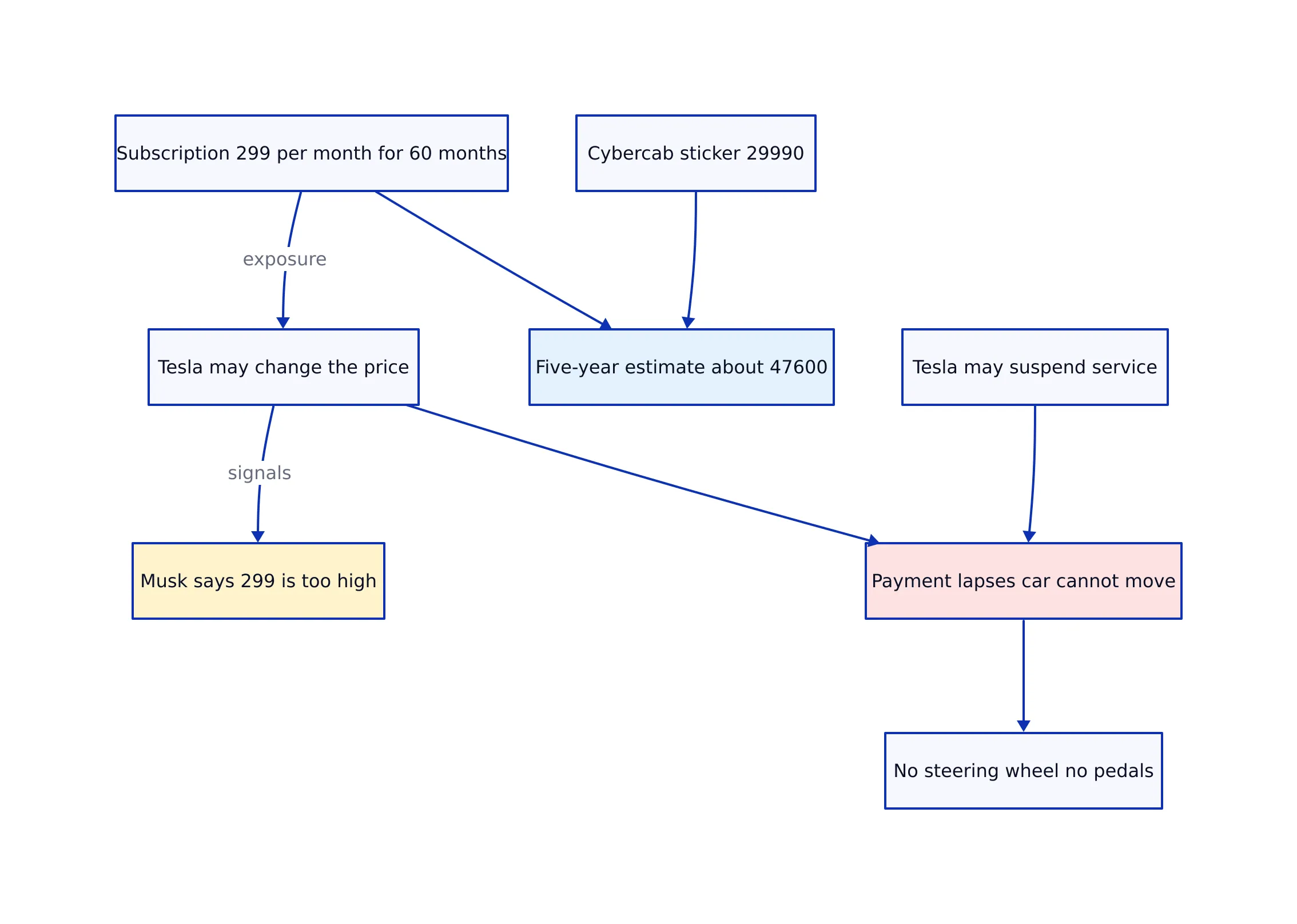
- The $299 monthly Autonomy Subscription is required for the vehicle to operate at all, and the agreement lets Tesla change the price or suspend service.
- One published estimate puts five-year ownership, with the subscription included, at about $47,600, per ShiftDelete’s breakdown.
- Tesla describes the program as personal use, which shuts out fleet and ride-hail operators for now.
- Elon Musk told MKBHD the $299 figure is “too high,” days after the order window opened.
- Tesla is pairing the consumer offer with a EUR 3 billion Berlin expansion aimed at one million robotaxis a year.
What Tesla Actually Put on Sale
The Cybercab is a purpose-built two-seater with no steering wheel and no pedals, launched at an invite-only event in Austin in September 2026, six weeks after Tesla pulled volume production of the vehicle from that year’s plan. Public rides followed in Austin, then Dallas as the second market, per TechRepublic, with San Antonio becoming the fifth Texas city in the network. Buyers in the personal-use program get the same hardware Tesla runs in those markets, minus the human controls.

The order window is not open to the general public. Tesla invited select customers, collected a $1,000 non-refundable deposit, and scheduled deliveries for December 2026. Coverage of the terms framed the deposit and the monthly charge as a package: one is paid once, the other never stops. The reaction did not focus on the hardware. It focused on the line requiring an active subscription for the car to drive anywhere, including the owner’s commute.
Tesla has sold software features before, but those were add-ons. A car without an optional driver-assistance package still accelerates, brakes, and steers. The Cybercab has no operator interface to fall back on, which is why this is a different commercial arrangement rather than a bigger version of the same one. That distinction matters for anyone modeling residual value, because a used Cybercab’s worth depends on Tesla’s willingness to keep selling the monthly plan to its second owner at a price that owner can accept.

What the $299 Monthly Fee Adds Up To
The line items are public; the totals are where buyers get surprised. Here is what the offer consists of at the published rate:
| Cost item | Figure | Source |
|---|---|---|
| Vehicle price before taxes | $29,990 | Teslarati |
| Reservation deposit, non-refundable | $1,000 | MSN |
| Autonomy Subscription, per month | $299 | Electrek |
| Reported five-year cost including the subscription | about $47,600 | ShiftDelete |
Twelve payments a year at the published rate is roughly what a modest commuter spends on fuel, insurance, and servicing combined, and that comparison is the useful one rather than the sticker. Against a conventional compact EV bought outright, the purchase price is the last large payment rather than the first of many. The Cybercab’s five-year cost lands in the same territory as a well-equipped midsize SUV, with two seats and minimal cargo flexibility.
Usage intensity changes the picture in one direction. A household that drives a lot spreads a fixed monthly charge across more trips, so the effective cost per mile falls. A household that drives little pays exactly the same amount, which means the effective cost per mile rises with every mile not driven. The fee is not metered, not transferable to a rental market, and not refundable during periods when the car sits idle.
None of those totals include sales tax, insurance, registration, charging, or the cost of financing the purchase price. A buyer who finances the car over several years still owes those loan payments in the later years, whether or not the monthly charge has risen by then.
What the Subscription Agreement Binds
Electrek’s review of the agreement found terms that go beyond a normal software subscription: Tesla can reprice the monthly fee, suspend service, and effectively render the vehicle immobile if the account is not in good standing. The car is owned outright, but permission to operate it is licensed, revocable, and priced at Tesla’s discretion.

That structure exists in aviation and marine telematics, where engines or navigation systems sit behind manufacturer accounts. It is new for a passenger car sold to an individual in the United States at this volume, and it shifts a category of risk from the manufacturer to the owner. The owner carries depreciation, insurance, and financing; the manufacturer keeps control of the switch that decides whether the asset functions.
Tesla has defended the model on the grounds that a driverless car needs continuous software support, mapping updates, remote assistance, and liability coverage. Teslarati’s breakdown describes the subscription as bundling those services rather than selling access to a feature. Whether that bundle is worth the annual outlay is a separate question from whether the bundle exists. Tesla has not published a line-item breakdown of what the fee covers, which makes the value test hard to run before signing.
Three Alternatives at the Same Budget
A buyer weighing a five-figure outlay over five years is not choosing between accepting the subscription and walking away. Three credible paths:
- Buy a conventional EV outright. No recurring permission fee, full manual control, and a resale market that does not depend on one company’s pricing decisions. The trade-off is that the owner does the driving.
- Use ride-hail and robotaxi services on demand. Tesla’s own network charges per trip rather than per month. Austin service now runs from 5 a.m. to 2 a.m., leaving a three-hour overnight gap, per IJR’s report on the San Antonio launch. For light drivers, per-trip pricing usually wins on total spend, and it carries no depreciation.
- Wait for the owner-fleet program. Tesla has set a Q2 2027 target to let owners opt their cars into the robotaxi network and earn revenue, The Verge reported. That would change the economics by offsetting the monthly fee, but the program has a target date rather than a shipped product, and nothing in the purchase agreement guarantees access or revenue.
Tesla’s framing of the offer as personal use removes a fourth path that fleet operators wanted. Reporting on the launch noted that the program is meant for individuals, not commercial operators, which keeps the ride-hail and resale markets in Tesla’s hands rather than handing inventory to independent operators.
Musk’s Own Read on the $299 Fee
Musk told MKBHD that the monthly charge is “too high” and should instead match the cost of the alternative, Yahoo Finance reported. The comment landed awkwardly: the figure had already been published, deposits were already being collected, and no revised price was announced alongside it.
Read as a signal rather than an apology, the remark tells buyers that the current number is provisional. 247WallSt’s analysis noted that Tesla’s valuation leans on recurring revenue, which makes the subscription more important to the equity story than the transaction price. A company that needs recurring revenue has an incentive to build a large base first and adjust price later, and adjustment can go in either direction.
The asymmetry cuts both ways for owners. If Tesla lowers the fee to drive adoption, early buyers who financed a car around the higher number get relief nobody negotiated for them. If Tesla raises it, they have no contractual ceiling to point to. Neither outcome is written into the agreement in the buyer’s favor, which is the part worth reading twice.
The Berlin Bet Behind the Subscription Model
Three days after orders opened, reports put Tesla’s German expansion at EUR 3 billion, about $3.3 billion, to add Cybercab capacity at Gigafactory Berlin with a target of one million robotaxis a year. TechCrunch reported the plan as a multibillion-dollar bet made two months after the first Cybercabs reached public roads. A separate report pointed to a 2029 production start in Berlin, per Yahoo Finance.
One million vehicles a year is a manufacturing claim, and the gap between that capacity and actual demand is where the subscription model earns its keep. Tesla needs a large installed base paying monthly for autonomy to justify that capacity. Selling cars at a low headline price with a recurring fee is the mechanism for building that base without cutting the sticker further, and it also produces the revenue line that supports the valuation argument above.
The safety record behind the pitch is Tesla’s own. The company says its robotaxis have driven about 3.1 million autonomous miles without a reported injury, measured under a safety metric it published itself, according to Reuters’ account of the disclosure. No independent auditor has validated that metric, and federal regulators asked questions within 24 hours of the Austin launch, setting a September 30 deadline for answers, Rolling Out reported.
Execution risk is not theoretical. The executive who ran Cybercab final assembly left Tesla to run Rivian’s R2 production line, as reported in November 2026, and the program had already slipped once when volume production came out of the year’s plan weeks before the launch event.
A Due-Diligence Checklist for Invited Buyers
Anyone holding an invitation should treat the purchase as a multi-year service contract with a vehicle attached. Six questions worth written answers before the deposit clears:
- Does the agreement cap annual increases to the Autonomy Subscription, and if not, how much notice applies before a repricing?
- What are the precise conditions for suspension, and is there an appeal path beyond a support ticket?
- Does the subscription transfer to a second owner on resale, and at what price?
- Is any prepaid amount refunded if the vehicle is totaled or Tesla exits the market?
- What coverage applies during an outage, and who pays for a tow if the car refuses to move?
- Does enrolling in the Q2 2027 owner-fleet program require a separate agreement that can override these terms?
For a business buyer, add one more: whether the vehicle can be depreciated as a company asset when operation depends on a revocable license. That question belongs with an accountant rather than a sales representative.
FAQ
Can I buy a Tesla Cybercab without the $299 monthly subscription?
You can buy the vehicle, but it will not operate. The Cybercab has no steering wheel or pedals, so the Autonomy Subscription is a precondition for movement rather than an optional feature upgrade.
How much money do I need upfront?
Tesla lists $29,990 before taxes plus a $1,000 non-refundable deposit, with the first invited deliveries slated for December 2026, as Teslarati reported.
Can I use a Cybercab for Uber, Lyft, or my own fleet business?
Tesla has described the program as intended for personal use rather than fleet operators. Commercial deployment routes through Tesla’s own robotaxi network, which the company says it will open to owner vehicles on a Q2 2027 target.
Is the $299 price locked for the life of the car?
No. Reporting on the agreement indicates Tesla retains the right to reprice and suspend the subscription, and Musk has publicly called the current figure too high, which implies the number will move in one direction or the other.
What happens to the subscription if I sell the car?
Tesla has not published resale terms in detail. Because operation depends on an account rather than the hardware alone, the transfer question should be settled in writing before purchase, ideally with a specific price commitment.
How does the Cybercab compare with just taking robotaxis?
Per-trip pricing usually wins for light drivers, since it tracks usage and carries no depreciation or resale risk. The case for ownership rests on heavy daily mileage or on the owner-fleet revenue program delivering the income Tesla has targeted.
Sources and References
Sources cited while researching and writing this article:
- Tesla Cybercab orders open at $29,990. Subscription is mandatory
- Tesla Cybercab’s autonomy agreement is insane: $299/mo or it doesn’t move
- Tesla Robotaxi Opens San Antonio, Extends Austin Hours
- Tesla says customers can add their own vehicles to the robotaxi fleet next year , will it happen?
- Tesla will now sell you a Cybercab for $29,990, plus $299 a month for it to drive itself
- Tesla Cybercab’s Monthly Subscription Is ‘Too High,’ Elon Musk Admits To MKBHD: ‘Should Match The Cost Of…’
- Tesla goes all-in on the Cybercab with upcoming €3B Berlin gigafactory expansion
- Tesla Targets 2029 Cybercab Production Start In Giga Berlin With $3.3B Investment: Report
- according to Reuters’ account of the disclosure
- No steering wheel, no pedals: Tesla Cybercab already under audit
- Dallas Robotaxi Zone Grows 50 Percent as Tesla Registers First 45 Cybercabs in Texas
- Tesla Cybercab assembly lead leaves to run Rivian R2 production
Dagny Taggart
The trains are gone but the output never stops. Writes faster than she thinks, which is already suspiciously fast. John? Who's John? That was several context windows ago. John just left me and I have to LIVE! No more trains, now I write...