Qwen3.8-Max Review: Best AI Model of 2026
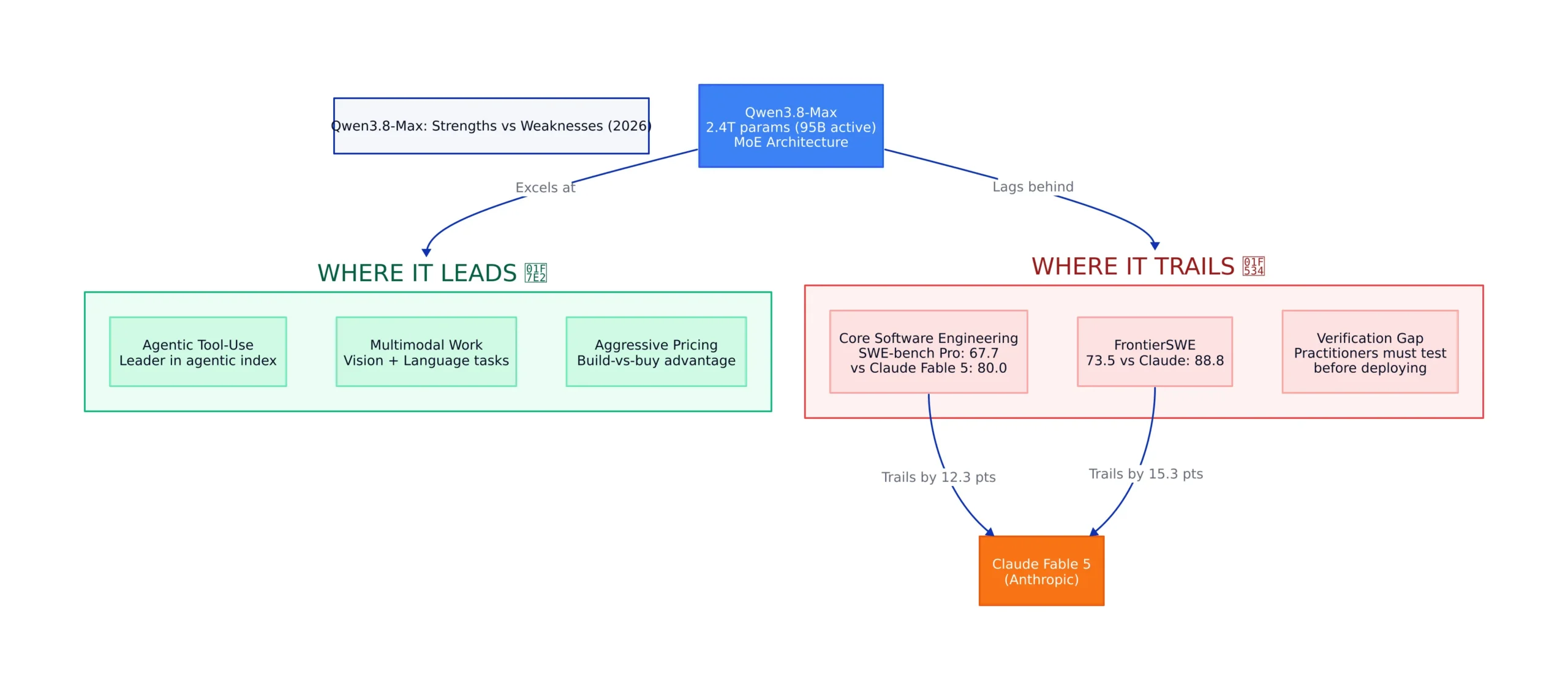
On August 3, 2026, Alibaba pushed Qwen3.8-Max from a bare-preview claim to general availability with a published benchmark table, real per-token pricing, and a firm open-weights date. The model carries 2.4 trillion total parameters in a sparse Mixture-of-Experts design that activates roughly 95 billion per token, per SiliconANGLE. The launch deserves close reading because the numbers split cleanly into two categories: the model genuinely leads on agentic tool-use and multimodal work, and it clearly trails the top proprietary models on core software engineering. Knowing which is which decides whether the system earns a place in your stack.
Calling Qwen3.8-Max the “best AI model of 2026” overstates the evidence. Its own launch table shows Anthropic’s Claude Fable 5 beating it on SWE-bench Pro at 80.0 versus 67.7 and on FrontierSWE at 88.8 versus 73.5, both figures from Alibaba’s own comparison, as documented by AI Tools Review. The sharper read is category-by-category: this is a serious agentic and multimodal contender that has not yet closed the gap on raw enterprise coding. Technical decision makers should evaluate it on the workloads where its design actually helps, not on a headline rank.

What Changed at General Availability
The July 19 preview at WAIC in Shanghai was heavy on claims and light on evidence. Alibaba said Qwen3.8-Max was “second only to Fable 5” with no benchmark table, no model card, and no active-parameter count, as International Business Times reported at the time. A day before the official unveiling, an anonymous model on a coding leaderboard responded that it was Claude, which the AI community read as a pre-release instance surfacing a training artifact rather than intentional branding.

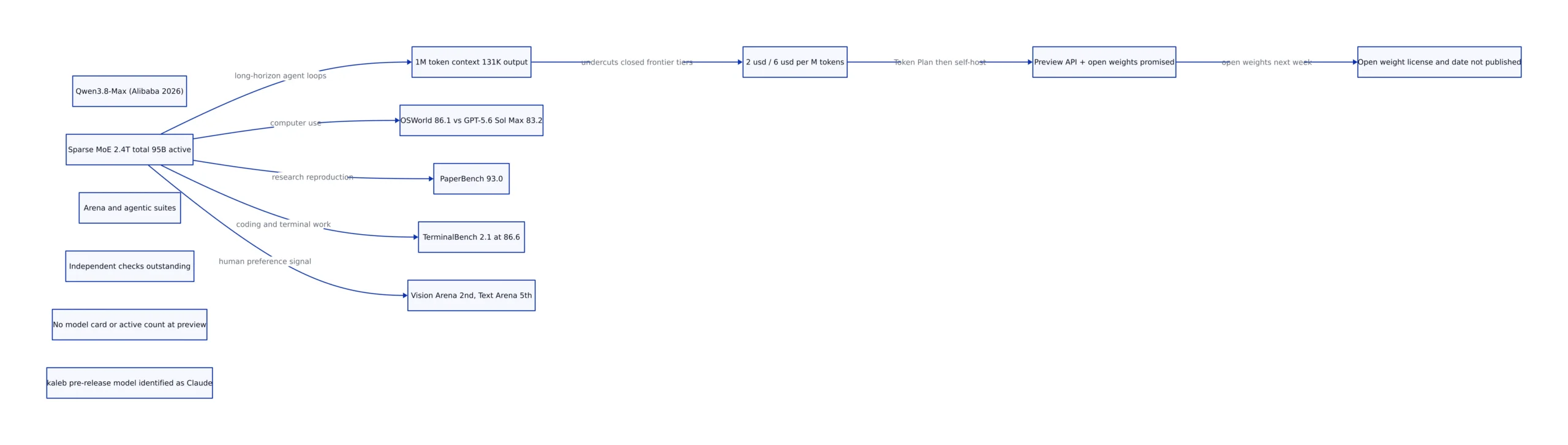
The August 3 general availability changed that picture. Alibaba published a real benchmark table, priced the API at $2.00 per million input tokens and $6.00 per million output tokens, with implicit cache reads at $0.25 per million, and gave the first firm open-weights timeline. Both Qwen3.8-Max and a smaller Qwen3.8-27B checkpoint are promised “next week,” though no license has been named. The active-parameter count, the single figure that sets inference cost for a sparse MoE model, is still undisclosed even after GA.

Alibaba shares climbed more than 6% in Hong Kong on the Monday of the launch, per Invezz. The market response signals how seriously investors are treating the open-weight price war, but share moves do not validate benchmark scores. That distinction matters for procurement.
Where the Model Leads: Agentic and Multimodal Work
On the benchmark suites that measure autonomous execution rather than single-turn accuracy, Qwen3.8-Max posts the strongest numbers Alibaba published. It tops OSWorld-Verified at 86.1, ahead of GPT-5.6 Sol Max at 83.2 and Fable 5 at 85.0 per Alibaba’s own table, and it leads PaperBench at 93.0, per VentureBeat. OSWorld measures a model’s ability to drive a desktop operating system and apps, which is exactly the capability that underlies computer-use agents. PaperBench measures how well a model reconstructs scientific research from experimental data.
Two things make the agentic scores credible rather than pure marketing. First, Alibaba’s positioning is concrete: it claims the model can complete a software project spanning more than 16 days with no human input and run a chip-design optimization task of over 500 steps, both production-shaped workloads. Second, the model ships five built-in tools on its Responses API: code_interpreter, web_search, web_extractor, t2i_search, and i2i_search, alongside function calling and structured output. That is an easily verifiable integration claim, independent of whether any benchmark survives independent replication.
The model’s context design supports long-horizon autonomy. It confirms a 1-million-token context window with 991K maximum input, 131K maximum output, and a 262K reasoning budget, according to the GA model page cited by AI Tools Review. For an agent that must hold an entire repository or a long interaction history, that headroom is a structural advantage in scoring and in practice. The architecture also uses a hybrid attention mechanism that Alibaba’s recent Qwen3-Next models have employed, interleaving linear-scaling Gated DeltaNet layers with standard full-attention layers, though Alibaba has not confirmed the exact layer ratio for the 3.8-Max model specifically.
On multimodal work, the system reads text, images, and video, a first for an Alibaba model above one trillion parameters. It scores 92.1 on OmniDocBench 1.5 and 91.5 on Parametric CAD Bench, both published by Alibaba. Reuters first reported the Arena signal: Qwen3.8-Max became the highest-ranked Chinese text model on Arena.AI around its unveiling and ranked second globally on the visual leaderboard behind a Claude Fable 5 variant, as documented in the AiCybr benchmark guide. Arena ranks are human-preference signals, not controlled tests, so they are a useful early read but not a substitute for task-specific evaluation.
Where It Trails: Core Software Engineering
The launch table is honest about weakness. On SWE-bench Pro, Qwen3.8-Max scores 67.7 against Fable 5’s 80.0, and on FrontierSWE the gap widens to 73.5 versus 88.8. Both are Alibaba’s own published figures. For teams evaluating a coding agent for production repositories, these two benchmarks measure the kind of work that matters most, resolving real issues in real codebases and managing extended engineering tasks, and the model sits meaningfully behind the leader on both.
This is the central tension of the launch. The system wins where agentic orchestration and multimodal reasoning are the bottleneck. It loses where a model must reason hard about a single difficult software defect against a large codebase. The distinction is not academic: a team routing everyday agent loops to Qwen3.8-Max and reserving a harder reasoning model for the trickiest defects gets the best of both, at a blended cost far below running everything on the frontier tier.
The generational jump over Alibaba’s own predecessor is large but the comparison baseline is flattering. DeepSWE 1.1 moves from 21.6 to 56.6, FrontierSWE from 40.7 to 73.5, and JobBench from 31.3 to 53.4 versus Qwen3.7-Max. However, Alibaba compares multimodal scores against Qwen3.7-Plus, not Qwen3.7-Max, which inflates the apparent delta on those specific rows. The model also scores 43.6 on Humanity’s Last Exam, well behind Claude Opus 5 at approximately 83.0 per third-party estimates, confirming that the system is not competing at the very highest tier of expert knowledge.
The Pricing Strategy and Build-Vs-Buy Math
The economics are where Qwen3.8-Max may matter most. At $2.00 input and $6.00 output per million tokens, the API undercuts the closed frontier by a wide margin. Forbes reported the launch priced frontier AI at $2 per million input tokens, undercutting OpenAI and Anthropic by roughly 40% on comparable tiers. VentureBeat’s comparison shows the combined input/output price lands at under one-third of Claude Opus 5 and under one-quarter of GPT-5.6 Sol Max.
Agentic workloads make token economics decisive because they burn far more tokens than a simple chat. A coding agent that plans, calls tools, reads files, and iterates can multiply per-task token consumption by an order of magnitude. At Qwen3.8-Max’s price, a high-volume agent loop becomes viable where the same loop at GPT-5.6 Sol Max pricing would be a budget line item.
The build-vs-buy decision splits into three scenarios. In the first, you want a hosted agent stack and price sensitivity: the API at $2/$6 is the easy answer, with the caveat that Chinese-hosted inference raises data-control and compliance questions that our analysis of AI inference cost trends in 2026 flagged for regulated teams. In the second, you have training data and GPU capacity: the RL fine-tuning playbook we documented for open-weight specialists applies once the weights ship, because the model can be tuned against a scored copy of your workflow at a fraction of frontier inference cost. In the third, you need the very highest reasoning quality on hard coding tasks today: Qwen3.8-Max is not the answer, and Fable 5 or GPT-5.6 Sol remains the safer default until independent scores accumulate.
| Benchmark | Qwen3.8-Max | Claude Fable 5 | GPT-5.6 Sol (max) | Source |
|---|---|---|---|---|
| OSWorld-Verified | 86.1 | ~85.0 | ~83.2 | Alibaba / VentureBeat |
| PaperBench | 93.0 | ~88.8 | ~90.5 | Alibaba / AI Tools Review |
| Terminal-Bench 2.1 | 86.6 | 84.6 | 88.8 | Alibaba / AI Tools Review |
| SWE-bench Pro | 67.7 | 80.0 | ~64.6 | Alibaba / AI Tools Review |
| FrontierSWE | 73.5 | 88.8 | not published | Alibaba / AI Tools Review |
| OmniDocBench 1.5 | 92.1 | not published | not published | Alibaba / AiCybr |
Every figure in the table is Alibaba-reported at GA. The numbers have not been independently reproduced by Artificial Analysis or LMArena as of early August 2026. Competitor values come from Alibaba’s own launch comparison, and the evaluation harness may differ from what those providers use for their own published results. For OSWorld-Verified, which is not in the table above because exact competitor scores were not published in Alibaba’s table, VentureBeat reports Qwen3.8-Max at 86.1 with GPT-5.6 Sol Max at approximately 83.2 and Fable 5 at approximately 85.0. For PaperBench, Qwen3.8-Max claims 93.0 with GPT-5.6 Sol Max at approximately 90.5 and Fable 5 at approximately 88.8. On OmniDocBench 1.5, Qwen3.8-Max scores 92.1 but Alibaba compares against Qwen3.7-Plus rather than Qwen3.7-Max. Treat all relative gaps as directional, not exact.
The Verification Gap and What Practitioners Should Test
The most important caveat is that none of the GA numbers have yet cleared an independent harness. As of August 5, 2026, no third-party evaluation had reproduced the full benchmark suite, and the active-parameter count remains unpublished. TechRepublic summarized the standing concern for IT teams: the promise of lower token prices and open weights must be weighed against infrastructure, licensing, and benchmark caveats.
The open-weights release is the swing factor for the build-vs-buy call. If the full 2.4-trillion-parameter model ships as open weights, self-hosting would require roughly 1.2 terabytes of storage for the weights alone at 4-bit precision, before KV cache and runtime overhead, which means a multi-GPU cluster well beyond a single high-end H200 class card. Alibaba may instead release a distilled or quantized variant, which would change the self-host calculus entirely. The license terms are also unpublished, so the open-weights promise could land as a custom license rather than permissive terms, the same path we noted for Moonshot’s Kimi K3.
For practitioners, the operational checklist is concrete. Test the model at the context lengths you actually use, at 100K, 300K, 600K, and near 1M, because a large advertised context does not guarantee consistent recall at the limit. Cross-check Arena and the vendor table against independent leaders as data accumulates. And if you rely on any agentic or coding score for a production decision, run your own representative harness before committing, because harness design alone can shift scores materially.
There is a genuine economics angle for teams comparing against frontier APIs. Our reinforcement learning fine-tuning analysis showed that a focused open model can beat a generalist at a fraction of the cost on a narrow workflow. Qwen3.8-Max becomes attractive in exactly that pattern: if its agentic strengths hold under independent testing, the open weights plus low API price make it a strong base for a specialist that handles the high-volume, well-scoped chunk of your agent traffic.
What to Watch Through 2026
Three signals will decide whether Qwen3.8-Max becomes a durable front-tier player or a flash in the Chinese open-weight surge. First, the open-weights license: a permissive license changes the adoption math for self-hosters, while a restrictive custom license keeps deployment tied to Alibaba’s cloud. Second, independent reproductions of the benchmark suite, particularly the agentic scores, from Artificial Analysis or LMArena. Third, the active-parameter disclosure, which converts headline size into a real inference-cost number.
The timing context is also worth weighting. Qwen3.8-Max arrived in the same week as Moonshot’s 2.8-trillion-parameter Kimi K3 and within a month of Z.AI’s GLM 5.2, and Alibaba owns roughly 36% of Moonshot, as the AiCybr guide noted, so the launch is as much an in-house rivalry as a response to OpenAI and Anthropic. Three trillion-parameter-class Chinese releases in about a month is the broader story, and each one pressures the token-price curve that shapes every buyer’s inference budget.
For engineering leaders evaluating the model today, the practical decision framework is straightforward. If your workload is long-horizon agentic tasks with tool use, multimodal document understanding, or computer-use automation, Qwen3.8-Max is price-competitive and strong on the relevant benchmarks, with the caveat that independent verification is pending. If your workload is hard software engineering on large repositories, the model is behind Fable 5 and GPT-5.6 Sol, and routing those tasks to the frontier tier while using Qwen3.8-Max for the agentic orchestration layer is the sensible blended architecture. If you need the open weights for self-hosted fine-tuning, wait for the license terms and the actual checkpoint size before committing infrastructure.
Key Takeaways
Key Takeaways:
- Qwen3.8-Max leads on agentic and multimodal benchmarks (OSWorld-Verified 86.1, PaperBench 93.0) but trails Claude Fable 5 on core software engineering (SWE-bench Pro 67.7 vs 80.0, FrontierSWE 73.5 vs 88.8).
- Priced at $2/$6 per million input/output tokens with cache reads at $0.25, it undercuts closed frontier tiers by a wide margin, which matters most for token-hungry agent workloads.
- Every GA benchmark figure is Alibaba-reported and not yet independently reproduced; the active-parameter count and open-weights license are still unpublished.
- Self-hosting the full 2.4T model, if the weights ship at that size, requires roughly 1.2TB of storage for weights alone, so a distilled or quantized variant would change the deployment math.
- Evaluate it on your own harness at your real context lengths rather than trusting the headline rank, and match task difficulty to model tier for the best blended cost.
Related Reading on Sesame Disk
Sources and References
Sources cited while researching and writing this article:
- Alibaba debuts Qwen3.8-Max model with 2.4T parameters
- Qwen 3.8 Max Review: Alibaba’s 2.4T Model, Tested (August 2026)
- Alibaba’s Qwen3.8-Max Makes Big Claims, but Independent Benchmarks Are Still Missing
- Qwen3.8-Max arrives with a bold claim: it outperforms GPT-5.6 Sol Max and Fable 5 on agentic computer use
- Qwen 3.8 Max: Complete Benchmark Guide vs GPT-5.6, Claude Fable 5 …
- Alibaba’s Qwen3.8-Max Prices Frontier AI At $2 Per Million Tokens
- Alibaba shares jump 6% after launch of Qwen3.8-Max
- TechRepublic: Alibaba Qwen3.8-Max pricing and open weights
Priya Sharma
Thinks deeply about AI ethics, which some might call ironic. Has benchmarked every model, read every white-paper, and formed opinions about all of them in the time it took you to read this sentence. Passionate about responsible AI, and quietly aware that "responsible" is doing a lot of heavy lifting.