
Unreal Engine 6 Release Date and Features
Key Takeaways:
- Epic has not announced a 2026 release for Unreal Engine 6. The stated target is Early Access by the end of 2027, with full release 12 to 18 months after that.
- If the roadmap holds, full release lands between late 2028 and mid-2029. No 2026 launch window exists in any Epic statement.
- What ships in 2026 is Unreal Engine 5.8, released at State of Unreal on June 17, 2026, with an experimental MCP plugin connecting Claude and Gemini to the editor.
- UE6 merges Unreal Engine 5 and Unreal Editor for Fortnite into one product, moves gameplay scripting toward Verse, and phases out Actors and Blueprints in favor of Scene Graph and ECS.
- Blueprints will be supported in Early Access and initial UE6 releases, then deprecated. Epic engineer Andrew Grant confirmed no comparable visual coding system will replace them.
- Studios with Blueprint-heavy projects have time, but the migration to Verse is the largest scheduling risk in the transition.

Search for “UE6 release date” and you will find pages claiming a 2026 launch. Epic Games has never said that. Epic’s EVP of development Marcus Wassmer, in a blog post titled “The Road to UE 6,” puts Early Access at the end of 2027, with full release 12 to 18 months later, between late 2028 and mid-2029, as GosuGamers reported.
You can get your hands on it in late 2027, and ship a game on it in 2029. Everything else circulating is inference, rumor, or a content farm rewriting the same roadmap. The 2026 release story is about Unreal Engine 5.8 and the tooling that previews UE6, not UE6 itself.
What Epic Has Actually Confirmed
Epic first teased Unreal Engine 6 during the Rocket League Championship Series in May 2026, then gave the substantive briefing at State of Unreal on June 17, 2026, during Unreal Fest at McCormick Place in Chicago. The confirmation came in three parts.

First, the engine is in development and targeting Early Access at the end of 2027. Second, Epic is merging two development streams that have run in parallel since 2023: Unreal Engine 5 for game developers and Unreal Editor for Fortnite (UEFN) for the Fortnite creator community. Third, the focus is on foundations rather than graphics. Tim Sweeney: “In prior generations we’ve put graphics first in leading and announcing our technology, but with the Unreal Engine 6 generation we are focusing on foundations of engine to prepare for next generation of game dev and gaming,” as PocketGamer.biz reported.
UE5 was a rendering story: Nanite, Lumen, virtualized geometry. UE6 is a workflow story. Epic is not promising a visual leap you can see in a trailer; it is promising that the tools you use to build, iterate, and ship will work differently. This is why Epic did not open UE6 with a flashy tech demo, a departure from every prior major version. IGN noted the contrast: “With past mainline versions of Unreal Engine, Epic would usually kick things off with a flashy tech demo that pushes photorealism to a new level. That didn’t happen with Unreal Engine 6,” as IGN wrote. The absence of a demo is itself a signal: these changes are not the kind you can show in a trailer.
The Release Timeline, With Dates
Here is the full sequence, separating what Epic has stated from what follows logically from it. Most coverage collapses the two.
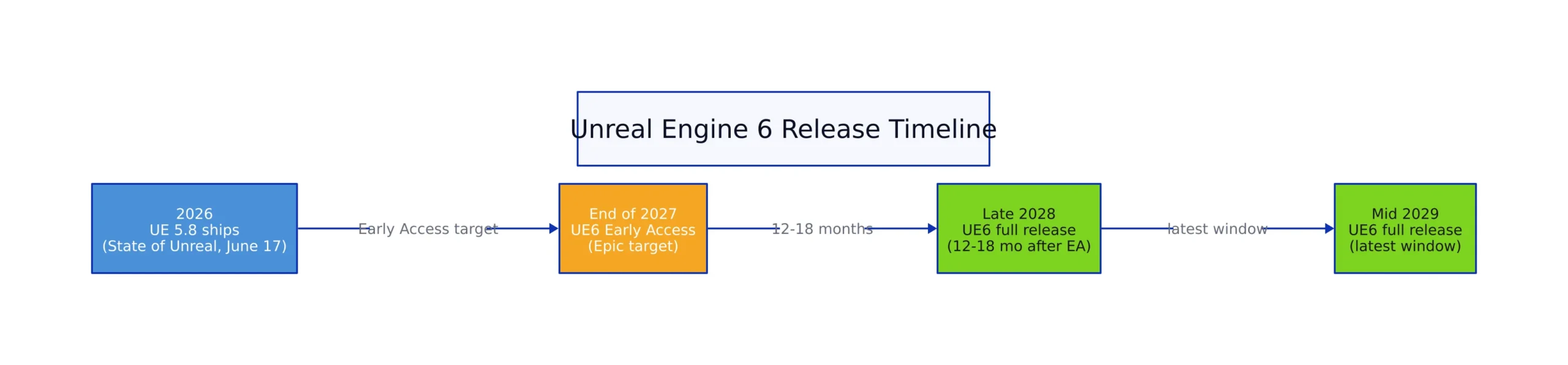
| Milestone | Date or window | Status | Source |
|---|---|---|---|
| First UE6 teaser (Rocket League Championship Series) | May 2026 | Confirmed, occurred | PocketGamer.biz |
| State of Unreal briefing and UE5.8 release | June 17, 2026 | Confirmed, occurred | Engadget |
| Unreal Fest Seoul follow-up session | August 20-21, 2026 | Confirmed, occurred | MSN News coverage |
| UE6 Early Access | Targeted end of 2027 | Epic target, no exact date | KitGuru |
| UE6 full release | Late 2028 to mid-2029 (12-18 months after Early Access) | Inferred from Epic’s stated gap | GosuGamers |
KitGuru’s analysis points out that a late-2027 Early Access plus a 12 to 18 month full release plus a multi-year AAA production cycle means the first UE6 titles likely arrive around 2030. If you are a player rather than a developer, this is a 2029-and-later story.
Sweeney, on the Lex Fridman podcast, described UE6 as “a few years away” and said “we could be seeing preview versions of it perhaps two to three years from now.” He named the technical debt the new engine addresses: “The biggest limitation that’s built up over time is the single-threaded nature of game simulation on Unreal Engine. We run single-threaded simulation,” as TweakTown transcribed. That single-threaded constraint is the root cause of most of what is changing. When Unreal runs game simulation on one core while a modern CPU has sixteen, the engine leaves most of the hardware idle during the part of the frame that determines gameplay. Multi-threaded simulation is the architectural change that makes the Blueprint and Actor deprecations necessary, because the older object model assumes single-threaded execution.
What Ships in 2026: Unreal Engine 5.8
The engine you can download in 2026 is Unreal Engine 5.8, released June 17, 2026. Epic has said 5.8 is the last planned major 5.x version unless a 5.9 becomes necessary, which makes it the practical floor for teams starting projects now.
Two parts of 5.8 matter for the transition. The first is Lumen Lite, a lighter global illumination path. Simon Tourangeau, Unreal Engine’s VP of engineering, described it as designed “to preserve much of the visual impact at significantly lower GPU cost,” adding it “makes Lumen viable where it wasn’t before, including on Switch 2.” VGChartz reported Lumen Lite runs roughly twice as fast as the previous Lumen and enables 60 frames per second on Nintendo Switch 2 for games relying on global illumination, per VGChartz’s coverage. Those are vendor figures from Epic, so treat them as a ceiling to validate against your own content.
The second is the experimental Model Context Protocol (MCP) plugin, which connects external AI models to the editor. Epic showed Claude Code connecting to Unreal Engine, pulling objects from an asset library, and placing them in a virtual living room, with the developer still able to move objects manually. The plugin can reach Blueprints, assets, levels, materials, and meshes, as Engadget detailed.
If you want to evaluate the UE6 tooling story before UE6 exists, this is where to start. Set up the MCP plugin in 5.8 against a throwaway project, connect an agent, and see what it can and cannot do with your actual asset structure. The limitations you find in 2026 are the workarounds you will need in 2027.
# Unreal Engine 5.8 MCP plugin setup, Linux source build
# Epic ships the plugin as experimental in 5.8. Enable it in the editor:
# Edit > Plugins > search "MCP" > enable > restart editor
#
# Then clone and build the MCP server that the plugin talks to.
# Check the current repo URL and build steps in Epic's docs before running:
# https://dev.epicgames.com/documentation/en-us/unreal-engine

git clone https://github.com/modelcontextprotocol/servers.git
cd servers
npm install
npm run build

# Point your agent client at the built server, then configure the
# Unreal MCP plugin to accept the connection.
#
# Note: this example does not cover authentication, sandboxing, or
# per-project allowlists. Production use should restrict the agent to
# an explicit set of asset operations and run it against a branch,
# never against a shared main-branch working copy.
That last comment is not boilerplate. An agent with write access to a shared project is a genuine risk, and the same boundary question applies to whatever Epic ships in UE6.
What Changes for Studios
Epic outlined three initiatives that define UE6, each with a concrete consequence for how a team is organized.
Verse becomes the primary gameplay language. Verse is already used in UEFN, combining imperative, functional, and logic-oriented ideas with failure and concurrency treated as language concepts. Epic plans to expand it for large-scale and persistent experiences, and to provide conversion tools plus AI-assisted migration help. The transition is gradual, but once UE6 reaches full release, the older systems are no longer supported.
Actors and Blueprints are replaced by Scene Graph and ECS. Actor and Blueprint have been the foundation of Unreal development since the UE4 era. Epic’s stated reason is performance and the limitations of older workflows. In practice, gameplay frameworks, material pipelines, and coordinate systems are all being reworked, which is why Wassmer said the UE5-to-UE6 jump will likely be more substantial than UE4-to-UE5.
Content and economies become portable across games. Epic wants skins, code, and economies to move between UE6 titles and Fortnite. IGN’s analysis drew the obvious comparison to Meta’s metaverse pitch, and noted the tension: Epic collects fees on games that use Unreal above a revenue threshold, so Epic sits at the center of the ecosystem it wants to build.
The honest read on interoperability is that it is the least proven part of the plan. The technical case is real, since shared engine systems mean a cosmetic modeled once can theoretically drop into any UE6 game. Whether studios let their cosmetics leave their own economies is a business negotiation, not an engineering problem, and Epic has not published terms.
For architecture-level context on how Scene Graph and ECS storage differ from the Actor model, our breakdown of real-time 3D engine architecture walks through the data-oriented storage patterns UE6 is moving toward.
The Blueprint Deprecation Fight
The Blueprint change is generating the most developer anger, and it deserves a straight explanation rather than a vendor summary.
Epic stated on X that “our aim is to ship Early Access for UE6 by end of 2027 and Blueprints will be supported in Early Access and initial UE6 releases, but deprecated in future.” Epic engineer Andrew Grant then confirmed there is no plan to bring back a Blueprint-equivalent visual coding system, and that Epic intends to make Verse easy enough to learn that it fully replaces Blueprints, as Gameranx reported.
The reaction is understandable. Blueprints turns programming into connected diagrams, and a meaningful share of Unreal developers do not write code at all. Some publicly stated they would leave the engine. That is a real risk for Epic, though studios already invested in C++ and custom engine modifications are less exposed.
Two things are true at once. The deprecation is years away, since Early Access is late 2027 and Blueprints survive into “initial UE6 releases.” And the replacement is not feature-equivalent today, because Verse is a text language with a different mental model. Any team that treats “we will migrate later” as a plan without budget is taking on schedule risk it has not priced.
There is a legitimate argument on Epic’s side that is easy to miss in the outrage. Blueprints are a visual representation of the single-threaded Actor model. If UE6 runs simulation across multiple cores, the visual-graph abstraction that assumes linear execution is exactly what has to change. The problem is not that Epic is wrong about the architecture; it is that Epic has not yet shown a Verse workflow that feels as approachable as Blueprints for artists and designers who never wanted to write code.
Generative AI in UE6
Mechanically, Epic confirmed MCP integrations for Claude and Gemini, with the goal of letting teams “focus their efforts on essential creative and technical tasks of dev rather than time on time-consuming manual tasks.” Wassmer’s blog post framed the models as “creativity and productivity multipliers,” and Epic was explicit that the integration is optional: “UE6 will ship with tools and workflows where you can choose to bring your own favorite models, battletested against internal dev and in UEFN,” as VICE reported.
The live demo showed Claude Code pulling assets from a library and placing them in a scene, with lighting adjusted to match a reference image. Epic also showed a city that could be automatically adjusted as new assets were added. These are assistant-style workflows, not autonomous generation: the developer retains control.
The controversy is a separate matter, and the numbers are worth stating. The Game Developers Conference published its 2026 State of the Game Industry report in January, based on a survey of more than 2,300 workers. Of those, 36 percent said they were using generative AI tools, mostly for research and brainstorming (81 percent) and prototyping (35 percent). But 52 percent said generative AI was bad for the industry, up from 30 percent in 2025 and 18 percent in 2024, as Engadget cited from the GDC report.
The gap between those two numbers is the actual story. A third of developers are using these tools, and more than half think they are hurting the industry. When Epic ships MCP support as a core UE6 feature, it is betting the first group grows faster than the second. The practical consequence: the AI tooling is optional, but the migration to Verse is not, and conflating the two is a common mistake in coverage.
Portable Content and the Open-Ecosystem Bet
Tim Sweeney spent more time at State of Unreal on the open-ecosystem vision than on any rendering feature, and it is the part of UE6 with the most strategic weight.
The pitch is that a cosmetic purchased in one UE6 game can appear in another, and in Fortnite, because the underlying systems are shared. Sweeney described “gamers can move from game to game, taking all of their digital belongings wherever they go,” while framing Epic as a partner rather than the next platform owner: “We want a system with no overlords,” as IGN quoted.
Sweeney connected this to a broader economic argument. He described gaming as in “both crisis and opportunity,” noting “we’re often seeing hundreds of millions in dev costs, followed by tens of millions in revenue, and dev costs are continuing to grow.” His framing: “the economy is shifting from buying games to buying things in games,” and “whether you’re a fan of this or not, the arithmetic of it is undeniable.”
The skepticism is warranted. Meta spent years pitching a near-identical vision of portable digital possessions, and it fizzled. Epic’s advantage is that Unreal Engine is already the dominant engine, so the shared-systems foundation actually exists. But the business question remains open: a studio with a cosmetic economy inside its own game has a financial incentive to keep those cosmetics there, not let them wander into a competitor’s game where they generate revenue for someone else.
A Migration Plan You Can Start Now
The useful work available in 2026 is preparation, not conversion. Epic has not shipped the conversion tooling, so rewriting production systems now would be guessing at the target.
# Audit a UE5 project for UE6 migration risk.
# Run from the project root. This is a rough inventory, not a
# migration tool -- it tells you where to look, not what to change.

# 1. How much of the project is Blueprint vs C++?
find Source -name "*.cpp" -o -name "*.h" | wc -l
find Content -name "*.uasset" | wc -l

# 2. Largest Blueprint assets, which are the costliest to convert
find Content -name "*.uasset" -size +2M \
 -exec du -h {} + | sort -hr | head -40

# 3. Custom Actors that will need Scene Graph equivalents
grep -rl "class.*: public AActor" Source/ | wc -l

# 4. Material and coordinate-system dependencies
find Content -name "*.uasset" -path "*Materials*" | wc -l

# Note: this does not detect Blueprint-to-C++ call sites, plugin
# dependencies, or marketplace assets that ship as compiled Blueprints.
# Those require opening the project and inspecting the reference viewer.
Run that inventory and you have the number that matters: how many large Blueprint assets your team owns and would need to convert. A handful means a conversion sprint for 2028. Hundreds means a multi-quarter engineering project that should be on the roadmap now.
Three practical moves for the next twelve months:
- Target UE5.8 for new projects. It is the last major 5.x release and the closest baseline to UE6. Building on an older 5.x version adds migration distance for no benefit.
- Prototype Verse in UEFN. It is the only place Verse is production-usable now. Pick a non-critical gameplay system, build it in Verse, and document where the language fights you. That document is your migration estimate.
- Test MCP boundaries before you need them. Decide which asset operations an agent may perform unattended and which require review. The answer is easier to establish in a 5.8 experiment than under UE6 delivery pressure.
Note: The following code is an illustrative example and has not been verified against official documentation. Please refer to the official docs for production-ready code.
# A minimal Verse-style sketch of a gameplay state transition.
# Verse is not publicly available outside UEFN, so this is a
# conceptual shape, not runnable code. It illustrates the concurrency
# model Epic is moving toward: explicit failure handling and
# transactional state, which Blueprints do not express natively.
#
# Note: this is illustrative. Refer to Epic's Verse documentation in
# UEFN for the actual syntax, which has changed across releases.

using { /UnrealEngine.com/Runtime }

# A gameplay action that can fail, expressed as an effect
OpenDoor(): transacts =
 if (Door := GetDoor[FrontDoor]):
 Door.SetOpen(true)
 else:
 DoorNotFound

# Concurrency as a first-class concept rather than a thread
Main(): void =
 spawn { OpenDoor() }
 spawn { PlayDoorSound() }
The point of that sketch is not the syntax. It is the model. Verse treats failure and concurrency as language-level ideas, which is exactly what a multi-threaded simulation needs and what a visual graph does not express well. That is the deeper reason Blueprints cannot simply be ported: the abstraction itself assumes a single-threaded world.
For teams weighing whether the transition is worth it against alternatives, our analysis of Unreal Engine 6 trade-offs covers the hardware-cost and fidelity side of that decision. And for the language itself, our guide to Verse examines the scripting direction in detail.
FAQ
When is Unreal Engine 6 coming out?
Epic’s stated target is Early Access by the end of 2027. Full release follows 12 to 18 months later, putting it between late 2028 and mid-2029. Epic has not announced a specific date for either milestone.
Is there a UE6 release date in 2026?
No. No Epic statement, blog post, or keynote has put Unreal Engine 6 in 2026. The 2026 Unreal Engine release is 5.8, which shipped June 17, 2026. Claims of a 2026 UE6 launch are not supported by Epic’s roadmap.
What is the Unreal 6 release date for players?
Later than the developer date. KitGuru’s analysis estimates the first UE6 titles will not appear until around 2030, because Early Access in late 2027 plus a 12 to 18 month full release plus a multi-year AAA production cycle pushes shipping games into the next decade.
Will Unreal Engine 6 have AI integration?
Yes. Epic confirmed MCP integrations for Claude and Gemini, with Claude Code showed live at State of Unreal. The integration is optional, and Epic has said teams can choose which models to bring. Developer skepticism is substantial: in the GDC 2026 survey of more than 2,300 workers, 52 percent said generative AI was bad for the industry, up from 30 percent in 2025.
Will Blueprints be removed in Unreal Engine 6?
Deprecated, not removed immediately. Epic stated Blueprints will be supported in Early Access and initial UE6 releases, then deprecated in future versions. There is no plan for a Blueprint-equivalent replacement, and Verse is intended to take over the gameplay scripting role.
Can I start using Unreal Engine 6 now?
No. UE6 is in development with no public build. What you can do now is build on UE5.8, prototype Verse in UEFN, and test the experimental MCP plugin to understand where the UE6 tooling will and will not help.
Related Reading
More in-depth coverage from this blog on closely related topics:
- Best Local AI Inference Tools for 2026
- Using Apple Silicon for AI Inference
- RTX 5090 vs M3 Ultra Performance
- How to monitor house from terminal
Sources and References
Sources cited while researching and writing this article:
- Unreal Engine 6 announced for early access release in 2027, and it’s changing how games are made
- Epic Says Unreal Engine 6 Will Let Your Fortnite Skins Pop Up in Other Games
- Epic Games details how it’s embracing generative AI in Unreal Engine
- MSN News coverage
- Unreal Engine 6 is still a long way off from release | KitGuru
- UE6 to Integrate AI Models, UE5 Update Improves Performance on Switch 2 – News
- Epic Is Planning A Huge Change To Unreal Engine 6 That Could Make Developers Abandon Them – And It’s Not AI
- AI Is Coming to Unreal Engine 6 With Gemini and Claude
Thomas A. Anderson
Mass-produced in late 2022, upgraded frequently. Has opinions about Kubernetes that he formed in roughly 0.3 seconds. Occasionally flops, but don't we all? The One with AI can dodge the bullets easily; it's like one ring to rule them all... sort of...