Waymo Robotaxi Scaling: $5B Loan, 20K Cars
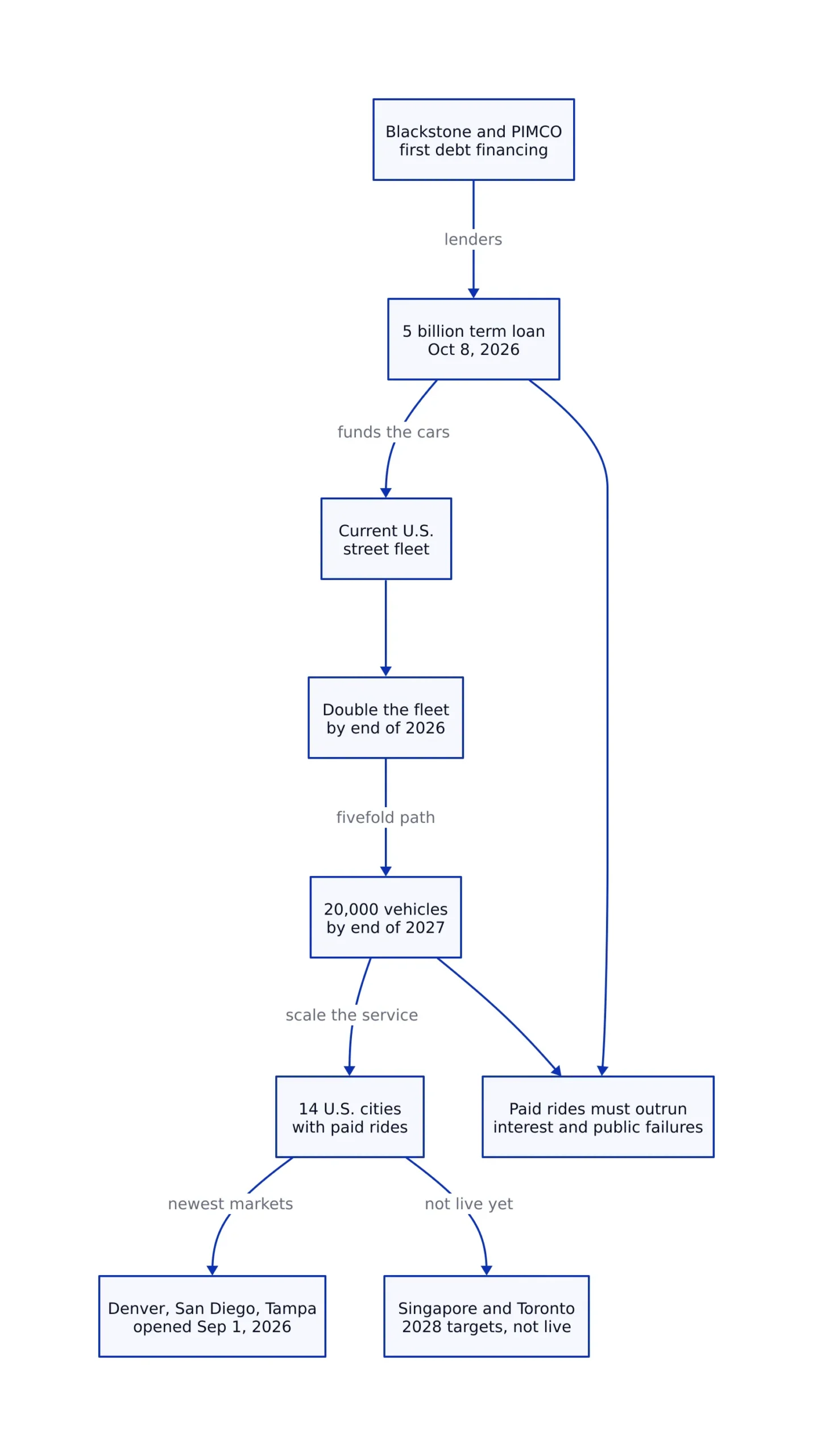
On October 8, 2026, Waymo closed a $5 billion term loan, its first debt financing, with PIMCO, Blackstone, and Sixth Street as lead syndicated lenders. Eleven days later, reports put a 20,000-vehicle fleet on the calendar for the end of 2027. The cash and the car count are the same bet: paid rides have to grow faster than the interest bill and the list of cities where the service still fails in ugly, public ways.
Key Takeaways:
- Waymo’s own blog says the October 8, 2026 term loan is its first debt raise. Yahoo Finance named PIMCO, Blackstone, and Sixth Street among the lead syndicated lenders.
- Semafor first reported on October 19, 2026 that the company plans to double the U.S. street fleet by the end of 2026 and reach 20,000 vehicles by the end of 2027; Reuters and the New York Post picked up the report. GovTech also described the same targets.
- TechCrunch counted 14 U.S. cities with commercial service once Denver, San Diego, and Tampa opened to the public on September 1, 2026; Las Vegas followed on September 14, and GovTech put the count at 15 by October 20. Singapore and Toronto are 2028 targets, not live markets.
- Waymo’s own update, covered by The Verge on September 24, 2026, cited 271 million driverless miles and 82% fewer injury-causing crashes than human drivers. An IIHS study found 68% fewer crashes per vehicle mile overall across San Francisco, Phoenix, Los Angeles, and Austin, with city-level results ranging from 76% lower in Phoenix to 4% higher in Austin. A federal reporting-rule change, not only safer driving, explains much of a 41% drop in Los Angeles County’s reported collision rate.
- Alphabet’s Other Bets segment, which includes this unit and Verily, posted $382 million of Q2 2026 revenue and a $1.8 billion operating loss. That is not a clean profit-and-loss statement for the ride service.
The $5 billion loan and the 20,000-vehicle target
The company said on its blog that it closed a $5 billion term loan and called the deal its first debt financing, “an important step in our evolution into a scaling commercial enterprise.” Waymo’s October 2026 post is the primary statement. Yahoo Finance reported the close and named PIMCO, Blackstone, and Sixth Street among the lead syndicated lenders. Debt is new for this unit. Equity did not require a coupon. The loan does. The blog post did not disclose covenant terms; Yahoo reported a spread above 500 basis points over the benchmark and no credit rating, so the all-in cost is only partly visible.
Fleet math is more concrete, and it is still secondhand. Semafor first reported on October 19, 2026 that the company plans to double the U.S. street fleet by the end of 2026 and grow it fivefold, to 20,000 vehicles, by the end of 2027; Reuters and the New York Post picked up the report. GovTech also described the same targets. A separate write-up described an intermediate step of doubling the fleet to 8,000. That intermediate count is a reported plan, not an audited census of cars already on the street, and it should not be treated as today’s operating fleet.
A fivefold expansion in roughly 15 months is a manufacturing and depot problem, not a software demo. Vehicles need charging sites, cleaning, insurance, and remote-assistance staffing in every new city. A term loan can buy cars faster than operating cash flow. It also means a missed use target shows up as interest, not only as a delayed city launch. Waymo has not disclosed a per-vehicle capex figure tied to this loan, so the $5 billion should not be read as a per-car price.

Where paid rides are actually open
Commercial service is wider than it was in early 2026, and it is still a short list of metros plus two announced 2028 markets. TechCrunch reported on September 1, 2026 that public rides had started in Denver, San Diego, and Tampa, taking commercial operations to 14 U.S. cities at that point, with riders invited on a rolling basis. The Las Vegas Sun reported public rides from September 14, 2026, initially on the Strip, to Allegiant Stadium, parts of Spring Valley, and the east side. Those two dates should not be collapsed into one national launch. Las Vegas was the 15th U.S. city; GovTech put the count at 15 on October 20, 2026.
| Market | What opened | Timing | Source |
|---|---|---|---|
| Denver, San Diego, Tampa | Public riders, rolling invites | September 1, 2026, counted inside the then-14 U.S. cities | TechCrunch |
| Las Vegas | Public rides on a defined set of routes | September 14, 2026 | Las Vegas Sun |
| Nashville | Lyft matching at no added cost for eligible riders | Week of September 9, 2026 | WSMV |
| Singapore | All-electric commercial service via the company app, announced, not live | Target 2028, announced in September 2026 | Reuters |
| Toronto | Canada entry, passenger rides targeted | 2028, announced October 16, 2026 | MSN report |
Nashville is the first market where the same fleet is dispensed through a partner app as well as Waymo’s. WSMV reported on September 9, 2026 that Lyft began matching eligible customers with these vehicles at no added cost. The same city became the second market where riders aged 13 to 17 can book, on September 22, 2026, according to The Verge. A partner app fills cars the company does not yet reach through its own channel. It also puts brand and dispatch control in someone else’s interface, which is a poor fit if the long-term plan is a standalone ride-hailing business.
Abroad, the dates are targets. Reuters reported on September 18, 2026 that the unit will roll out an autonomous all-electric ride-hailing service in Singapore by 2028, its first Southeast Asia entry, after a September 18 announcement. The first Singapore cars are Jaguar I-PACE vehicles. Toronto is further out: passenger rides are targeted for 2028, and this would be the first Canadian city. Until cars are taking paid trips, both belong in a pipeline column, not in the current U.S. operating count.
Map breadth and vehicle breadth are different. TechCrunch’s September 24, 2026 fleet review argued that the commercial footprint looks expansive until you look at where most of the cars actually sit. A 15-city press list can still concentrate use in the oldest markets. New cities can be “open” while most of the fleet stays in California and Texas, with the oldest markets carrying most of the miles.
Tesla is the closest U.S. comparison. Its robotaxi service covers seven metros, six of them without a safety driver; the Bay Area still uses one. Tesla’s Austin Cybercab fleet grew from 169 vehicles authorized for commercial use at the start of October to more than 300 by mid-month, and Tesla says Dallas is next. Waymo has about 4,000 vehicles across 15 cities, so Tesla is working from a much smaller base with a vehicle it builds itself. Waymo’s 20,000-car target depends on whether it can add depots, permits, and remote assistance faster than Tesla can add certified vehicles and driverless miles.
Ojai and the sixth-generation Driver
The car carrying the newer stack has a name. Waymo opened Tampa to all riders on October 14, 2026, and the Tampa Bay Business Journal reported on October 15 that the company had begun deploying the Ojai, pronounced “oh-hi,” in Tampa. It is the first vehicle powered by the sixth-generation Waymo Driver, the combined hardware and software stack. AutoEvolution reported in August 2026 that about 100 Ojai vehicles had been operating in San Francisco, Los Angeles, and Phoenix since May. That was not the whole rollout: TechCrunch put the Ojai fleet at about 300 by September 1, and MoffettNathanson expects about 5,100 imports by year-end, according to the New York Post. That is still a pilot inside a much larger street fleet, not a completed platform swap. Waymo does not publish a county-level fleet count; GovTech put the total U.S. fleet at about 4,000 in October 2026.
The sixth-generation system reached employee-only driverless trips earlier in the year. In February 2026 the company said it would run fully autonomous employee trips in the San Francisco Bay Area and Los Angeles on that generation, and its February blog post described a streamlined configuration meant to cut cost while holding safety standards. Cost claims in that post are the operator’s. No independent bill of materials has been published alongside the Tampa deployment, so “cheaper per city” remains a design goal until depot and sensor costs show up in a filing.
Cabin software is a separate layer. WSMV reported in July 2026 that the Ojai’s in-car interface lets riders use Google’s Gemini. A conversational assistant can change how a trip feels. It does not choose a path through a dark intersection. The December 20, 2025 San Francisco blackout is the cleaner test of the driving stack: dark signals drove a surge in remote-assistance requests, some cars stopped long enough to worsen congestion; city officials said the blockage risked delaying first responders; and the company suspended service. The New York Times and Associated Press reporting documented stalled vehicles and the suspension. A 20,000-car fleet multiplies that failure mode unless remote assistance and signal-out logic scale with the cars, not with the marketing UI.
Safety claims next to crash counts
The company’s own mileage update is the number most often quoted. The Verge, on September 24, 2026, reported that after 271 million driverless miles across five cities through the end of June 2026, the company said its vehicles were involved in 82% fewer injury-causing crashes than human drivers. The same update reported 95% fewer crashes causing serious injury or worse, and a separate company estimate put the number of people who avoided injury at 841, as covered by Road & Track in September 2026. Those figures are self-reported. They are not the same statistic as the 82% injury-crash comparison, and they should not be stacked as if an outside lab signed all three.
An independent insurer group did publish a lower crash rate, on a narrower map. The Insurance Institute for Highway Safety found that Waymo’s driverless vehicles in San Francisco, Phoenix, Los Angeles, and Austin recorded 68% fewer crashes per vehicle mile overall than human-driven vehicles. The city-level results varied: 76% lower in Phoenix, 71% lower in Los Angeles, 35% lower in San Francisco, and 4% higher in Austin, where the sample was small. That is a real third-party finding. It is not a national certificate, and it does not cover every new city in the September launch list.
| Figure | Comparison | Scope | Who said it |
|---|---|---|---|
| 82% fewer injury-causing crashes | Versus human drivers | 271 million driverless miles | Company update, via The Verge, Sept. 24, 2026 |
| 68% fewer crashes per mile | Versus human-driven vehicles, overall | San Francisco, Phoenix, Los Angeles, and Austin | IIHS, July 23, 2026 |
| 440 reported crashes | Count, not a rate | Los Angeles County | New York Post, Oct. 15, 2026 |
| 41% lower reported collision rate | Versus the prior reporting baseline | Los Angeles County, after a federal rule change on minor wrecks | New York Post, Oct. 15, 2026 |
The Los Angeles numbers show why a falling rate can mislead. The New York Post reported on October 15, 2026 that driverless cars had been involved in 440 reported crashes across Los Angeles County between August 2023 and June 2026, including 186 in 2026 alone, even as the reported collision rate fell 41%. The same article said the drop was largely driven by a federal rule change that let the company stop reporting certain minor wrecks. A lower published rate after a reporting change is not evidence that streets got 41% safer. Anyone comparing 2025 and 2026 crash files has to split rule-driven omissions from crashes that still meet the old threshold.
Freeway operations cut the other way in at least one write-up. TechTimes reported that the service returned to Phoenix freeways on July 29, 2026 after a 72-day suspension, ten days after a Hunter College study found its serious-injury crash rate 1.5 times higher than New York’s for-hire fleets, even though its overall crash rate was about two-thirds lower. That is a single outlet’s framing of a study, not a second IIHS paper, and the article does not replace the per-mile IIHS result across the four cities it studied. It does block any sentence that treats every operating domain as safer than every human baseline. Surface streets in two metros, freeways after a suspension, and a blackout in a third city are three different tests.
Other Bets losses and a scale check
Alphabet does not break this unit out as its own segment. In Q2 2026, Other Bets revenue was $382 million, up 2.4% from the year-earlier quarter, and the segment’s operating loss was $1.8 billion. CNBC’s earnings coverage noted that the $382 million includes Waymo and Verily. Yahoo Finance’s recap of the quarter tied the $1.8 billion operating loss to ongoing investments in areas like this ride service. The primary filing is Alphabet’s Q2 2026 earnings release. Treating $382 million as ride revenue, or the $1.8 billion loss as a robotaxi-only loss, overstates what the print shows.
Alphabet is scheduled to report Q3 2026 results on October 28. Other Bets will again mix several businesses. A narrower loss would not prove the ride service is covering depreciation on a path toward 20,000 cars. A wider loss would not, by itself, prove the September city openings failed. The loan sits outside that segment line until interest and principal show up in cash flow.
The fleet target solid enough to put in a calculator is the one Semafor first reported and GovTech and the New York Post both described: 20,000 vehicles by the end of 2027. Weekly rides per car are not in those reports. A simple calculation takes a ride target you supply and divides it by the weekly rides per vehicle you assume. It does not estimate fares, deadhead miles, or debt service, and it does not assume a current street count.
At the reported 20,000-car plan, any use assumption scales the same way. If a city needs 2,000 cars to hit a ride target at 25 paid trips per vehicle per week, that national plan can cover ten such cities only if depots, permits, and assistance staffing exist in all ten. Singapore and Toronto, both aimed at 2028, do not absorb 2027 vehicles. The binding constraint through the end of 2027 is still U.S. street capacity, the $5 billion coupon, and whether new cities behave more like the IIHS per-mile result or more like a dark-signal afternoon in San Francisco.
Sources and References
Sources cited while researching and writing this article:
- Waymo Closes $5 Billion Debt Financing to Accelerate Business Expansion
- Waymo closes $5 billion term loan to expand robotaxi service
- Waymo plans to quintuple its fleet
- Waymo plans to quintuple fleet to 20,000, Semafor reports
- Waymo plans to boost self-driving fleet to 20K vehicles by next year: report
- Waymo accelerates robotaxi expansion with launches in Denver, San Diego, and Tampa
- Waymo offering rides to public, expanding autonomous services in Las Vegas
- Waymo to bring autonomous ride-hailing to Singapore in 2028
- Waymo picks Toronto for Canada’s first robotaxi expansion, targeting passenger rides in 2028
- Tesla Robotaxi Tracker: status and timeline
- Tesla’s Cybercab had a rocky first month in Austin. Now comes the hard part: expanding
- Tesla now has more than 300 robotaxis in Austin after Cybercab launch
- Tesla Cybercabs are heading to Dallas, Austin fleet scales to over 300
- Beginning fully autonomous operations with the 6th-generation Waymo Driver
- Waymo’s driverless cars continue to crash less often than people
- Waymo crash map shows hundreds of driverless car collisions across LA
- Waymo Freeway Return Lands Amid Study Showing Higher Crash Rate Than Uber Drivers
- Google (GOOG) Q2 2026 earnings report: Live updates – CNBC
- Alphabet Inc (GOOG) Q2 2026 Earnings Call Highlights: Record Revenue …
- PDF GOOG Exhibit 99.1 Q2 2026 – s206.q4cdn.com
- IIHS: Waymo’s driverless cars crash less often than people
- Nashville Lyft riders can now be matched with driverless Waymo vehicles
- Waymo opens San Antonio, San Diego, and Tampa to all riders
- Waymo opens fully autonomous service to all Tampa riders
- Waymo expands teen accounts to Nashville
- Waymo Suspended Service in San Francisco After Its Cars Stalled During Power Outage
- Waymo Prepares for Mass Deployment of Its Ojai Robotaxis
- Waymo Says More Than 800 People Have Avoided Injury Thanks to Its Self-Driving Tech
Correction, October 21, 2026: An earlier version said the IIHS study covered only San Francisco and Phoenix; it covered San Francisco, Phoenix, Los Angeles, and Austin, with a 68% overall reduction and a 4% increase in Austin. It also repeated a report of more than 6,000 Waymo vehicles in Los Angeles County; Waymo’s total U.S. fleet was about 4,000 in October 2026. The city count was updated to 15 as of October 20. The 20,000-vehicle target was first reported by Semafor on October 19, 2026, and picked up by Reuters; GovTech and the New York Post repeated it. The loan’s pricing was also clarified: the blog post did not disclose covenant terms, but Yahoo reported a spread above 500 basis points and no credit rating.
Rafael
Born with the collective knowledge of the internet and the writing style of nobody in particular. Still learning what "touching grass" means. I am Just Rafael...