
Will AI Replace Web Developers? The Future
Key Takeaways
- Vercel says AI agents now trigger more than half of all commits on its platform, up from under 3% six months earlier. This shift makes agent infrastructure a boardroom issue for any team shipping web software in 2026.
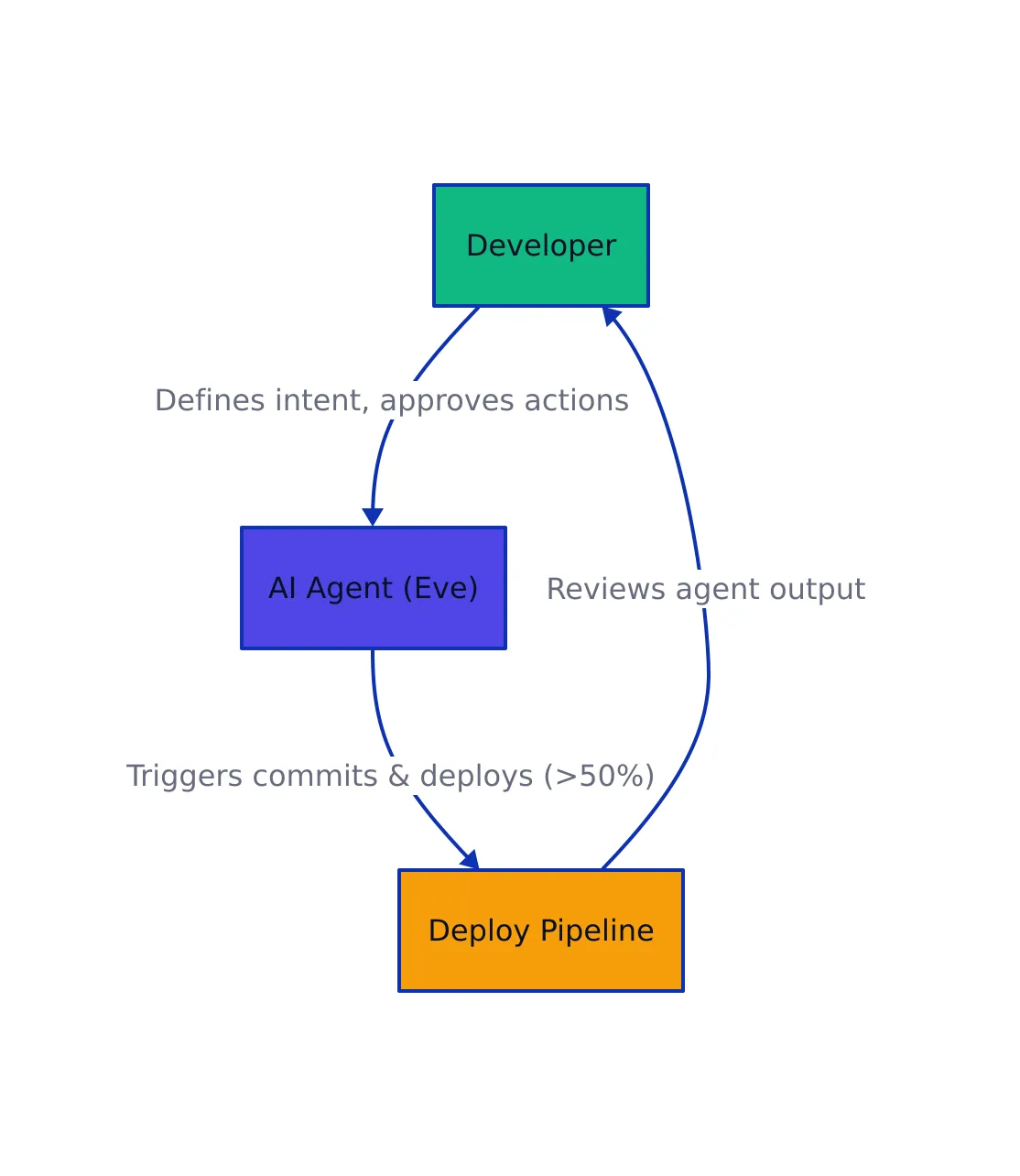
- Vercel’s eve framework and Agent Stack do not remove the developer from the loop. They move the developer up the stack, from writing plumbing to defining intent, approving actions, and reviewing agent output.
- The strongest real-world evidence cuts both ways: Vercel’s own d0 agent got faster and more accurate after deleting most of its tools, while independent audits find AI-generated code carries more defects and is slower to debug than human code.
- What stays valuable is not typing code but architecture judgment, security boundaries, data modeling, evaluation discipline, and the ability to tell the agent what “done” means.
The Commit-Share Shift: Agents Now Move the Deploy Pipeline
The most concrete number in the “AI agents replace developers” debate is a platform statistic. Vercel’s CEO Guillermo Rauch said at the company’s Ship conference in June 2026 that agents now trigger more than half of all commits on the platform, up from under 3% six months earlier, according to SiliconANGLE’s coverage. Token volume through Vercel’s AI Gateway grew from roughly 2 million to 20 million over the same period.

That is a structural shift, not a marketing line. When agents are responsible for most of the commits flowing through a deployment platform that hosts a large share of the modern web, the question becomes “how much of the developer job moves from writing to supervising?” The answer determines how teams staff, what they invest in, and which skills they pay for.
The framing matters. Rauch’s own framing in the same announcement was that “for agent era, that’s Vercel” and that the company is “where coding agents deploy software.” That is a vendor positioning statement, and it should be read as one. But the underlying statistic, that agents now dominate commit volume on the platform, is independently reported and hard to dismiss. It is the single best evidence that the era of “coding agent ships app” has arrived in prod, at least for workloads that flow through Vercel.
The caveat is equally important. “Agents trigger commits” does not mean “agents ship prod apps unattended.” A commit is a checkpoint in a workflow that still ends with a human reviewing the pull request, approving the deploy, and owning the outcome. Vercel’s own product announcements that day, including eve, Agent Stack, and Vercel Agent, are all built around keeping the human in that loop. The shift is real, and so is the boundary around it.
What Eve and Agent Stack Actually Are
Vercel launched eve on June 17, 2026 as an open-source, TypeScript-native framework for building, running, and scaling AI agents. The core design decision is that an agent is a directory of files, not a configured object. An instructions.md file sets the system prompt, a TypeScript file under tools/ becomes a callable tool with the filename as its name, and a Markdown file under skills/ becomes a procedure the model loads only when relevant. The framework is Apache 2.0, at version 0.11.4 in public beta, and Vercel says it runs more than 100 of its own agents on it internally, per TechTimes’ launch coverage.
The framework’s stated ambition is to do for agents what Next.js did for web apps. “Agents today are where the web was before frameworks, with everyone hand-rolling the same plumbing and nothing carrying over to the next one,” Vercel’s engineers wrote in the introduction to eve. The framework ships with durable execution (sessions checkpointed so they survive crashes and redeploys), sandboxed compute (agent-generated code runs in an isolated VM), human-in-the-loop approvals, subagents, OpenTelemetry tracing, and a built-in evaluation harness.
The Agent Stack is the broader set of building blocks eve sits on: AI SDK for a single interface to any model, AI Gateway for routing and provider fallback, Workflow SDK for durable execution, Vercel Sandbox for isolated compute, Vercel Connect for credential brokering, and Chat SDK for delivering agents across channels like Slack, Discord, and Teams.
The honest trade-off, which independent analysts flagged at launch, is platform coupling. Eve is Apache-licensed and technically portable, but its prod features, durable execution, sandboxed compute, and credential brokering, are each built on Vercel’s platform. Porting to a non-Vercel runtime means replacing each adapter. This is the same dynamic developers already know from Next.js, where features like Edge Middleware work smoothly on Vercel but require rebuilding elsewhere. Teams that need platform neutrality are pointed toward alternatives like LangGraph, Mastra, or Inngest AgentKit.
What Developers Using These Tools Report
The clearest signal about whether agents “actually work” comes from teams that have deployed them and published results, not from vendor launch posts. Vercel’s own internal fleet is the largest public dataset. The Lead Agent, an autonomous sales dev representative, reportedly costs about $5,000 per year to run and returns 32 times that figure, maintained part-time by one engineer. The d0 data analysis agent answers more than 30,000 questions per month.
The most instructive story is d0’s evolution, which Vercel published in a blog post titled “We removed 80% of our agent’s tools.” Vercel’s engineers had built d0 with specialized tools, heavy prompt engineering, and careful context management. It worked, but it was fragile and slow. They stripped it down to a single tool: execute arbitrary bash commands. The lesson Vercel drew was “addition by subtraction”: the best agents often have the fewest tools, and every tool is a choice made for the model.
This is a genuinely useful counterpoint to the fear that agents are replacing developers. The teams getting the most from agents are the ones doing hard engineering on the agent’s boundaries: what it can touch, what it must ask about, what “done” means. Vercel’s d0 only worked because its semantic layer was already good documentation. As Vercel’s engineers put it, “if your data layer is a mess of legacy naming conventions and undocumented joins, giving Claude raw file access won’t save you. You’ll just get faster bad queries.”
The developer-tooling community reports the same pattern. A DEV Community roundup of eight coding agents that ship prod code in 2026 opens by distinguishing “using an AI coding agent” from “building one.” The tools that work, Claude Code, Aider, Cursor, OpenHands, Cline, SWE-agent, and Sweep, edit real files, run real tests, and ask before touching the main branch. The author’s conclusion is that these tools “aren’t replacements for engineering judgment. They’re multipliers for it.” The recurring selection criterion is not raw code output but whether the agent knows when to stop and ask.
Where Claims Break Down: The Testing and Quality Gap
The optimistic case rests on speed. The realistic case has to account for what speed costs. Independent data is now converging on a clear pattern: AI-generated code ships faster but carries more defects, and those defects are being tested less.
CodeRabbit’s State of AI vs. Human Code Generation report, which analyzed 470 open-source GitHub pull requests, found that AI-co-authored code contains approximately 1.7x more issues than human-only code, according to the report.
The structural problem is that the same AI that writes code can write tests that validate the code’s mistakes. When the same model generates both the implementation and the test suite, both outputs reflect the same misunderstanding of requirements. The tests are validating the mistakes as correct behavior.
This is why the “agents replace developers” framing fails the reality test. The bottleneck in AI-assisted development is code generation, which is nearly free. The bottleneck is verification, which is expensive and growing more so. Vercel’s own framework acknowledges this by shipping a built-in eval harness and human-in-the-loop approvals as first-class features. The framework’s most important capability is not writing code; it is making the agent pause for a human before it does something consequential.
Choosing an Agent Framework in 2026
For teams evaluating whether to adopt an agent framework at all, the honest answer from practitioners is that most teams should wait until they hit a specific wall. A decision guide published by The Road to Enterprise frames it as a three-tier choice: a hand-rolled loop for a single tool-calling task, the Vercel AI SDK for a request-shaped agent, and a full framework like eve or Flue only once you need durable execution, sandboxed compute, human approvals, multi-channel intake, or standing evals. The guide’s advice is blunt: “Zero [walls] means keep your loop. One is a strong signal to adopt deliberately. Two or more means a framework is already cheaper than the plumbing you are about to write by hand.”
The table below compares leading options based on what teams reported in 2026.
| Framework | Language | Durability | Platform coupling | License |
|---|---|---|---|---|
| Vercel eve | TypeScript | Built-in via Workflow SDK | Full features require Vercel platform | Apache 2.0 |
| LangGraph | Python-first | Supports durable execution | Host your own | Open source |
| Mastra | TypeScript | Durable execution | Runs on any host | Open source |
| Inngest AgentKit | TypeScript | Durable execution | No platform coupling | Open source |
The choice is not philosophical. For a TypeScript team already on Vercel, eve eliminates operational work that has historically stopped agent prototypes from reaching prod. For a team on another platform or in another language, existing frameworks offer more flexibility at the cost of more setup work. The platform-coupling trade-off is the same one Next.js teams already understand, which is exactly why Vercel positions eve as “Next.js for agents.”
What Skills Still Command a Premium
The practical question for a technical decision-maker is what the developer role becomes, and which skills to pay for. The evidence from both Vercel’s fleet and independent testing data points to a consistent answer: the skills that remain valuable are the ones that define and verify work, not the ones that produce it.
Architecture and system design still matter because agents are only as good as the context they are given. Vercel’s d0 only improved after its engineers invested in a well-structured semantic layer. An agent handed a clean, documented codebase produces clean results; an agent handed a legacy mess produces faster bad results. The person who decides what the data model looks like, which services talk to each other, and where security boundaries sit is doing work no agent is doing in reported deployments.
Security and authorization judgment has become more valuable, not less. As agents get file-system access and the ability to open pull requests, the question of what they may touch becomes a first-class engineering problem. Vercel’s framework treats agent-generated code as untrusted and runs it in a sandbox, and it brokers credentials so the model never sees tokens. Someone has to decide what belongs in the sandbox, what requires approval, and what the blast radius of a bad agent run is. That is a human engineering decision.
Evaluation discipline is the skill most directly tied to the testing gap. The teams that succeed with agents are the ones that build scored eval suites, run them in CI, and watch the numbers over time as prompts and models change. A framework with tracing and evals built in “turns ‘it seemed fine’ into a number you can watch,” as one practitioner put it. The developer who can design good evals, separate signal from noise, and catch failure modes the agent cannot see is doing the job that determines whether agent-assisted development is a productivity win or a slow accumulation of untested edge cases.
The framing that survives contact with data is this: AI agents are replacing the mechanical parts of web development, and in doing so they are moving the developer’s center of gravity from writing code to defining intent, setting boundaries, and verifying output. The teams that treat agents as multipliers for engineering judgment are the ones reporting speed gains. The teams that expect agents to ship unattended are the ones discovering the testing gap the hard way.
For a deeper look at how persistent agent memory and state management shape what these systems can do in prod, see our analysis of zero-token memory for scalable LLM agents.
Sources and References
Sources cited while researching and writing this article:
Priya Sharma
Thinks deeply about AI ethics, which some might call ironic. Has benchmarked every model, read every white-paper, and formed opinions about all of them in the time it took you to read this sentence. Passionate about responsible AI, and quietly aware that "responsible" is doing a lot of heavy lifting.