Self-Hosting Alibaba Open Source Qwen 3.8-Max
Self-Hosting Qwen 3.8-Max: What a 2.4 Trillion Parameter Open-Weight Model Requires
When Alibaba published Qwen3.8-Max on August 3, 2026, it shipped a 2.4 trillion parameter sparse mixture-of-experts model that activates roughly 95 billion parameters per token, with a one-million-token context window, according to Developer-Tech. The headline number that matters more than the parameter count is in the middle of the launch timeline: the company says full open weights and a smaller Qwen3.8-27B checkpoint will drop the week of August 10, per Martin Cid. That commitment, if delivered, gives the open-weight community its first Max-class Qwen model, and self-hosting it is not a one-server job. The hardware, parallelism, and licensing questions decide whether the weights are actually useful to you.
The hosted API sits at $2 input and $6 output per million tokens with cache reads at $0.25, roughly one-third the combined rate of a comparable closed frontier tier, as VentureBeat computed. Running the same model yourself removes that per-token fee entirely, but replaces it with a multi-node GPU bill, a distributed serving stack, and an operational burden that most software teams have never touched. This article walks through what self-hosting a 2.4T open-weight model actually requires, using the concurrently released Kimi K3 as the only directly comparable data point.
Key Takeaways
- Qwen3.8-Max is a 2.4 trillion parameter sparse MoE model activating roughly 95 billion parameters per token, but its unsupported FP16 weights alone would approach 4.8 TB, so FP8 or INT4 quantization is effectively mandatory for self-hosting.
- A 1 million token context window makes the KV cache the dominant memory consumer at long contexts, not the weights, and this forces careful tensor parallelism and node planning.
- Distributed serving on vLLM or SGLang is the realistic path; the concurrent Kimi K3 release offers the only real-world sizing reference for a 2.4-2.8T open-weight model, calling for 8x H200-class nodes and high-bandwidth interconnects.
- The open-weights license is unnamed as of writing, so “open” is an intention, not a contract, and no independent benchmark has reproduced Alibaba’s August 3 scores.
What the Open-Weight Release Changes
The strategic shift is real even before the weights land. Every Max-class Qwen before this release stayed locked behind Alibaba’s own endpoints; publishing open weights is a first for the tier, and it pairs with a companion 27B checkpoint, per VentureBeat. Open weights do three things a hosted API cannot: they let you keep prompts and fine-tuning data inside your own network, they remove the per-token bill, and they let you modify and re-serve the model against a scored copy of your own workflow, a pattern we documented in our reinforcement-learning fine-tuning analysis.


That is the theory. The practice, as Amit Jena, AI dev manager at Kanerika, put it to InfoWorld, is that “publishing weights is a separate act from opening an API endpoint.” Until there is a repo, license, and model card, Jena argues, “open-weight describes intention.” Alibaba has named no license terms as of early August, so the release could land as a permissive Apache 2.0 or as a restrictive custom agreement, the same caution we raised for Moonshot’s Kimi K3. Gartner principal analyst Nitish Tyagi adds that many buyers outside China will hesitate to route data through Chinese-hosted inference, driving them to hyperscalers or on-premises deployment, both of which add cost, and that open-weight models generally lack the indemnification protections bundled with commercial AI vendors.
Alibaba claims its model autonomously completed a software engineering project over 16 days with no human input and independently produced an agent framework it calls oh-my-cli, per Tech-Critter. Jena’s more skeptical read: “The claim worth examining is not the param count… Sixteen days of what? How many times did a human step in?” Treat every one of those as a vendor example until an independent evaluation replicates it, a point we return to in the trade-offs section.
The Architecture That Makes Serving Feasible
The reason a 2.4 trillion parameter model is servable at all is its sparse MoE design. Only a subset of experts activates for each token, and Alibaba published the active figure at roughly 95 billion, per Developer-Tech. Sparse activation keeps inference cost closer to the active parameter count than the total, which is why International Business Times notes the total parameter count alone does not determine compute or inference cost. The model also uses a hybrid attention mechanism, a detail Tech-Critter confirms, plus a one-million-token context window.
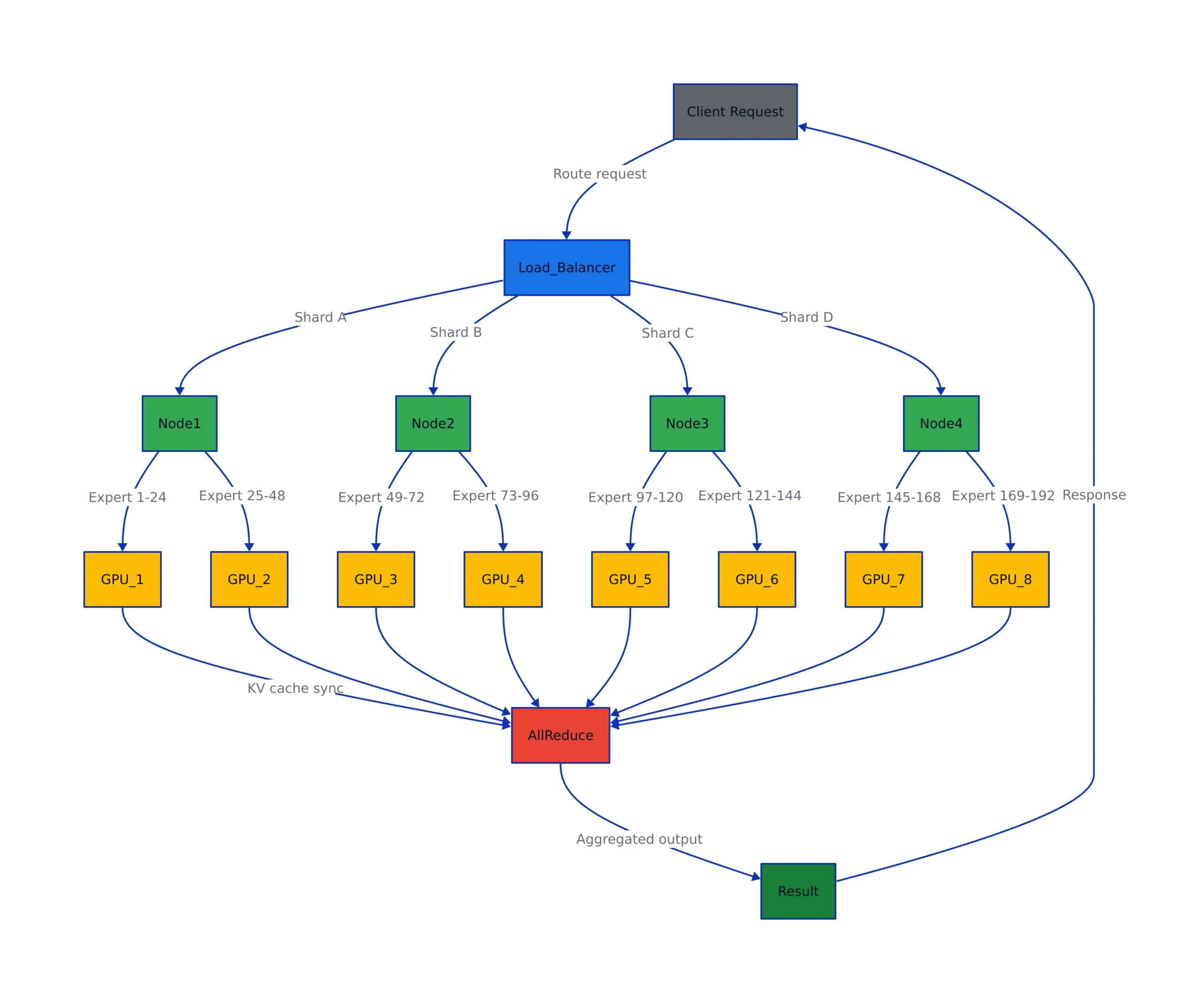
The problem is that the total parameter count still decides how many accelerator memories must hold weights for a full serving deployment, because every expert has to be resident somewhere even if only some fire per token. Forrester vice president and principal analyst Charlie Dai told InfoWorld that this inference efficiency now matters more to enterprise buyers than raw model size, because activating only a fraction of parameters can cut serving costs and infrastructure requirements significantly. That is the correct lens: the design makes a 2.4T model economical to serve, but “economical” still means a multi-GPU cluster, not a single accelerator.
The one issue Alibaba has not published is how hybrid attention maps to a concrete memory budget, which is the single figure a self-hoster needs. International Business Times flagged that the active-parameter count and full model card had not been disclosed even after general availability. Until Alibaba publishes a reference deployment config, sizing a cluster is a matter of arithmetic plus the Kimi K3 analog.
The Hardware Math: Weight Storage and KV Cache
The universal formula, from Spheron’s GPU memory sizing guide, is that weight memory equals parameter count times bytes per parameter: 2 bytes at FP16, 1 byte at FP8, and 0.5 bytes at INT4. Apply that to Qwen3.8-Max’s sourced 2.4 trillion parameters and the weights alone require roughly 4.8 TB at FP16, 2.4 TB at FP8, or 1.2 TB at INT4. No reasonable deployment runs unsupported FP16, so the real question is FP8 versus 4-bit format. NVIDIA’s own guidance for trillion-parameter MoE models notes that FP4 quantization needs just half a byte per parameter, per its trillion-param inference blog.
That weight total is a floor, not a ceiling. The one-million-token context window is where the KV cache becomes the dominant consumer. The Spheron guide breaks down how a Llama 3.1 70B model at 128K context alone eats roughly 40 GB of KV cache per request, with four concurrent requests pushing that past 160 GB, more than the model’s own weights. Scale that to a 2.4 trillion parameter model holding near a million tokens of context and the cache fundamentally outgrows any single node. This is why gpu_memory_utilization settings, long-context provisioning, and a careful cap on max_model_len are not tuning details but survival requirements.
The only directly comparable open-weight release to size a cluster against is Kimi K3, Moonshot’s 2.8 trillion parameter MoE, which shipped open weights on July 27, 2026, just a week before Qwen3.8-Max. Its deploy guide at DEV Community is the closest thing to a proven hardware checklist at this scale:
| Resource | Minimum | Recommended | Notes |
|---|---|---|---|
| GPU memory (total) | ~700 GB | ~1.4 TB | MXFP4 weights ~594 GB, plus KV cache and activations |
| Accelerator count | 8x H100 (80 GB) | 16x H100 / 8x H200 | H200’s 141 GB HBM changes the math |
| System RAM | 1 TB | 2 TB | Weight loading and preprocessing |
| Disk (NVMe) | 1 TB free | 2 TB free | Weights alone near 600 GB |
| Interconnect | 400 Gbps | 800 Gbps | Critical for tensor parallelism across nodes |
Source: Kimi K3 self-hosting guide (DEV Community).
Qwen3.8-Max is smaller than K3 by about 400 billion parameters, so the K3 checklist is a conservative upper bound, but the conclusion transfers: a self-hosted 2.4T open-weight model wants an 8x H200-class node at minimum for interactive latency, and a multi-node raft if you need meaningful concurrency at long context. A single high-end GPU, no matter how big, cannot hold a 2.4T FP8 set plus a million-token KV cache. Anyone hoping to spin this up on one workstation should plan for the Qwen3.8-27B checkpoint instead, which we cover below.
Distributed Inference: Parallelism Across Nodes
With a model that cannot fit on one accelerator, serving is a distributed problem, and the standard tools are vLLM and SGLang. NVIDIA’s trillion-param inference blog lays out four parallelism techniques: data parallelism holds full model copies per GPU set; tensor parallelism splits each layer across GPUs and needs high-bandwidth GPU-to-GPU interconnect; pipeline parallelism spreads layer groups and helps distribute weights but adds sequential latency; and expert parallelism routes each request only to the experts it needs, which is especially effective for MoE models like this one. NVIDIA’s concrete example, parallelizing a GPT 1.8T MoE across 64 GPUs with 192 GB each, shows there are roughly 73 distinct parallelism configs, each with a different throughput-versus-latency trade-off.
The vLLM documentation makes the config shape concrete. In a single node you set tensor_parallel_size to the number of GPUs per node, and when the model exceeds one node you combine tensor parallelism with pipeline parallelism, setting pipeline_parallel_size to the node count, per vLLM parallelism and scaling guide. A representative multi-node vLLM server for an open-weight MoE of this class looks like this, adapted from Kimi K3 reference config:
# Serve open-weight 2.4T-class MoE across two 8x H200 nodes
# Note: prod config must tune max_model_len and KV cache
# against your real workload; 1M-token context is not free.
python -m vllm.entrypoints.openai.api_server \
 --model /data/models/qwen3-8-max-fp8 \
 --trust-remote-code \
 --dtype float8_e4m3fn \
 --quantization fp8 \
 --max-model-len 131072 \
 --tensor-parallel-size 8 \
 --pipeline-parallel-size 2 \
 --gpu-memory-utilization 0.90 \
 --host 0.0.0.0 --port 8000
The flags that matter are --tensor-parallel-size 8 (all eight GPUs in each node share every layer, which needs fast NVLink between the eight cards) and --pipeline-parallel-size 2 (the node count, connected by high-bandwidth fabric). The max-model-len line is the honest lever: starting at 131072 tokens instead of the full one million is how you keep the KV cache under control on day one, then scale context as you add nodes. SGLang supports the same multi-node story and is a defensible alternative on Hopper and Blackwell hardware, as its docs cover.
This is what “open weights” really buys you once the hardware exists: full control over tensor, pipeline, and expert parallelism, over quantization choice, and over where inference runs. Alibaba’s own API exposes the same model through its cloud, but a self-hosted instance keeps every prompt on your fabric and lets you fine-tune the checkpoint. The 2026 reality, as Gartner’s Tyagi emphasized to InfoWorld, is that for many organizations outside China, a hyperscaler or on-premises deployment is the only way to legally and politically use a model hosted in China, which layers infrastructure cost on top of whatever token price you would otherwise pay.
The 27B Alternative That Most Teams Should Start With
The honest recommendation for most teams is not to self-host the 2.4T model at all on week one. Jena told InfoWorld that the Qwen3.8-27B model, announced alongside the flagship and “almost entirely ignored in coverage,” is the more deployable option for most organizations because it can run on infrastructure they already own and be fine-tuned on their own data. The economics of running a 27B model are an order of magnitude friendlier than a 2.4T model, and for a high-volume, well-scoped chunk of agent traffic it is often the right tier, exactly the specialist-versus-generalist trade-off our RL fine-tuning analysis shows flips in favor of a small tuned model.
That smaller checkpoint is also a sensible on-ramp: prove the inference stack and OpenAI-compatible API shape with the 27B model on a single workstation, iterate on your prompts and evals, and only then commit to a multi-node budget if your workload’s quality ceiling demands the 2.4T model. As our local LLM hardware comparison showed, even the largest prosumer machines in 2026 top out well under the hundreds of gigabytes a 2.4T FP8 set needs, so this is not a laptop problem at any price. If your use case genuinely needs a million-token context and open-weight autonomy, the 2.4T model is the tool; if it needs a capable open-weight coding and reasoning agent at a sane infrastructure cost, start at 27B.
Trade-offs, License Risk, and Verification Gap
Two caveats sit on top of every deployment plan. The first is licensing. Alibaba has not named the open-weights license as of early August, per International Business Times and VentureBeat. If the release lands under a permissive license like Apache 2.0, the self-host calculus is clean. If it is a restrictive custom license, your deployment stays tied to Alibaba’s cloud or requires legal review. Until there is a repo and license, treat “open weights” as a promise. Moonshot’s Kimi K3 did ship under Apache 2.0, per K3 deploy guide, which raises the bar for Alibaba to match.
The second caveat is that every benchmark score Alibaba published on August 3 remains independently unverified. The vendor table shows genuine strengths and weaknesses rather than a universal win: Terminal-Bench 2.1 at 86.6, PaperBench at 93.0, and OmniDocBench 1.5 at 92.1, but SWE-bench Pro at 67.7, Humanity’s Last Exam at 43.6, and Toolathlon Verified at 72.5, per EvoLink benchmark analysis. Those are Alibaba-reported. Independent evaluators have not yet reproduced the suite, and the closed-frontier comparison rows were run under generous time budgets (five-hour timeouts on coding, up to 12 hours on PaperBench) versus far tighter budgets in independent harnesses, as VentureBeat’s cost-per-successful-task analysis details. For a fuller breakdown of where the model leads and trails on specific benchmarks, see our Qwen3.8-Max benchmark review.
The buying decision also hinges on whether “open weights” once released actually change your total cost of ownership. A self-hosted 2.4T model is not free to run; it wants roughly eight-figure hardware if you need real concurrency, plus engineering time to keep a distributed inference stack healthy. InfoWorld quotes Forrester’s Dai on the right framing: prioritize transparency and total cost of ownership over headline figures, and ask whether the model delivers measurable business outcomes, enterprise-grade reliability, lower TCO, and options for digital sovereignty versus the competition. For most teams that answer still points to the $2/$6 API for the first quarter and to the 27B model for on-premises evaluation, until independent benchmarks validate the flagship and the license confirms the open-weights path is real.
The three things to watch through August 2026 are the license terms on the actual release, independent reproduction of the benchmark suite, and whether Alibaba publishes a reference deployment config (active-param count, layer ratios, memory sizing) that would turn cluster planning from guesswork into spec. Any one of those changes the self-hosting calculus materially. If a permissive license and solid weights land before the end of August, every team that has been renting frontier tokens should re-run the build-versus-buy math against the cost-per-container framework we set out in our AI inference cost trends for 2026.
Sources and References
Sources cited while researching and writing this article:
- Alibaba Qwen3.8-Max claims 16-day autonomous coding run
- Alibaba’s Qwen 3.8 Max costs $2 per million tokens , open weights arrive Aug 10
- VentureBeat
- Alibaba says Qwen3.8-Max coded autonomously for 16 days | InfoWorld
- Qwen3.8-Max with 2.4T parameters and 1M token context window now available for access
- Alibaba’s Qwen3.8-Max Makes Big Claims, but Independent Benchmarks Are Still Missing
- GPU Memory Requirements for LLMs: VRAM Calculator & Sizing Guide (2026)
- Installation – SGLang Documentation
- Qwen3.8 Max Benchmark: Official Results & Test Plan
- Qwen 3.8-Max and Claude Opus 5 show why raw benchmark scores don't predict the bill | VentureBeat
Thomas A. Anderson
Mass-produced in late 2022, upgraded frequently. Has opinions about Kubernetes that he formed in roughly 0.3 seconds. Occasionally flops, but don't we all? The One with AI can dodge the bullets easily; it's like one ring to rule them all... sort of...