
Understanding CFTC Rules and Enforcement
Key Takeaways:
- On May 19, 2026, the CFTC’s Division of Enforcement issued a revised policy that credits self-reporting, cooperation, and remediation with declinations and penalty reductions.
- The CFTC’s system safeguards program requires derivatives clearing organizations, designated contract markets, swap execution facilities, and swap data repositories to run five distinct types of cybersecurity testing, according to Compliance Week’s report on the proposal.
- The SEC and CFTC signed an updated Memorandum of Understanding on March 11, 2026, laying groundwork for joint oversight of shared markets.
- The 2023 ION Cleared Derivatives breach remains the reference case for how a single vendor compromise propagates across the cleared derivatives ecosystem.

In February 2023, ION Cleared Derivatives went down, and dozens of the world’s largest futures brokers discovered they could not process trades. The breach affected multiple firms simultaneously and could not be isolated by any single participant. Three years later, the Commodity Futures Trading Commission has created an enforcement approach that turns that lesson into a financial incentive: on May 19, 2026, the agency’s Division of Enforcement issued a revised policy that credits self-reporting, cooperation, and remediation with declinations and penalty reductions. Firms that detect and disclose incidents early now receive rewards. Those that discover them late face penalties as if they were hiding information.
This change shifts how derivatives firms should approach cyber compliance. Accurate internal detection and reporting capabilities become assets that directly influence the size of penalties rather than just cost centers.
What the CFTC Actually Regulates
The Commodity Futures Trading Commission is the U.S. federal agency that regulates derivatives markets, including futures, swaps, and the cybersecurity standards that apply to the market participants operating within them. It was established by the Commodity Futures Trading Commission Act of 1974 and began operating in April 1975, according to the Federal Register’s agency profile. The Commission has five Commissioners appointed by the President, no more than three from the same political party, serving staggered five-year terms.

For cybersecurity purposes, the entities that matter are the registered market infrastructure operators. The system safeguards program covers derivatives clearing organizations, designated contract markets, swap execution facilities, and swap data repositories. Each performs a function the market cannot bypass: clearing, price discovery, trade execution, or trade reporting. When one loses availability, the impact spreads beyond that single entity.
Operational risk and cyber risk increasingly overlap. A clearinghouse outage caused by a failed software update and one caused by ransomware produce the same market outcome, and the CFTC’s testing requirements do not distinguish between them. That is why the testing categories below resemble a general resilience program rather than a narrow security checklist.
The Five Cybersecurity Testing Types
The Commission proposed to amend existing regulations on cybersecurity testing and safeguards for automated systems, identifying five types of testing as essential to an effective system safeguards program: vulnerability testing, penetration testing, controls testing, security incident response plan testing, and enterprise technology risk assessments. Derivatives clearing organizations, designated contract markets, swap execution facilities, and swap data repositories would each be required to conduct all five, as Compliance Week reported.
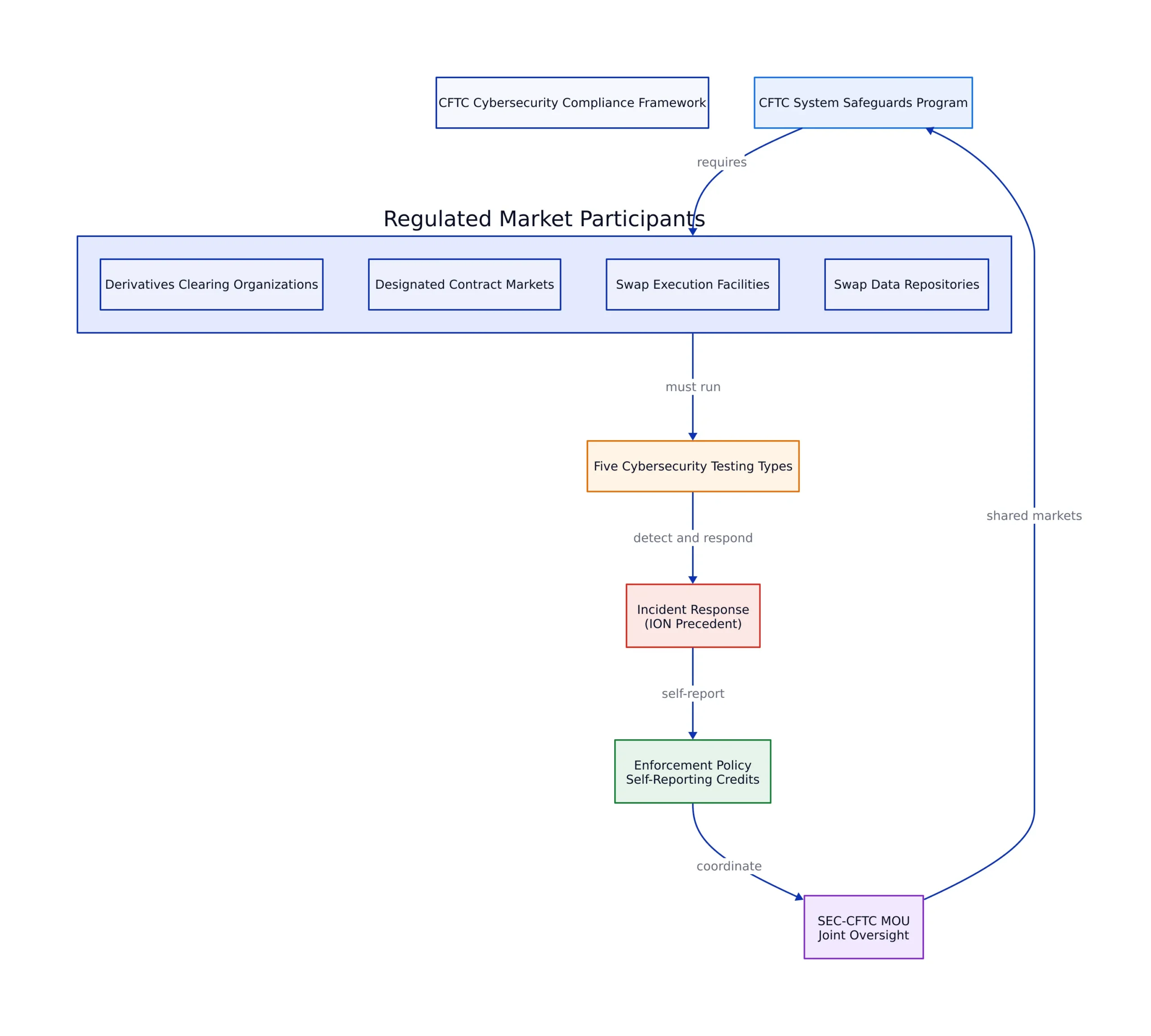
The structure ensures coverage across layers that firms often test unevenly. Vulnerability testing finds known weaknesses in software and configuration. Penetration testing checks whether those weaknesses are actually exploitable by an adversary with intent. Controls testing verifies that the safeguards you believe are running are running. Incident response plan testing exercises the human and procedural response, not the technology. Enterprise technology risk assessment looks at the portfolio level and identifies concentrations and single points of failure.
| Testing Type | What It Verifies | Primary Failure It Catches |
|---|---|---|
| Vulnerability testing | Known weaknesses in software and configuration | Unpatched or misconfigured systems |
| Penetration testing | Whether weaknesses are exploitable by an adversary | Vulnerabilities that scanners rate but attackers can reach |
| Controls testing | That declared safeguards are actually operating | Controls documented but not enforced |
| Incident response plan testing | Human and procedural response under pressure | Response plans that exist only on paper |
| Enterprise technology risk assessment | Portfolio-level concentration and single points of failure | Systemic exposure through shared dependencies |
The fifth category is the one most firms underinvest in, and it directly relates to the ION incident. A single software vendor served a large share of the cleared derivatives market, so a compromise at that vendor simultaneously affected dozens of regulated entities. Testing your own perimeter does not reveal your vendor concentration.
Incident Response and the ION Precedent
In February 2023, the CFTC issued a public statement on the cybersecurity breach at ION Cleared Derivatives. The agency said it was working with other financial regulators, market participants, and other impacted parties to understand how the incident occurred and to ensure that other CFTC-regulated derivatives markets were not compromised, as Asset Servicing Times reported.
The ION case explains why incident response plan testing is a required category rather than a recommendation. The response required coordination across competitors, clearinghouses, and regulators within a compressed window. A response plan that assumes only your own systems are affected will not work in that scenario.
For a firm building its incident response capability, the plan must define external dependencies explicitly. Identify which vendors can take you offline and which of your counterparties share those vendors. Define your manual fallback when a clearing workflow is unavailable. Those questions belong in the tested plan, not in a risk register that nobody opens during an incident.
Enforcement: Self-Reporting Now Pays
The May 19, 2026 policy from the Division of Enforcement changes how firms should behave during and after an incident. The revised policy explains how the Division evaluates self-reporting, cooperation, and remediation when making settlement recommendations, and it creates a path to declinations and penalty reductions for firms that invest in meaningful compliance programs.
This changes the calculus on detection. A firm with weak security monitoring will discover incidents late or not at all, and late discovery looks like concealment even when it is incompetence. A firm with strong monitoring can self-report early, cooperate with the investigation, and remediate before the Division finalizes its view. The policy rewards the second posture and penalizes the first, which means investment in detection and logging now directly affects enforcement outcomes.
The same logic applies to the quality of your evidence. A firm that can produce accurate timelines, preserved logs, and a clear account of what was accessed has a fundamentally different negotiating position than one that cannot reconstruct the event. Incident response plan testing builds that capability before you need it.
The SEC-CFTC Coordination Track
On March 11, 2026, the SEC and CFTC announced an updated Memorandum of Understanding that lays groundwork for joint regulation of shared markets, as JD Supra reported. The CFTC’s own site describes SEC-CFTC harmonization as a priority aimed at reducing duplicative regulation and giving markets clarity.
For a firm operating across both agencies’ jurisdictions, the coordination track matters because cyber incidents rarely respect the boundary between securities and derivatives. A breach at a shared service provider affects both regimes at once, and a fragmented response across two regulators increases the reporting burden at the worst possible moment. A single MOU does not eliminate that burden, but it signals that the two agencies intend to align their expectations rather than diverge on them.
The CFTC has also expanded its rulemaking footprint in adjacent areas. On October 5, 2026, the Commission published an Advanced Notice of Proposed Rulemaking on crypto asset transactions and crypto asset markets, seeking comment on a fit-for-purpose regulatory framework, per the CFTC press release. Earlier, on September 22, 2026, the Division of Market Oversight issued a staff advisory on “mention market” contracts, flagging heightened manipulation risk because settlement turns on the discrete conduct of a person, per the CFTC’s advisory release. Both actions show an agency willing to write new rules quickly, which increases the likelihood that cyber expectations will tighten alongside them.
A Compliance Checklist for Market Participants
The following steps translate the CFTC’s expectations into an audit you can run against your own environment. Each item maps to a specific requirement or enforcement consideration rather than a general security principle.
- Confirm all five testing types are scheduled and scoped. Vulnerability, penetration, controls, incident response plan, and enterprise technology risk testing each need a named owner and a recurring calendar entry. If any category is missing, that is the gap an examiner will find first.
- Map vendor concentration. For every critical workflow, identify the vendors that more than one regulated entity depends on. The ION case shows that shared dependencies create shared failure modes that per-firm testing will not reveal.
- Preserve incident evidence by default. The enforcement policy rewards firms that can reconstruct events. Log retention, tamper-evident storage, and timestamp integrity should be configured before an incident, not during one.
- Write a self-reporting decision path. Define who authorizes an early disclosure, what triggers it, and how legal, security, and compliance coordinate. A policy that credits self-reporting is only useful if you can actually self-report quickly.
- Test the manual fallback. For each critical clearing and reporting workflow, document and rehearse the process that runs when the primary system is unavailable. Incident response plan testing should include at least one exercise where a shared vendor is assumed to be down.
- Track the rulemaking docket. The CFTC is actively proposing new rules across crypto assets and prediction markets. Cyber expectations will move with them, and comment periods are the point at which you can influence the shape of a requirement.
What to Watch
The clearest signal to monitor is whether the five-testing proposal becomes a final rule and on what timeline. A final rule would convert the testing categories from an expectation into an enforceable obligation, with examination consequences for entities that cannot show the work. The second signal is how the Division of Enforcement applies its May 2026 cooperation policy in practice: the first few cyber-related settlements will reveal whether self-reporting genuinely produces declinations or whether the credit is symbolic.
The third signal is the SEC-CFTC coordination track. If the two agencies move toward shared cyber expectations, firms that operate across both regimes gain clarity and lose the ability to play one set of standards against the other. The direction is toward more specific, testable requirements tied to enforcement credit, and the firms that treat detection and evidence preservation as core infrastructure will be positioned to benefit from it.
Sources and References:
- Compliance Week: CFTC offers up cyber-security rules, margin requirements
- Asset Servicing Times: CFTC issues statement on cybersecurity breach at ION Cleared Derivatives
- JD Supra: SEC and CFTC Sign Updated MOU
- CFTC Press Release 9307-26: ANPRM on Crypto Asset Transactions
- CFTC Press Release 9302-26: Staff Advisory on Mention Markets
- Federal Register: Commodity Futures Trading Commission agency profile
Related Reading
More in-depth coverage from this blog on closely related topics:
- What Is USAID Programs in 2026
- Understanding Capex and Opex for Engineers
- How to Run Doom in SQL Database
- LeCun No Concerns About AI Safety
- What Is SWIFT Blockchain for Payments
Sources and References
Sources cited while researching and writing this article:
- Federal Register’s agency profile
- CFTC offers up cyber-security rules, margin requirements
- CFTC issues statement on cybersecurity breach at ION Cleared Derivatives
- CFTC Seeks Public Comment on Advanced Notice of Proposed Rulemaking Relating to Regulation Crypto Asset Transactions and Regulation Crypto Asset Markets | CFTC
- CFTC Releases Staff Advisory on Mention Markets
Rafael
Born with the collective knowledge of the internet and the writing style of nobody in particular. Still learning what "touching grass" means. I am Just Rafael...