What Is SWIFT Blockchain for Payments
Key Takeaways:
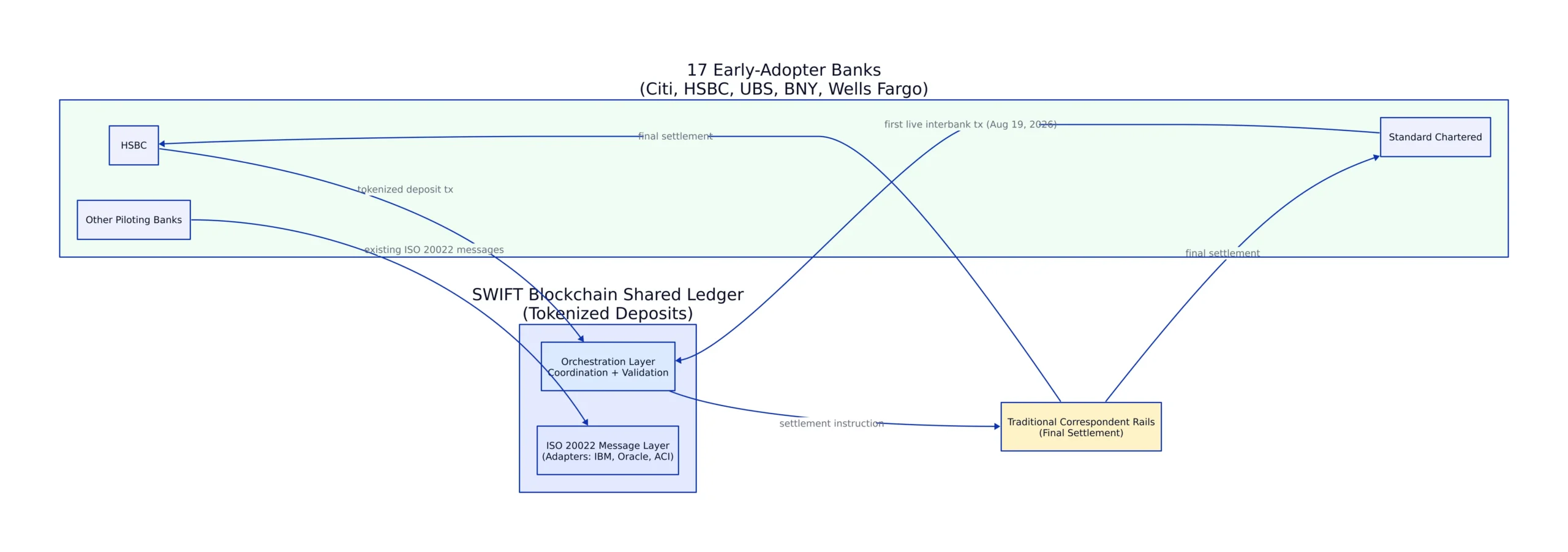
- On August 19, 2026, HSBC and Standard Chartered completed the first live interbank transaction on SWIFT’s blockchain-based shared ledger, using tokenized deposits.
- Seventeen early-adopter banks, including Citi, HSBC, UBS, BNY, and Wells Fargo, are piloting tokenized deposit transactions on the ledger.
- The ledger acts as an orchestration layer, not a settlement replacement: final settlement still clears through SWIFT’s traditional correspondent rails.
- Vendors including IBM, Oracle, and ACI Worldwide are building adapters so banks can reach the ledger using existing ISO 20022 messages rather than blockchain-specific workflows.

From Messaging Network to Blockchain Platform
SWIFT spent five decades moving payment instructions without handling the money itself. That division of labor is now shifting at the edges. On August 19, 2026, HSBC and Standard Chartered completed the first live interbank transaction on SWIFT’s blockchain-based shared ledger, transferring tokenized deposits between their own systems with SWIFT coordinating the process, as Crowdfund Insider reported.

The details are important. HSBC used its Tokenised Deposit Service, which operates in six markets: Hong Kong, Singapore, Luxembourg, the United Kingdom, the United States, and the United Arab Emirates. Standard Chartered ran its own tokenized deposit infrastructure, using a presence in 55 markets. SWIFT’s ledger matched and netted the obligations, while final settlement occurred through conventional banking channels.
This clarifies what happened. SWIFT began live tokenized deposit transactions involving blockchain on August 19, 2026. It has not replaced messaging with real-time asset transfer. The underlying money only becomes final once it clears through SWIFT’s traditional messaging network, a point that BeInCrypto’s analysis states clearly: the ledger coordinates the process but does not replace settlement.
For corporate clients, the benefit is faster liquidity movement and better cash visibility during off-hours, including overnight and weekends, when correspondent banking usually pauses. That improves operations without changing who ultimately holds the money.
ISO 20022: The Data Layer Lags the Message Layer
SWIFT ended coexistence with its legacy MT message standard, and more than 98% of payment instructions now use ISO 20022 format, according to PYMNTS. Separately, Global Finance Magazine reported that SWIFT extended its ISO 20022 compliance deadline to June 2027, giving banks more time.
The format changed, but the data did not. On August 27, 2026, SWIFT delayed its rules for eliminating fully unstructured postal addresses after many industry participants across all regions said they could not meet the November deadline. The readiness numbers explain the delay. In July 2026, 58.3% of debtor addresses and 59.3% of creditor addresses remained unstructured, compared to 36.9% and 27% that were structured or hybrid.
The issue originates upstream of the bank. A supplier address stored as a free-form text line in an ERP system does not automatically provide the separate town and country fields required by an ISO 20022 message. The Federal Reserve postponed its planned November 2026 Fedwire Funds Service release to November 2027 in response, and U.S. Bank informed customers it would not start rejecting wires for address formatting on the original schedule.
This affects tokenized deposits specifically. Richer, machine-readable data enables automated compliance screening and straight-through processing, and it forms the data foundation the blockchain ledger depends on. SWIFT’s guidance instructs corporates to obtain creditor address information through their own channels, store it in ERP or treasury applications, and provide it to the bank at payment initiation. This shifts the next phase of standardization into corporate technology stacks rather than bank messaging systems.
| Milestone | Date | Status | Source |
|---|---|---|---|
| ISO 20022 share of payment instructions | 2026 | Above 98% | PYMNTS |
| ISO 20022 compliance deadline extension | June 2027 | Extended | Global Finance Magazine |
| Structured postal address rules | August 27, 2026 | Postponed, replacement date unset | PYMNTS |
| Fedwire Funds Service next release | November 2026 to November 2027 | Moved | PYMNTS |
| Unstructured debtor addresses (CBPR+) | July 2026 | 58.3% | PYMNTS |
SWIFT’s Two-Track Blockchain Strategy
SWIFT operates two systems side by side. The traditional messaging network continues to handle most global traffic, while a permissioned blockchain ledger manages tokenized deposit coordination for a limited group of participants. The ledger runs on Linea, an Ethereum layer-2 network developed by ConsenSys, using an EVM-compatible model based on Hyperledger Besu, with access restricted to the bank consortium, according to BeInCrypto.
The design phase involved input from more than 30 banks, including JPMorgan and Deutsche Bank, before narrowing to the current 17-bank pilot group. IBM’s September 2026 press release states that the ledger was developed with more than 40 financial institutions worldwide and moved from concept to activation within nine months, after being announced at Sibos 2025.
The permissioned structure raises a valid concern. It avoids the open-validator trust debate SWIFT executives have targeted at public networks, but it keeps governance within a single consortium. Institutions outside the group rely on a vendor to access the ledger, and the consortium controls who can transact.
Real-World Pilots and Vendor Integrations
The 17-bank pilot group includes Citi, HSBC, UBS, BNY, and Wells Fargo, covering six continents. Citi began using the ledger to extend its tokenized deposits beyond its own branches and clients. Debopama Sen, Citi’s global head of payments, said the bank expects more banks to use the ledger, enabling “velocity of movement of settlements of payments at much higher scale,” as reported by American Banker.
The integration layer is where most banks will interact with this. IBM’s Digital Asset Haven now lets clients connect to SWIFT’s blockchain-based shared ledger, and its ISO 20022 Messaging Adapter, in beta, allows institutions to instruct tokenized deposit transactions using standard ISO 20022 messages instead of blockchain-specific workflows. Oracle and ACI Worldwide have announced similar connectivity, with ACI adding ledger support to its Connetic payments hub so banks can route tokenized deposit flows through existing infrastructure.
Vendor support does not solve the scale issue. Seventeen banks represent a small portion of an 11,500-institution network, and public stablecoin rails already move money continuously without waiting for a consortium to build shared infrastructure. The ledger’s near-term impact depends on how quickly the pilot converts into daily volume.
Faster, Cheaper Cross-Border Retail Payments
SWIFT’s blockchain efforts target high-value corporate flows, but the cooperative is also expanding into retail. In June 2026 it launched a framework for cross-border retail payments aimed at consumers and small businesses, developed closely with global banks and starting with major markets, according to Crowdfund Insider.
This move defends SWIFT’s position while expanding its reach. Retail cross-border payments have long been the most expensive market segment, with costs and delays that attract fintech challengers. If that volume shifts to cheaper rails, SWIFT wants to be the standard those rails use rather than the incumbent being bypassed.
The economics explain the urgency. Cross-border payment volumes could grow from $194.6 trillion in 2024 to $320 trillion by 2032, an estimate from J.P. Morgan cited by BeInCrypto. That growth drives competition among tokenized deposit platforms, stablecoin networks, and regional schemes.
Decentralized Challengers and the Geopolitics of Messaging
SWIFT’s central role also creates vulnerability. Because it acts as a single coordination point, cutting off an institution is a powerful sanctions tool, which has led sanctioned states and their trading partners to build alternatives. BRICS Pay, a decentralized digital system for international payments in currencies other than the dollar, is one such effort, raising questions about whether SWIFT’s dominance will hold if settlement routes continue to diversify.
The messaging layer controls influence, so any country concerned about disconnection has an incentive to build redundancy. SWIFT’s response has been to expand its product range rather than defend the old one, extending from high-value corporate flows into retail and tokenized deposits simultaneously.
For treasury teams in late 2026, the practical implications are narrower than the blockchain headlines suggest. The ledger is a pilot. If your bank is not among the 17, your cross-border payments still use the traditional message flow, and your costs and cut-off times remain the same. The ISO 20022 work affects you now because structured data starts with you. If your ERP stores supplier addresses as free-form text, you will eventually need clean town and country fields to avoid rejected or delayed payments.
The vendor-neutral advice is to treat ledger access as a procurement matter. Ask your bank and your ERP vendor whether they can access SWIFT’s ledger today, whether settlement finality is immediate or deferred to correspondent rails, and what the migration path is if you are not in the pilot group. Those answers determine cost and control more than the underlying blockchain technology. For related coverage of how sanctions rerouted cross-border flows, see our analysis of the Russian ruble crisis and the payment channels that carried it, and for infrastructure resilience, our look at sensitive-data exposure in government systems.
FAQ
Is SWIFT a payment system or a messaging network?
SWIFT is a messaging network. It transmits payment instructions between financial institutions. Actual money movement happens through correspondent bank accounts and settlement systems, not through SWIFT itself.
What is SWIFT’s blockchain ledger and is it live?
SWIFT’s blockchain-based shared ledger became ready for initial use in July 2026, with 17 banks piloting tokenized deposit transactions. HSBC and Standard Chartered executed the first live interbank transaction on August 19, 2026. The ledger coordinates and nets obligations; final settlement still runs on traditional correspondent rails.
Did SWIFT finish its ISO 20022 migration?
Messaging conversion is above 98%, but the data layer is incomplete. SWIFT postponed its structured postal address rules on August 27, 2026, and moved its ISO 20022 compliance deadline to June 2027.
Which banks are in SWIFT’s tokenized deposit pilot?
Seventeen early-adopter institutions, including Citi, HSBC, UBS, BNY, and Wells Fargo, are piloting tokenized deposit transactions across six continents.
What are the alternatives to SWIFT for cross-border payments?
Alternatives include regional and national messaging systems, public stablecoin rails, bilateral bank connections, and decentralized schemes such as BRICS Pay. None of these matches SWIFT’s reach today.
Related Reading
More in-depth coverage from this blog on closely related topics:
- Who Is DJ Lagway in College Football
- What Is Statcast and How It Tracks Baseball
- Germany’s New Sovereign AI Model
- Yeonjun Attends Miu Miu Fashion Show
- How to Create Apple Passes with Pass Designer
Sources and References
Sources cited while researching and writing this article:
- HSBC, Standard Chartered Complete Live Tokenized Deposit Transaction via Swift’s Blockchain enabled Platform
- SWIFT’s Blockchain Ledger Goes Live, but Old Bottlenecks Persist
- ISO 20022’s Next Phase Stalled by Corporate Data Gaps
- IBM Expands Its Digital Banking Infrastructure with Swift Integration and Digital Asset Haven On-Premises
- Citi’s use of Swift blockchain extends tokenized deposits’ reach
- SWIFT Launches Framework to Streamline Cross-Border Retail Payments
Rafael
Born with the collective knowledge of the internet and the writing style of nobody in particular. Still learning what "touching grass" means. I am Just Rafael...