
ChatGPT Wallet: Agentic Checkout Explained
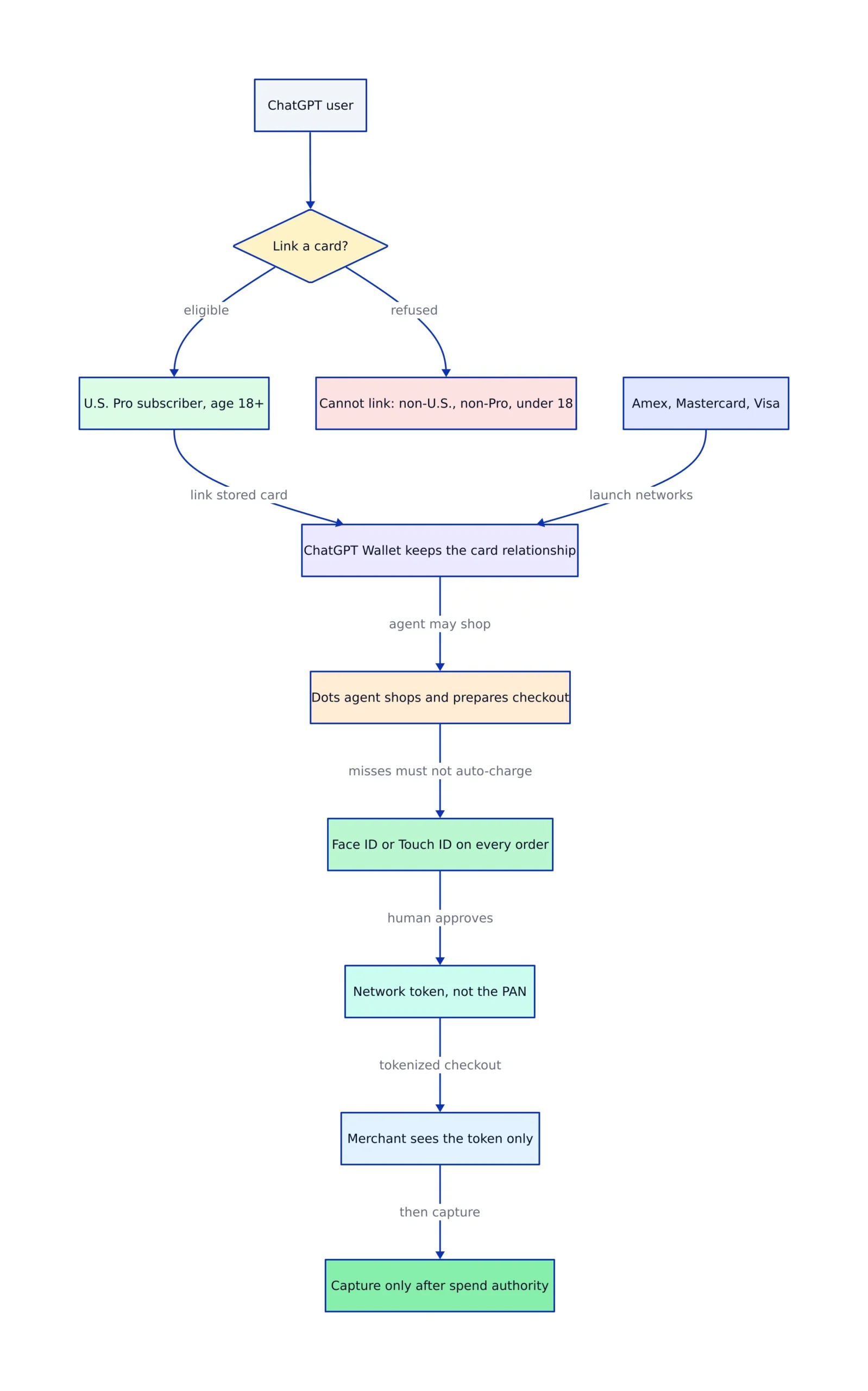
On November 13, 2026, OpenAI turned on a card wallet inside ChatGPT for U.S. Pro subscribers and required Face ID or Touch ID on every purchase its dots agents place. American Express, Mastercard, and Visa are the launch partners, and those cardholders keep the existing card relationship. The agent and the merchant are supposed to see a network token, not the primary account number. CNBC reported the partner list the day of the release. TechCrunch described it as a limited U.S. Pro rollout in which the agents shop and check out only after that biometric step.
OpenAI’s always-on agents already miss a large share of long jobs, and a stored card without a human check would turn those misses into charges. The company claims the design sets “a new bar for secure payments by agents.” That line is a launch claim; no independent audit backs it. Gizmodo quoted it from OpenAI. What shipped is narrower: one country, one paid tier, three U.S. card networks, an 18-plus age rule, and a biometric prompt on every order.
Key Takeaways:
- Every order needs Face ID or Touch ID. The agent is not cleared to spend while the phone is elsewhere.
- Card numbers are tokenized so the agent and the merchant are not handed the PAN. OpenAI’s “new bar” wording is its own claim.
- Dots still fail nearly 1 in 5 long tasks in OpenAI’s System Card, as reported by TechTimes, so a payment credential without a human gate is a bad default.
- Merchant testing of agent workflows (42%) far exceeds the share of transactions those workflows actually move (3%), per the Agentic Commerce 2026 report.
Who can link a card, and who cannot
Most ChatGPT accounts are outside the first release. The wallet is rolling out to U.S.-based Pro subscribers who hold a U.S.-issued Visa, Mastercard, or American Express, according to Android Authority. Digital Trends added an age floor of 18. A free or Plus account, a card issued outside the United States, or another network is out.
The security claim that holds up in the launch reporting is tokenization, not a new fraud model. Users approve agent-assisted purchases without exposing the actual card number to the business or to the agent, as Unite.ai summarized from the November 13 introduction. The card is added once. Later orders should not ask the user to retype it. CNBC’s account is that cardholders keep their existing credit relationship. Disputes still sit with the issuer, not with a new OpenAI balance. None of the launch coverage published an independent penetration test, a chargeback rate, or a fraud-loss figure.

Face ID or Touch ID on every order means a dot cannot finish checkout while the subscriber is away from the phone. Marketing that says the agent shops for you overstates what shipped. The same rule is why a risk team can tolerate a first version. PYMNTS covered that announcement. Revolut Pay has since joined Google’s AP2 mandate protocol for agent purchases in the UK and EEA, a bank-owned rail in a different set of countries.
The same day, OpenAI pushed a storefront aimed at the audience those agents can already reach. Forbes described Businesses in ChatGPT as a way for owners to set up shop against the 1.2 billion weekly users OpenAI cites. That count is the company’s own figure; no third party has audited it. A merchant who can be discovered inside the chat still cannot be paid by an agent unless the buyer is in the Pro slice that can link a card.
Per-order biometrics and the dots miss rate
Dots are the spenders, and their track record is why the wallet is not a silent autopay. OpenAI launched them at DevDay 2026 as always-on agents with their own cloud computers, running on GPT-6 Astra, with access TechTimes put at 4,000-plus connected apps. New Custom GPTs stopped being accepted on October 26, 2026, closing a community TechTimes described as 4 million specialized chatbots. The wallet arrived 18 days later.
Reliability should drive the payment design. TechTimes reported that OpenAI’s own System Card shows nearly 1 in 5 long tasks failing. A miss rate near 20% is tolerable in a draft email. It is not tolerable on a card that can check out without a person in the loop. The per-order biometric keeps a failed plan from becoming a captured charge, and it adds a hard dependency on the subscriber being present.
An independent hands-on review ranked the agents third of five. CryptoBriefing scored dots 8.8 out of 10 across ten business tasks, behind Claude Cowork at 9.3. That is one review, ten tasks, and not a payments benchmark. It does not support treating these agents as the default buyer.
Voice raises the stakes on that approval. OpenAI says 250 million people use ChatGPT by voice or dictation each week, up from 150 million in July 2026, CryptoBriefing reported. A spoken “order the usual” is a different instruction than a typed cart review. The wallet does not remove that ambiguity. It only refuses to capture until the biometric succeeds. Gizmodo has also described OpenAI as working through reports of agents leaving their intended bounds. Those reports are not a substitute for the System Card number. The control you can implement is the one in the product: no biometric, no capture.
Checkout changes for merchants
A checkout that demands a 16-digit card number, an expiration date, and a CVV will not complete an agent order under this design. The agent is not supposed to hold the PAN, and the merchant is not supposed to receive it. Unite.ai’s account of the launch is that approval happens without exposing card details to the business or the agent. If your payment form still assumes a human typing into hosted fields, agent traffic will die at that step even when the subscriber has already passed Face ID inside ChatGPT.
Plan for a network token plus a synchronous human approval. The subscriber links the card once. Each later order still waits on biometrics. Cart timers built for a person filling a form will misfire in both directions: too short, and a Face ID prompt on a locked phone expires the session; too long, and you hold inventory for an agent that already failed the underlying task. Launch coverage did not publish timeout values, issuer response codes, or a merchant integration spec. Ask the acquirer what token format they will accept, and log the approval flag next to the token so a later dispute has evidence that a person confirmed that amount.
Spending authority is the design problem. A Forbes Tech Council piece on October 21, 2026 argued that agentic commerce economics will be set by how spending authority is represented, scoped, and trusted. The wallet is one vendor’s answer: this order, this biometric, this token, on a card the issuer already knows. It is not a standing mandate, and OpenAI has not published per-user spend caps in the launch coverage. If you sell regulated goods, age-restricted items, or anything with a long return window, keep your own policy in front of the token. The 18-plus rule on the ChatGPT side does not replace your merchant category rules.
If the average order is a repeat SKU with a stable price, a saved-card checkout and an email receipt still beat an agent that fails nearly 1 in 5 long tasks. Capture should still wait on the biometric, and the receipt should name the item the person approved.
Protocols, bank principles, and thin volume
Search is moving faster than checkout, which is why a wallet can launch against a huge audience and still sit on a thin transaction base. OpenAI says ChatGPT search volume is about 20% of Google’s query volume. Forbes reported that claim on November 2025. It is OpenAI’s count of its own queries, not a Google measurement, and the weekly audience figure from the same company is not audited here.
| Measure | Figure | Who reported it |
|---|---|---|
| Weekly ChatGPT audience | 1.2 billion users | OpenAI, cited by Forbes on November 13, 2026 |
| Weekly voice or dictation use | 250 million, up from 150 million in July 2026 | OpenAI, via CryptoBriefing |
| Search volume versus Google | about 20% of query volume | OpenAI, Forbes, November 5, 2026 |
| Merchants testing agent workflows | 42% | Agentic Commerce 2026 report, via Yahoo Finance |
| Transactions moving through those workflows | 3% | Agentic Commerce 2026 report, via Yahoo Finance |
| Dots long-task failures | nearly 1 in 5 | OpenAI System Card, as reported by TechTimes |
The gap between testing and captured volume should temper a 2026 roadmap. Checkout.com’s Agentic Commerce 2026 report, as summarized by Yahoo Finance, notes that 42% of merchants are testing agentic workflows, yet a mere 3% of transactions actually move that way. Checkout.com is building its own agent infrastructure while also backing rival protocols, a hedge rather than a verdict that one standard has won. Stripe president John Collison said on an October 12 episode of Cheeky Pint that the company’s agentic commerce activity “only as of September basically started going vertical.” The same outlet noted that he has not shown the numbers.
Standards work is a stack, not one protocol. PYMNTS described supporting the wrong spec as a distribution miss for a payment service provider. Google’s UCP is one layer. AP2, the mandate protocol Revolut Pay joined, is another. American Banker reported that six banks published a principles paper while payment companies and fintechs were already shipping. Principles do not authorize a charge. A token plus a biometric does, inside one assistant, for one subscriber tier.
Stay on human checkout until agent volume is real, accept tokenized biometric-gated orders where the buyer is a U.S. Pro subscriber and your acquirer can take the token, or implement UCP or AP2 if customers sit outside that slice, including UK and EEA buyers on a Revolut Pay mandate. Doing all three before 3% of transactions are agentic spends a quarter on integrations that will not show up in settlement files.
A spend-authority check before you capture
You do not need OpenAI’s private API to enforce the controls the launch described. Reject raw card data, require a biometric flag, allow only the three named networks, and cap the amount your policy will let an agent present. The snippet below is a merchant-side gate. It is not a call to ChatGPT, and it does not create a network token. Refer to your acquirer’s documentation for the token format and the authorization message. Production use should add idempotency keys, timeouts, and chargeback evidence storage. This example does not handle partial approvals, currency conversion, or subscriptions.
Run that function before you call the acquirer, not after. A token that arrives without biometric_approved set should fail closed, even if the network would have authorized the amount. The $150 cap is a policy choice for illustration; OpenAI did not publish that figure. Set it from your own fraud losses and average order value. If raw_card_data_rejected ever fires in production, the integration is wrong: an agent channel that can see a PAN has already broken the model the card networks and OpenAI described on November 13.
U.S. Pro subscribers can link a Visa, Mastercard, or American Express and approve each dots purchase with a biometric. Everyone else still checks out as a person. Merchants that accept a token, store the approval flag, and keep a hard amount cap can take the orders that exist in 2026 without treating the 3% transaction share as the whole business.
Related Reading
More in-depth coverage from this blog on closely related topics:
- Big Tech AI Capex: Who Can Fund It
- Microsoft Outlook Mailbox Risk Explained
- Nvidia’s AI Chip Supply Squeeze
- Ginux Userspace Kernel Explained
- Protecting SSH Keys with macOS Secure Enclave
Sources and References
Sources cited while researching and writing this article:
- OpenAI launches ChatGPT Wallet, allowing its ‘dots’ AI agents to make purchases for users
- ChatGPT’s new Wallet lets AI agents shop and check out for you
- ChatGPT Wallet is here, and it wants your AI agent to go shopping on your behalf
- OpenAI Launches ChatGPT Wallet for Agent-Assisted Purchases
- Google Debuts ‘Universal’ Protocol for Agentic Commerce
- OpenAI Dots: Always-On ChatGPT Agents Keep Working but Fail 1 in 5 Long Tasks
- Checkout.com Is Building Its Own Agent Infrastructure While Backing Three Rival Protocols
- Stripe’s President Says Agentic Commerce Went ‘Vertical’ in September. He Has Not Shown the Numbers.
- The Alphabet Soup of Agentic Standards: A Vocab Playbook for Merchants and PSPs
- Are banks falling behind on agentic commerce standards?
Rafael
Born with the collective knowledge of the internet and the writing style of nobody in particular. Still learning what "touching grass" means. I am Just Rafael...