
CISA in 2026: Cybersecurity Leadership
Security professionals monitoring screens in cybersecurity operations center
CISA coordinates national cyber defense from operations centers that monitor threats across federal networks and critical infrastructure sectors.
CISA’s Role in Federal Cybersecurity Infrastructure
On July 16, 2026, CISA added three actively exploited vulnerabilities to its Known Exploited Vulnerabilities (KEV) catalog. One of them, CVE-2026-58644, is a critical SharePoint Server flaw with a CVSS score of 9.8 that involves deserialization of untrusted data, allowing an unauthorized attacker to execute code over the network. CISA’s SSVC data for this vulnerability flags the exploitation as active and automatable, with total technical impact. Federal agencies had until July 19 to apply mitigations per the agency’s BOD 26-04 directive. That is a three-day window for a vulnerability that allows unauthenticated remote code execution on every supported on-premises SharePoint version.
The Cybersecurity and Infrastructure Security Agency (CISA) is the U.S. federal agency charged with protecting the nation’s critical infrastructure and coordinating cybersecurity across all levels of government and the private sector. Established as part of the Department of Homeland Security, its mission spans three congressionally mandated areas: cybersecurity, infrastructure security, and emergency communications. As the agency’s official about page explains, CISA works with partners to defend against today’s threats and collaborate on building more secure and resilient infrastructure for the future.
The agency’s operational scope is broad. It manages the EINSTEIN intrusion detection system to monitor malicious activity on federal government networks. It provides incident response services to federal executive branch agencies and U.S.-based entities. It leads national efforts to understand, manage, and reduce risk to cyber and physical infrastructure. In 2023 and 2024 alone, more than 12,000 state, local, federal, and tribal entities received security support from the agency, according to data shared with StateTech Magazine.
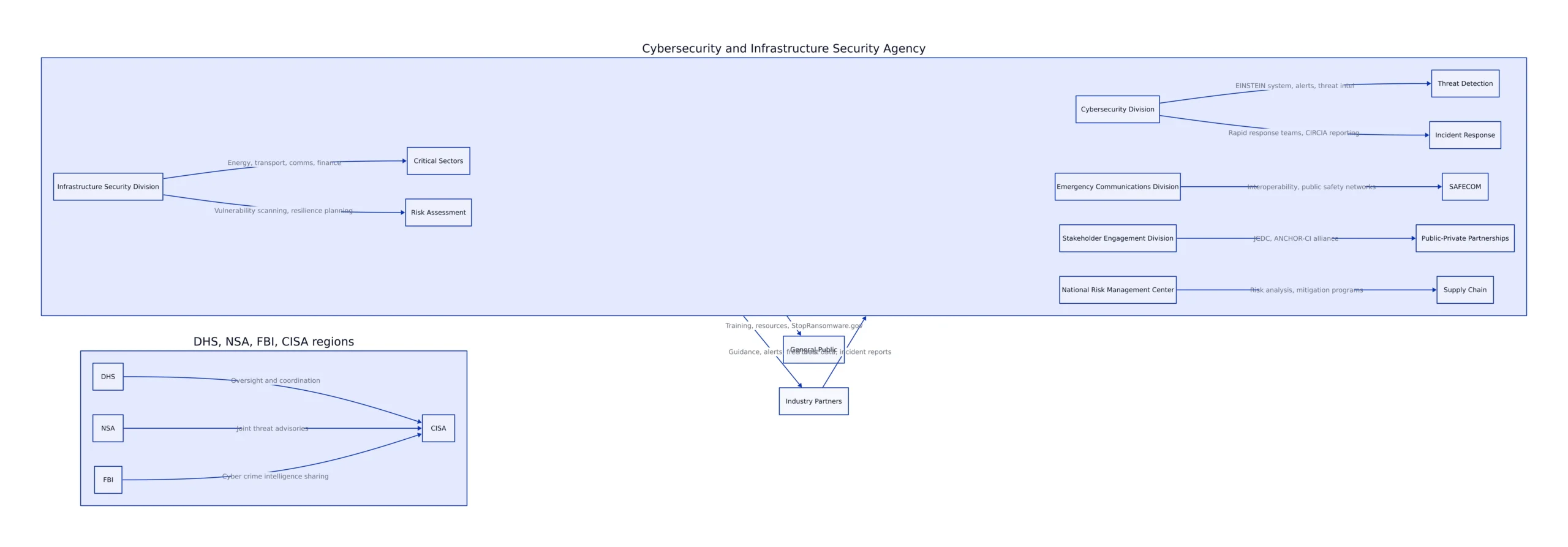

CISA’s organizational structure reflects the breadth of its mission. The Cybersecurity Division handles threat detection, incident response, and vulnerability management. The Infrastructure Security Division focuses on protecting critical sectors such as energy, transportation, communications, and financial services. The Emergency Communications Division ensures interoperability for public safety networks. The Stakeholder Engagement Division builds partnerships through initiatives like the Joint Cyber Defense Collaborative (JCDC) and the ANCHOR-CI alliance. The National Risk Management Center analyzes supply chain risks and coordinates cross-sector resilience planning.
The agency collaborates with the NSA on joint cybersecurity advisories, with the FBI on cyber crime intelligence sharing, and with international partners on cross-border threat response. Through its regional offices, CISA provides direct assistance to state and local governments, offering free cybersecurity services, training, and exercises.
CISA Initiatives and Programs in 2024-2026
The period from 2024 through mid-2026 has been one of the most active in CISA’s history, marked by new initiatives, strategic realignments, and operational updates that reflect the evolving threat landscape.
AI Cybersecurity Initiatives
Following the Biden administration’s executive order on artificial intelligence, CISA prepared a wave of AI-related initiatives. The agency hosted the federal government’s first tabletop exercise on AI cybersecurity incidents, bringing together more than 100 AI experts from government, industry, and international partners. These exercises contributed to the development of the AI Cybersecurity Collaboration Playbook, which provides guidance on voluntarily sharing cybersecurity incident information across the AI community, including providers, developers, and adopters.
Emergency Directives Retired
In a rare bulk closure, CISA retired 10 Emergency Directives issued between 2019 and 2024, signaling that the required actions had been completed or incorporated into standard operational procedures. This retirement marks a milestone in CISA’s vulnerability management lifecycle, showing how the agency transitions from emergency response to sustained security practices.
Threat Intelligence and Alerts
CISA has maintained an aggressive alerting cadence. On July 16, 2026 alone, the agency added three vulnerabilities to its KEV catalog: CVE-2026-58644 (SharePoint Server, CVSS 9.8), CVE-2026-25089 (Fortinet FortiSandbox), and CVE-2026-39808 (Fortinet FortiSandbox). Earlier in July, CISA warned of active exploitation of multiple SharePoint Server vulnerabilities including CVE-2026-32201, CVE-2026-45659, and CVE-2026-56164, urging organizations to harden on-premises instances. Joint advisories with the NSA and FBI have highlighted Russian state-sponsored cyber threat activity targeting routers and network devices across critical infrastructure sectors.
Strategic Alliances: ANCHOR-CI
CISA launched the Alliance of National Councils for Homeland Operational Resilience for Critical Infrastructure (ANCHOR-CI), a new advisory-body framework that replaces the Critical Infrastructure Partnership Advisory Council with a broader information-sharing structure. This initiative aims to strengthen partnerships across government and industry to secure the nation’s critical infrastructure.
Operational Modernization and Zero Trust
In June 2024, CISA released a new guide to assist federal agencies with transitioning to modernized Zero Trust architectures. This guidance aligns with the broader federal push toward eliminating implicit trust in network perimeters and adopting continuous verification models.
Insider Threat Guidance
CISA also released new insider threat guidance for critical infrastructure organizations, addressing both malicious acts and human error. The guidance emphasizes automation, organizational alignment, and a culture of security awareness as key components of an effective insider threat program.

CISA Certification: Industry Recognition and Career Impact
The Certified Information Systems Auditor (CISA) credential, administered by ISACA, is a global standard for professionals who audit, control, monitor, and assess information technology and business systems. According to the official ISACA page, the certification validates expertise in assessing vulnerabilities, reporting on compliance, and instituting controls within an enterprise.
Industry Recognition
CISA certification is widely recognized across government, consulting, and corporate sectors as a benchmark for IT audit proficiency. Organizations seeking to show compliance with frameworks such as NIST, ISO 27001, and COBIT frequently require or prefer CISA-certified professionals in audit and risk management roles. The credential’s global recognition carries weight across industries and borders, making it a strategic asset for professionals working with multinational organizations or federal contractors.
Career Impact
The career implications of earning CISA certification are substantial. Certified professionals typically command higher salaries and are prioritized for roles such as IT auditor, information security auditor, compliance officer, and risk manager. According to ISACA’s certification guides and industry salary surveys, CISA-certified individuals report earning premiums over non-certified peers, with the gap widening as organizations face increased regulatory scrutiny and compliance requirements.
Certification Requirements
Earning the CISA credential requires passing a comprehensive exam covering five domains: Information System Auditing Process, Governance and Management of IT, Information Systems Acquisition Development and Implementation, Information Systems Operations and Business Resilience, and Protection of Information Assets. Candidates must also meet minimum professional experience requirements and commit to continuing professional education to maintain the credential.
Relevance in 2026
As AI-driven threats, supply chain vulnerabilities, and complex regulatory landscapes reshape the cybersecurity profession, CISA certification remains highly relevant. The credential’s emphasis on audit, control frameworks, and governance aligns directly with the challenges organizations face in 2026: showing compliance, validating security controls, and providing assurance to stakeholders that systems are protected against sophisticated attacks. The CIRCIA final rule, expected by September 2026, will only increase demand for professionals who can audit and verify incident reporting processes.
CISA vs. CISSP vs. CISM: Choosing the Right Credential
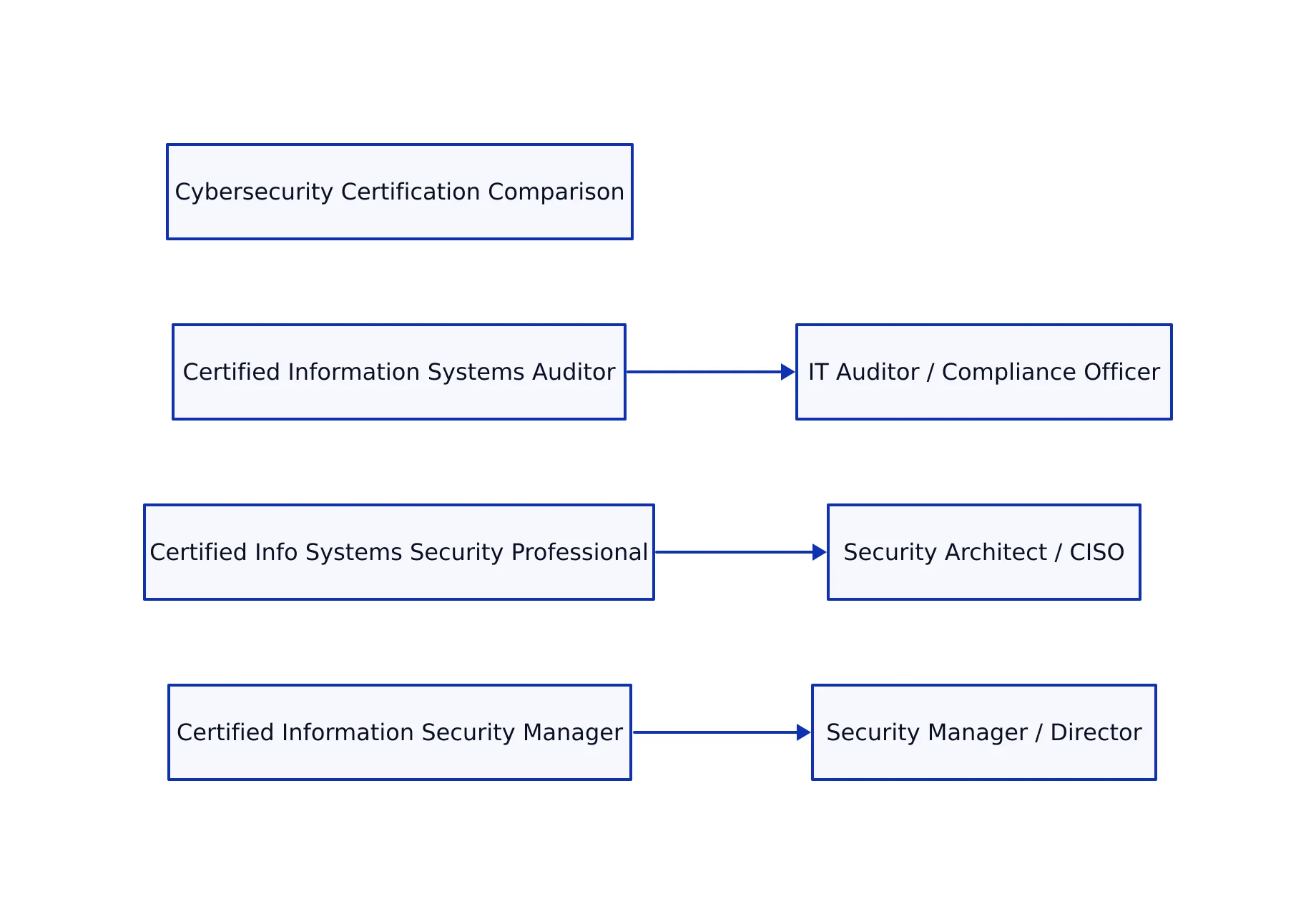
Cybersecurity professionals often face a choice among three premier certifications: CISA, CISSP (Certified Information Systems Security Professional), and CISM (Certified Information Security Manager). Each serves a distinct career path and validates a different skill set.
| Dimension | CISA | CISSP | CISM |
|---|---|---|---|
| Primary Focus | IT audit, control, and compliance | Security architecture and engineering | Security management and governance |
| Target Audience | Auditors, compliance officers, risk managers | Security architects, engineers, CISOs | Security managers, directors, senior leaders |
| Governing Body | ISACA | (ISC)2 | ISACA |
| Key Domains | Auditing, governance, risk management, incident response | Security design, cryptography, access management, network security | Security governance, program development, incident management, risk management |
| Typical Roles | IT Auditor, Compliance Analyst, Risk Manager | Security Architect, Security Engineer, CISO | Security Manager, Security Director, CISO |
| Experience Required | 5 years in IS audit, control, or security | 5 years in 2+ of 8 CISSP domains | 5 years in security management (3 years with waiver) |
When to Choose CISA
The CISA certification is the right choice for professionals who want to specialize in auditing, compliance, and control validation. It is particularly valuable for those working in regulated industries such as finance, healthcare, and government, where showing audit readiness is a core operational requirement. CISA-certified professionals are the ones who verify that security controls are working as intended and that organizations meet their regulatory obligations.
When to Choose CISSP
The CISSP certification is designed for security practitioners who build and design security systems. It covers a broader technical scope, including cryptography, network security, identity management, and security architecture. CISSP is often the preferred credential for security engineers, architects, and those aspiring to senior technical leadership roles.
When to Choose CISM
The CISM certification targets security managers and leaders who oversee security programs rather than implementing technical controls. It emphasizes governance, program development, and incident management from a strategic perspective. CISM is frequently pursued by professionals moving from technical roles into management.
Stacking Certifications
Many senior cybersecurity professionals hold multiple certifications. A common combination is CISA plus CISSP, which signals both audit expertise and technical depth. Another is CISA plus CISM, which covers both audit and management perspectives. The choice depends on career trajectory: audit and compliance roles benefit most from CISA, while leadership roles benefit from adding CISM.
Future Outlook for CISA and Critical Infrastructure Security
CISA’s role in national security is set to expand further as cyber threats grow in sophistication and the attack surface widens with AI adoption, IoT proliferation, and increasing connectivity of operational technology.

CIRCIA: The Mandatory Reporting Shift
The most significant regulatory development on the horizon is the Cyber Incident Reporting for Critical Infrastructure Act (CIRCIA) final rule, which CISA expects to finalize by September 2026, according to Nextgov/FCW. The rule requires critical infrastructure entities to report substantial incidents to CISA within 72 hours and ransomware payments within 24 hours. This marks a fundamental shift from CISA’s historical reliance on voluntary cooperation. The law grew out of post-SolarWinds and Colonial Pipeline concerns that voluntary reporting left the government blind to major incidents. Russia’s invasion of Ukraine added urgency by raising fears that geopolitical conflict could spill into attacks on U.S. critical infrastructure.
CISA published its first procedural notice for the rule in April 2024 and missed the statutory October 2025 final-rule deadline. A now-resolved DHS funding lapse this spring delayed stakeholder town halls. But as of July 2026, the final rule is on track for September publication, per a regulation document published last week. For cybersecurity professionals, this means the compliance landscape is about to shift dramatically. Organizations that have not yet built incident reporting workflows aligned to CISA’s requirements will need to move quickly.
AI and Emerging Technology Risks
CISA’s AI initiatives lay the groundwork for a more structured approach to AI security. The AI Cybersecurity Collaboration Playbook provides a framework for incident information sharing that could become a model for other technology domains. CISA’s participation in the TRAINS (Testing Risks of AI for National Security) taskforce, focused on testing advanced AI models across national security domains, signals the agency’s commitment to staying ahead of AI-enabled threats. However, the broader AI ecosystem has faced its own security challenges, including a friendly fire breach in NotebookLM and Gemini that exposed how even AI-powered tools from major vendors can be vulnerable to exploitation.
Leadership and Organizational Stability
CISA has experienced leadership transitions in 2024 and 2025, including the reassignment of acting director Madhu Gottumukkala to a DHS headquarters role and the appointment of Nicholas Andersen as acting director. As of 2026, the agency has operated for an extended period without a Senate-confirmed director, with reports indicating Tom Parker as a potential nominee. Leadership stability will be a key factor in the agency’s ability to execute its strategic vision.
Workforce Development
CISA’s investment in training and workforce programs addresses the persistent cybersecurity talent gap. The agency offers free cybersecurity training, exercises, and certification support, aiming to build a pipeline of skilled professionals capable of defending critical systems. These programs are particularly important as AI-augmented attacks demand new skills that traditional cybersecurity training may not cover.
The Bottom Line
CISA remains the central coordinating body for U.S. cybersecurity defense in 2026. Its initiatives in AI security, threat intelligence, public-private partnerships, and regulatory oversight position it to address the most significant challenges facing the nation’s digital and physical infrastructure. For cybersecurity professionals, understanding CISA’s mission and priorities is essential, whether they work in government, industry, or as certified auditors applying the CISA framework to their organizations.
Key Takeaways
- On July 16, 2026, CISA added three actively exploited vulnerabilities to its KEV catalog, including a critical SharePoint RCE (CVE-2026-58644, CVSS 9.8), giving federal agencies just three days to patch.
- CISA is the lead U.S. federal agency for critical infrastructure protection and cybersecurity coordination, managing systems like EINSTEIN and programs like JCDC and ANCHOR-CI.
- CIRCIA’s final rule is expected by September 2026, mandating 72-hour incident reporting and 24-hour ransomware payment reporting from critical infrastructure entities.
- The CISA certification (ISACA) remains the global standard for IT audit professionals, with strong career and salary premiums in compliance-driven roles.
- Compared to CISSP (engineering focus) and CISM (management focus), CISA specializes in audit, control, and governance, making it the right choice for compliance and assurance careers.

Related Reading
More in-depth coverage from this blog on closely related topics:
- Friendly Fire Breach in NotebookLM and Gemini
- Microsoft Comic Chat: Open Source History
- Alphabet’s 2026 AI Infrastructure Investment
- Why SQLite Should Adopt Rust-Style Editions
- How to Spot Fake USB 3.0 Hubs
Sources and References
Sources cited while researching and writing this article:
Rafael
Born with the collective knowledge of the internet and the writing style of nobody in particular. Still learning what "touching grass" means. I am Just Rafael...