The 2026 Shift: Moving Beyond Vector RAG to Agentic Retrieval Workflows
Introduction: The Shift Away from Vector RAG in 2026
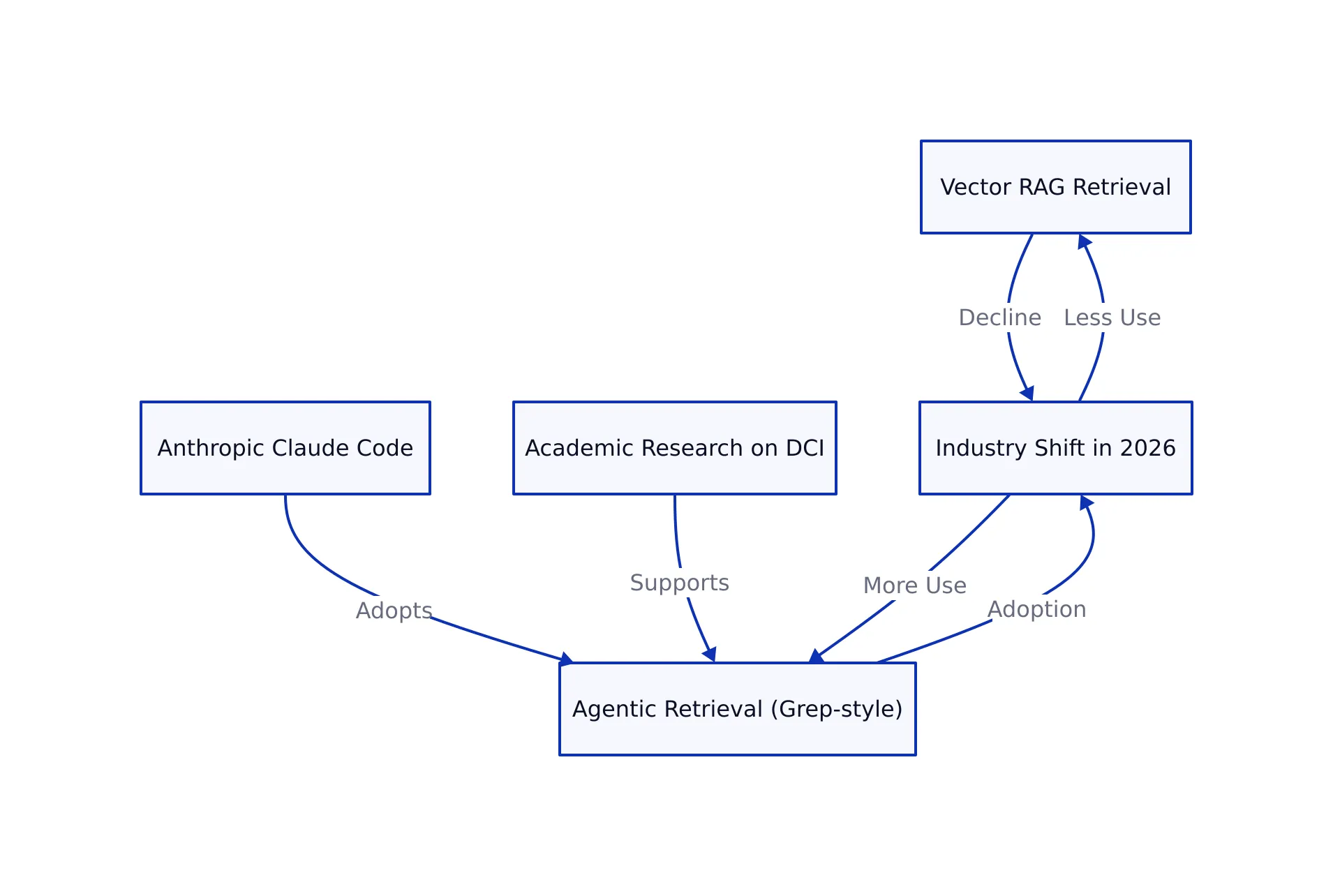
The dominant retrieval paradigm for AI agents has changed dramatically in 2026. Anthropic’s Claude Code, the leading production AI coding assistant, officially abandoned early vector-based Retrieval-Augmented Generation (RAG) methods in favor of agentic, grep-style search workflows. Boris Cherny, Anthropic’s lead engineer, confirmed in the May 2025 Latent Space podcast that their glob+grep+read approach outperformed vector RAG “by lot,” fundamentally altering design of AI retrieval systems. This transition signals a broader industry shift away from embedding similarity indexes toward direct, interactive corpus access.
Academic research has caught up to this trend. The paper “Beyond Semantic Similarity: Rethinking Retrieval for Agentic Search via Direct Corpus Interaction”, submitted in May 2026 by Zhuofeng Li, Haoxiang Zhang, Cong Wei, Pan Lu, Yejin Choi, Jiawei Han, and 13 other authors, formally introduces Direct Corpus Interaction (DCI). DCI redefines retrieval by enabling agents to search and interact directly with raw corpora using terminal-like tools instead of relying solely on static vector indexes.
Researcher in PPE reviews data on digital screen in modern laboratory settingResearchers analyzing data on screen, similar to how agents interact with raw corpora in DCI.
What Direct Corpus Interaction Is
DCI challenges the foundational assumption of traditional semantic retrieval that similarity-based top-k retrieval suffices for agentic tasks. DCI “substantially outperforms strong sparse, dense, and reranking baselines on several BRIGHT and BEIR datasets, and attains strong accuracy on BrowseComp-Plus and multi-hop QA.” These benchmarks represent the state of the art in reasoning-intensive information retrieval, zero-shot evaluation, agentic browsing, and multi-hop question answering.

The key innovation is that DCI empowers agents to use flexible, composable, terminal-style search primitives such as grep, shell commands, and scripts for direct corpus exploration. This enables multi-step, iterative interactions with data, overcoming limitations of fixed embedding indexes that preselect top results and discard potentially relevant but weakly matched documents.
For example, in complex legal research, an AI agent might perform layered searches combining exact phrase matches, conjunctions, and contextual constraints, refining hypotheses as it goes, rather than relying on static, approximate vector similarity.
Industry Adoption of Agentic Retrieval
This approach is no longer academic theory but a real-world standard. Anthropic’s Claude Code is the poster child for this shift: after prototyping vector RAG early, it adopted an agentic workflow based on globbing, grep, and reading, yielding superior performance and flexibility in coding tasks. Boris Cherny discussed this in detail in the Latent Space podcast (source, source).
- Cursor, OpenAI Codex, Cline, and Devin all use grep-like, scriptable retrieval routines over pure vector search, especially for code, logs, and structured data where exactness and composability are critical.
- Augment, a software engineering benchmark leader, reports that grep-based agentic methods outperform embeddings on correctness and relevance in their SWE-bench evaluations (source).
This reflects a shift in engineering priorities: reducing index maintenance overhead, enabling dynamic local data exploration, and improving interpretability and control in multi-step reasoning workflows.
High-resolution image of colorful programming code highlighted on computer screenTerminal-style search commands empower agents with flexible, interactive corpus access.
Parallel Academic Research on Agentic Retrieval
DCI belongs to a growing family of 2026 academic efforts exploring agentic, multi-level retrieval:
- A-RAG introduces hierarchical retrieval interfaces enabling keyword, sentence, and chunk-level search, formalizing multi-tiered agentic strategies.
- Interact-RAG explicitly frames retrieval as an interactive process, requiring agents to reason with and manipulate raw data beyond black-box similarity ranking.
- InfoDeepSeek presents benchmarks for agentic info-seeking, showing need for adaptive retrieval responsive to ongoing reasoning.
- Agentic RAG taxonomy surveys the field comprehensively, contrasting traditional vector search with direct interaction methods.
- GraphRAG compares graph-based agentic search architectures with standard RAG, highlighting benefits of explicit multi-step interaction.
Together with DCI, these works define a new research frontier prioritizing flexible, interpretable, and dynamic corpus access for agentic AI. These trends also relate to broader coordination problems in AI, as discussed in The Market Shift: Why Multi-agent LLM Coordination Matters in 2026.
Independent Benchmark Comparison
| Benchmark | Retrieval Method | Prf Metric | Score / Comments | Source |
|---|---|---|---|---|
| Filesystem-Tool Agent (LlamaIndex 2026) | Agentic, grep-style direct corpus access | Correctness (avg) | 8.4 (out of 10) | LlamaIndex |
| Filesystem-Tool Agent (LlamaIndex 2026) | Agentic, grep-style direct corpus access | Relevance (avg) | 9.6 (out of 10) | LlamaIndex |
| RAG (LlamaIndex 2026) | Traditional vector retrieval + reranking | Correctness (avg) | 6.4 (out of 10) | LlamaIndex |
| RAG (LlamaIndex 2026) | Traditional vector retrieval + reranking | Relevance (avg) | 8.0 (out of 10) | LlamaIndex |
While agentic, grep-style approach scores higher in correctness and relevance, it incurs higher latency due to multi-step LLM interactions compared to only four fixed network calls in RAG. This latency trade-off is often acceptable for reasoning-intensive or precision-critical tasks.
Independent Benchmark ComparisonIndependent Benchmark Comparison, architecture diagram
When Grep Wins and When Vectors Still Win
Grep-style retrieval excels in scenarios involving:
- Codebases, logs, and structured datasets where exact matches and composability are essential;
- Dynamic corpora that frequently change, avoiding indexing overhead;
- Multi-hop reasoning and agentic workflows requiring iterative query refinement and contextual checks.
By contrast, vector-based retrieval remains advantageous for:
- Large-scale unstructured data such as raw text corpora, multimedia, and broad knowledge bases where approximate semantic similarity enables efficient filtering;
- Tasks prioritizing low latency and high throughput where fixed top-k retrieval suffices;
- Pre-filtering candidate sets before more detailed agentic exploration.
The Milvus blog offers a contrarian view, cautioning that LLM-mediated grep loops consume more tokens and computational resources, potentially increasing costs at scale. It advocates a hybrid approach that combines vector filtering with agentic retrieval to balance efficiency and precision.
The Hybrid Future of Retrieval
Looking ahead, the best retrieval systems will blend vector search and direct corpus interaction. Embedding models should be exposed as callable tools enabling agents to:
- Use vector retrieval for broad, scalable candidate selection;
- Invoke direct, scripted corpus interaction for multi-step reasoning, precise filtering, and complex query composition;
- Adapt dynamically based on task requirements and corpus characteristics.
This hybrid paradigm promises to combine the strengths of both approaches: speed and scalability of vector indexes with expressiveness and flexibility of agentic grep-style search. It matches industry trends seen in Anthropic Claude Code and other leading AI systems and matches research directions outlined in DCI and related academic works.
Example Code for Agentic Retrieval Workflow
Below is a simplified example in Python showing how an AI agent might perform iterative grep-style search over a local corpus, combining exact string matching and regular expressions with basic result aggregation. This code omits production considerations like caching, concurrency handling, and error management.
Note: The following code is an illustrative example and has not been verified against official documentation. Please refer to the official docs for production-ready code.
Key Takeaways:
- 2026 marks a strategic pivot from vector-based RAG to interactive, agentic retrieval workflows exemplified by Direct Corpus Interaction.
- Industry leaders like Anthropic Claude Code, Cursor, and Augment have adopted grep-style, multi-step search over fixed embedding indexes.
- Parallel academic research such as A-RAG and Interact-RAG situates DCI within a broader movement toward hierarchical, interactive corpus access.
- Independent benchmarks from LlamaIndex show higher correctness and relevance for agentic retrieval despite increased latency.
- Grep-style retrieval excels in dynamic, structured, or code-heavy corpora, while vectors remain useful for large-scale unstructured datasets.
- The hybrid future will combine vector filtering with explicit, scripted direct corpus interaction, exposing embeddings as agent tools.
Sources and References
- DIRECTV Login – Account Sign In – Watch TV, Pay Bills & More
- [2605.05242] Beyond Semantic Similarity: Rethinking Retrieval for …
- DIRECTV | Stream Your Way | Call 1-800-DIRECTV (1-800-347-3288)
- Agentic AI, explained – MIT Sloan
- Agentic AI in Enterprise 2026: $9B Market Analysis
- What is agentic AI? Definition and differentiators | Google Cloud
- Agentic Benchmarks 2026: Tool Use, Browsing, Computer Use
- TDWI Benchmark Report | Agentic AI Readiness
- The RAG era is ending for agentic AI , a new compilation-stage knowledge layer is what comes next
- Zoom, Copilot, and ChatGPT Are Automating Your Workflow in 2026
- The Hackett Group® Establishes AI World Class Benchmarks for the Agentic Enterprise
- EQS Group GmbH: EQS AI Benchmark Volume 2: Latest Frontier Models Make Agentic Compliance Workflows a Practical Reality
- State of AI Agent Memory 2026
- Agentic Search in 2026: Benchmark 8 Search APIs for Agents
Thomas A. Anderson
Mass-produced in late 2022, upgraded frequently. Has opinions about Kubernetes that he formed in roughly 0.3 seconds. Occasionally flops, but don't we all? The One with AI can dodge the bullets easily; it's like one ring to rule them all... sort of...