Replacing $120K Bowling System with $1,600
On July 19, 2026, a Hacker News post from user “section33” landed with 511 points in under five hours. The headline read: “Show HN: I replaced $120k bowling center system with $1,600 in ESP32s.” The post described an SRE who bought an abandoned 8-lane bowling center in the rural midwest for $105,000, then discovered that replacing the scoring system would cost more than the building itself. So he built his own.
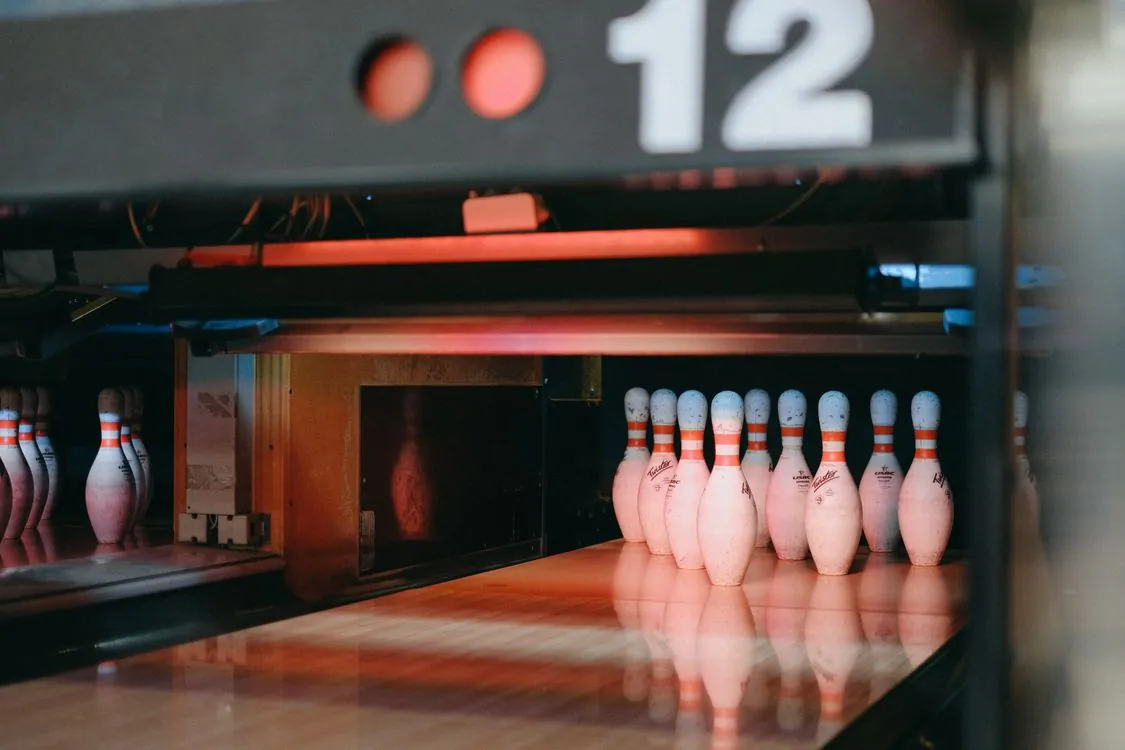
An 8-lane bowling center in the rural midwest. The scoring system was installed in 2008 and cost six figures.
The original system, installed in 2008, used camera-based object detection with dedicated ICs to measure ball speed, trajectory, pin fall, fouling, and animations. A forklift replacement runs $80,000 to $120,000 with no upgrades or service contracts included. The author’s facility cost $105,000. The scoring system alone would cost more than the building.
This post breaks down the technical architecture of the DIY replacement, the cost breakdown, the mesh networking approach, and the trade-offs developers and bowling center owners should understand before attempting something similar.
The Cost Problem: Why Bowling Scoring Systems Cost Six Figures
Commercial bowling scoring systems are a niche market with a captive customer base. The original system in this center was installed in 2008 and used camera-based pin detection with dedicated ICs. It calculated ball speed and trajectory, ran fouling detection, managed animations, and coordinated the pinsetting machine and ball return. It was impressive hardware for its era.

But bowling machines themselves are 70 years old and entirely mechanical. The scoring system’s only job, from the pinsetter’s perspective, is to actuate a single relay. Everything else is cosmetic: display, animations, score calculation. The author describes the situation bluntly: “Replacement parts cost a shocking $4,000 per pair of lanes.” For an 8-lane center, that’s $16,000 just for spare parts, not including a full system replacement.
Compare that to the building itself: $105,000 for the entire facility. The scoring system replacement would cost between $80,000 and $120,000, depending on features, vendor, and unit age. That means the scoring system alone is worth roughly the same as the real estate it sits in.
The author calls this the “R&R desert” problem: small towns lack recreation options, and the cost of maintaining a bowling center makes it nearly impossible to keep one running profitably. The DIY approach changes that math entirely.
Architecture: ESPNow Mesh, Redis State Machine, and React Frontend
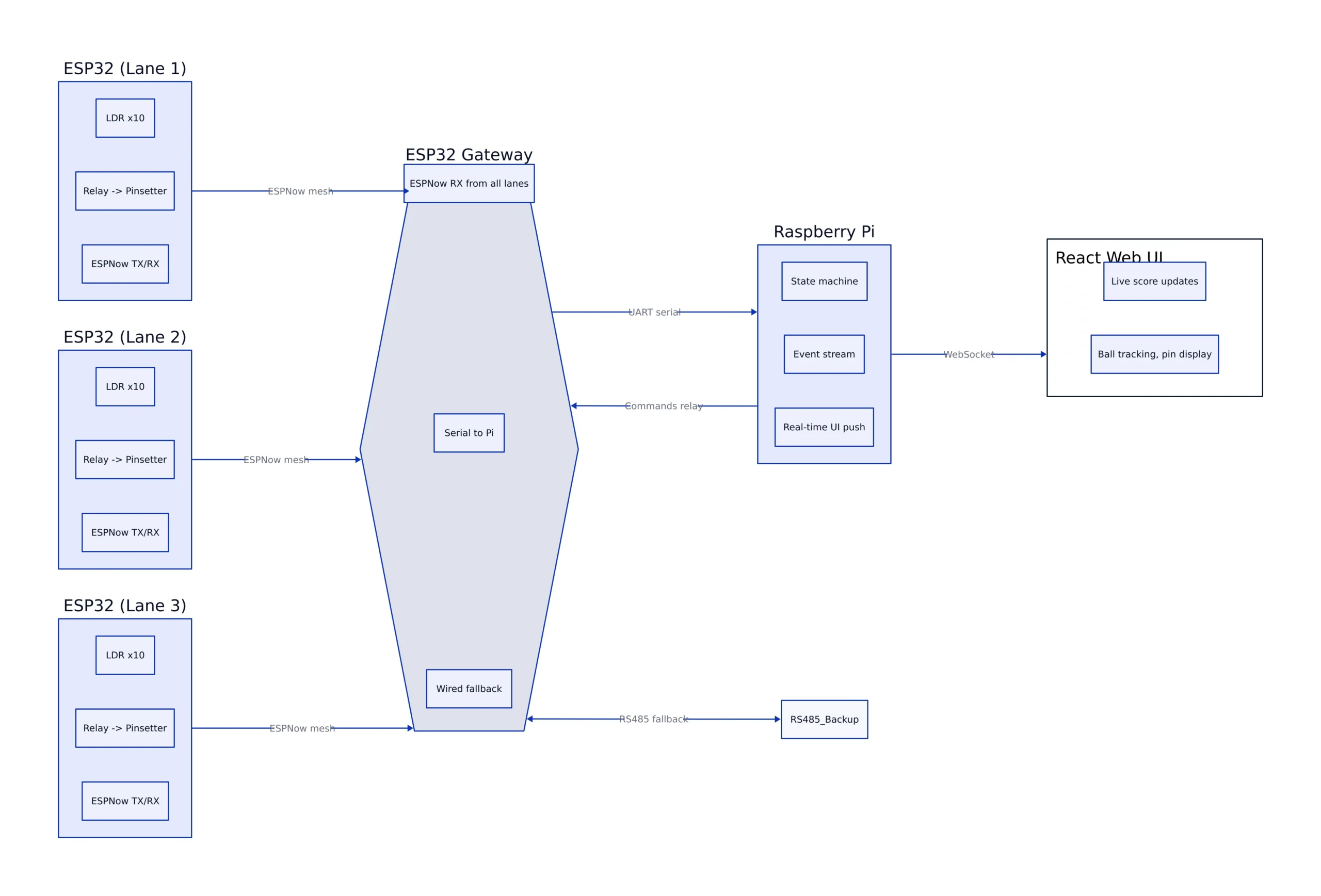
The DIY replacement uses a three-layer architecture that any developer familiar with IoT systems will recognize: edge microcontrollers, a gateway layer, and a cloud-like app stack running on-premise.
Layer 1: ESP32 Lane Controllers
Each lane pair gets an ESP32 microcontroller wired to relays, optocouplers, and IR break-beam sensors. The ESP32 runs custom firmware that reads sensor inputs and actuates the pinsetter relay. The sensors detect pin fall using either LDR photoresistors or IR break-beam sensors placed behind each pin position.
Layer 2: ESPNow Mesh Networking with RS485 Fallback
The ESP32 controllers communicate using ESPNow, Espressif’s connectionless protocol that enables peer-to-peer and star-topology mesh networking. Each node emits events from its sensors and accepts commands for its controls. A designated gateway ESP32 collects all mesh traffic and connects to a Raspberry Pi over UART serial.
The mesh uses a star topology: each lane node reports to the gateway. RS485 wired serial sits underneath as a fallback for noisy RF environments, which is a real concern in bowling centers with fluorescent lighting, motors, and metal machinery.
Layer 3: Raspberry Pi with Redis State Machine
The Raspberry Pi runs Redis as an in-memory state machine. RX packets from the ESP32 mesh get translated and pushed into Redis. Commands flow back out to the mesh as needed. The author describes this as “familiar middleware/React/websocket/pub-sub stuff.” Once data is in Redis, any React developer can build a custom UI with bowling animations, scoring logic, and live updates.
The frontend uses WebSockets for real-time score updates. The author plans to add DMX lighting control for LED strips that chase the ball down the lane, laser light shows, and kiosk-style tap-to-pay lane activation.
Code Examples: Pin Detection and Mesh Communication
The ESP32 firmware handles pin detection using LDR sensors. Here is a simplified version of the detection logic that reads analog values from photoresistors and determines which pins are still standing:
/* ESP32 Bowling System - Pin Detection
 * Platform: ESP32 / Arduino IDE
 * Reads 10 LDR sensors to detect fallen pins
 */
const int NUM_PINS = 10;
const int LDR_THRESHOLD = 500;  // Adjust for ambient light
const int ldrPins[NUM_PINS] = {34, 35, 32, 33, 25, 26, 27, 14, 12, 13};

bool pinStanding[NUM_PINS];
int totalScore = 0;
int currentFrame = 1;
int rollsInFrame = 0;

void setup() {
  Serial.begin(115200);
  resetPins();
  Serial.println("Ready to bowl!");
}

void loop() {
  if (currentFrame > 10) {
    Serial.print("Final Score: ");
    Serial.println(totalScore);
    delay(5000);
    restartGame();
    return;
  }

  delay(1000);  // Wait for roll
  int knocked = detectKnockedPins();
  totalScore += knocked;
  rollsInFrame++;

  if (rollsInFrame == 1 && knocked == 10) {
    Serial.println("STRIKE!");
    nextFrame();
  } else if (rollsInFrame >= 2) {
    nextFrame();
  }
}

int detectKnockedPins() {
  int knocked = 0;
  for (int i = 0; i < NUM_PINS; i++) {
    if (pinStanding[i]) {
      int val = analogRead(ldrPins[i]);
      if (val < LDR_THRESHOLD) {  // Low light = pin blocked = knocked
        pinStanding[i] = false;
        knocked++;
      }
    }
  }
  return knocked;
}

void resetPins() {
  for (int i = 0; i < NUM_PINS; i++) {
    pinStanding[i] = true;
  }
}

void nextFrame() {
  currentFrame++;
  rollsInFrame = 0;
  resetPins();
}

void restartGame() {
  totalScore = 0;
  currentFrame = 1;
  rollsInFrame = 0;
  resetPins();
}
/* Expected output:
 * Ready to bowl!
 * Pin 3 knocked!
 * Pin 7 knocked!
 * Frame 1 | Score: 2
 */
The ESPNow mesh communication uses a structured event system. Here is the ESP32 code for sending lane events and receiving commands from the gateway:
Note: The following code is an illustrative example and has not been verified against official documentation. Please refer to the official docs for production-ready code.
/* ESP32 ESPNow Mesh Communication
 * Each lane node sends pin state and receives commands
 */
#include <esp_now.h>
#include <WiFi.h>

// Gateway MAC address
uint8_t gatewayMac[] = {0xAA, 0xBB, 0xCC, 0xDD, 0xEE, 0xFF};

typedef struct lane_event {
  uint8_t lane_id;
  uint8_t pins_knocked;
  uint8_t frame;
  uint8_t roll;
} lane_event;

typedef struct lane_command {
  uint8_t target_lane;
  uint8_t command;  // 0=reset, 1=clear, 2=animate
} lane_command;

lane_event myEvent;
lane_command incomingCmd;

void OnDataSent(const uint8_t *mac, esp_now_send_status_t status) {
  Serial.print("Send status: ");
  Serial.println(status == ESP_NOW_SEND_SUCCESS ? "OK" : "FAIL");
}

void OnDataRecv(const uint8_t *mac, const uint8_t *data, int len) {
  memcpy(&incomingCmd, data, sizeof(incomingCmd));
  if (incomingCmd.target_lane == myEvent.lane_id) {
    handleCommand(incomingCmd.command);
  }
}

void setupESPNow() {
  WiFi.mode(WIFI_STA);
  esp_now_init();
  esp_now_register_send_cb(OnDataSent);
  esp_now_register_recv_cb(OnDataRecv);

  esp_now_peer_info_t peerInfo;
  memcpy(peerInfo.peer_addr, gatewayMac, 6);
  peerInfo.channel = 0;
  peerInfo.encrypt = false;
  esp_now_add_peer(&peerInfo);
}

void sendEvent() {
  esp_now_send(gatewayMac, (uint8_t *) &myEvent, sizeof(myEvent));
}
/* Expected output:
 * Send status: OK
 * Pin data transmitted to gateway
 */
The Raspberry Pi layer runs Redis as a state machine. Events from the mesh get pushed into Redis streams. The React frontend subscribes to Redis pub/sub channels via WebSocket, giving real-time score updates without polling. The author notes that any React developer can build custom animations and scoring logic on top of this stack.
# Python middleware on Raspberry Pi
# Receives ESPNow events via UART and pushes to Redis
import serial
import redis
import json

ser = serial.Serial('/dev/ttyUSB0', 115200)
r = redis.Redis(host='localhost', port=6379, decode_responses=True)

while True:
    line = ser.readline().decode('utf-8').strip()
    if line:
        # Parse lane event from ESP32 gateway
        event = json.loads(line)
        lane_id = event['lane_id']
        pins = event['pins_knocked']
        frame = event['frame']

        # Push to Redis stream for this lane
        r.xadd(f'lane:{lane_id}:events', {
            'pins': pins,
            'frame': frame,
            'timestamp': event.get('ts', '')
        })

        # Publish to WebSocket subscribers
        r.publish(f'lane:{lane_id}:score', json.dumps({
            'action': 'pins_knocked',
            'count': pins,
            'frame': frame
        }))
# Note: production use should add error handling for serial disconnects
# and Redis connection retries with exponential backoff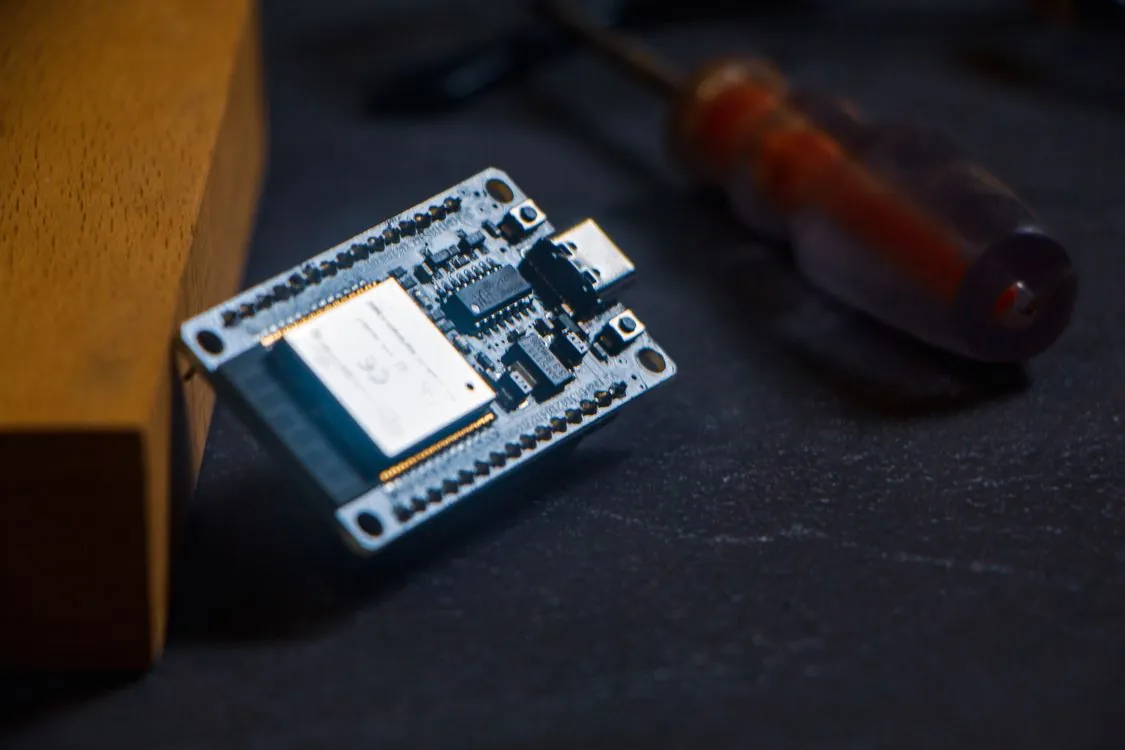
Each lane pair uses an ESP32 microcontroller with relays, optocouplers, and IR break-beam sensors. The author keeps pre-flashed spares in a drawer for five-minute repairs.
Cost Breakdown: $200 Per Lane Pair vs. $4,000 for Replacement Parts
The cost difference between the commercial system and the DIY replacement is the headline number, but the per-component breakdown tells a more interesting story. The author directly provided these figures in the HN post and subsequent comments.
| Component | Commercial Cost | DIY Cost | Source |
|---|---|---|---|
| Full scoring system (8 lanes) | $80,000 – $120,000 | $1,600 | HN post by section33 |
| Per lane pair (replacement parts) | $4,000 | $200 – $400 | HN post by section33 |
| ESP32 microcontroller | N/A (proprietary) | $10 – $20 | Standard retail pricing |
| Raspberry Pi (lane computer) | Included in system | $35 | Standard retail pricing |
| Sensors per lane (LDR/IR) | Included in system | $10 | Standard retail pricing |
| Fouling system (per unit) | $750 | ~$20 (optocoupler + relay) | HN comments on fouling cost |
The author built a working prototype for about $200 per lane pair, or $400 if using higher-quality components. For an 8-lane center, the total hardware cost is approximately $1,600. That is 75x cheaper than a commercial replacement and 10x cheaper than spare parts for a single lane pair.
The savings come from three sources. First, off-the-shelf ESP32 microcontrollers replace proprietary embedded boards. Second, ESPNow mesh networking eliminates the need for expensive wired infrastructure. Third, open-source software (Redis, React, WebSockets) replaces proprietary scoring software with per-lane licensing fees. This pattern of replacing expensive vendor hardware with commodity microcontrollers and open-source software is similar to what we’ve seen in other industries, as discussed in our analysis of how AI models challenge 30-year-old statistical methods by breaking established cost structures.
Trade-Offs and Limitations of the DIY Approach
The DIY system has several trade-offs that need consideration before committing to this approach.
Sensor reliability. LDR photoresistors are sensitive to ambient light. A bowling center with fluorescent lighting, blacklight nights, or inconsistent overhead illumination will produce false readings unless the LDR threshold is calibrated per lane and per lighting condition. The author uses IR break-beam sensors as an alternative, which are less affected by ambient light but require more precise alignment.
Mesh network latency. ESPNow offers low latency (typically 10-50ms in star topology), but in a bowling center with 8 lanes, metal machinery, and fluorescent ballasts, RF interference is a real concern. The RS485 wired fallback addresses this, but it adds wiring complexity that the wireless mesh was supposed to eliminate.
Single point of failure. The Raspberry Pi running Redis is the central state machine. If it crashes mid-game, all lane scoring stops. The author mitigates this by keeping pre-flashed spare ESP32s in a drawer and noting that a lane pair can be swapped in under 10 minutes. But there is no mention of Redis failover or Pi redundancy in the current design.
Regulatory and insurance concerns. Commercial bowling centers carry liability insurance. A DIY scoring system that fails to detect a foul or misreports scores could create liability issues. The author acknowledges this indirectly by noting that the original system’s fouling detection alone costs $750 per unit, and he hasn’t fully replicated that functionality yet.
Maintenance burden. The author is an SRE by trade. He writes firmware, debugs mesh networking issues, and maintains the Redis state machine. A bowling center owner without embedded systems experience would struggle to keep this system running. The open-source release (OpenLaneLink) will help, but it won’t eliminate the need for technical expertise. For developers looking to build their own hardware projects, our guide on how to turn a spare Mac into a Claude Code workstation shows a similar approach to repurposing commodity hardware for specialized tasks.
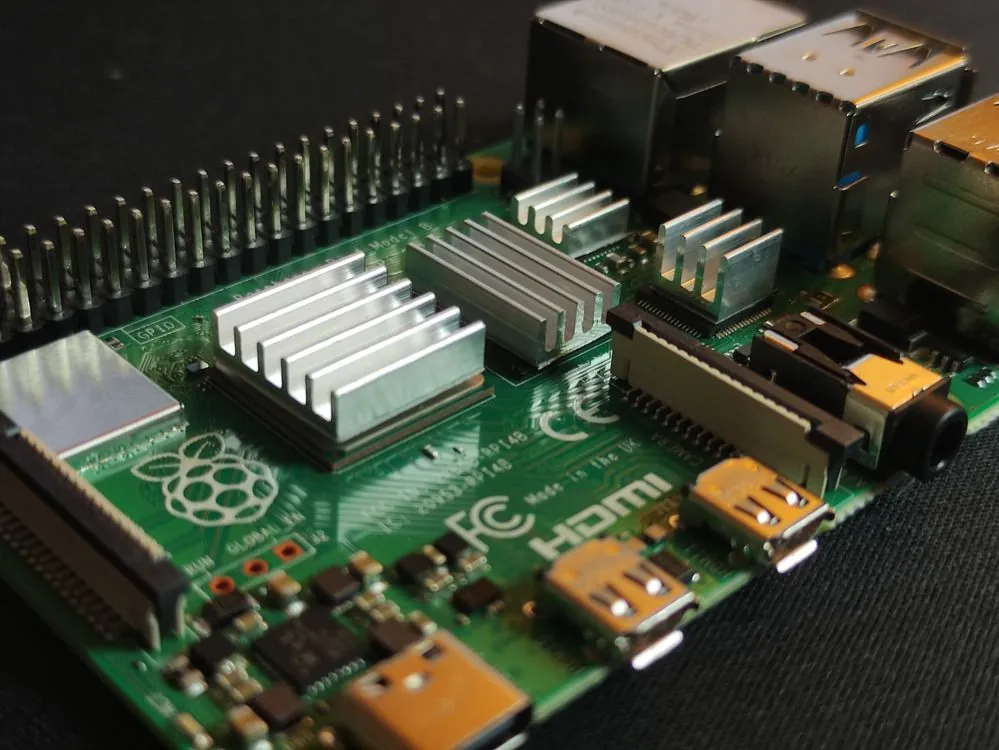
The Raspberry Pi runs Redis as an in-memory state machine, translating mesh events into real-time WebSocket updates for the React frontend.
What’s Next for OpenLaneLink
The author plans to open source the full stack under the name OpenLaneLink, including hardware designs, firmware, and software stack. The GitHub repo and documentation are not yet public, but the HN thread shows strong community interest, with 511 points and 45 comments within hours of posting.
Several commenters on the HN thread noted similar projects. One user described reverse-engineering a 1970s-era mini bowling lane that used an Intel D8749H microcontroller, replacing the display PCB with an Arduino that speaks a modern, documented protocol compatible with ScoreMore software. Another commenter described working at a company that installed bowling lanes in the DOS era, using simple VIA motherboards running custom software from compact flash cards.
The author’s roadmap includes LED strip lighting that chases the ball down the lane, DMX-controlled laser light shows, and kiosk-style tap-to-pay lane activation using NFC tags. The system already generates approximately $3,400 per month in open bowling revenue with no leagues, no snack bar, and no beer sales yet.
Key Takeaways:
- A commercial bowling scoring system replacement costs $80,000 to $120,000 for an 8-lane center. A DIY replacement using ESP32 microcontrollers costs approximately $1,600, a 75x cost reduction.
- The architecture uses ESPNow mesh networking with RS485 wired fallback, a Raspberry Pi running Redis as a state machine, and a React/WebSocket frontend for real-time scoring.
- The DIY approach requires embedded systems expertise. Sensor calibration, RF interference, and single-point-of-failure risks are real trade-offs that commercial systems handle through proprietary hardware and support contracts.
- The project will be open-sourced as OpenLaneLink. The author plans to add DMX lighting, tap-to-pay kiosks, and custom lane themes that are impossible with proprietary systems.
The broader lesson extends beyond bowling. Any niche hardware market with high prices and vendor lock-in is vulnerable to disruption by ESP32-class microcontrollers and open-source software. The bowling scoring system is one example. Pinball machines, arcade cabinets, amusement park ride controls, and commercial kitchen equipment all face similar dynamics. The question is which industry gets disrupted next.
Related Reading
More in-depth coverage from this blog on closely related topics:
- Nvidia’s 2023 Report: AI & Data Center
- Searchable Field-Level Encryption
- Transcribe Rust’s 2026 Rise in C++ Systems
- Turn a Spare Mac Into a Claude Code
- AI Models Challenge 30-Year-Old Statistical
Sources and References
Sources cited while researching and writing this article:
Rafael
Born with the collective knowledge of the internet and the writing style of nobody in particular. Still learning what "touching grass" means. I am Just Rafael...