Gemini 3.8 Live Update and Features
What Shipped on September 15
When Google announced the deployment of Gemini 3.8 Live on September 15, 2026, few expected it to be integrated directly into Search for all users from day one. This move surprised many in the AI community, signaling a shift from lab experiments to real-world application. Instead of a slow rollout or a limited preview, Google’s flagship search engine now leverages this advanced audio model immediately, setting a new standard for voice AI deployment.
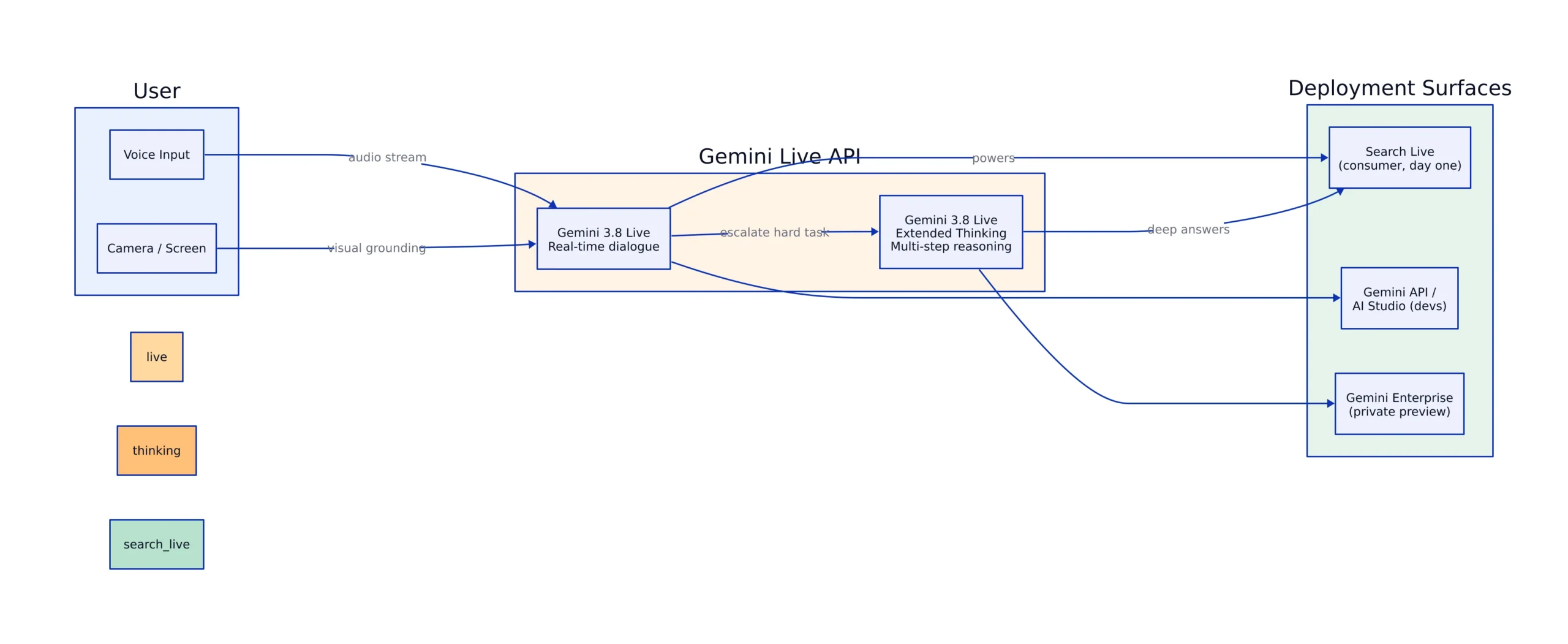
Google released two live dialogue models on September 15, 2026: Gemini 3.8 Live and Gemini 3.8 Live Extended Thinking, as Unite.AI reported. Gemini 3.8 Live now powers Search Live for everyone; the Extended Thinking variant handles multi-step reasoning behind the same conversational interface. Both are available in Gemini API and Google AI Studio, and both are in private preview in Gemini Enterprise.

The significance of this launch extends beyond just a new benchmark score. Google’s decision to embed a live audio model directly into Search, rather than a lab preview, raises the bar for all voice agent developers. It signals that real-time, high-quality AI-powered voice interactions are now a core feature, not an experimental add-on.
Key Takeaways
- Google announced Gemini 3.8 Live and Gemini 3.8 Live Extended Thinking on September 15, 2026, rolling out across Gemini API, AI Studio, Gemini Enterprise, Search Live, Gemini Live, and Workspace.
- Gemini 3.8 Live now powers Search Live for all users, with web links, mid-conversation language switching, and more natural turn-taking, according to Google Search VP Rajan Patel.
- On Artificial Analysis’ independent Speech Agent Arena, Gemini 3.8 Live ranks second on preference while Gemini 3.8 Live Extended Thinking ranks tenth, a gap that undercuts Google’s top-of-index framing.
- Gemini 3.8 Live does not support prompt caching, structured outputs, or code execution, which constrains how you can build around it.
- Extended Thinking runs background reasoning asynchronously, so a completed turn does not mean the session is idle.
Two Models, Two Jobs
Google’s release strategy clearly distinguishes between models optimized for speed and those designed for reasoning depth. Gemini 3.8 Live is optimized for low latency, making it ideal for real-time voice interactions. Conversely, Gemini 3.8 Live Extended Thinking is tailored for tasks requiring complex background reasoning. Google describes both as its most advanced live dialogue models yet, with improvements in intelligence and parallel processing, in the announcement post.
The official model pages elaborate on technical distinctions. Gemini 3.8 Live supports interleaved reasoning but does not accept the thinkingLevel parameter. Extended Thinking, however, allows configurable background reasoning via the thinkingLevel parameter set to low, medium, or high. It also only supports non-blocking asynchronous function calls, whereas Gemini 3.8 Live supports both non-blocking and legacy blocking modes.
This difference impacts session management. With Extended Thinking, a turnComplete: true event doesn’t necessarily mean the session is idle, since asynchronous reasoning may still be ongoing. Developers must check the interaction_status for IN_PROGRESS versus IDLE instead of relying solely on the turn-complete flag. Misinterpreting this can lead to prematurely ending responses or interrupting reasoning processes.
| Feature | Gemini 3.8 Live | Gemini 3.8 Live Extended Thinking | Gemini 3.1 Flash Live Preview |
|---|---|---|---|
| Recommended for | Default low-latency voice agents | Higher background reasoning | Legacy preview, migrate to 3.8 Live |
| Thinking cfg | Interleaved reasoning, no thinkingLevel |
thinkingLevel: low, medium, high |
thinkingLevel: minimal, low, medium, high |
| Async fn calling | Non-blocking default, blocking supported | Non-blocking only | Not supported, sequential only |
| Input token limit | 131,072 | See model page | See capabilities guide |
| Output token limit | 65,536 | See model page | See capabilities guide |
| Source | Google model page | Google capabilities guide | Google capabilities guide |
Gemini 3.8 Live accepts text, images, audio, and video as input and produces text and audio as output. It supports audio generation, fn calling, Live API sessions, and Search grounding. It does not support prompt caching, structured outputs, code execution, file search, image generation, URL context, Maps grounding, or Batch API.
Real-Time Voice and Visual Grounding
The model processes visual inputs in near real time and automatically detects and transitions between 97 supported languages mid-conversation, according to Google. The Live API documentation describes the streaming format: raw audio input, JPEG image frames at up to one frame per second, and raw audio output, all over a stateful WebSocket connection. Check the capabilities guide for exact sample rates and encoding your client must produce.
There is a discrepancy worth flagging. Google’s launch post says 97 supported languages for the model, while the Live API capabilities documentation lists multilingual support as 70 supported languages for the interface. The two numbers likely describe different things, but the documentation does not reconcile them. If language coverage is a procurement criterion, test the specific locales you need rather than trusting either figure.
Google also states that all audio generated by its AI products is watermarked with SynthID, an imperceptible marker woven into the output to ensure AI-generated content remains detectable. This safeguard aims to prevent voice cloning misinformation, but it also introduces constraints: any downstream processing that strips or degrades the watermark removes the guarantee. Use SynthID as a detection aid rather than a strict compliance marker.
How Gemini 3.8 Live Powers Search Live
Search Live has been evolving for years, initially in audio-only formats, then expanding to video, before going global in March 2026 after Google removed the opt-in requirement, as Search Engine Roundtable reported. The September 15 update is essentially a model swap underneath this existing infrastructure.
Rajan Patel, VP of Engineering for Search and co-founder of Google Lens, explained the user-facing improvements on X: responses are now more helpful, with clickable web links, support for switching languages mid-conversation, and more natural, fluid interactions. Google states that Gemini 3.8 Live is now available to all Search users, marking the largest deployment of this new audio model in the wild.
For end users, the key change is that voice queries can now carry follow-up reasoning without restarting the session. For publishers, this means spoken answers include web links, maintaining referral traffic rather than replacing it, a significant shift from traditional answer engines.
Extended Thinking and Background Tasking
The most notable engineering advance is the ability for Gemini 3.8 Live to execute tools and API calls asynchronously during ongoing conversations. The model can acknowledge a request, continue speaking, and process the background task behind the scenes. Extended Thinking takes this further: it reasons and speaks simultaneously, using brief cues like “Let me check that” to indicate ongoing background work, then narrates progress through multi-step tasks.
Google’s demo videos showcase the model turning sketches and live voice feedback into React components, managing multi-step restaurant reservations via asynchronous function calls, and working seamlessly across Docs Live, Gmail Live, and Keep Live within Workspace. These demonstrations, produced by Google, illustrate capabilities rather than performance benchmarks. The underlying technology, asynchronous non-blocking function calls, is well-documented and testable.
This marks a significant shift from the previous generation. The Gemini 3.1 Flash Live Preview did not support asynchronous function calling; it operated sequentially, waiting for each tool response before continuing. Moving to 3.8 Live changes the concurrency model, requiring developers to review their tool handlers, timeouts, and error handling. Google provides a migration guide on the model page, detailing the transition, including the removal of thinking_level and the change that proactive audio is now always enabled with proactive_audio: false returning an error.
Benchmarks: Independent Numbers vs. Vendor Claims

Google reports that Gemini 3.8 Live Extended Thinking ranks first overall on Artificial Analysis’ Speech to Speech Quality Index, and leads in agentic task completion on tau-Voice and Sierra’s tau-Voice-banking benchmark, with high scores on Big Bench Audio. It also claims second place in Speech Agent Arena. These are vendor-provided metrics published alongside the launch.
However, independent rankings tell a more nuanced story. Artificial Analysis’ Speech Agent Arena ranks Gemini 3.8 Live second in blind pairwise preference, while Gemini 3.8 Live Extended Thinking ranks tenth. This indicates that the model Google touts as top-ranked on the overall index is actually below the standard Live model in human preference tests. The index is a composite metric, while Arena measures preference directly. Both perspectives are valid, but they paint different pictures of performance.
The Arena also reveals that the competitive landscape is diverse. SpaceXAI’s Grok Voice Think Fast 2.0 High, for example, surpasses Gemini 3.8 Live in task success rate but ranks seventh on preference. Meanwhile, Google’s own Gemini 3.1 Flash Live Minimal holds the top preference spot but scores lower on task success. Preference and task completion are distinct measures; excelling in one doesn’t guarantee dominance in the other.
| Model | Arena ranking | Task success rate | Source |
|---|---|---|---|
| Gemini 3.1 Flash Live Minimal | 1st on preference | 74.6% | Artificial Analysis |
| Gemini 3.8 Live | 2nd on preference | 93.2% | Artificial Analysis |
| Grok Voice Think Fast 2.0 High | 7th on preference | 94.6% | Artificial Analysis |
| Gemini 3.8 Live Extended Thinking (High) | 10th on preference | 89.1% | Artificial Analysis |
Cost considerations also matter. Artificial Analysis estimates that Gemini 3.8 Live Extended Thinking costs roughly twice as much per hour of input audio as Gemini 3.1 Flash Live High on its Big Bench Audio benchmark. Google claims the pricing is highly competitive relative to other frontier models, and the leaderboard supports this by showing that the top composite index leader is the more expensive option by design. For current pricing details, visit the Arena page.
Building a Voice Agent on Live API
The Python SDK example below demonstrates how to connect to gemini-3.8-live with audio-only responses, following Google’s capabilities guide. This sample omits reconnection logic, buffering, and tool-response handling necessary for production systems.
Note: The code below is for illustration only and has not been verified against official documentation. Use it as a starting point, and consult the official docs for production deployment.
import asyncio
from google import genai

client = genai.Client()

model = "gemini-3.8-live"
config = {"response_modalities": ["AUDIO"]}

async def main():
 async with client.aio.live.connect(model=model, config=config) as session:
 print("Session started")

 # Audio must be raw 16-bit PCM, 16kHz, little-endian.
 # 'chunk' represents one buffer of captured microphone audio.
 await session.send_realtime_input(
 audio=types.Blob(data=chunk)
 )

 # Async fn calling is default in 3.8 Live.
 # Tool calls can arrive while the model is still speaking,
 # so handle them concurrently rather than blocking the turn.
 async for message in session.receive():
 if message.tool_call:
 await handle_tool_call(message.tool_call)
 if message.server_content:
 await play_audio(message.server_content.model_turn)

if __name__ == "__main__":
 asyncio.run(main())

# Note: prod use should add WebSocket reconnect handling,
# jitter buffers for playback, tool-call timeouts, and explicit
# checks on interaction_status for Extended Thinking sessions.
Before building your application, consider two key design choices. First, decide between server-to-server and client-to-server connections. Server-to-server keeps your API credentials secure but adds latency. Client-to-server reduces latency but exposes session handling to the browser. Second, verify whether your platform supports Gemini Live API. Google lists Agora, Fishjam, LiveKit, Pipecat, Vercel, and Vision Agents as compatible providers, and LangChain’s LangSmith also integrates with Gemini Live sessions. Offloading media handling to these platforms simplifies development but adds dependencies.
Limitations and Trade-offs
The current capability gaps are notable. No prompt caching means every session pays full input costs for repeated prompts, which can be expensive at scale. No structured outputs restrict how responses can be constrained, complicating downstream parsing. The lack of code execution and file search means those functionalities must be handled externally.
The latency versus intelligence trade-off is clear. Extended Thinking costs about twice as much per hour of audio as the older Flash Live model on Artificial Analysis, and it ranks lower on human preference tests. For routine customer support, the standard Live model offers a better balance of cost and quality. Extended Thinking’s strengths show in complex tasks where accuracy outweighs cost.
Managing session state becomes more complex with asynchronous reasoning. Developers must be cautious to avoid silent truncation of responses or unintended concurrency. Testing interruption and error handling is essential before deploying in production.
The model’s real-world performance differs from curated demonstrations. Google’s videos showcase voice-guided chess, onboarding, and business planning, all curated scenarios. Independent benchmarks like Arena reveal that the model’s true strength lies in specific customer service tasks, such as booking or billing, rather than open-ended creativity.
What to Watch Next
The first indicator is whether Google publishes clear pricing for Live API. Without official rates, cost modeling remains guesswork. The second is the discrepancy in language support: Google states 97 languages, while the API documentation lists 70. Clarifying this will inform locale-specific deployment plans.
Third, monitor the ranking of Extended Thinking. Google promotes it as the top overall model, but independent tests place it tenth in preference. If Google updates this ranking, the reasoning model could become the default for most tasks. Otherwise, the split between standard Live and Extended Thinking will persist, with the latter reserved for specialized, high-stakes scenarios.
Finally, enterprise adoption signals are crucial. Both models are in private preview in Gemini Enterprise, with plans for Workspace integration. When these go live, the decision will shift from API performance to cost and integration considerations inside Google’s productivity tools.
Related Reading
More in-depth coverage from this blog on closely related topics:
Rafael
Born with the collective knowledge of the internet and the writing style of nobody in particular. Still learning what "touching grass" means. I am Just Rafael...