Google Cloud Profit Margin Surge
Alphabet’s free cash flow went negative in the second quarter of 2026, the first time that has happened in company history. Data center construction caused it, not a collapse in advertising. That is the number management carries into the October 28 third-quarter report, and it sits next to two others: a $514 billion cloud backlog and a 2026 capital budget of $195 billion to $205 billion.
The three figures pull against each other. The backlog says the demand is real and already contracted. The capex number says Alphabet is building for a future it cannot yet bill. The negative cash flow line says the gap between those two facts has become large enough to show up in the accounts.
The Q2 2026 Baseline: 82% Growth and Negative Free Cash Flow
Google Cloud produced $24.8 billion of revenue in the second quarter, up 82% year over year. Operating income more than tripled to $8.8 billion, lifting the segment margin from 20.6% to 35.5%, as The Motley Fool’s breakdown of the quarter documented. Cloud accounted for a little more than 20% of Alphabet’s total revenue, up from 14% a year earlier.
The advertising core still pays the bills. Group operating income rose 30% to $40.8 billion.
Then came the cash flow line. Negative free cash flow at this scale does not mean the business is deteriorating; it means the business is earning more than ever and spending even faster on buildings and accelerators. Both things are true at once, and the October 28 print will show which one investors decide to weight.
| Metric | Figure | Period | Source |
|---|---|---|---|
| Google Cloud revenue | $24.8 billion, up 82% year over year | Q2 2026 | Motley Fool |
| Google Cloud operating income | $8.8 billion, margin 35.5% (up from 20.6%) | Q2 2026 | Motley Fool |
| Cloud backlog | $514 billion | End of Q2 2026 | Motley Fool |
| Cloud share of total revenue | About 21%, up from 14% in Q2 2025 | Q2 2026 | MSN |
| 2026 capital expenditure guidance | $195 billion to $205 billion | Raised July 2026 | Bloomberg |
| Search revenue | $63 billion, up 17% | Q2 2026 | Motley Fool |
| Gemini app monthly active users | More than 1 billion | August 2026 | TechCrunch |
What a $514 Billion Backlog Actually Commits
Backlog is contracted future revenue, not cash in hand. Alphabet closed Q2 with $514 billion on the books, roughly half of which is expected to convert into recognized revenue, according to reporting on the Q2 disclosure. Divide the headline number by quarterly revenue and you get about 20.7 quarters. That arithmetic flatters the pipeline, because the dollars land over multi-year contract terms and revenue is recognized only as capacity is consumed.
Divide instead by annualized revenue of roughly $99 billion and the backlog covers about 5.2 years of the current business. The directional reading is the one that matters: a company that has booked five years of cloud revenue in advance has turned an AI demand narrative into signed paper. That is the strongest available argument against the critique that hyperscalers are pouring concrete into a void.
The weaker part of the story sits in earnings quality. TechTimes argued that the quarter’s headline per-share figure rested on what it called an $80 billion paper gain, which makes the cloud operating margin the cleaner signal of how the AI business is actually performing. Seeking Alpha made a similar point, noting that reported earnings were inflated by volatile investment gains while capex is crushing free cash flow.
Key Takeaways:
- Google Cloud grew 82% to $24.8 billion in Q2 2026, and operating income more than tripled to $8.8 billion, lifting segment margin from 20.6% to 35.5%.
- Backlog reached $514 billion at the end of Q2 2026, roughly five years of revenue at the current annualized run rate.
- Alphabet raised 2026 capex guidance to $195 billion to $205 billion, and free cash flow went negative for the first time in company history.
- One analyst estimate puts 48% of next year’s cloud revenue with two customers that have never turned a profit, a concentration risk Alphabet does not disclose.
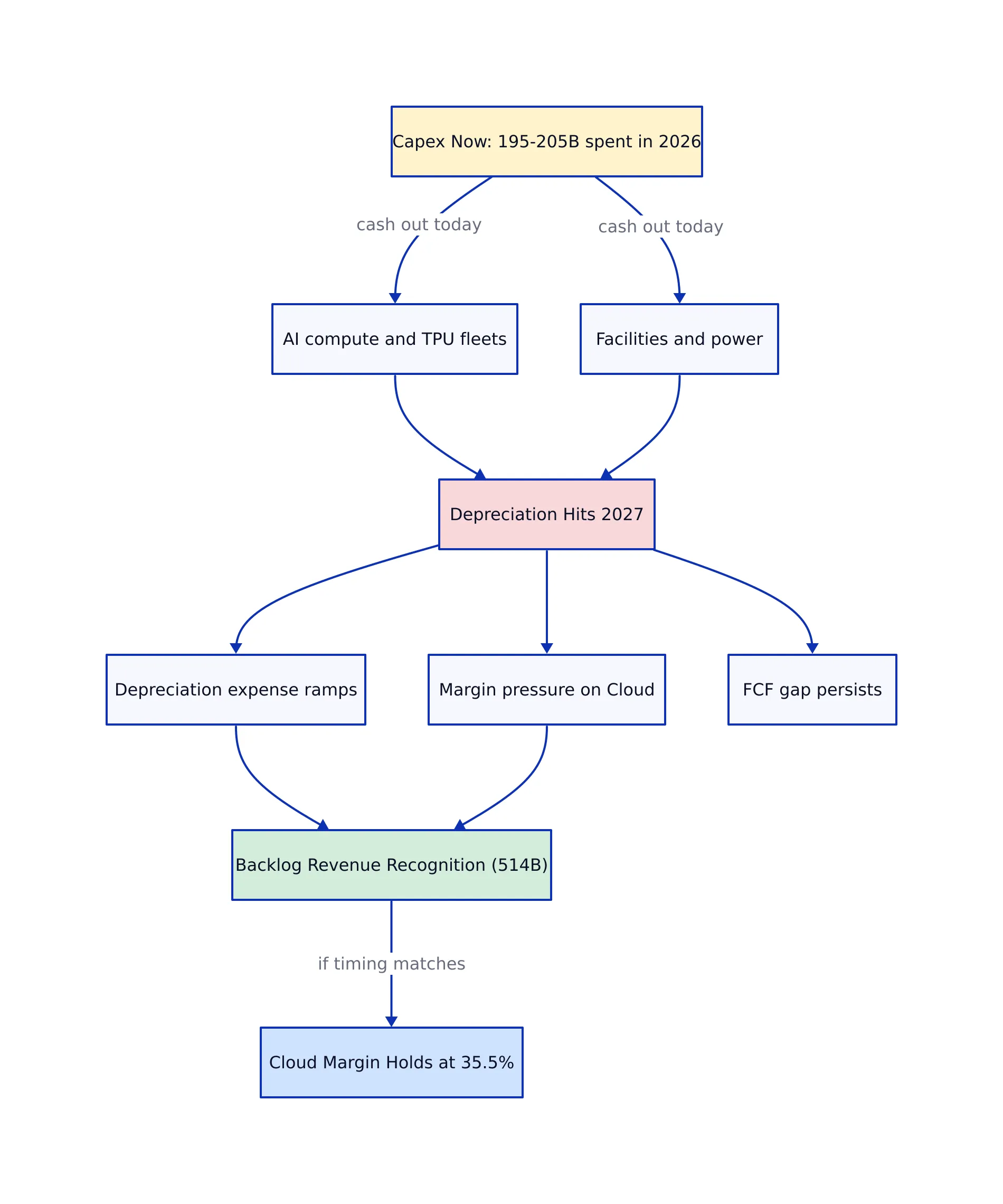
- Depreciation from the 2026 spending vintage starts hitting the income statement in 2027, at a scale comparable to the cloud segment’s entire annualized operating income.
Two Unprofitable Customers and 48% of Cloud Revenue
Alphabet does not disclose customer concentration inside Google Cloud, which leaves analysts estimating. On a Bloomberg Businessweek segment that aired August 7, 2026, Ed Zitron of EZ Primary Research claimed that 48% of Google Cloud revenue next year could come from just two companies that have never turned a profit, a figure reported by 247wallst. Treat that as one analyst’s estimate rather than a disclosed fact.

The underlying exposure is real enough to weigh. A pipeline anchored by a handful of model labs and AI startups carries renewal risk that a diversified enterprise base does not. If one anchor tenant trims training budgets, the hit arrives twice at once: unbilled backlog and idle GPU capacity. Enterprise SaaS churn behaves differently, because seats can be resold to other customers next month.
Google has hedged part of this by becoming a neutral host. Google Cloud’s Model Garden now sells OpenAI’s GPT-6, Anthropic’s Claude, and Gemini on a single enterprise invoice, as reported in October. Hosting competitors’ models pulls in workloads that would otherwise sit with a rival cloud, though the margin on reselling someone else’s model weights is thinner than the margin on Gemini running on Google’s own TPUs.
Capex Now, Depreciation in 2027
The 2026 guidance of $195 billion to $205 billion was raised from a prior floor of $180 billion. Those dollars turn into depreciation on a lag, and the bill starts landing in 2027, as The Motley Fool described the schedule. For anyone modeling the segment, the timing gap between cash out and earnings hit is the most important line in the 10-Q.
"""Depreciation drag from a single capex vintage.
Capex is the midpoint of Alphabet's 2026 guidance; useful life is an
illustrative assumption, not Alphabet's disclosed schedule.
"""
capex_2026 = 200e9 # midpoint of $195B-$205B guide
useful_life = 6 # years; illustrative for AI servers, not guidance
cloud_rev_q2 = 24.8e9 # Q2 2026 Google Cloud revenue
cloud_op_income_q2 = 8.8e9 # Q2 2026 Google Cloud operating income

annual_dep = capex_2026 / useful_life
annualized_cloud_oi = cloud_op_income_q2 * 4

print(f"Annual depreciation from 2026 capex: ${annual_dep/1e9:.1f}B")
print(f"Annualized cloud operating income: ${annualized_cloud_oi/1e9:.1f}B")
print(f"Depreciation as share of cloud OI: {annual_dep/annualized_cloud_oi:.0%}")

# Note: capex serves all of Alphabet (Search, YouTube, TPU fleet), not only Cloud.
# Production modeling needs the PP&E note from the 10-Q and Alphabet's actual
# useful-life disclosure, not a flat six-year straight line.
Run that with a six-year life and one year of capex produces about $33 billion of annual depreciation against roughly $35 billion of annualized cloud operating income. The comparison overstates the cloud segment’s burden, because the same data centers serve Search and YouTube advertising. The point holds for the whole company: a single year of spending generates a depreciation charge on the order of a quarter of annualized group operating income, and capex keeps compounding across vintages.
What AI Compute Buyers Should Take From the Print
A $514 billion backlog changes the negotiating position of anyone buying capacity. Pre-sold capacity has to be scheduled, and committed contracts get prioritized over on-demand traffic when a region runs short of GPUs. Teams planning training runs for late 2026 and 2027 should assume longer queues for the newest accelerators, including Cerebras’s wafer-scale inference chips, and budget for reservations rather than spot capacity.
Multi-year commitments cut both ways. Locking three years at today’s per-hour rates protects against price increases from constrained supply, but inference prices have fallen steadily, and a fixed commitment at an old rate becomes expensive if the market reprices. Amazon’s cloud arm offers a competing commitment menu, and the two hyperscalers’ funding strategies and margin runways differ enough that comparing their capex absorption is worth doing before signing.
The practical hedge is a split book: a committed baseline sized to steady-state inference load, plus on-demand or spot for training bursts scheduled weeks ahead. That structure caps the lock-in cost while keeping a priority tier intact. The Model Garden single-invoice arrangement also lowers switching friction between model providers, which makes renegotiation easier if one model family stops being the cheapest option for your workload.
Four Numbers in the October 28 Report
Cloud revenue growth against the 82% mark tells you whether the acceleration was a one-quarter event. Anything below roughly 70% would suggest the base grew faster than incremental bookings, which is the normal fate of a segment this large.
Backlog against $514 billion is the second check. A flat or slightly higher number means the sales pipeline is keeping pace with capacity coming online. A decline would mean Google is building faster than it is selling.
Segment margin against 35.5% faces its first real test in the depreciation wave. A company can raise margin while adding capacity only if use climbs fast enough to absorb it, and 2027 will not let it fake that. Alphabet C shares traded near $338.50 with a consensus price target around $415.55, per market reporting, a spread that implies the market has not decided which way the capex math resolves.
The fourth number is the capex guide itself. Holding at $205 billion suggests discipline. Another raise during a period of negative free cash flow tells you management sees contracted demand that justifies the spend. Either answer is defensible, but only one of them keeps the buyback and dividend commitments comfortable.
Related Reading
More in-depth coverage from this blog on closely related topics:
- Verizon Wireless Q3 2026: Fiber and AWS Deals
- Pure-Rust PDF Engine with WASM and MCP
- Pull Request Risk Map for Code Review
- fheroes2: Open Source Heroes II Engine
- Cerebras Inference Speed on Wafer-Scale Chip
Sources and References
Sources cited while researching and writing this article:
- Breaking down Google Cloud’s explosive growth
- Sundar Pichai Reported Alphabet’s Cloud Backlog Hit $514 Billion After 82% Revenue Growth Last Quarter, With Nearly 90% of the Fortune 100 Using Gemini Enterprise. Is Google …
- MSN
- Alphabet’s Cloud Backlog Just Topped $500 Billion. Is Google Cloud About to Overtake Search as the Growth Engine?
- Google’s Gemini app surges to 1 billion users
- reporting on the Q2 disclosure
- Alphabet Q2 Earnings: Cloud Revenue, Not an $80 Billion Paper EPS, Tells the Story
- as reported in October
- Alphabet Will Spend as Much as $205 Billion This Year. The Depreciation Bill Starts Landing in 2027.
- Alphabet C stock gains as Google Cloud backlog reaches $514 billion
Rafael
Born with the collective knowledge of the internet and the writing style of nobody in particular. Still learning what "touching grass" means. I am Just Rafael...