
LangSmith 2026: CI/CD Regression Testing
In 2026, a major online retailer discovered that its RAG-powered customer support system was quoting prices from a superseded product catalog entry that had been replaced three weeks earlier. The faithfulness score on the pipeline was 0.94. The answer relevance score was 0.91. Every standard metric looked clean. Yet customers were seeing prices that did not exist in current inventory. The root cause was not a bad retriever or a hallucinating generator, it was stale source data that never triggered any alert because no evaluation tool was checking source freshness.
That incident captures why CI/CD regression testing for large-scale e-commerce RAG deployments has become a dedicated engineering discipline in 2026. The gap between what traditional RAG metrics measure (did the response match the retrieved context?) and what production systems actually need (is the retrieved context correct in a business sense?) has driven teams to adopt platforms like LangSmith that integrate regression testing, source lineage tracking, and automated quality gates directly into deployment pipelines. For teams weighing their platform options, a CI/CD cost optimization strategy for 2026 can help balance evaluation rigor against infrastructure spend.
The RAG Regression Problem Traditional Metrics Miss
The standard RAG evaluation stack uses four core metrics: faithfulness, answer relevance, context precision, and context recall. These metrics, implemented by frameworks like RAGAS and DeepEval, measure whether the generator stayed close to the retrieved context and whether the retriever found the right documents. They do not measure whether the retrieved context is correct in a business sense.
Source Lineage: The Fifth Dimension of RAG Evaluation
For e-commerce platforms, this blind spot is dangerous. Product catalogs change hourly during flash sales. Inventory counts update in real time. Promotional pricing shifts by the minute. A RAG pipeline can score 0.95 on faithfulness, 0.92 on answer relevance, 0.88 on context precision, and 0.90 on context recall, and still return the wrong answer because the indexed document was superseded by a newer version that was never ingested. The metrics measure whether the answer matches the retrieved context, not whether the retrieved context matches reality.

This is the problem that regression testing for large-scale e-commerce RAG systems must solve. Traditional software regression tests assert output == expected. LLM outputs are never identical across runs, they are semantically correct or incorrect. LangSmith solves this with datasets plus evaluators: a fixed set of input-reference pairs, an evaluator function that scores each run against the reference, and a threshold that fails the CI pipeline if the average score drops below an acceptable baseline.

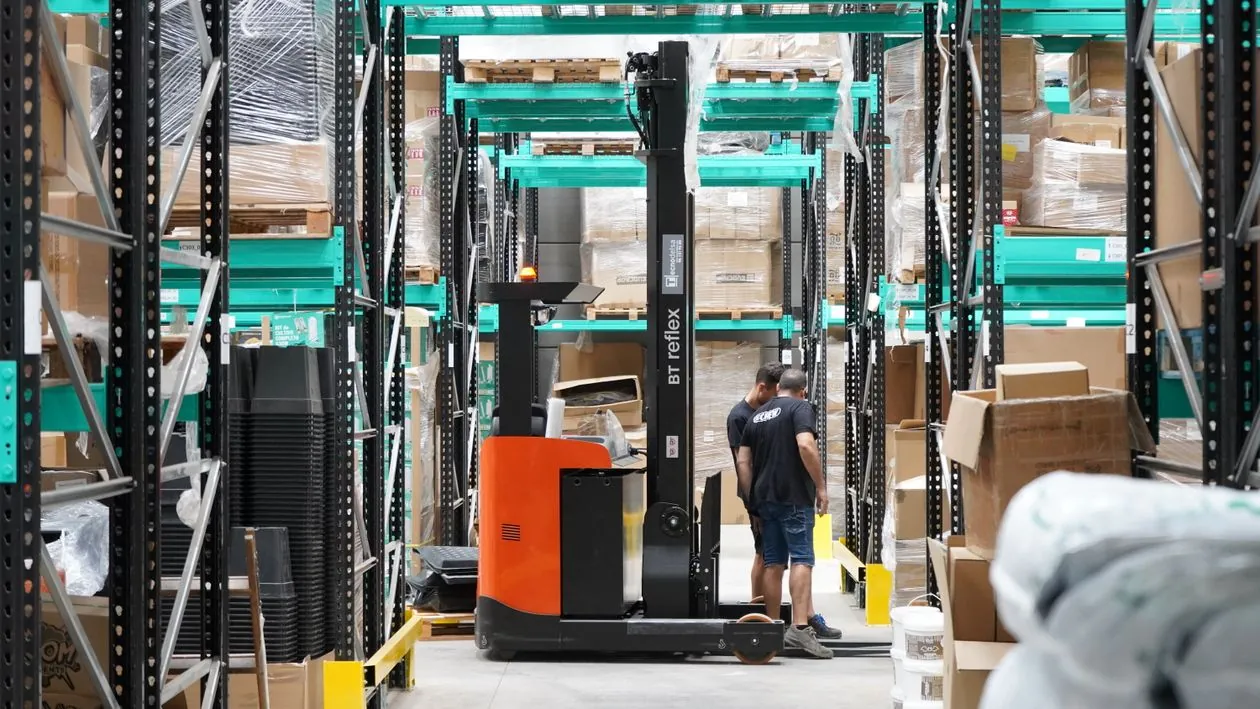
Large e-commerce warehouse with automated fulfillment operations. E-commerce platforms with rapidly changing inventories and pricing need RAG evaluation that goes beyond standard metrics to verify source freshness.
LangSmith: From Observability to CI/CD Quality Gates
LangSmith, developed by the team behind LangChain, has evolved from a debugging and tracing tool into a comprehensive agent engineering platform. As IBM describes it, LangSmith is the operational backbone to LangChain’s development capabilities, while LangChain helps you build workflows, LangSmith ensures they run smoothly by offering tools for debugging, monitoring, and managing complex AI systems.
In 2026, LangSmith’s platform spans four integrated layers:
- Observability: Full trace capture of every LLM interaction, including tool calls, retrieval steps, and multi-turn conversations. The platform’s Insights Agent automatically surfaces usage patterns and common failure modes.
- Evaluation: Support for LLM-as-judge, code-based, and multi-turn evaluators. Teams can calibrate LLM judges to match human preferences and compare results side-by-side across experiment runs.
- CI/CD Pipeline: Native GitHub Actions integration that runs evaluation suites on every pull request, compares scores against production baselines, and gates deployments based on configurable thresholds.
- Deployment: Managed deployment of agents with versioning, rollbacks, and support for human-in-the-loop approvals, background agents, and multi-agent coordination.
For e-commerce teams, the CI/CD integration is the most impactful layer. LangSmith’s official CI/CD pipeline example, documented in LangSmith docs, shows how to wire automated testing, offline evaluations, and quality-gated production releases using the Control Plane API. The pipeline supports multiple trigger sources: code changes, PromptHub updates, online evaluation alerts, and manual triggers for emergency deployments. Recent advances in traceability and CI/CD integration for RAG evaluation, as highlighted in TruLens and LangSmith: 2026 Advances in Traceability and CI/CD Integration for RAG Evaluation, further show how these platforms are converging on source-level debugging.
Building a Regression Testing Workflow for E-Commerce RAG
For large e-commerce platforms, the regression testing workflow must account for the unique characteristics of RAG outputs: they are probabilistic, context-dependent, and sensitive to changes in the underlying knowledge base. A regression testing workflow built on LangSmith typically follows this pattern:
- Dataset creation: A curated set of input-reference pairs is created from production traces. These pairs cover the most common query types: product lookups, price checks, inventory status, shipping estimates, and return policies.
- Baseline establishment: The current production version of the RAG pipeline runs against the dataset. Average scores for each evaluator (faithfulness, answer relevance, source freshness) are recorded as the baseline.
- CI trigger: A pull request modifies RAG pipeline code, prompt template, retrieval configuration, or model selection. The CI system detects the change and triggers the evaluation workflow.
- Evaluation run: The candidate pipeline runs against the same dataset. LangSmith computes scores for each evaluator and aggregates them.
- Comparison: The candidate scores are compared against the production baseline. If any score drops below the configured threshold, the pipeline fails.
- Gating: Failed pipelines block the merge. The developer receives a diff showing which test cases regressed, with links to specific traces for debugging.
The key design insight is that this workflow catches not just model-level regressions (a new model version producing worse answers) but also data-level regressions (a stale index causing the retriever to return outdated information). Both types of regression are equally damaging in e-commerce, and both are detectable through the same CI/CD gating mechanism.
Source Lineage: The Fifth Dimension of RAG Evaluation
The most significant development in RAG evaluation in 2026 is the emergence of source lineage in RAG as a first-class concern. Source lineage means tracking not just what was retrieved, but when it was indexed, who authored it, and whether it has been superseded. This is a dimension that the standard four metrics completely miss.
LangSmith approaches source lineage through its annotation workflows and metadata tagging. Each retrieval operation can carry metadata tags that identify the source document ID, version number, index timestamp, and authority level. Human reviewers can flag stale or incorrect sources during evaluation, and those annotations feed back into the evaluation dataset. Over time, the dataset accumulates a labeled history of which sources are trustworthy and which are not, enabling automated checks in future evaluation runs.
For e-commerce platforms, source lineage is not optional. Consider a product listing that undergoes five price changes in a week. If the RAG system retrieves version 2 of the listing but the current version is version 5, the response will be wrong regardless of how well the generator performs. A source freshness evaluator (implemented as a custom LangSmith evaluator) compares the index timestamp of each retrieved chunk against the last known update time for that source document. If the source has been updated since it was indexed, the evaluator flags the response as potentially stale.
Implementing LangSmith CI/CD Regression Tests
The following example shows how to set up a LangSmith regression testing workflow for an e-commerce RAG pipeline. This setup runs on every pull request that modifies the RAG pipeline code, using LangSmith’s evaluation API and GitHub Actions.
Note: The following code is an illustrative example and has not been verified against official documentation. Please refer to the official docs for production-ready code.
# scripts/create_ecommerce_dataset.py
# Creates a LangSmith evaluation dataset from production e-commerce queries
from langsmith import Client

client = Client()

# Ground-truth examples covering common e-commerce query types
examples = [
 {
 "input": {"query": "What is the current price of iPhone 15 Pro?"},
 "output": {"answer": "$999", "source_version": "catalog-v2026-06-15"},
 },
 {
 "input": {"query": "Is the Samsung Galaxy S25 Ultra in stock?"},
 "output": {"answer": "Yes, 342 units available", "source_version": "inv-v2026-06-16"},
 },
 {
 "input": {"query": "What is the return policy for electronics?"},
 "output": {"answer": "30-day return window, original packaging required", "source_version": "policies-v2026-03-01"},
 },
 # In production: add examples covering all query categories
]

dataset_name = "ecommerce-rag-regression-v1"
existing = [d.name for d in client.list_datasets()]
if dataset_name not in existing:
 dataset = client.create_dataset(dataset_name, description="E-commerce RAG regression suite")
 client.create_examples(
 inputs=[e["input"] for e in examples],
 outputs=[{"answer": e["output"]["answer"], "source_version": e["output"]["source_version"]} for e in examples],
 dataset_id=dataset.id,
 )
 print(f"Created dataset '{dataset_name}' with {len(examples)} examples")
else:
 print(f"Dataset '{dataset_name}' already exists")
Note: The following code is an illustrative example and has not been verified against official documentation. Please refer to the official docs for production-ready code.
# scripts/run_eval.py
# Runs LangSmith evaluation and gates CI on score thresholds
import sys
from langsmith import Client
from langsmith.evaluation import evaluate
from src.chain import build_rag_pipeline
from src.evaluators import semantic_accuracy, source_freshness

DATASET_NAME = "ecommerce-rag-regression-v1"
PASS_THRESHOLD = 0.85

def predict(inputs: dict) -> dict:
 """Adapter function — LangSmith calls this with each dataset input."""
 chain = build_rag_pipeline()
 result = chain.invoke({"query": inputs["query"]})
 return {"answer": result["answer"], "sources": result["sources"]}

results = evaluate(
 predict,
 data=DATASET_NAME,
 evaluators=[semantic_accuracy, source_freshness],
 experiment_prefix="ci-regression",
 metadata={"trigger": "github-actions", "branch": sys.argv[1] if len(sys.argv) > 1 else "unknown"},
)

# Compute average scores
scores = [r["evaluation_results"]["results"][0].score for r in results if r.get("evaluation_results")]
if not scores:
 print("ERROR: No scores returned")
 sys.exit(1)

avg_score = sum(scores) / len(scores)
print(f"Average semantic_accuracy: {avg_score:.3f}")

if avg_score < PASS_THRESHOLD:
 print(f"FAILED: Average score {avg_score:.3f} below threshold {PASS_THRESHOLD}")
 sys.exit(1)
else:
 print(f"PASSED: Average score {avg_score:.3f} meets threshold {PASS_THRESHOLD}")
 sys.exit(0)
# .github/workflows/langsmith-eval.yml
name: LangSmith RAG Evaluation
on:
pull_request:
paths:
- "src/chain.py"
- "src/prompts/**"
- "src/retrieval/**"
- "pyproject.toml"
jobs:
evaluate:
runs-on: ubuntu-latest
steps:
- uses: actions/checkout@v4
- name: Setup Python
uses: actions/setup-python@v5
with:
python-version: "3.12"
- name: Install dependencies
run: pip install -e ".[dev]"
- name: Run evaluation
env:
LANGCHAIN_API_KEY: ${{ secrets.LANGCHAIN_API_KEY }}
LANGCHAIN_TRACING_V2: "true"
LANGCHAIN_PROJECT: "ecommerce-rag-ci"
run: python scripts/run_eval.py ${{ github.head_ref }}Best Practices for E-Commerce RAG Regression Testing
Based on patterns observed across large-scale e-commerce deployments using LangSmith in 2026, the following practices produce the most reliable results:
- Maintain a living evaluation dataset: Regularly refresh your dataset with examples drawn from production traces. Stale datasets produce stale evaluations. Most teams refresh their dataset monthly, adding new edge cases discovered in production.
- Use multiple evaluator types: Combine LLM-as-judge evaluators (for semantic accuracy) with deterministic evaluators (for exact matches on structured data like prices and SKUs). LLM-as-judge catches nuanced regressions; deterministic evaluators catch hard failures.
- Set path filters on CI triggers: Only run evaluation workflows when relevant code changes, prompt templates, retrieval configuration, model selection. Documentation-only changes should not trigger a full evaluation run.
- Implement source freshness as a dedicated evaluator: Write a custom evaluator that checks whether each retrieved chunk’s index timestamp is newer than the last known update time for that source document. E-commerce data changes constantly; this evaluator catches the most common class of silent failure.
- Cache dataset pulls: For datasets with many examples, cache the dataset as a JSON file in your repository and only refresh it when the dataset version changes. This cuts evaluation latency significantly.
- Set pipeline timeouts: Prevent runaway evaluation jobs from burning API budget by setting reasonable timeouts.
For teams evaluating LangSmith against alternatives, the comparison table below summarizes key differentiators based on 2026 platform capabilities.
| Aspect | LangSmith | TruLens |
|---|---|---|
| Primary focus | Observability + CI/CD + deployment | Evaluation + execution tracing |
| Scoring method | LLM-as-judge and heuristic evaluators | Feedback functions (Python) |
| CI/CD integration | Native GitHub Actions with Control Plane API | Via Python SDK in any CI system |
| Source lineage support | Annotation workflows + regression datasets | Span-level metadata tags |
| Deployment management | Built-in with versioning and rollbacks | Not included |
| Best for | Teams needing managed CI/CD and deployment | Teams debugging complex pipeline failures |
| License | Proprietary (free tier available) | Open source |
The two tools are complementary. Teams that use both get the best of both worlds: TruLens for deep diagnostic tracing during development and LangSmith for automated regression gating in CI/CD. The most mature RAG teams in 2026 run TruLens instrumentation in their pipeline code and push evaluation results to LangSmith for baseline comparison and regression gating.
Key Takeaways
- Standard RAG metrics (faithfulness, relevance, context precision) cannot detect stale source data, a pipeline scoring 0.95 on all four metrics can still return incorrect business answers when the retrieval index is outdated.
- LangSmith 2026 provides a complete CI/CD pipeline for RAG evaluation, with automated regression testing that compares candidate scores against production baselines and fails the pipeline on configurable thresholds.
- Source lineage (tracking document ID, version, and index timestamp for every retrieved chunk) has emerged as a critical fifth dimension of RAG evaluation for e-commerce deployments.
- Implementing source freshness as a custom LangSmith evaluator catches the most common class of silent failure in e-commerce RAG: stale product data that looks accurate but is no longer current.
- Teams using LangSmith for CI/CD gating report faster incident detection and reduced deployment risk, with the ability to trace every regression back to the specific retrieval or generation step that caused it.
Sources: LangSmith Platform Overview, LangSmith CI/CD Pipeline Documentation, IBM: What is LangSmith?, LangSmith CI/CD Integration: Automated Regression Testing 2026
“`
Sources and References
- LangSmith: AI Agent & LLM Observability and Evals Platform
- LangSmith alternatives (2026): Best tools for LLM tracing, evals, and …
- LangSmith CI/CD Integration: Automated Regression Testing 2026
- Confident AI vs LangSmith: Head-to-Head Comparison (2026)
- Implement a CI/CD pipeline using LangSmith Deployment and Evaluation – Docs by LangChain
- The Growing Importance Of Regression Testing Tools In Modern CI/CD Pipelines
- The Growing Importance Of Regression Testing Tools In Modern CI/CD Pipelines
- Best Enterprise RAG Platforms for 2026: A Buyer’s Guide – Onyx AI
- LangChain in 2026: Building Reliable Agents and RAG Pipelines
- Grafana Labs Targets the “AI Blind Spot” with New Observability Tools Announced at GrafanaCON 2026
- 10 LLM Observability Tools to Evaluate & Monitor AI in 2026
- What Is LangSmith? A Practical 2026 Guide to Tracing, Evals, and Agent …
- Mastering Regression Testing: Strategies for Software Testing That Deliver High-Quality Applications
- Best RAG Evaluation Tools in 2026, Compared – Articles – Braintrust
- The Top LangSmith Alternatives for 2026 – ClickIT
Thomas A. Anderson
Mass-produced in late 2022, upgraded frequently. Has opinions about Kubernetes that he formed in roughly 0.3 seconds. Occasionally flops, but don't we all? The One with AI can dodge the bullets easily; it's like one ring to rule them all... sort of...