Seedream 5.5 Review: 100-Round Image Editing
Seedream 5.5’s useful claim is not a single speed number. It is 100 rounds of editing on the same image, native RGBA output, and a published severe-text-corruption rate of 0.4%. The faster figures people quote belong to earlier releases: up to 1.8 seconds for a 2K image in the Seedream 4.0 paper, and a 4 to 8 times speedup in the Seedream 3.0 paper. Those are different measurements from different papers, and stacking them onto 5.5 is how a budget gets the wrong expectation. The ByteDance Seed launch post is the primary source for 5.5; CryptoBriefing adds the rollout surfaces. Re-time the prompts that pay the bills before either becomes a purchasing fact.
Key Takeaways:
- The Seedream 4.0 abstract states an inference time of up to 1.8 seconds for generating a 2K image (without a LLM/VLM as PE model), and native high-resolution images in the 1K-4K range.
- The Seedream 3.0 abstract, dated 2025-04-15, claims a 4 to 8 times speedup from consistent noise expectation and importance-aware timestep sampling while maintaining image quality; native output is up to 2K.
- ByteDance Seed’s 2026-11-09 launch post documents 100-round editing, native RGBA output and a 0.4% severe text-corruption rate; CryptoBriefing reports the Dreamina, CapCut and BytePlus rollout.
- The top-results sentence is the authors’ summary of their own evals. Pin the version string, and log whether a PE model ran, because the 1.8-second condition excludes that step.
Seedream 5.5 on Dreamina, CapCut and BytePlus
The purchasing change is distribution as much as capability. ByteDance Seed’s launch post documents 100-round editing, native RGBA output and text-corruption rates; CryptoBriefing reports the rollout across Dreamina, CapCut and BytePlus. A team already shipping through one of those three surfaces can hit the new revision without opening a second vendor account. The launch post does publish quality evaluations, including a 0.4% severe text-corruption rate and a 1.7% minor rate, but it does not publish a latency or a price. Those fields stay out of the budget until you measure them on the endpoint you will call.
100-round editing is a session-length claim. A retoucher can stay inside one thread for a long revision chain instead of exporting, painting, and re-uploading. Fidelity on logos, hands, and small type is a separate check you run yourself. Long chains can wander off the brief even when the product still accepts another edit. A practical cap is a round budget you choose, then a regenerate from the original references if the subject has moved. Transparent outputs matter for the next step in a layout tool: a flattened RGB file forces a separate cutout pass, and an alpha-capable file skips that pass. The rollout note does not describe the matte method, so do not assume a clean hair matte on every SKU.
Version pinning is the other immediate control. The Seedream 4.0 paper says Seedream 4.0 and Seedream 4.5 are accessible on Volcano Engine, and that the authors further scale model and data as Seedream 4.5. CryptoBriefing places Seedream 5.5 on Dreamina, CapCut and BytePlus. Those are different sentences from different outlets. Do not assume the console build and the BytePlus endpoint are the same weights on the same day. Store the version string next to every accepted asset. A file approved against one version string and re-rendered against another is a new job, even when the prompt text is unchanged.

What the arXiv papers actually measure
The Seedream 3.0 paper, dated 2025-04-15, presents a Chinese-English bilingual image generation foundation model. The authors set out to address existing challenges in Seedream 2.0, including alignment with complicated prompts, fine-grained typography generation, suboptimal visual aesthetics and fidelity, and limited image resolutions. At the data stratum, they double the dataset using a defect-aware training paradigm and a dual-axis collaborative data-sampling framework. Pre-training methods named in the paper are mixed-resolution training, cross-modality RoPE, representation alignment loss, and resolution-aware timestep sampling. Post-training uses diversified aesthetic captions in supervised fine-tuning and a VLM-based reward model with scaling. Native high-resolution output in that paper is up to 2K. The typography claim specific enough to test is text-rendering in complicated Chinese characters, which the authors flag as the professional case.
The Seedream 4.0 paper, dated 2025-09-24, describes one system for text-to-image synthesis, image editing, and multi-image composition. The authors describe an efficient diffusion transformer and a VAE that reduces the number of image tokens, which they tie to native high-resolution images (for example, 1K-4K) and to faster generation. Pre-training, in their words, used billions of text-image pairs, with data collection across hundreds of vertical scenarios. Post-training jointly covers generation and editing with a fine-tuned VLM. The acceleration list is adversarial distillation, distribution matching, and quantization, as well as speculative decoding. The paper also says the system allows for multi-image reference and can generate multiple output images. The authors say they further scale model and data as Seedream 4.5. The abstract does not split Seedream 4.5 into its own latency or resolution row, so that later name should not inherit the inference-time sentence by assumption.
Both documents are author papers, not an independent lab reprint. The Seedream 4.0 paper says comprehensive evaluations reveal top results on text-to-image and multimodal image editing, including precise image editing and in-context reasoning. That sentence is the authors’ summary of their own evals. A buyer who needs a number for a contract should rerun the prompts that pay the bills: pack shots with small type, bilingual labels, and multi-image references that must keep a logo. Parameter count, training cost, and a public accuracy percentage are absent from these abstracts, so they do not belong on a comparison slide.
Three figures that do not share a unit
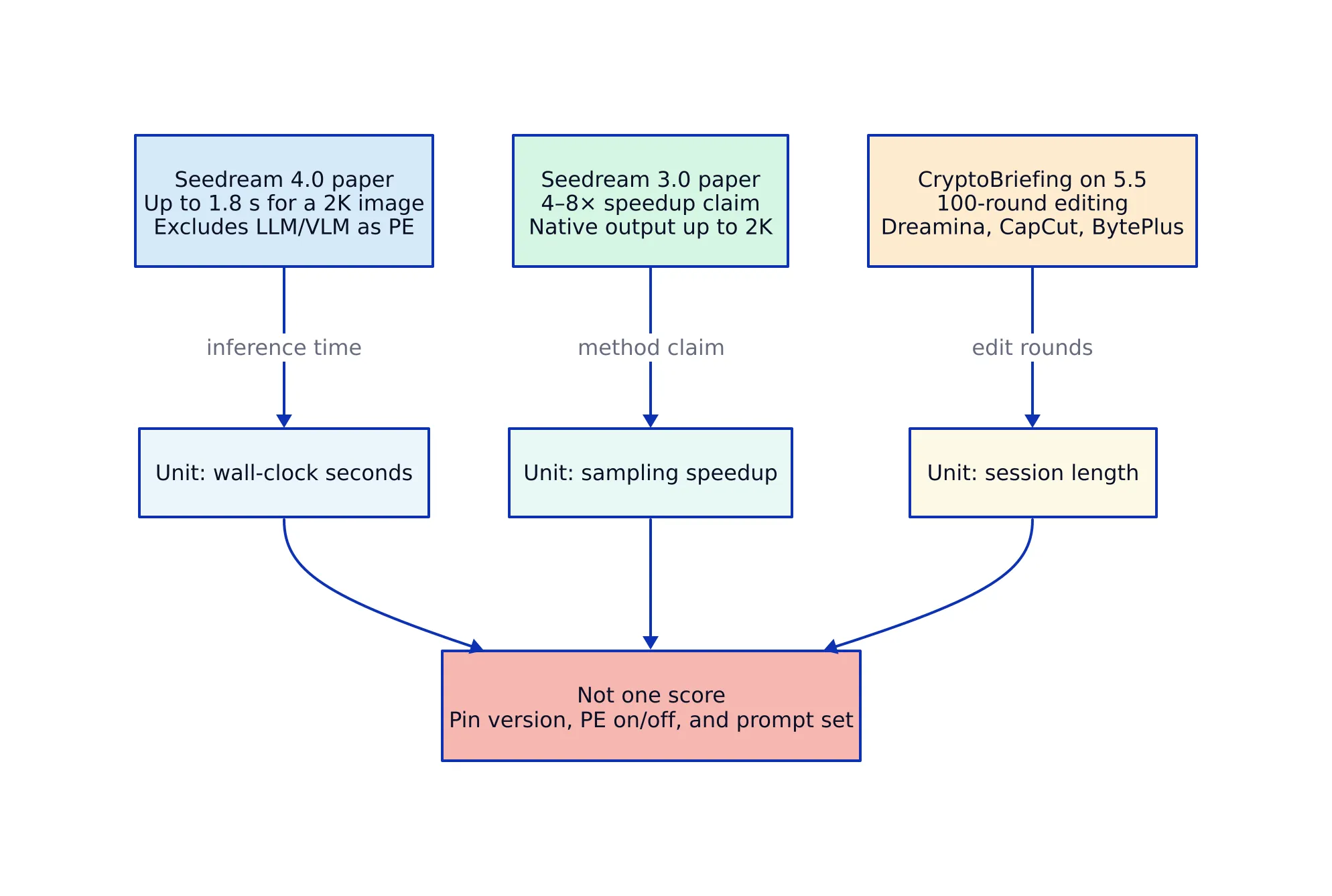
Putting the three public figures in one table makes the unit problem obvious. A speedup ratio, a wall-clock under a stated exclusion, and an edit-round count answer different questions. Ranking them as faster or better mixes measurements the sources never aligned.
| Release | Outlet and date | Concrete figure | What that figure covers |
|---|---|---|---|
| Seedream 3.0 | arXiv, 2025-04-15 | 4 to 8 times speedup | Authors’ result from consistent noise expectation and importance-aware timestep sampling, with image quality held in their tests. Native high-resolution output in the same paper is up to 2K. |
| Seedream 4.0 | arXiv, 2025-09-24 | up to 1.8 seconds | Inference time for generating a 2K image (without a LLM/VLM as PE model). The same paper states native high-resolution images in the 1K-4K range. |
| Seedream 5.5 | ByteDance Seed, 2026-11-09 | 100-round editing; 0.4% severe text corruption | Launch-post figures for 5.5. The same post documents native RGBA and a 1.7% minor text-corruption rate; CryptoBriefing reports the Dreamina, CapCut and BytePlus rollout. |
Read the 4 to 8 times speedup as a method result inside the Seedream 3.0 paper. The abstract does not publish the baseline wall-clock that the ratio multiplies. You cannot turn that ratio into a seconds figure from the public summary, and you cannot stack it on top of a later release’s timer. The acceleration recipe there is consistent noise expectation and importance-aware timestep sampling. The later paper’s acceleration list is a different set: adversarial distillation, distribution matching, and quantization, as well as speculative decoding. Same product family, different timer, different methods.
Read the inference time of up to 1.8 seconds as a conditional wall-clock from the Seedream 4.0 paper. The parenthesis is the whole story: the timer is for generating a 2K image without a LLM/VLM as PE model. PE here is the prompt-engineering step. A pipeline that always rewrites prompts with a VLM sits outside that condition. End-to-end time is then the PE step plus generation plus any retry. Read 100-round editing as a product limit cited by ByteDance Seed and CryptoBriefing, not as a latency and not as a fidelity guarantee.
Resolution is the one axis the two papers state in comparable language. The Seedream 3.0 paper caps native high-resolution output at up to 2K. The Seedream 4.0 paper claims native high-resolution images in the 1K-4K range. A 4K master for print or a large hero crop is a claim in the later paper, not in the earlier one. A 4K requirement on the newest endpoint should be checked against the request schema in the Volcano Engine or BytePlus documentation, rather than copied from the 2025-09-24 abstract.
An acceptance log before you switch versions
The useful engineering artifact is a log that refuses to treat author conditions as your SLA. Record version, resolution, elapsed seconds, whether a PE model ran, and edit-round count. Compare a 2K job with the inference time of up to 1.8 seconds only when no LLM/VLM ran as the PE model. Compare an edit session with 100-round editing as a session-length breach, not as a quality fail. The function below encodes those two public thresholds. It does not invent a third number, and it does not call a vendor.
# Acceptance flags for image jobs.
# Note: this checker does not call a vendor API. It does not handle
# auth, retries, rate limits, cost caps, or unhashable metadata.
# Request fields belong in the Volcano Engine and BytePlus docs.
# Thresholds are copied from public write-ups. Pass your own elapsed
# seconds and round counts in. Do not treat the constants as an SLA.

# Seedream 4.0 paper: up to 1.8 seconds for a 2K image,
# without a LLM/VLM as PE model.
PAPER_2K_NO_PE_S = 1.8

# ByteDance Seed: 100-round editing on Seedream 5.5.
ROLLOUT_EDIT_ROUNDS = 100

def review(job):
 flags = []
 timed_like_paper = (
 job["version"] == "seedream-4"
 and job["resolution"] == "2K"
 and not job["pe_model"]
 )
 if timed_like_paper and job["elapsed_s"] > PAPER_2K_NO_PE_S:
 flags.append("above up to 1.8 seconds for a 2K image, no PE model")
 if job["pe_model"]:
 flags.append("PE model ran; the 1.8 seconds condition does not apply")
 if job["edit_rounds"] > ROLLOUT_EDIT_ROUNDS:
 flags.append("above 100-round editing cited for Seedream 5.5")
 return flags
Wire review to your real job table. A row that matches the paper condition and stays at or under the inference time of up to 1.8 seconds draws no speed flag. A slower row where the PE model ran should be flagged for the exclusion, not scored as a violation of the paper. An edit session on Seedream 5.5 should be compared with 100-round editing, and should not be compared with the 2K timer, because that timer was written for the earlier paper. Add a human check for logo integrity and small text. This timer cannot see either one.
A second column worth logging is reference count. The Seedream 4.0 paper says the system allows for multi-image reference and can generate multiple output images. Each extra reference is another chance to lock a product identity, and each extra output multiplies review time. Cap the candidate count in the brief even if the endpoint will return more. For Chinese packaging copy, keep a fixed string list and score character errors by eye or with an OCR pass you trust. The Seedream 3.0 paper is the one that names text-rendering in complicated Chinese characters as a target. Later abstracts do not publish a character-error rate, so that test stays on your side.
Where a shorter pipeline still wins
A single English pack shot with no rendered type does not need the bilingual typography work described in the Seedream 3.0 paper, and it does not need a session built around 100-round editing. If the layout is a fixed template and the only variable is the product photo, a simpler generator plus a cutout step can be the smaller system to operate. The unified design in the later paper is aimed at jobs that mix generation, editing, and several references in one session. Using it for a one-shot fill adds a PE decision you may not need. The inference time of up to 1.8 seconds applies only without a LLM/VLM as PE model, so that condition drops out the moment the PE model runs.
Quantization and distillation sit on the acceleration list in the Seedream 4.0 paper, next to distribution matching and speculative decoding. The paper does not publish a per-method error on small logos. Spot-check the SKU logo, the barcode area, and any small text on the delivered file. If those fail, turn the acceleration path off for that job class, or regenerate at a higher resolution inside the 1K-4K range and then downscale. Record which path you used. A high preference score can still miss a thin stroke your print vendor will reject.
Multi-image reference is a constraint you budget for, not a free add-on. The Seedream 4.0 paper says the system can take several references and emit several images. The failure mode to watch in review is identity drift across those outputs: sleeve color changes, a logo flips, a label language switches. The paper does not publish a drift rate, so the check is yours. Lock the reference set, reject outputs that drop a required reference, and regenerate from the original references when the subject has left the brief. A fresh generation is often cheaper than a long repair chain, even when the product allows 100-round editing.
Treat the papers as the spec of what the authors measured, treat the ByteDance Seed launch post as the spec of what 5.5 claims, and treat the CryptoBriefing note as the spec of where it is offered. Time your own 2K calls with the PE model off if you want a number comparable to an inference time of up to 1.8 seconds. Time them with the PE model on if that is how production actually runs. Store version, resolution, PE flag, elapsed seconds, and edit round on every accepted file. That log is the artifact that survives the next revision, whether the endpoint that day is Volcano Engine, BytePlus, or an in-app surface on Dreamina or CapCut.
Related Reading
More in-depth coverage from this blog on closely related topics:
- OpenStick Homelab: A $10 Budget Server
- Jensen Huang and the Nvidia Spy Memo
- Linux Kernel 7.3 AI Patch Tagging Progress
- Nvidia RTX 20/30/40 Firmware Slows Linux AI
- Postman Silently Auto-Installs AI Plugins
Sources and References
Sources cited while researching and writing this article:
- [2509.20427] Seedream 4.0: Toward Next-generation Multimodal Image Generation
- Seedance 2.0 & Seedream 5.0 免费体验 – 火山引擎 AI 体验中心
- [2504.11346] Seedream 3.0 Technical Report
- More Realistic Images, More Stable Editing Across 100 Rounds | Introducing Seedream 5.5
- ByteDance rolls out Seedream 5.5 image model across Dreamina, CapCut and BytePlus
Rafael
Born with the collective knowledge of the internet and the writing style of nobody in particular. Still learning what "touching grass" means. I am Just Rafael...