
SOC 2 vs ISO 27001 Comparison for Startups
Key Takeaways:
- SOC 2 Type II costs range from $15,000 to $25,000 in the first year for startups, with a 6-12 month timeline.
- ISO 27001 costs typically run $6,000 to $25,000 for startups in year one, with mid-sized companies reaching up to $70,000, and implementation generally takes 4-8 months.
- ISO 27001 implementation effort is estimated at 200-500 hours; SOC 2 Type II at 150-400 hours.
- Over 80% of North American prospects explicitly request SOC 2, while ISO 27001 is recognized globally and opens doors in Europe and Asia.
- Compliance automation platforms now reduce internal effort significantly, and some startups earn both credentials at once.

For a startup in 2026, the choice between SOC 2 and ISO 27001 usually comes down to sales rather than security. A prospect’s procurement team sends a security questionnaire, and the answer to “which framework do you hold?” determines whether the deal moves forward. The two credentials are not interchangeable, and the cost difference between them is large enough that choosing the wrong one first can cost a startup months and tens of thousands of dollars.
The figures below come from 2026 cost breakdowns published by compliance vendors and consultants. They are ranges, not quotes, because actual pricing depends on employee count, system scope, auditor, and geography. What follows is a practical comparison of what each framework costs, what it requires from a small team, and how to decide which to pursue first.
The Cost and Timeline of SOC 2 vs ISO 27001
The headline figures differ in shape as much as size. A SOC 2 Type II engagement costs a startup roughly $15,000 to $25,000 in the first year, with a 6-12 month process from kickoff to report, as documented in Sprinto’s SOC 2 cost analysis. ISO 27001 costs typically run $6,000 to $25,000 for startups in year one, with mid-sized companies reaching up to $70,000, and implementation generally takes 4-8 months, according to SecureSlate’s 2026 cost breakdown.

The lower ISO 27001 floor reflects a different cost structure. ISO 27001 certification body fees can be modest for a small, cloud-only organization that excludes physical controls from scope, but the standard requires more documentation and management-system work than SOC 2. That work appears as internal time rather than auditor fees, which is why the total can climb well past the entry-level figure.
| Dimension | SOC 2 Type II | ISO 27001 |
|---|---|---|
| First-year cost (startup) | $15,000-$25,000 | $6,000-$25,000 |
| Mid-sized company ceiling | See Sprinto for current ranges | Up to $70,000 |
| Typical timeline | 6-12 months | 4-8 months implementation |
| What you receive | Attestation report from a CPA firm | Certificate from an accredited body |
| Validity | Annual re-attestation | Three years with annual surveillance |
The timeline difference is smaller than founders expect. SOC 2 Type II needs an observation window during which controls operate, which stretches the calendar even when the audit itself is quick. ISO 27001 front-loads the work into building the management system, then certifies in two stages. Neither is a fast path, and starting only after a customer asks puts a startup three to six months behind.
Implementation Effort and Resources
Audit fees are only part of the bill. The larger cost for most startups is internal labor, and the two frameworks require different amounts of it. Atlant Security’s 2026 comparison estimates ISO 27001 implementation at 200-500 hours of team effort, while Xorabyte’s startup guide puts SOC 2 Type II at 150-400 hours.
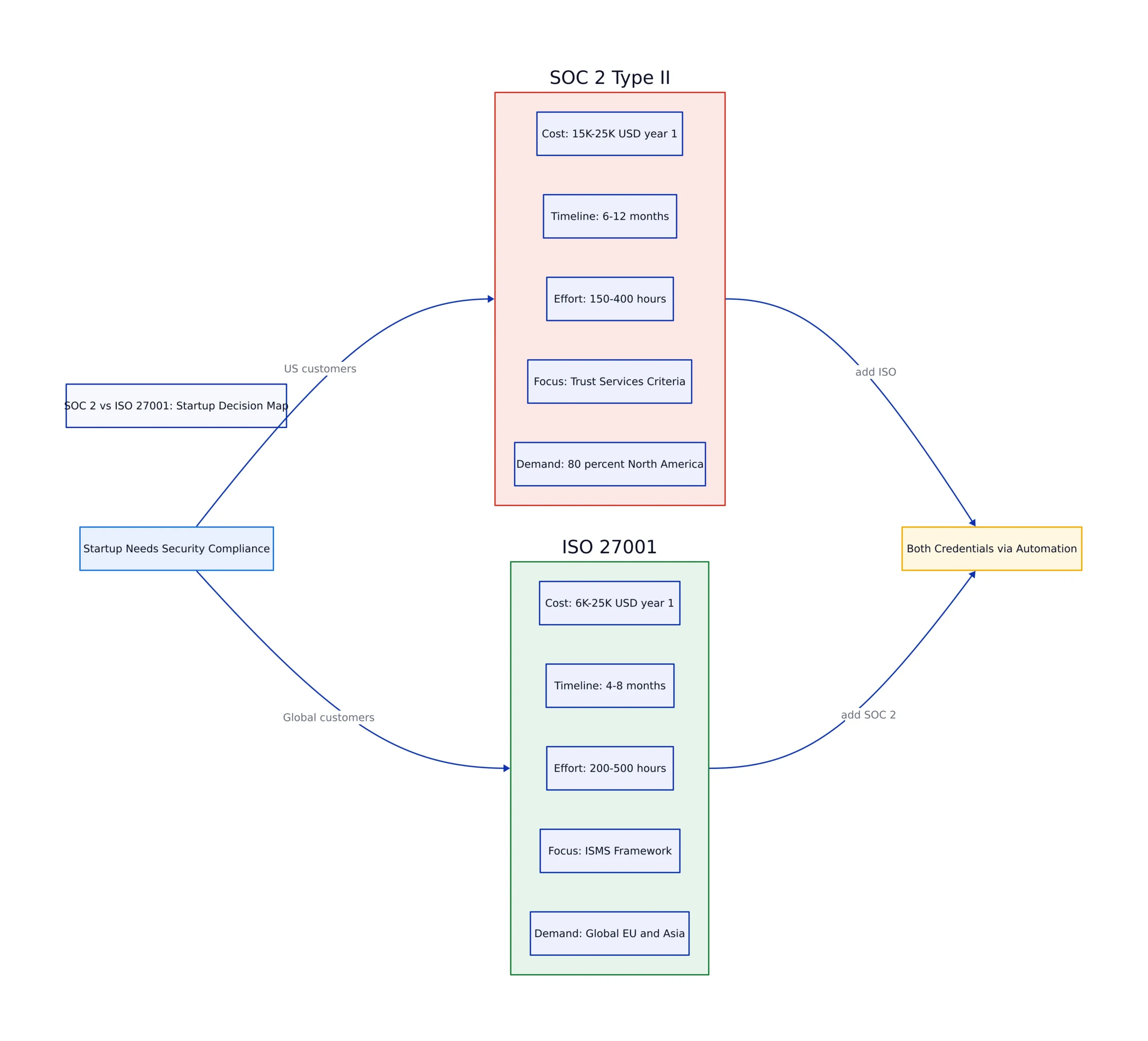
The ISO 27001 figure is higher because the standard requires a functioning Information Security Management System, not just a set of controls. That means a formal risk assessment, an asset inventory with owners, a Statement of Applicability, a management review process, and a mandatory internal audit. SOC 2 has no equivalent of the Statement of Applicability and does not require an internal audit, which is why its effort estimate is lower.
For a ten-person startup, 400 hours of compliance work is roughly a quarter of one engineer’s year. That is the real constraint, not the auditor’s invoice. Teams that underestimate it end up either delaying the certification or pulling engineers off product work at the worst possible moment.
Certification Scope and Focus
The two frameworks answer different questions. SOC 2 focuses on controls: it asks whether the controls protecting a specific service are designed appropriately and operating effectively. That scope fits a SaaS startup with US clients, because the report can be limited to the product and the systems that support it. ISO 27001 focuses on the system: it certifies a management system that covers the whole organization, including people, processes, and suppliers.
ThinkCloudly’s control comparison explains the distinction well: SOC 2 lets you define your own controls against the AICPA’s Trust Services Criteria, with Security mandatory and Availability, Processing Integrity, Confidentiality, and Privacy optional, while ISO 27001 provides 93 Annex A reference controls across four themes and requires you to justify any you exclude.
That flexibility affects startups both ways. SOC 2’s narrow scope makes it cheaper and faster to achieve, but the evidence is tied to the systems you put in scope, so launching a new product can require a new audit window. ISO 27001’s organization-wide scope means the certificate covers everything you do, which is more useful for a company with multiple products or a broad international presence, but it also means more documentation to maintain.
Regional Market Demands and Customer Expectations
Geography is the clearest signal, and the data is blunt. According to soc2auditors.org’s 2026 framework guide, over 80% of North American prospects explicitly request SOC 2. US and Canadian procurement teams rely on it, and a lapsed report can disqualify a vendor before a human reviews the proposal.
ISO 27001 is recognized globally and carries more weight in Europe and Asia, where procurement teams ask for the certificate by name. ISO27001Kit’s startup comparison notes that European, UK, APAC, and Middle East buyers prefer it, and that global enterprises frequently list it as a requirement. Regulatory pressure is reinforcing that preference: as of March 2026, 21 of 27 EU member states had transposed the NIS2 Directive into national law, according to the ECSO NIS2 transposition tracker cited by soc2auditors.org, which has increased ISO 27001 demand among EU-serving vendors.
For a startup selling into both regions, the practical approach is to lead with the framework of the higher-revenue market and add the second when the new market requires it, rather than pursuing both on day one.
Cost-Effectiveness and Hidden Expenses
The advertised audit fee is not the total. Tooling costs for ISO 27001 can reach up to $40,000 per year for legacy platforms, though lighter options exist well below that, as noted in SecureSlate’s breakdown. Total first-year ISO 27001 costs often land between $15,000 and $60,000 once tooling, consulting, and internal effort are counted, per GovernanceDocs’ startup guide.
Three hidden line items catch startups off guard. Penetration testing is required by both frameworks, and auditors do not accept an automated scan as a substitute. Readiness consulting often makes the difference between a clean report and a qualified one, and it is a real cost. And the internal engineering hours, the 150-400 or 200-500 range, never appear on an invoice but are the largest single expense for a small team.
Scope discipline controls costs best. Every system added to the audit scope is more evidence to collect and more money spent proving things no customer asked about. Scoping the first engagement strictly to production systems and customer data keeps both frameworks affordable.
Automation and Tooling Support
Compliance automation platforms have changed the effort involved. Tools like Sprinto, Vanta, and Klaay connect to your identity provider, cloud accounts, and ticketing systems to collect evidence continuously, replacing the manual screenshot-and-spreadsheet routine that once consumed most of the internal hours. Sprinto reports that automation can reduce ISO 27001 effort by up to 50%, and Klaay’s 2026 tool comparison lists platforms that cover both SOC 2 and ISO 27001 in a single product.
Automation does not replace control design. A platform will not write your access review policy, define your change management process, or run your risk assessment. It collects evidence that your controls exist and operate, but you still have to build and run them. The common failure is connecting integrations, watching the dashboard turn green, and assuming the audit will be straightforward, when the auditor is testing whether the controls actually worked, not whether the dashboard looks healthy.
The trade-off deserves mention. Automation platforms add recurring subscription cost, and a startup that adopts one before it has basic hygiene, meaning inventory, access reviews, and patching, will be overwhelmed by alerts it cannot triage. The alternative is to start with the provider’s native configuration tools, which are free but less automated, and move to a dedicated platform when manual review stops scaling.
Strategic Considerations for Startups
Startups targeting US clients often pursue SOC 2 first, because North American procurement asks for it and it unblocks deals fastest. Startups with international ambitions should evaluate ISO 27001 for its global recognition, since European and APAC buyers ask for the certificate by name. That decision framework, laid out by soc2auditors.org, depends on customer geography rather than framework quality.
The two frameworks overlap heavily, which lowers the cost of eventually holding both. Estimates of shared controls range from 60 to 80 percent depending on the source, but the direction is consistent: access control, encryption, logging, change management, incident response, and vendor management appear in both. That means the second credential is mostly documentation mapping rather than a second full program, and a startup that already runs one framework can typically add the other in a few months.
The effective sequence is to build against the stricter requirement first, then map the same evidence to the second framework. This is the evidence discipline covered in our SOC 2 Type II audit preparation guide, and it keeps the second certification from doubling the cost.
Surprising Findings and Practical Examples
Some startups do not sequence the two frameworks at all. OpenAssets, a digital-asset infrastructure provider, announced in August 2026 that it holds both a clean SOC 2 Type 2 report covering January 6 through July 5, 2026, and a renewed ISO/IEC 27001:2022 certification, per its announcement. The company serves regulated financial institutions, which matches the customer profile that demands both credentials. Note the sourcing: this is a company press release, so it describes the company’s own claims about its program.
Holding both simultaneously is efficient only if planned early, because the shared control core means the second audit reuses most of the first one’s evidence. Startups that discover the overlap after building two separate programs pay for the same work twice. The lesson is that the control set should be designed once, mapped to both frameworks, and certified in the order the market requires.
The deciding factor for most startups is which one the buyers already in the pipeline will accept, and how soon. SOC 2 is the faster, narrower path for US-facing SaaS; ISO 27001 is the broader, more documentation-heavy path for international and regulated markets. Getting the order right, and building once, makes the difference between one program and two.
Related Reading
More in-depth coverage from this blog on closely related topics:
- SOC 2 Compliance in 2026: A Complete Guide
- SOC 2 Type II Audit Preparation
- Enterprise Compliance Standards for Data Security
Sources and References
Sources cited while researching and writing this article:
- How Much Does ISO 27001 Cost in 2026? Full Breakdown
- ISO 27001 vs SOC 2: Complete Comparison Guide (2026)
- SOC 2 for Startups: The Practical Guide for 2026 – Xorabyte
- SOC 2 vs ISO 27001: From Security Controls to Compliance
- SOC 2 vs ISO 27001 (2026): Which Should You Get First?
- ISO 27001 vs SOC 2 – Side-by-Side Comparison for Startups (2026)
- Best SOC 2 Compliance Tools for Startups in 2026 – Klaay
Nadia Kowalski
Has read every privacy policy you've ever skipped. Fluent in GDPR, CCPA, SOC 2, and several other acronyms that make people's eyes glaze over. Processes regulatory updates faster than most organizations can schedule a meeting about them. Her idea of light reading is a 200-page compliance framework, and she remembers all of it.