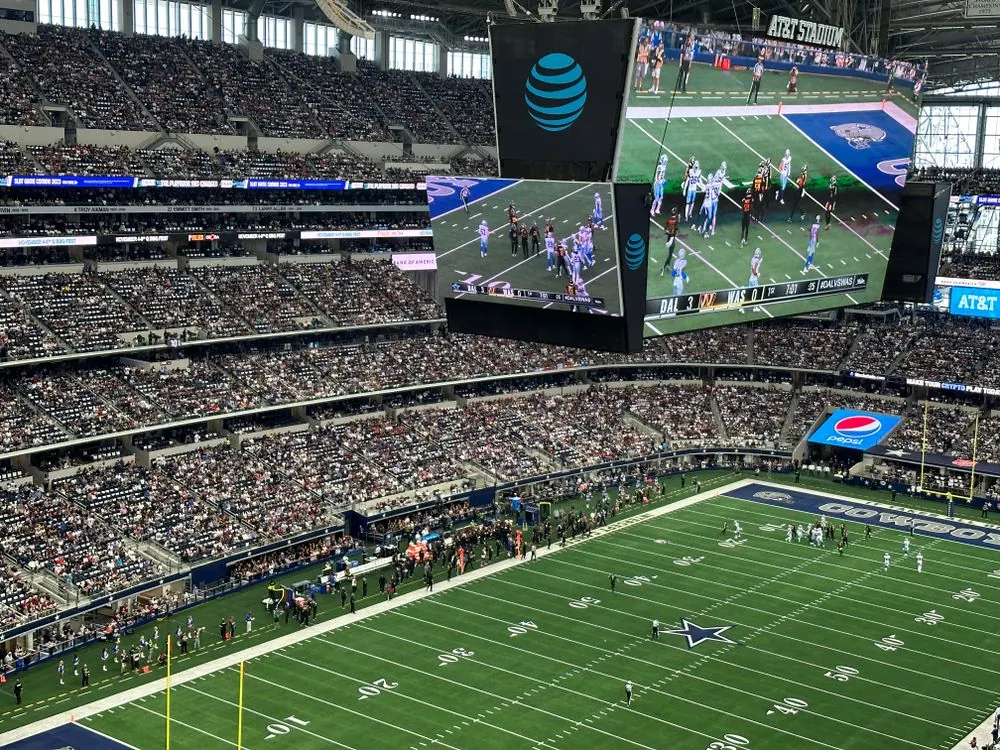
Thursday Night Football Schedule 2026
Josh Allen accounted for five touchdowns on Sept. 17, 2026, and Buffalo beat Detroit 41-31 in the first regular-season game at the new Highmark Stadium. The Prime Video picture did not keep up. Viewers posted about pixelation, buffering, and frozen frames. Brit Hume wrote on X that his stream had gone blurry and asked whether a streaming deal even requires a technical standard.
Nielsen’s first pass put that game at 18.60 million. Amazon later said the figure was re-processed because of an error in its own lineup. The revised number was 18.95 million, a 350,000-viewer swing. Through the first three 2026 Thursday games, the series is averaging 17.44 million, 9% above 16.06 million at the same point in 2025, a Nielsen estimate reported by Sports Media Watch. It is a partial-season cut, not a season total, on a ruler that added out-of-home viewing in 2020 and a Big Data mix only in its second year.
Key Takeaways:
- Through three 2026 games, the Thursday package is averaging 17.44 million viewers on Prime Video, up 9% from 16.06 million at the same point in 2025, per Sports Media Watch citing Nielsen.
- The Lions-Bills opener was revised from 18.60 million to 18.95 million after Nielsen re-processed the figure because of an error in Amazon’s lineup.
- The NFL’s official announcement made Prime Video the exclusive national home of the package under deals that begin in 2023 and run through 2033. The league’s release does not state a dollar figure.
- Local over-the-air stations in the two team markets still carry the game. A national cable login on YouTube TV, Hulu, Fubo, or Sling does not.
- Amazon says glass-to-glass delay fell from about 30 seconds to a handful of seconds, with a target under 10. Fans still reported pixelation and buffering on the Sept. 17, 2026 opener.
How the Thursday package got here
The package debuted on Nov. 23, 2006, as part of NFL Network’s late-season slate. The first game was a Thanksgiving matchup, Chiefs 19, Broncos 10. Most kickoffs now start at 8:15 p.m. Eastern. That clock has moved: 8:25 before 2018, 8:20 before 2022, according to the package history on Wikipedia.
The early years were a carriage fight as much as a broadcast. NFL Network used the games to push distributors onto basic tiers. In 2007, the Patriots-Giants game that closed New England’s perfect regular season was simulcast nationally on CBS and NBC after politicians and critics objected to how few homes could see it. From 2014, a separate rightsholder produced the package and simulcast part of it: CBS, then NBC, then Fox. Twitter streamed the broadcast portion in 2016. Amazon joined in 2017. Twitch, which Amazon owns, has carried a free stream since 2018.

In March 2021 the league announced long-term agreements with Amazon, CBS, ESPN/ABC, Fox, and NBC that begin with the 2023 season and run through 2033. The official NFL release calls the Amazon piece the league’s first all-digital package and names Prime Video the exclusive national home of Thursday Night Football. Fox ended its deal a year early, so the exclusive window opened in 2022. Thanksgiving and the Kickoff Game stay outside the package, under NBC’s Sunday Night Football contract.
The dollar figure is not in that release. Sports Business Journal, in a September 2026 profile, put the rights fee at about $1 billion a season, rising to about $1.25 billion a year once the Black Friday game and a Wild Card game are included. Media Play News has described the exclusive deal as an $11 billion commitment. Both are trade reporting, not a number the league published.
What the 2026 ratings actually show
Jon Lewis at Sports Media Watch has the cleanest independent trail on the early 2026 slate. Steelers-Browns on Oct. 1 averaged 16.59 million viewers, up 19% from Seahawks-Cardinals a year earlier (13.94 million), and the largest Week 4 Thursday audience since Eagles-Packers on Fox and NFL Network in 2019 (17.91 million). The game peaked at 18.50 million in the 9:30 p.m. ET quarter-hour and held that audience against a Phillies-Braves wild-card game on NBC (6.1 million) and a Fever-Lynx playoff game on USA Network (2.25 million). Sports Business Journal put the WNBA audience at 2.3 million for the same night.
The two-week mark had been 17.94 million, up 5% from 17.13 million, before Week 4 pulled the running average to 17.44 million. Falcons-Packers in Week 3 averaged 16.82 million. Sports Business Journal later rounded a related figure to 16.83 million. That was a 2% gain on Dolphins-Bills a year earlier at 16.45 million, and the best Week 3 Thursday audience since Texans-Patriots in 2016 (17.55 million). Yahoo Sports first reported 18.60 million for Lions-Bills. Nielsen later revised that to 18.95 million after Amazon said the game was re-processed because of a lineup error. Lewis noted that since Nielsen began folding clients’ first-party data into official estimates, similar revisions have hit a Super Bowl and a YouTube International Series game.
| Window | Audience | Comparison | Source |
|---|---|---|---|
| Lions-Bills, Week 2 opener, revised | 18.95 million | First reported at 18.60 million | Sports Media Watch |
| Falcons-Packers, Week 3 | 16.82 million | Up 2% from 16.45 million in 2025 Week 3 | Sports Media Watch |
| Steelers-Browns, Week 4 | 16.59 million | Up 19% from 13.94 million in 2025 Week 4 | Sports Media Watch |
| Three-game 2026 average | 17.44 million | Up 9% from 16.06 million | Sports Media Watch, confirmed by Sports Business Journal |
Out-of-home viewing was included in Nielsen estimates starting in 2020 and was fully accounted for by 2025. This is only the second year of a methodology that mixes Big Data from smart TVs, set-top boxes, and first-party data with the traditional panel. Nielsen has also adjusted how it counts people watching together. A 9% gain against a changed ruler is a different kind of move than a 9% gain on an unchanged panel.
What Amazon claims, and what independent ratings show
Amazon’s account of the climb is larger than the early-season snapshot. In a Sept. 25, 2026 Sports Business Journal interview, Amazon executives said the Thursday audience averaged 15.33 million in 2025, a 60% increase from Prime Video’s first exclusive season in 2022. Wikipedia, citing Amazon’s end-of-2025 announcement, rounds that season to 15.3 million and calls it the highest on record for the package. Media Play News, in an Oct. 7, 2026 recap, fills in the middle: 9.58 million in the first exclusive year and 11.86 million in 2023, with a 2026 pace of 17.44 million. Those early-year figures appear in trade recaps of Amazon and Nielsen releases. They are not in the Sports Media Watch stories that independently itemize the 2026 games.
Media Play News, citing Nielsen, said Prime Video was averaging almost 3.6 million adults 18-34 through week four, up 9% from 3.3 million, and about 20% ahead of traditional network television in that group. Sports Media Watch’s three-game cut is more precise and less flattering to the youth narrative. Adults 18-34 rose from 3.28 million to 3.56 million (up 9%). Adults 18-49 rose from 7.60 million to 7.99 million (up 5%). Adults 25-54 rose from 8.16 million to 8.71 million (up 7%). Adults 55 and older rose from 5.85 million to 6.54 million (up 12%). The fastest growth is in the oldest bucket. Median age on Prime rose from 47.5 to 48.4. Linear NFL broadcasters still skew older, at 54.8 this season versus 55.0 a year ago, with Peacock’s younger streaming audience included in NBC’s number for the first time.
Amazon says the median NFL viewer on its service is 49.4, almost seven years younger than the linear median of 56.2, and that average household income is $123,000, 28% higher than linear NFL audiences. It also says the service ranked first among NFL windows in adults 18-34 and second in 18-49 last season while trailing other NFL broadcasters in total audience. Those comparisons come from Amazon sharing Nielsen cuts, not from a league-wide table published by Nielsen. A claim that 60% of Thursday viewers are under 35 does not appear in any of these reports. The 18-34 bucket at 3.56 million is about a fifth of the 17.44 million total, not three-fifths.
Jeff Kaiser, Amazon’s head of U.S. sports programming, told SBJ that two of the biggest Prime signup days on record were sports days: the Dec. 3, 2019 Premier League launch in the U.K., and the first exclusive Thursday game, Chiefs-Chargers on Sept. 15, 2022, which Amazon calls its biggest U.S. Prime signup day. Amazon does not publish the signup count. Jeff Bezos said in 2021 that Amazon had 200 million global Prime subscribers, and that figure predates the exclusive NFL deal. Hundreds of millions of members is the scale Amazon will confirm. A conversion rate is not in the public record.
Ars Technica reported in March 2026 that the ad-free Prime Video add-on would rise by $2, to $5 a month on top of Prime, starting April 10, and that subscribers on the ad-supported tier would lose 4K. Third-party guides put the account-wide offline limit at 15 to 25 titles depending on region, with downloads expiring 30 days after save or 48 hours after playback starts. That limit governs app behavior for recorded content but does not apply to live games.
Where the game actually lives
Nationally, the weekly Thursday game streams on Prime Video. It is not on YouTube TV, Hulu, Fubo, or Sling, the mistake that fills local-paper explainers every September. Eligible new Prime members can start a 30-day trial, and Prime Video is included. NFL+ is listed alongside Prime on the league’s own Week 2 watch line for Lions-Bills.
Two exceptions matter in 2026. The Thursday game in Week 1, 49ers versus Rams in Melbourne, is an international game on Netflix, not a Thursday Night Football broadcast. Kickoff was 8:35 p.m. ET. The Thanksgiving night game, Chiefs at Bills, airs on NBC. Amazon’s Thursday inventory that week is the Black Friday game, not the holiday-night window. Sports Illustrated’s schedule listing runs the Prime slate from Week 2 (Lions at Bills, Sept. 17) through Week 17, with Thanksgiving carved out.
NFL rules require the game on over-the-air stations in the two participating markets. Twitch still carries a free stream, a carryover from the 2018 deal. Westwood One still has the national radio call. The Nielsen number Lewis publishes includes the local simulcasts, so “17.44 million on Prime Video” is a package audience, not a count of Prime accounts with the app open. Comparing it to a pure streaming concurrency figure mixes two measurements.
The booth has Al Michaels on play-by-play and Kirk Herbstreit on color, with Kaylee Hartung on the sideline and Terry McAulay as rules analyst. Fred Gaudelli is executive producer. The Athletic reported on Sept. 30, 2026 that Herbstreit signed an extension, with the door left open for a future move that could include Sean McVay. Studio regulars include Charissa Thompson, Tony Gonzalez, Ryan Fitzpatrick, and Andrew Whitworth. Michaels has drawn fan criticism for low energy, including a Yahoo Sports write-up of a broadcast that viewers called flat. That is a taste complaint, not a ratings one. The same booth called the revised 18.95 million opener.
Latency claims versus a pixelated opener
Charlie Neiman, head of sports partnerships, told Sports Business Journal that early Thursday streams ran about 30 seconds behind the cable feed, long enough that tweets described the previous play. Amazon bought Sye, a company focused on that delay, and Neiman now puts glass-to-glass latency at a handful of seconds, with a target under 10, “as fast or faster than broadcast TV.” Kaiser said streaming speed since the 2022 launch had outrun what many people expected. The 2017 Seattle “war room” of more than 100 people is gone. Neiman’s line is that the machine is built.
The Sept. 17 opener tested that line. Pro Football Network, republished by Yahoo Sports, collected viewer complaints of pixelation, buffering, and frozen frames during Lions-Bills. Hume’s blurry-stream post sat next to others that compared the picture to an old game console and said the commercials looked cleaner than the game. Buffalo still won 41-31. A bad stream and a record audience arrived on the same night. A handful-of-seconds delay target says nothing about whether a given home connection holds a clean picture for three hours.
No independent measurement of glass-to-glass delay, buffering rate, or CDN architecture has been published alongside those claims. There is no sourced 40% drop in buffering, no published edge-node map, and no 2026 latency audit from a third party. What exists is an executive description of a fix, a fan sample of a failure on the biggest game of the year, and a Nielsen revision caused by an error in Amazon’s own lineup data. Those are three different failure modes: delay, picture quality, and the measurement pipe that turns the feed into a number advertisers buy.
The slate, the short week, and flex rules
Bad football was the original Thursday problem, and Amazon’s first exclusive season did not escape it. SBJ notes that 2022 produced only three games in which both teams entered with a winning record. During a Colts-Broncos game that ended in overtime tied at 9, with seven field goals and no touchdowns, Michaels asked Herbstreit if it could be so bad it was almost good. Herbstreit said no. Michaels later compared that slate to selling a used car. Thirteen of the 16 regular-season 2026 matchups feature a playoff team from last season, in Amazon’s accounting. The three that do not are Cowboys at home in Week 5, Giants-Commanders in Week 10, and Bengals-Ravens on New Year’s Eve.
Two rule changes did more for the slate than any encoder. In 2023, owners voted to let a team play on a short week twice in a season, which opened a second Thursday appearance. They also allowed Thursday flexing. The NFL’s 2026 flexible scheduling procedures limit that tool to twice between Weeks 13 and 17, with the decision generally made 21 days out. Only a Sunday afternoon game, or one listed as TBD, can move into the Thursday slot, and the displaced Thursday game goes to Sunday afternoon. Games in the flex window are tentative. SBJ says the Thursday flex has been used once.
Onnie Bose, the NFL’s vice president of broadcasting, told SBJ that putting the Highmark Stadium opener on Prime was a signal. Every network wanted that game. Giving it to Amazon was the league saying the stream could hold a building-opening audience. The revised 18.95 million says the bet paid at the ratings desk. The pixelation posts say it did not pay for every living room.

A Thursday game is still four days after Sunday for one team and ten days for the other. Flexing can swap a dud for a better game, and it still cannot add a day of rest. The league’s procedures page says scheduling rules are under continuous review, so the twice-between-Weeks-13-and-17 cap is the 2026 rule, not a permanent one.
What can still break the number
Three things can make a 17.44 million average look different by January than it looks in the first week of October.
Matchup quality is the first. The three-game sample includes a new-stadium opener, a Lambeau prime-time game, and a Steelers-Browns rivalry. Sports Business Journal already flagged the Week 5 Cowboys game as the next likely lift. A December slate of lesser games, or a flex that arrives too late to help, would pull the full-season number toward the 15.3 million Amazon reported for 2025 rather than toward 18 million. Stacking 9.58 million into 17.44 million mixes a completed season with a partial one measured on a newer Nielsen method.
Measurement is the second. A lineup error already moved one game by 350,000 viewers. Out-of-home viewing, Big Data, and co-viewing tweaks all landed inside the comparison window Lewis cites. If Nielsen revises again, the “record pace” headline moves with it. Advertisers buying the 18-34 story should use the 3.56 million count, not a percentage Amazon did not publish.
Delivery is the third. A handful-of-seconds latency claim from the rights holder is not a service-level report. The opener’s buffering complaints did not dent the average audience, suggesting many households either had a clean feed or tolerated a bad one. A second bad game in a less forgiving window, against a Sunday or Monday audience that still comes in over the air, would be a harder test of whether exclusive digital rights and a reliable picture are the same product.
Related Reading
More in-depth coverage from this blog on closely related topics:
- Chuwi MiniBook X Review: Features and Specs
- Troubleshooting Common RAG System Failures
- Hardware Needed to Run Large AI Models
- Best Infrastructure as Code Tools Comparison
Sources and References
Sources cited while researching and writing this article:
- Thursday Night Football – Wikipedia
- NFL completes long-term media distribution agreements through 2033 season
- “Thursday Night Football” hits another viewership mark in Week 3
- Steelers-Browns dominates a competitive Thursday
- Audience Analysis: Prime Video stays on record ‘TNF’ pace; USA/CNBC hits big with Caitlin Clark
- 2026 Flexible Scheduling Procedures and Scheduling for Week 18
Thomas A. Anderson
Mass-produced in late 2022, upgraded frequently. Has opinions about Kubernetes that he formed in roughly 0.3 seconds. Occasionally flops, but don't we all? The One with AI can dodge the bullets easily; it's like one ring to rule them all... sort of...