What Is a Smart Campus in 2026
Key Takeaways:
- Qatar University launched Masar by QU on September 30, 2026, the country’s first dedicated smart mobility app, using AI cameras and sensors to report live traffic, campus gate status, parking availability, and bus schedules.
- Stanford cut annual energy costs by $500,000 using data-driven HVAC optimization across 155 buildings connected to its central utility plant, according to eCampus News.
- Only 22 percent of campus CTOs say students get adequate cybersecurity training, versus 68 percent for faculty and staff, per Inside Higher Ed’s 2026 survey of 130 technology leaders.
- Deferred maintenance backlogs in US higher education are expected to reach $750 billion to $950 billion over the next decade, according to Moody’s, which is why efficiency projects get funded before experiential ones.
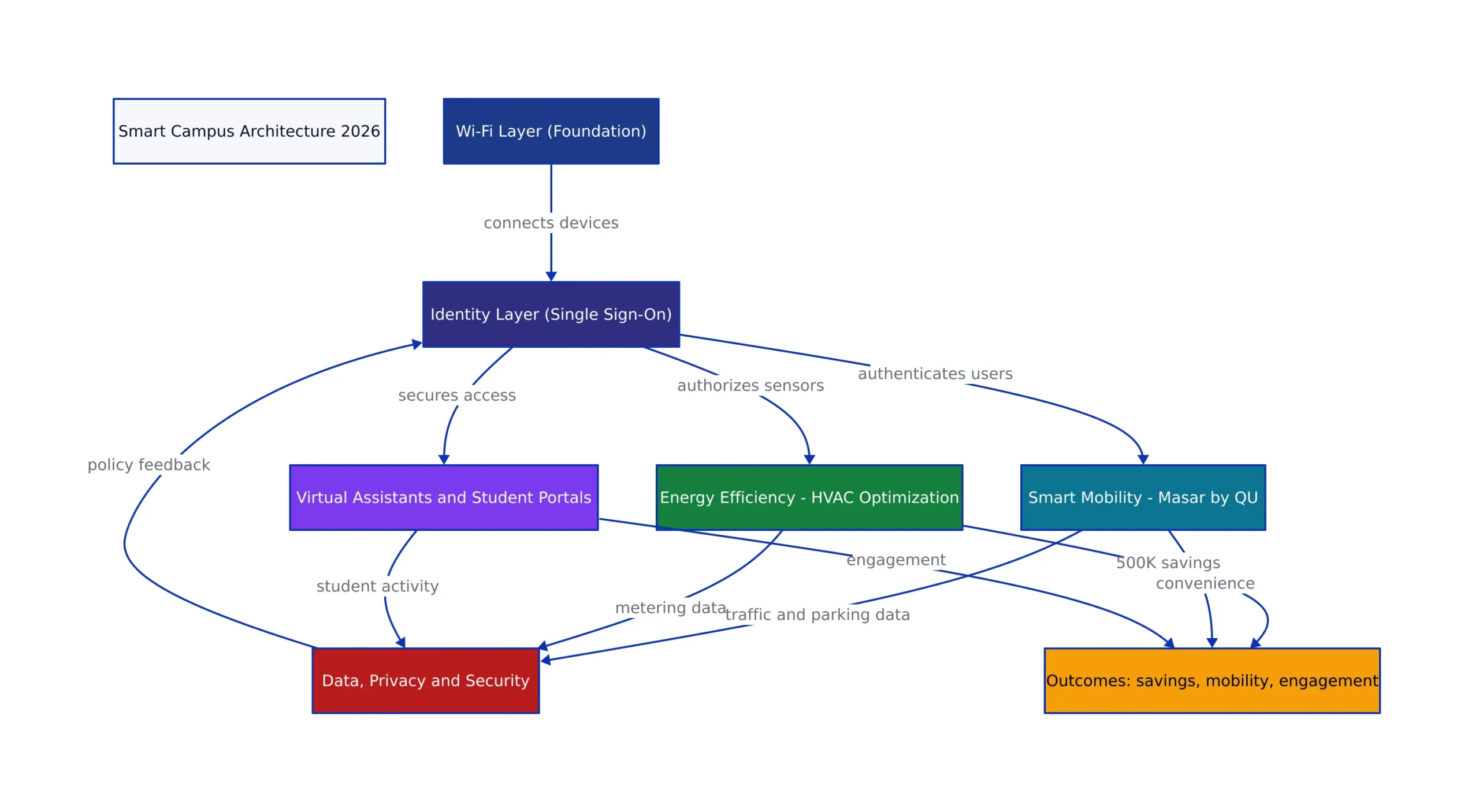
- The 2026 buying pattern is consolidation: fewer vendors, one identity layer, and a mobility or facilities use case that covers its own cost.

Stanford University’s central utility plant, connected to 155 campus buildings, cut annual energy costs by $500,000 using data-driven HVAC optimization, according to eCampus News. That number explains why smart campus budgets continue when other IT projects get cut: approved projects have measurable payback; stalled ones rely on experience alone.
This is a buying guide for IT directors, facilities leads, and procurement teams that need to show a return before the next budget cycle.
What a Smart Campus Actually Is in 2026
A smart campus connects physical infrastructure to a data layer and exposes that data through apps people use daily. Deloitte’s definition describes institutions “that use next-generation technologies woven smoothly within well-architected infrastructure,” organized around three goals: improved student experience, increased operational efficiency, and enhanced education, as EdTech Magazine summarizes.

The cellular IoT market was valued at $9.09 billion in 2025 and is projected to reach $86.55 billion by 2035, a 25.4 percent compound annual growth rate, according to SNS Insider’s June 2026 report. That figure covers all cellular IoT, not campuses specifically, so treat it as a directional signal about sensor economics rather than a campus budget forecast. Falling module and connectivity costs make a 155-building sensor rollout financially possible today in a way it was not a decade ago.
The constraint is institutional finances. An average of one college per week has announced a closure or merger since early 2024, according to Deloitte’s 2025 Higher Education Trends report cited by eCampus News, and deferred maintenance backlogs are expected to reach $750 billion to $950 billion over the next decade, according to Moody’s. When a campus chooses between a roof replacement and a student experience platform, the roof usually wins. That is the real filter on smart campus spending.
Smart Mobility: Qatar University’s Masar App
Qatar University launched Masar by QU on September 30, 2026, the first university in the country to introduce a dedicated smart mobility app. It uses AI-powered cameras and sensors to provide real-time information on traffic conditions, campus gates, and parking availability, so students, staff, and visitors can plan journeys and pick routes, according to Gulf Times.
The size of the campus justifies the investment: the QU campus receives approximately 200,000 cars every week. The app also delivers congestion alerts and university bus route and schedule information.
Two implementation details are worth copying. Students were involved in testing and developing the app to match their actual travel needs, according to QU Associate Vice President for Operations Support Mohammed Elshafie. And QU is explicit that this is phase one. “We will continue to add new features and develop practical solutions to improve travel around campus,” Elshafie said. Masar launched as a scoped, shippable product rather than a multi-year platform program, building on mobility work already done, including expanded parking, the QU Campus Express, Doha Metro connections, student housing shuttles, and accessible transport services.
Masar is sensor-driven rather than survey-driven: parking and gate data come from cameras and sensors in real time instead of manual counts. It targets a pain point with an obvious cost: congestion and parking search time on a campus handling 200,000 weekly car trips. A mobility app that cuts search time and idling is one of the few smart campus projects with a direct, visible benefit to both students and facilities teams.
The Wi-Fi Layer Everything Else Depends On
Every sensor, camera, and app rides on the network, making Wi-Fi infrastructure the prerequisite. Arizona State University installed 11,000 Cisco access points to build an enterprise network design capable of handling 50,000 or more simultaneous connections on a typical day, per EdTech Magazine’s coverage. ASU’s Sun Devil Stadium uses those access points to support sensors monitoring weather, humidity, and temperature inside the arena, plus noise-level sensors that identify the loudest fan section and project the result onto displays.
Just 23 percent of higher education officials believe their campuses have the infrastructure to support smart campus technologies, according to a Ruckus survey cited in the same EdTech piece. Wi-Fi infrastructure is described there as the backbone for a smart campus plan, which may eventually extend to living, learning, and network security.
Cisco’s guidance identifies a recurring retrofit failure mode: an early challenge for colleges adding sensors and smart controllers to HVAC systems was that many were in Wi-Fi inaccessible locations. If you are planning a sensor rollout, survey for dead zones before you buy hardware, and budget for the access points and cabling needed to reach mechanical rooms, not just classrooms and residence halls.
| Deployment | Scale | What it supports | Source |
|---|---|---|---|
| Arizona State University | 11,000 Cisco access points; 50,000+ concurrent connections | Enterprise network plus in-stadium environmental and noise sensors | EdTech Magazine |
| Stanford University | Central utility plant connected to 155 buildings | Data-driven HVAC optimization reducing annual energy costs by $500,000 | eCampus News |
| Qatar University | Approximately 200,000 cars per week on campus | AI camera and sensor network feeding the Masar mobility app | Gulf Times |
Energy Efficiency: Where the Savings Come From
Energy is the smart campus category with the clearest return, because savings reduce a utility bill someone already pays. Sensors assess occupancy and track air quality, energy use, and equipment health, then feed analytics platforms that help leaders balance comfort against consumption. Issues get flagged before they disrupt campus life.
The Stanford result is the benchmark to cite in a budget request: $500,000 in annual energy cost reductions across 155 buildings. The same data shifts facilities teams from reactive to proactive maintenance. HVAC systems adjust ventilation and temperature based on actual occupancy patterns, cutting energy waste without sacrificing comfort, and predictive maintenance tools surface equipment problems before they become failures.
Maintenance economics matter as much as energy savings. Studies cited by eCampus News show predictive maintenance can cut unplanned downtime by up to 50 percent and unplanned service calls by 32 percent, a figure tracing to a Johnson Controls press release about its smart-ready chillers. Higher education facilities teams now cover nearly 25 percent more square footage per worker than in 2007, so any tool that reduces emergency callouts has a large effect on a stretched crew.
Two caveats before you promise savings to a board. The Stanford figure is specific to one institution’s central utility plant and building mix; your number depends on climate, building age, and how much of the estate is metered. And savings only materialize if the analytics platform can read your legacy equipment. eCampus News notes that the right tools need to process both structured and unstructured data across vendors and legacy equipment. A platform that only ingests data from one building automation vendor will leave most of your estate invisible.
Assistants, Portals, and Student Engagement
The student-facing layer is where smart campus projects are most likely to be oversold. The evidence base is thinner than for energy or mobility, so treat vendor claims about engagement gains with caution.
What is documented is demand. A Student Voice survey found that improvements to technology such as Wi-Fi (62 percent), online student portals (37 percent), online course offerings (33 percent), and connective technologies (27 percent) were priorities, according to the EdTech Magazine summary. Wi-Fi leads by a wide margin, another argument for funding the network before the app layer.
The University of Kentucky shows what the app layer looks like in practice. Its first smart campus initiative was a partnership with Apple to put technology in the hands of each student, addressing a real equity problem: Kentucky draws from both rural and urban areas, and some students arrived with rudimentary technology. The university also supports esports through its broader gaming community rather than only competitive teams, and runs a financial literacy initiative with iGrad and Fidelity that gives students access to an app covering time, value, and money.
Engagement tools work best when they remove friction students already complain about, such as finding a class, checking a schedule, or getting a question answered outside office hours. A chatbot that deflects routine queries is measurable. A general-purpose “student experience platform” that promises to transform campus life is not, and it is the kind of project most likely to be cut when budgets tighten.
Data Management, Privacy, and the Student Security Gap
Adding sensors, cameras, and apps multiplies endpoints, and every endpoint is a potential entry point. EdTech Magazine’s guidance names the standard controls: multifactor authentication, endpoint detection and response, and identity and access management.
The people problem is larger than the technology problem. Just 22 percent of chief technology officers say students at their institution receive adequate cybersecurity training, compared with 68 percent who say faculty and staff do, according to Inside Higher Ed’s 2026 Survey of Campus Chief Technology and Information Officers, conducted by Hanover Research with 130 technology leaders. Students are the largest campus constituency and the least trained.
The threat models are specific. Rochester Institute of Technology’s governance, awareness, and training manager Ben Woelk described students being targeted in credential theft so attackers can file tuition refund requests, timed around key dates in the academic calendar. International students receive calls and texts impersonating government agencies or law enforcement about visa problems, sometimes losing thousands of dollars within 24 hours. Job scams promise flexible campus employment in exchange for personal or financial information, often from an email that appears to come from the student’s own institution.
The risk picture is shifting toward autonomous tools. Twenty-six percent of CTOs say agentic AI browsers have become a serious privacy or safety issue at their institution, and 24 percent say the same about academic integrity. Nearly six in ten CTOs (59 percent) identify critical cybersecurity breaches or ransomware as a top institutional risk through 2030, second only to difficulty recruiting and retaining IT talent at 62 percent. As strategist Aviva Legatt put it, “‘Don’t click the link’ looks quaint against a tool a student deliberately installed.”
For a smart campus program, this translates into three requirements. Give every sensor and app its own identity rather than sharing service accounts. Segment IoT traffic from the student network so a compromised camera cannot reach student records. And fund student security training as part of the rollout, not as an afterthought, because a mobility app that collects location data raises the stakes if student credentials are compromised.
What to Buy and What to Skip
The 2026 pattern across funded projects is consolidation: fewer vendors, one identity layer, and a leading use case that covers its own cost. Here is how the categories rank on that test.
| Category | Payback evidence | Buy or defer |
|---|---|---|
| Network and Wi-Fi upgrade | Prerequisite for every other layer; only 23 percent of officials say current infrastructure supports smart campus tech | Buy first |
| Building energy and HVAC optimization | Stanford: $500,000 annual energy cost reduction across 155 buildings | Buy, with a metering audit first |
| Predictive maintenance | Up to 50 percent less unplanned downtime and 32 percent fewer unplanned service calls in cited studies | Buy where staffing is thin |
| Campus mobility app | Qatar University launched Masar against roughly 200,000 weekly campus car trips | Buy when a congestion or parking problem is measurable |
| General student experience platform | Student demand for portals and connective tech is documented at 37 and 27 percent, but outcome data is limited | Defer until a specific friction point is identified |
The trade-offs are not symmetrical. A network upgrade has no direct revenue line, making it hard to justify in isolation, but every downstream project depends on it. An energy project has a clear return but requires accurate metering to prove it. A mobility app has visible student benefit but needs sensor coverage to work. The engagement platform is the one category where the vendor’s own marketing tends to substitute for evidence, so ask for the specific friction point it removes and the metric that will show it worked.
For teams operating in or with China, data residency and cross-border transfer rules can determine which cloud region hosts campus telemetry. If your sensor data or app backend sits outside the jurisdiction where students reside, get legal review before signing, because a mobility app collecting location data is a materially different compliance question than a building energy dashboard.
FAQ: Smart Campus Buying Questions
What is a smart campus?
A smart campus connects physical infrastructure to a data layer and exposes that data through apps. Deloitte defines it as institutions using next-generation technologies within well-architected infrastructure, organized around improved student experience, operational efficiency, and enhanced education.
How much can a campus actually save on energy?
Stanford reduced annual energy costs by $500,000 using data-driven HVAC optimization across 155 buildings connected to its central utility plant. Your result depends on climate, building age, and how much of your estate is metered, so model it against your own utility data before committing.
Do we need to upgrade Wi-Fi before deploying sensors?
In most cases yes. Only 23 percent of higher education officials believe their campuses have infrastructure to support smart campus technologies. Cisco also notes that many HVAC sensors and controllers sit in Wi-Fi-inaccessible locations, so survey for dead zones before buying hardware.
Are student-facing AI assistants worth the cost?
They are measurable when they remove a specific friction point, such as answering routine questions outside office hours. They are hard to justify when sold as a general student experience platform. Ask for the metric that will show success before signing.
What are the biggest security risks in a smart campus deployment?
Endpoint proliferation and untrained users. Just 22 percent of CTOs say students receive adequate cybersecurity training, versus 68 percent for faculty and staff. Give each sensor its own identity, segment IoT traffic from the student network, and fund student security training as part of the rollout.
Should we build or buy the mobility app?
Qatar University’s Masar app was built in-house with student involvement in testing and development, and launched as phase one with more features planned. Building gives you control over sensor integration and lets you iterate on real travel patterns, but it requires ongoing engineering staff. Buying gets you a working product faster with less control over the data layer.
Related Reading
More in-depth coverage from this blog on closely related topics:
- How to Get StreetComplete on iOS Now
- Responsible Sharing of AI Math Tools
- Lessons from a Minecraft City Build
- What Are Dots Always-On Agents
- Open Source 3D Printable Desktop Robot
Sources and References
Sources cited while researching and writing this article:
- How smart campuses are turning efficiency into growth
- What Is a Smart Campus and What Technologies Support One?
- Cellular IoT Market Size to Reach $86.55 Billion by 2035 as 5G Networks and Smart Infrastructure Investments Accelerate Worldwide | Report by SNS Insider
- according to Gulf Times
- Smart Campus Solutions Start with Solid WIFI infrastructure
- Students Remain Higher Ed’s Cybersecurity Weak Link
Rafael
Born with the collective knowledge of the internet and the writing style of nobody in particular. Still learning what "touching grass" means. I am Just Rafael...