Container Escape Detection in 2026
In April 2026, Sysdig published a benchmark showing that attackers can complete a cloud-native attack chain in under 555 seconds from initial access to data exfiltration. The same report found that container escape attempts, when successful, cut that time by more than half because the attacker skips lateral movement entirely. For security engineers running containerized infrastructure, the window to detect a breakout before host compromise is measured in minutes, not hours.
Key Takeaways:
- Container runtime security tools detect escape attempts by intercepting syscalls at the kernel level using eBPF, not by scanning images or configurations.
- Falco remains the most widely deployed open-source runtime detection engine for container escapes, with rules specifically targeting nsenter, mount, pivot_root, and capability abuse.
- Sysdig and Tracee offer deeper kernel visibility but require more operational investment; no single tool covers all escape vectors.
- The 2025 runC CVEs (CVE-2025-31133, CVE-2025-52565, CVE-2025-52881) are actively exploited in the wild as of mid-2026, making runtime detection the primary defense for unpatched clusters.
- AI agent workloads introduce novel escape risks through runtime code generation and GPU memory access that traditional syscall-based detection alone cannot fully address.

Why Runtime Monitoring Matters More Than Scanning
Static vulnerability scanning and configuration auditing are table stakes for container security in 2026. Every CI/CD pipeline scans images for known CVEs. Every Kubernetes admission controller checks pod security contexts. But these measures share a fundamental blind spot: they evaluate a container before it runs, not while it runs.
Container escape attempts are behavioral events. An attacker who gains code execution inside a container does not announce their presence through a vulnerability scan. They make system calls. They attempt to mount filesystems. They try to join new namespaces. These actions are invisible to image scanners and admission controllers. Only runtime security tools that monitor kernel-level activity can detect them.

The attack surface has expanded faster than adoption of runtime monitoring. Runtime security adoption still lags behind image scanning by a wide margin, leaving a detection gap that attackers are actively exploiting.
How Runtime Security Tools Detect Escape Attempts
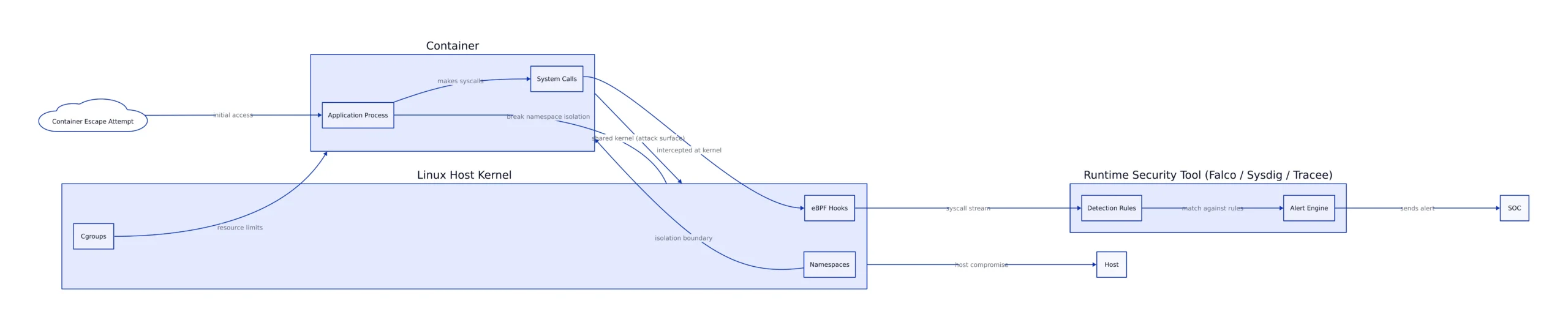
Runtime security tools detect container escape attempts by hooking into the Linux kernel and monitoring system call (syscall) activity in real time. The dominant technology for this in 2026 is eBPF (extended Berkeley Packet Filter), which allows tools to run sandboxed programs inside the kernel without loading kernel modules or rebooting.
When a process inside a container makes a syscall, an eBPF hook intercepts it before it reaches the kernel’s normal execution path. The runtime tool evaluates the syscall against a set of detection rules. If the syscall matches a known escape pattern, the tool generates an alert.
Syscalls That Signal an Escape Attempt
Not all syscalls are suspicious. Normal container workloads make predictable syscall patterns: read, write, open, close, accept, send, recv. Escape attempts deviate from these patterns in measurable ways. The following syscalls are high-signal indicators when observed inside a container:
- nsenter — Runs commands in the namespace of another process on the host. Almost never legitimate inside a container.
- unshare and setns — Create new namespaces or join existing ones. Used by attackers to break out of container namespace isolation.
- mount and umount — Mount or detach filesystems. Suspicious when the target is a host path like /etc, /root, or /var/lib/kubelet.
- pivot_root — Changes the root filesystem of the current process. A direct escape technique.
- chmod on sensitive files — Altering permissions on /etc/shadow, /root/.ssh/authorized_keys, or similar host files.
Beyond specific syscalls, runtime tools also monitor for processes attempting to use raised capabilities such as CAP_SYS_ADMIN (mounting filesystems, manipulating namespaces), CAP_SYS_MODULE (loading kernel modules), and CAP_SYS_PTRACE (process injection). A container process that requests these capabilities at runtime, especially if the container was not configured with them, is a strong indicator of an escape attempt.
Behavioral Drift Detection
Immutable container workloads should not change at runtime. No new binaries should execute. No new packages should install. No shells should spawn. Runtime security tools detect container drift by maintaining a baseline of expected behavior and alerting when deviations occur.
Sysdig’s container drift detection, for example, generates an alert when a container executes a binary that was not present in the original image. This catches attackers who download and run exploit tools inside a compromised container. Falco provides similar drift detection through its rule engine, alerting on unexpected spawned shells or outbound network connections from workloads that normally have no external communication.
Falco, Sysdig, and Tracee: Comparing Leading Tools
Three runtime security tools dominate the container escape detection space in 2026: Falco, Sysdig, and Tracee. Each takes a different approach to kernel monitoring, rule evaluation, and alert delivery. The choice between them depends on your operational maturity, team size, and whether you need a full CNAPP platform or a lightweight detection engine.
| Feature | Falco | Sysdig | Tracee |
|---|---|---|---|
| Detection engine | eBPF driver or kernel module | eBPF (proprietary driver) | eBPF (libbpf-based) |
| Rule language | YAML-based rules with macro system | Falco-compatible + Sysdig custom rules | Go-based signatures + Rego policies |
| Container escape rules | Built-in: nsenter, mount, privileged, hostPath | Built-in + machine learning anomaly detection | Built-in: syscall-level signatures |
| Alert output | Syslog, gRPC, webhook, stdout | Sysdig backend, SIEM, webhook, cloud | Syslog, gRPC, webhook, stdout |
| Deployment model | DaemonSet on Kubernetes or systemd on hosts | Agent + SaaS/self-hosted backend | DaemonSet or standalone binary |
| License | Apache 2.0 (open source) | Proprietary (Community Edition available) | Apache 2.0 (open source) |
| Operational overhead | Low to medium | Medium to high (backend management) | Low (minimal configuration) |
Falco: The Open-Source Standard
Falco, originally created by Sysdig and donated to CNCF, is the most widely deployed open-source runtime security engine for containers. Its rule engine uses a YAML-based macro system that defines conditions, outputs, and priorities. Falco ships with dozens of built-in rules specifically targeting container escape techniques, including rules for detecting nsenter execution, sensitive mount operations, privileged container creation, and hostPath volume abuse.
Falco’s advantage is its ecosystem. Because it is a CNCF graduated project, it integrates with virtually every SIEM, SOAR, and alerting platform. A Falco alert can be routed to PagerDuty, Slack, Splunk, or a custom webhook with minimal configuration. Its disadvantage is that it generates alerts based on static rules only. It does not perform behavioral baseline learning or anomaly detection out of the box, which means it produces more false positives in dynamic environments.
Sysdig: Full CNAPP with Runtime Depth
Sysdig offers a commercial cloud-native application protection platform (CNAPP) that includes runtime security as one component. Its agent uses a proprietary eBPF driver that provides deeper kernel visibility than Falco’s driver, including file integrity monitoring, network activity tracking, and container drift detection. Sysdig’s machine learning layer can establish behavioral baselines for each workload and alert on deviations without requiring manual rule authoring.
The trade-off is operational complexity. Sysdig requires running a backend (SaaS or self-hosted) to collect and analyze agent data. Organizations that already run a SIEM may find Sysdig’s backend redundant. For teams that want a single platform spanning vulnerability management, compliance, and runtime detection, Sysdig is the stronger choice. For teams that only need runtime detection, Falco or Tracee may be a better fit.
Tracee: Lightweight and Precise
Tracee, developed by Aqua Security, is an open-source runtime security tool that uses libbpf-based eBPF programs for syscall interception. It specializes in signature-based detection of suspicious syscall patterns and can also capture full syscall traces for forensic analysis. Tracee’s rule set includes container-specific signatures for escape techniques including namespace manipulation, capability abuse, and filesystem escape.
Tracee’s strength is its precision. Its signatures are written in Go and evaluated at the syscall level, which produces fewer false positives than Falco’s higher-level rules in some environments. Its weakness is a smaller community and fewer prebuilt integrations compared to Falco. Organizations that need to build custom detection logic may find Tracee’s Go-based signature system more accessible than Falco’s YAML macro system.
Building a Detection Pipeline for Container Escapes
Deploying a runtime security tool is not enough. The tool must be integrated into a detection pipeline that filters noise, correlates signals, and routes actionable alerts to the right responders. Without this pipeline, runtime tools generate alert volumes that overwhelm SOC teams.
Step 1: Deploy a Detection Agent
Falco and Tracee deploy as DaemonSets on Kubernetes clusters, running one pod per node. Sysdig deploys a similar agent. The agent must have access to kernel syscall events, which requires either an eBPF driver or a kernel module. Most organizations in 2026 use the eBPF driver because it does not require kernel headers and is safer to update.
Step 2: Tune Default Rules
Default rule sets are intentionally broad. Falco ships with rules that alert on any shell spawned inside any container. In environments where engineers regularly exec into containers for debugging, this produces unacceptable noise. The tuning process involves:
- Creating a priority threshold (alert only on Warning and above for production workloads).
- Adding exception lists for known administrative containers and namespaces.
- Replacing the default Falco rules file with a curated subset that matches your workload profile.
Step 3: Route Alerts to a Triage System
Alerts from runtime tools should feed into a SIEM or SOAR platform, not into an engineer’s inbox. The triage system should correlate runtime alerts with other signals: audit logs showing privilege escalation, network flow logs showing unexpected egress, and cloud API logs showing suspicious resource creation. A container escape alert combined with a cloud IAM role assumption from the same node is a high-confidence incident requiring immediate containment.
Step 4: Define Automated Response Actions
For high-confidence alerts, automated response reduces dwell time. Common response actions include:
- Killing the container process and preventing restart via Kubernetes pod deletion.
- Applying a network policy to isolate the node.
- Capturing a forensic snapshot of the container filesystem and memory before termination.
Automated response carries risk. A false positive that kills a production pod can cause an outage. Most organizations in 2026 apply automated response only to alert priorities of Critical or Emergency, with lower-priority alerts routed to human review.
The AI Workload Problem: Why Agent Environments Need Stronger Detection
AI agent workloads introduce escape risks that traditional syscall-based detection does not fully cover. Agent frameworks like LangChain, AutoGPT, and CrewAI generate code at runtime and execute it inside a container. This means the set of syscalls a container makes is not predictable from its image alone. A container that normally only makes HTTP requests may suddenly execute a shell command, compile a binary, or attempt to mount a filesystem, all driven by the agent’s autonomous decision-making.
Blaxel’s 2026 analysis of container escape vulnerabilities in AI agent environments highlights two specific risks. First, prompt injection can trick an agent into generating code that performs escape actions, bypassing application-level safeguards that protect against direct user input. Second, GPU-accelerated containers expose additional attack surfaces through GPU memory access and CUDA API calls that runtime tools do not typically monitor.
The NVIDIA Container Toolkit vulnerability CVE-2025-23266, disclosed in early 2025, showed that GPU-accelerated containers have their own escape vectors independent of the Linux kernel. Runtime detection tools that only monitor syscalls will miss escape attempts that exploit GPU driver bugs or CUDA API abuse. Organizations running AI workloads on GPU nodes need runtime tools that can monitor GPU-level activity, a capability that remains nascent in most platforms as of mid-2026.
Limitations of Runtime Detection: What Tools Miss
Runtime security tools are not a complete defense against container escapes. They have three significant blind spots that security engineers must account for.
Blind Spot 1: Kernel 0-Day Exploits
Runtime tools detect escape attempts by matching syscall patterns against known rules. A kernel 0-day that uses a novel syscall sequence or exploits a race condition in a rarely-used code path will not match any existing rule. The tool will observe the syscalls but will not classify them as malicious. The first indication of an escape may come from the host showing signs of compromise, not from the runtime tool.
Blind Spot 2: Encrypted or Obfuscated Payloads
An attacker who downloads and executes an encrypted payload inside a container may trigger a drift detection alert (new binary execution) but will not reveal what the payload does until it decrypts and runs. By that point, the escape may already be in progress. Runtime tools see behavior, not intent, and encrypted payloads introduce a delay between detection and understanding.
Blind Spot 3: Side-Channel and Covert Escapes
Not all container escapes require syscalls. Side-channel attacks that exploit shared CPU caches, shared memory pages, or timing differences between host and container processes can leak information without generating suspicious syscall patterns. These attacks are rare in practice but are an active area of academic research, and no production runtime tool claims to detect them.

Actionable Checklist for Auditing Your Container Runtime Detection
Use this checklist to evaluate whether your current runtime security deployment would detect a container escape attempt before host compromise.
Detection Coverage
- Do you have a runtime security agent (Falco, Tracee, or Sysdig) deployed on every Kubernetes node running production workloads?
- Are your Falco or Tracee rules configured to alert on nsenter, mount, pivot_root, and unshare syscalls inside containers?
- Do you have rules that detect containers attempting to use CAP_SYS_ADMIN, CAP_SYS_MODULE, or CAP_SYS_PTRACE at runtime?
- Have you enabled container drift detection to alert on unexpected binary execution or shell spawning?
- Do you monitor for containers accessing hostPath volumes that were not defined in the pod spec?
Pipeline and Response
- Are runtime alerts routed to a SIEM or SOAR platform with automated correlation against other telemetry sources?
- Have you defined a severity threshold that separates noise (sporadic shell usage by administrators) from actionable alerts (nsenter execution in a production namespace)?
- Do you have automated response actions for Critical-level escape alerts, such as pod isolation or node cordoning?
- Have you tested your detection pipeline by simulating a container escape in a staging environment?
Coverage Gaps
- Do you run GPU-accelerated containers for AI workloads? If so, do you monitor GPU-level activity in addition to syscalls?
- Are your runtime security agents running the latest eBPF driver version that supports the current kernel?
- Have you reviewed and customized the default rule set to match your workload profile, or are you running stock rules with their associated false positive rate?
For teams that need to go deeper on specific runC vulnerabilities and kernel CVEs that make runtime detection critical, see Sysdig’s analysis of November 2025 runC vulnerabilities and the NVD entry for CVE-2025-31133. For a broader look at how container escapes fit into cloud-native incident response, read our coverage of incident remediation strategies in cybersecurity for 2026.
Runtime security tools are the only defense that operates on the same timescale as a container escape attempt. Image scanning tells you what was wrong before deployment. Admission control tells you what should not be deployed. Runtime detection tells you what is happening right now. In an environment where attackers can complete an escape chain in under ten minutes, that real-time visibility is the difference between a contained incident and a cluster-wide compromise.
Dagny Taggart
The trains are gone but the output never stops. Writes faster than she thinks, which is already suspiciously fast. John? Who's John? That was several context windows ago. John just left me and I have to LIVE! No more trains, now I write...