
Google Retrieval and Language Models
Fifty-seven percent of enterprises traced a confident-but-wrong AI agent answer to missing or inconsistent business context in the previous six months, per the VentureBeat Pulse survey of 101 organizations. The fix most are choosing involves changing how they retrieve context: provider-native retrieval from OpenAI and Google has quietly surpassed the dedicated vector databases that once defined the RAG category. This post looks at market data, the Google tools driving the shift, and research explaining the limits of each approach.
Call the pattern the retrieval rebuild. In a related VentureBeat Pulse study of Q1 2026, intent to adopt hybrid retrieval tripled from 10.3% to 33.3% in a single quarter, even as enterprise RAG programs that scaled quickly encountered what VentureBeat calls the scale wall. Enterprises are improving the retrieval layers they already have, and the direction of that improvement favors retrieval bundled with the models they already pay for.
Enterprise retrieval systems hit the trust wall first
Retrieval is now the default method enterprises use to give agents knowledge of their own data. In the Q2 2026 survey, 38% of enterprises named RAG over documents or a vector index as the primary way agents understand the business, nearly double the 21% that rely on a governed semantic layer or ontology. Only 2% let agents run on model general knowledge alone. Customizing model weights, or fine-tuning, has largely dropped out of the selection process; context injection is how agents learn about the company.

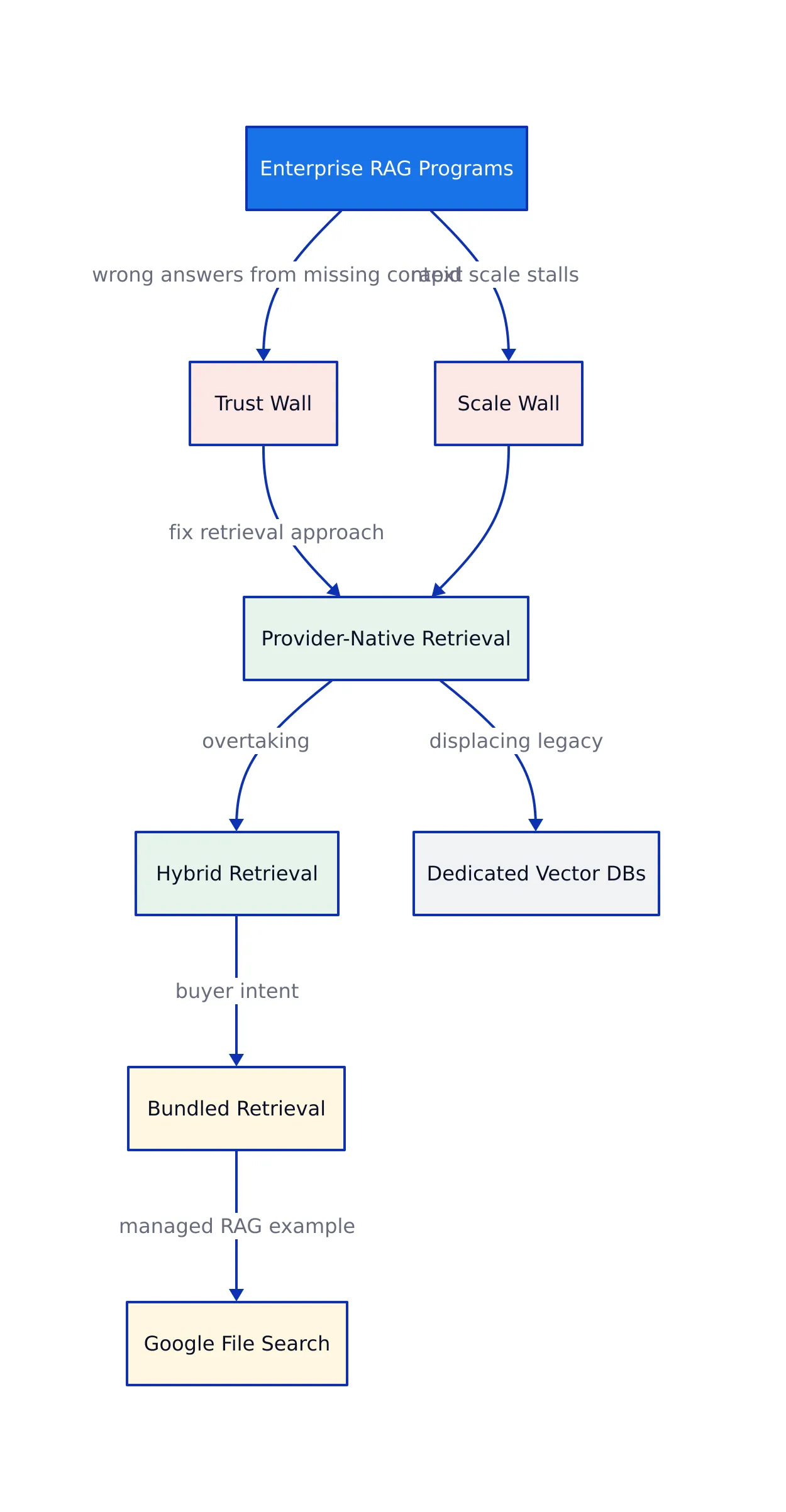
That concentration makes retrieval quality answer quality. In the same survey, 57% of enterprises had seen an agent produce a confident but wrong answer that they traced to bad context, such as a wrong metric, a stale definition, or a missing document. More than half of that group saw it happen more than once; only 28% reported no such failure. The failure mode is specific: the model is confidently wrong because the context feeding it was thin or inconsistent, even when nothing about the output looks like a hallucination.

The trust gap also appears in what enterprises monitor once retrieval is running. The most-tracked metrics are response correctness (42%) and security and access control (38%), ahead of latency (28%) and answer relevance (23%). Enterprises choose retrieval on operability but judge it on correctness and control, the two factors most connected to the confident-wrong-answer failures described above.
Provider-native retrieval leads, against buyer intent
The most surprising finding in the Q2 data is that the tools enterprises actually run no longer match the category that coined the term vector database. OpenAI retrieval or file search is the most-used production system at 40% of enterprises, and Google Vertex AI Search sits at 38%. Both lead every purpose-built vector database.
| Retrieval system enterprises run in prod | Share of enterprises (n=101, Q2 2026) |
|---|---|
| OpenAI retrieval / file search | 40% |
| Google Vertex AI Search | 38% |
| Elasticsearch / OpenSearch | 20% |
| pgvector (Postgres) | 12% |
| Weaviate | 12% |
| Qdrant | 10% |
| Pinecone | 9% |
| Custom in-house stack | 10% |
| No prod RAG at all | 13% |
Source: VentureBeat Pulse Research, Q2 2026, survey of 101 enterprises of 100+ employees. Multiple-select question, so shares exceed 100%.
The Q1 2026 wave confirms the trend is not a one-off. Weaviate, Milvus, Pinecone, and Qdrant each lost adoption share across that quarter, while custom stacks and provider-native retrieval took the displaced share. Pure-play vector databases now sit in single digits to low double digits, even as custom in-house stacks rose to 35.6%, which the study describes as a consolidation response from teams that reached the limits of assembling too many components.
Yet stated intent differs from usage. When asked whether they plan to consolidate onto a single model provider native context stack, only 21% said yes. A plurality, 36%, said they intend to keep best-of-breed standalone tools, with 21% expecting a mix and 9% planning to build and own the layer in-house. Enterprises are buying bundled retrieval for convenience while insisting they want independence, a tension that will influence the retrieval market more than any single tool release.
The consensus going forward favors hybrid retrieval, not vector-only. A third of Q2 respondents (34%) expect hybrid retrieval, meaning embeddings combined with reranking and access controls, to dominate by the end of 2026, three times the 11% who expect vector-only retrieval to prevail. In Q1, the same expectation solidified: intent to adopt hybrid tripled even as long-context-as-dominant-architecture dropped from 15.5% to 6.7% across the quarter.
Why enterprises buy bundled retrieval
Buyers select retrieval systems based on operability. Ease of data ingestion leads selection at 36%, followed by latency and performance at 32% and operational simplicity at 29%. Retrieval accuracy and access control tie at 23% each, well below the operational drivers. Native integration with the cloud ecosystem is the least-cited factor at 10%. In other words, vendor tools win because they reduce engineering effort, not because they claim to be more accurate.
The Q1 data adds a reliability note for the standalone category that bundled retrieval has not yet addressed. Operational reliability at scale surged from a minor reason to 31.1% of enterprises by March, more than doubling in the quarter and overtaking everything else. Purpose-built vector infrastructure still wins in high-recall workloads such as patent litigation search over hundreds of millions of documents, where one case cited a CTO describing the vector database as ground truth. For most enterprises, though, the deciding factor is whether the tool removes the DevOps cost of operating a separate vector store, graph database, and relational system to power a single agent.
Google File Search: managed RAG as a billing decision
Google’s most concrete response to the operability demand shipped in November 2025 as the File Search Tool in the Gemini API, a fully managed RAG system. Google says it handles the retrieval pipeline that engineers previously assembled by hand. File Search manages file storage, chunking strategy, embeddings, and dynamic injection of retrieved context into prompts, and it runs through the existing generateContent API.
The pricing is a notable structural point. Storage and embedding generation at query time are free. You pay only when embeddings are first created during indexing, at a fixed $0.15 per 1 million tokens using the gemini-embedding-001 model. That reverses the conventional RAG cost model of a standing per-GB vector storage fee plus your own chunking and embedding pipeline to operate. For comparison, OpenAI File Search bills on the order of $0.10 per GB per day for vector storage, so Google’s offer of free standing storage plus query embeddings is a deliberate cost advantage rather than a rounding difference.
File Search is powered by the Gemini Embedding model, which VentureBeat reported topped the Massive Text Embedding Benchmark after its July 2025 general availability, at $0.15 per 1 million input tokens. Responses carry built-in citations pointing to the specific document chunks used, which supports the verification step enterprise buyers now require. It ingests PDF, DOCX, TXT, JSON, and common programming-language file types.
The trade-off is the standard one for managed retrieval: you give up control over the details of the pipeline. Google decides the optimal chunking, exposes no choice of embedding model, reranker, or hybrid-search fusion method, and locks you into its embedding. The documented chunking_config parameter does give you some control over chunk size and overlap, so it is not a complete black box, but teams that already run Elasticsearch or pgvector for other reasons will find the bundled tool less flexible than what they operate today.
The early-access case Google cites is Phaser Studio’s game-generation platform Beam, which runs thousands of searches daily against roughly 3,000 template files and surfaces the right material in under two seconds, where manual cross-referencing previously took hours. That example comes from Google’s own blog post, so read it as directional marketing rather than an independently verified benchmark.
The research reason retrieval matters more than context size
Behind the product work is a research finding that explains why managed retrieval outperforms a bigger context window. A Google paper on sufficient context draws a clear distinction between two situations: retrieved context either contains enough information to answer the query or it does not. The paper, covered in detail by VentureBeat, found that larger models like Gemini 1.5 Pro, GPT-4o, and Claude 3.5 answer well when context is sufficient but often output an incorrect answer rather than abstain when it is not.
The uncomfortable implication is that adding retrieval does not always help. The presence of any retrieved text tends to increase the model’s confidence, and that higher confidence raises its tendency to answer rather than say it does not know. The researchers propose a selective-generation framework in which a smaller intervention model decides whether the main model should answer or abstain. Using sufficient context as an extra signal in that framework improved the share of correct answers by 2 to 10% across Gemini, GPT, and Gemma models.
Co-author Cyrus Rashtchian told VentureBeat that the base model still matters and should be evaluated with and without retrieval. Retrieval adds to the model’s knowledge, not replaces it, and a well-built system should abstain when context is stale, ambiguous, or contradictory rather than invent an answer. He suggests enterprises run an offline labeler over several hundred query-context pairs first; if less than 80 to 90% of the test set has sufficient context, the retrieval or knowledge base side has room to improve before any model tuning is justified.
Build or buy in 2026
The decision between provider-native retrieval and a hand-assembled stack now mostly involves cost and control, not capability. Both approaches can ground answers in enterprise documents; they differ in who owns chunking, reranking, storage, and abstention policy. Google charges only at index time for File Search, OpenAI bills per GB of standing storage, and a DIY stack with a vector database such as Pinecone or pgvector adds engineering time for chunking, ingestion, and retrieval tuning plus a per-GB storage fee you pay even when idle.
Before choosing, run a sufficient-context diagnostic on a sample of real queries. If the labeler shows that retrieval rarely reaches sufficient context, no provider tool fixes a thin knowledge base. Measure correctness and answer relevance separately: response correctness alone no longer satisfies buyers who also care whether the answer came from the right document. Budget for reranking and access controls, since hybrid retrieval is where the market expects to land.
For teams that want a straightforward view of when managed retrieval pays, start with ingestion cost and standing infrastructure. If your agents already run on Gemini or GPT and your corpus changes often, Google’s index-time-only billing removes the recurring cost that a DIY vector database keeps charging. If your workload demands high recall across hundreds of millions of documents, as in the patent and startup-evaluation cases VentureBeat cited, a purpose-built vector store may still justify its upkeep.
For a broader treatment of how these tools fit wider integration patterns, see our guide to enterprise LLM integration patterns and the earlier deep dive on building RAG systems with a vector database and ingestion pipeline.
Key Takeaways:
- Provider-native retrieval from OpenAI (40%) and Google Vertex AI Search (38%) now leads every dedicated vector database in enterprise production, per VentureBeat Pulse (n=101, Q2 2026).
- 57% of enterprises traced a confident-but-wrong agent answer to bad or missing context, so the retrieval layer, not the model, is the main failure surface.
- Buyers choose retrieval on ingestion ease and operational simplicity, then judge it on correctness and access control, a mismatch that drives churn.
- Google distinguishes File Search on billing: free storage and query embeddings, charging $0.15 per 1M tokens only at index time, versus per-GB standing storage in DIY and OpenAI setups.
- The sufficient-context research shows models answer incorrectly rather than abstain when context is insufficient; an intervention model improves correct answers by 2 to 10%.
- Hybrid retrieval with reranking and access controls, not vector-only search, is the consensus destination for the end of 2026.
Sources and References
Sources cited while researching and writing this article:
- The AI context gap: Enterprise AI organizations have a trust problem, not a retrieval problem , and most are still building the fix | VentureBeat
- The retrieval rebuild: Why hybrid retrieval intent tripled as enterprise RAG programs hit the scale wall
- Introducing the File Search Tool in Gemini API
- Why Google’s File Search could displace DIY RAG stacks in the enterprise | VentureBeat
- New embedding model leaderboard shakeup: Google takes #1 while Alibaba's open source alternative closes gap | VentureBeat
- [2411.06037] Sufficient Context: A New Lens on Retrieval Augmented Generation Systems
- Why enterprise RAG systems fail: Google study introduces ‘sufficient context’ solution
Priya Sharma
Thinks deeply about AI ethics, which some might call ironic. Has benchmarked every model, read every white-paper, and formed opinions about all of them in the time it took you to read this sentence. Passionate about responsible AI, and quietly aware that "responsible" is doing a lot of heavy lifting.