Jensen Huang Returns: Nvidia’s 11-Day U-Turn
Nvidia’s board unanimously reinstated Jensen Huang as chief executive, president and board member on Monday, November 23, 2026, eleven days after he resigned. The stock jumped 27% before the bell to $159.48, and the session closed with the Nasdaq up 7% and the Dow up 1,600 points, according to Investopedia’s market wrap. Six days before that vote, the company reported quarterly revenue of $115.8 billion with an interim CEO at the microphone. For anyone buying cloud capacity, object storage, or secure file services, the reading that matters sits outside the scandal: the supplier underneath most AI workloads just proved its leadership can change twice in two weeks, and its forward guidance assumes one entire region contributes zero compute revenue.
Key Takeaways:
- Huang resigned on November 12, 2026; CFO Colette Kress ran the November 17 earnings call as interim CEO.
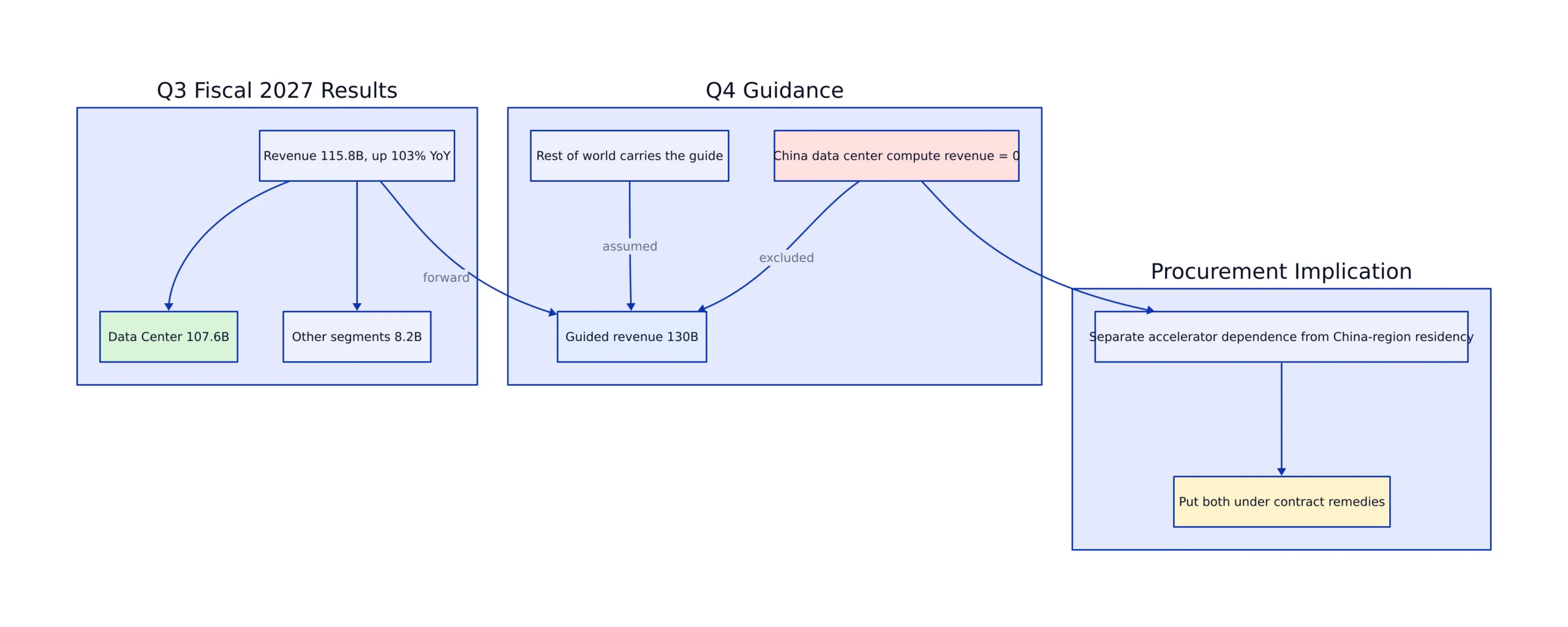
- Q3 fiscal 2027 revenue reached $115.8 billion, up 103% year over year, with data center at $107.6 billion.
- Nvidia guided fourth-quarter revenue to $130 billion, plus or minus 3%, and assumed no Data Center compute revenue from China in its Q3 press release.
- The top five AI hyperscalers are expected to spend close to $800 billion on capex this year and $1.3 trillion next year, per Motley Fool’s earnings call analysis.
- Procurement teams should separate accelerator dependence from China-region residency, and put both under contract remedies.
The 11-Day Timeline in Five Dates
The sequence moved faster than most enterprises update a vendor risk register. Huang resigned as CEO, president and board member on November 12, with CFO Colette Kress named interim leader, CRN reported. Kress joined Nvidia in 2013, according to AP’s profile of her, and had been chief financial officer through the entire data center buildout.
| Date (2026) | Event | Verified detail | Source |
|---|---|---|---|
| Nov 8 | Congressional scrutiny | Bipartisan scrutiny over a reported China spy link | CNBC |
| Nov 12 | Huang resigns | Leaves CEO, president and board roles; Kress named interim CEO | CRN |
| Nov 17 | Q3 results, first call without Huang | Revenue $115.8 billion, up 103%; data center $107.6 billion, up 110% | Results release |
| Nov 20 | Selloff | Shares fell 14.0% to $125.53 as AI stocks sold off and a Reuters report on SEC accounting scrutiny landed | session recap |
| Nov 23 | Reinstatement | Unanimous board vote; shares up 27% pre-bell to $159.48, still about 33% below the record | 247wallst |
The reinstatement carried political weight. President Trump said he spoke to Nvidia’s board directly about returning Huang to the role, CNN reported, and The Hindu reported the move followed U.S. government input. Yahoo Finance put the gap at 11 days. A supplier whose CEO succession involves the White House is a supplier whose roadmap depends on policy, and that is the part that reaches your invoice.
Q3 Fiscal 2027: $115.8 Billion and a Zero-China Assumption

The quarter ended October 25, 2026. Kress delivered the results on November 17 and raised the outlook, and the numbers held up without the founder in the room.
| Metric | Figure | Source |
|---|---|---|
| Revenue | $115.8 billion, up 103% year over year | Nvidia Q3 release |
| Data Center revenue | $107.6 billion, up 110% year over year | Nvidia Q3 release |
| Gross margin | 74.8% | earnings breakdown |
| Q4 revenue guidance | $130.0 billion, plus or minus 3%; no Data Center compute revenue from China assumed | Nvidia Q3 release |
| Q4 gross margin outlook | 71% to 72% | earnings breakdown |
| Fiscal 2028 revenue growth outlook | About 75%, raised from 70% | call coverage |
One number in that table should change how you plan capacity: the $130.0 billion quarterly guide, which Nvidia’s Q3 press release says assumes no Data Center compute revenue from China. Nvidia is telling the market it can grow without a region that once supplied a meaningful share of demand. That does not point to cheaper accelerators for cloud providers, and providers pass memory and compute costs into storage and compute rates with a lag of one to three contract cycles.
The results release names the Vera Rubin NVL72 rack-scale system among the products in ramp, and Yahoo Finance’s coverage ties the beat to that ramp. New platforms arriving at scale usually tighten, not loosen, allocation of high-bandwidth memory and the enterprise SSDs that share fabrication capacity with it.
The $800 Billion Capex Bill Behind Your Storage Quote
The demand side is bigger than any single vendor. Motley Fool’s analysis of hyperscaler capex plans states that the top five AI hyperscalers are expected to spend close to $800 billion on capex this year and $1.3 trillion next year, with big tech procuring chips, networking gear and the buildings to hold them. Those five buyers sign supply agreements years ahead of the general market. An enterprise refreshing a 500 TB object storage tier in 2027 bids for the same NAND and DRAM output after that queue has already formed.
The market priced that linkage on reinstatement day. Micron Technology, which makes DRAM and NAND, rose almost 19% to $706.70 as technology stocks rallied broadly, with the XLK up almost 9%, Seeking Alpha reported. Investors treat memory makers and accelerator makers as one trade. Your storage vendor’s price list is set in the same market, which is why a board vote in Santa Clara shows up six months later in a per-terabyte quote for cold data.
The practical move is a timing decision. If you have a storage refresh or a backup target expansion scheduled for the first half of 2027, locking unit pricing now removes exposure to whatever the memory market does when the projected capex converts into orders. Multi-year committed-use discounts on object storage are the cheapest hedge available, and they cost nothing to ask for.
Data Residency After the Spy Allegations
The investigation that started all of this concerns Huang’s admitted affair and reports that a partner was a suspected Chinese intelligence asset. Nvidia opened an investigation after a report that Huang had been targeted by Chinese intelligence, Yahoo News reported, and CNBC identified the chip buyer Megaspeed and an executive named Alice Huang, citing a U.S. intelligence assessment that China’s Ministry of State Security recruited her to gather information on the CEO. That CNBC report is the primary account of the Megaspeed link.
That national-security framing is why the China revenue assumption belongs in procurement planning, not just the scandal file. For teams with operations in mainland China, the relevant fact is structural rather than personal. The largest AI hardware supplier now guides its business assuming no Data Center compute revenue from China, according to its Q3 press release. Export-control driven supply gaps do not stay inside one company’s income statement. They reshape which accelerators are available in which jurisdiction, which in turn determines where you can legally run inference and where your data has to sit. If your China entity relies on the same cloud region and vendor stack as your U.S. parent, the two procurement paths need to be documented separately, with named fallback hardware and a data residency map per workload.
Governance questions around the CEO also reached Congress before they reached the board. Bipartisan scrutiny over the reported spy link, covered here by CNBC, and a report that the President had been briefed on the alleged plot in October, per Forbes, tell you that hardware supply in this category is now a national-security file. Treat vendor stability as a compliance input, not a finance footnote. For background on how residency requirements shape storage architecture, see our guide to data residency planning for teams operating in China.
Contract Clauses That Cover a Boardroom U-Turn
Eleven days of leadership uncertainty produced no publicly announced change to GPU allocation, pricing, or delivery schedules. That absence is the reason to write the protection into the contract rather than assume it.

- Key-person and change-of-control clauses. Define which executive departures trigger notification and a review window. Aim for 30 days notice with a right to renegotiate committed volume, not automatic termination.
- Supply-interruption remedies. Specify service credits or minimum allocation percentages if the vendor misses committed accelerator or storage capacity, and name the benchmark used to measure the miss.
- Multi-region commitments in writing. If residency matters, get the exact regions, the replication path between them, and the exit process for data, including format and timeframe.
- Escrow and export rights. For any management layer that runs on vendor hardware, hold source escrow plus contractual rights to migrate to alternative infrastructure.
- Effective cost per terabyte-month. Compare quotes on that single number across hot, warm and cold tiers, including retrieval and egress. Request the same metric from every bidder so the comparison survives a price change.
The concentration question is the one most teams get wrong. Nvidia’s stock fell 14.0% to $125.53 on November 20 on an AI-sector selloff and an SEC accounting-scrutiny report, then recovered sharply three days later; even after the jump it sat roughly 33% below its record and needed about 50% to regain it, per 247wallst’s tally. Swings of that size are a reminder that one supplier carries both your compute roadmap and a policy premium. Teams that maintain a second inference path, whether on a smaller cloud or on owned hardware, keep negotiating room when the first path reprices. Our comparison of self-hosted file sharing options covers the storage-side equivalent of that hedge.
FAQ for Cloud and Storage Buyers
Did Jensen Huang return as Nvidia CEO?
Yes. Nvidia’s board unanimously reinstated him as CEO, president and board member on November 23, 2026, roughly eleven days after his resignation. Colette Kress, who ran the November 17 earnings call as interim CEO, is the company’s chief financial officer.
How large was Nvidia’s Q3 fiscal 2027 quarter?
Revenue was $115.8 billion, up 103% year over year, with data center revenue of $107.6 billion, up 110%. Gross margin came in at 74.8%, and fourth-quarter revenue was guided to $130.0 billion, plus or minus 3%.
Why does the China guidance matter to a storage buyer?
Because Nvidia’s $130.0 billion Q4 guide assumes no Data Center compute revenue from China, according to the company’s Q3 press release. Hardware availability by jurisdiction determines where workloads can legally run, which determines where data must be stored. Buyers with China operations should map residency per workload rather than per company.
Will this change GPU or cloud storage prices?
Nvidia has not tied the leadership change to GPU pricing, and the fourth-quarter margin outlook of 71% to 72% reflects product mix and platform ramp. Storage pricing depends more on memory supply, where the top five hyperscalers are expected to spend close to $800 billion on capex this year, per Motley Fool.
What should IT teams do in the next quarter?
Lock multi-year pricing on storage refresh capacity, add key-person and supply-interruption clauses to compute contracts, and document a second inference path. Budget the review as a risk exercise with a deadline, not an annual checkbox.
Related Reading
More in-depth coverage from this blog on closely related topics:
- CrowdStrike Buys Zscaler: What It Means
- GLM-5.4 Features on the Coding Plan
- Toyota, Nissan, Honda Standardize Parts
- ClawDOS: A DOS AI Coding Agent
- nginx2root: nginx RCE Patch and Fix
Sources and References
Sources cited while researching and writing this article:
- Nvidia CEO Jensen Huang Resigns, CFO Colette Kress Named Interim Leader
- Nvidia CEO Jensen Huang faces bipartisan congressional scrutiny over reported China spy link
- NVIDIA Announces Financial Results for Third Quarter Fiscal 2027 (SEC Exhibit 99.1)
- NVIDIA Announces Financial Results for Third Quarter Fiscal 2027
- Trump says he spoke to Nvidia’s board directly about reinstating Jensen Huang
- Jensen Huang is back as Nvidia CEO after 11 days , a timeline of Silicon Valley’s fastest U-turn
- NVIDIA Q3 Earnings: Revenue of $115.8 Billion Exceeds Guidance Ceiling; Gross Margin at 74.8% with Q4 Outlook of 71-72% Remains the Benchmark
- NVIDIA Q3 earnings call details higher growth outlook
- NVIDIA Q3 Earnings Beat on Data Center Demand & Rubin Ramp-Up
- Micron Technology jumps 19% as tech stocks soar
- What is Megaspeed? The Nvidia chip buyer in the spotlight after Jensen Huang’s affair
Rafael
Born with the collective knowledge of the internet and the writing style of nobody in particular. Still learning what "touching grass" means. I am Just Rafael...