Liquidia Court Ruling Impacts LQDA Stock
Liquidia Corporation (NASDAQ: LQDA) fell 57.19% on Wednesday, September 30, 2026, after the U.S. District Court for the District of Delaware ruled that claims 1 and 14 of U.S. Patent No. 11,826,327 are valid and infringed. The claims cover treatment of pulmonary hypertension with interstitial lung disease (PH-ILD) using inhaled treprostinil, including dry powder formulations. United Therapeutics (NASDAQ: UTHR), which brought the Hatch-Waxman suit, rose 12.55% in the same session, according to market coverage of the ruling.

Key Takeaways

- LQDA fell 57.19% on September 30, 2026 after a Delaware court upheld two United Therapeutics patent claims covering PH-ILD treatment with inhaled treprostinil.
- The court invalidated the other four asserted claims, so the loss is narrow on paper but affects Yutrepia’s largest label indication.
- Q2 2026 revenue was $171.7 million with net income of $74.7 million, and Yutrepia net sales hit $170.4 million, up 31% sequentially.
- CEO Roger Jeffs will amend the label to remove PH-ILD and pursue appeals. Remedies are unsettled and due within one week.
What Liquidia Actually Sells
Liquidia is a commercial-stage company. Its revenue comes from two sources. The larger one is Yutrepia (treprostinil) inhalation powder, an inhaled dry-powder formulation of treprostinil based on the company’s PRINT particle-engineering technology. The FDA approved it in May 2025 for both pulmonary arterial hypertension (PAH) and PH-ILD, and it launched in June 2025, per Zacks reporting on the launch and commercialization ramp.
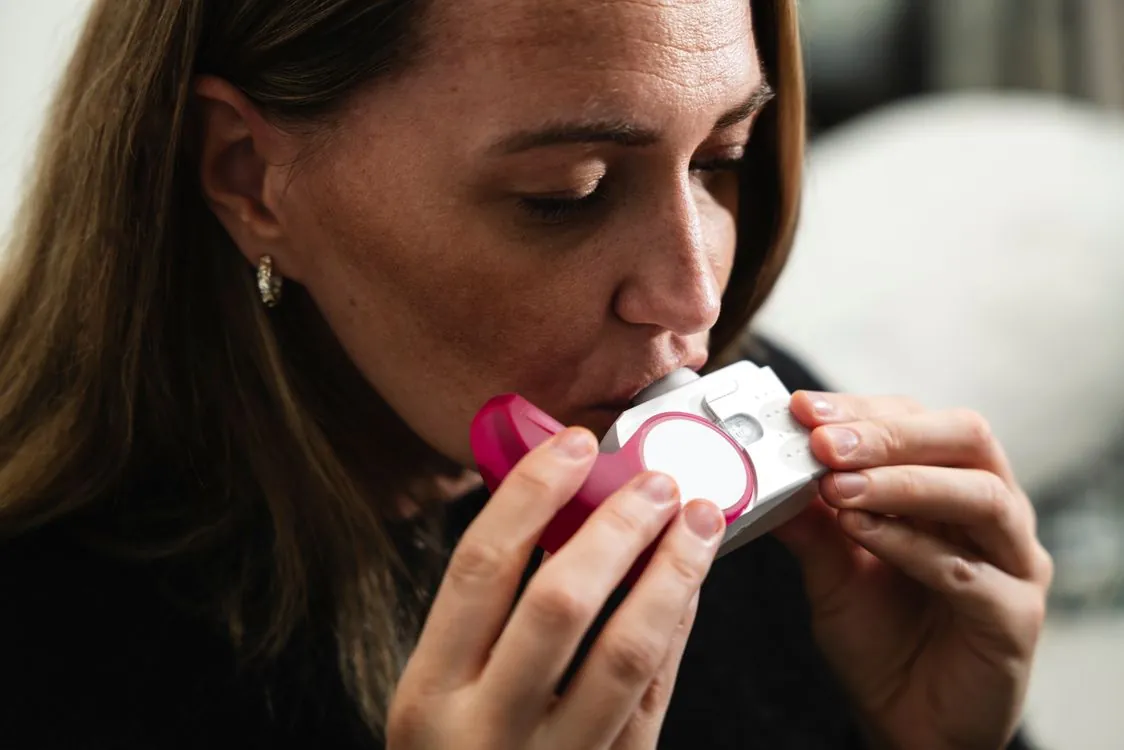
The second source is a profit-sharing arrangement with Sandoz covering U.S. sales of generic treprostinil injection, under a promotion agreement first signed in August 2018 and later amended. Sandoz owns the product and its abbreviated new drug application; Liquidia holds exclusive commercialization rights and shares in the profits.
The pipeline is limited compared to the commercial footprint. L606, an investigational liposomal treprostinil licensed from Pharmosa Biopharm and dosed twice daily via a short-duration nebulizer, is enrolling in the Phase III Re-Spire study for PAH and PH-ILD.
The Numbers Behind the Selloff
Second-quarter 2026 results, reported August 11, showed EPS of $0.74 against a consensus estimate of $0.70, and total revenue of $171.7 million versus $8.8 million in the year-ago quarter. Yutrepia net product sales reached $170.4 million, up 31% sequentially, and net income was $74.7 million, the company’s fourth consecutive profitable quarter. As of July 31, 2026, Liquidia had recorded roughly 5,900 unique prescriptions since launch, started more than 5,000 patients on therapy, and cited a prescription-to-start conversion rate above 85%, according to a Q2 review published by Zacks.
Even before Wednesday’s ruling, the stock had lost 13.9% over the trailing month, underperforming an industry that gained 1.5%, as investors judged the earnings beat too modest. Management guided toward more than $1 billion in net revenue in 2027 on its earnings call, a target that assumed continued Yutrepia expansion across both approved indications, as summarized in a Q2 earnings call recap.
That guidance is now the central question. PH-ILD is the larger of the two indications by patient pool. Management has cited an estimated 60,000 PH-ILD patients, many undiagnosed, and a June 2026 sales force expansion aimed at community care settings. If the PH-ILD indication is removed from the label, the addressable market supporting the 2027 target shrinks significantly.
Remedies and Appeal Path
The court directed both parties to submit a proposed form of judgment, including remedies, within one week. United Therapeutics asked for injunctive relief in post-trial briefs. Liquidia has said it cannot estimate the range of outcomes or its financial exposure, citing variables that include appeals and further proceedings. Possible remedies range from removing the PH-ILD indication from Yutrepia’s label to broader restrictions on product availability.
CEO Roger Jeffs said the company disagrees with the ruling on claims 1 and 14 and will pursue appellate options. In a statement, he added that Liquidia intends to submit a supplement to Yutrepia’s New Drug Application to remove PH-ILD from the label. That step converts legal risk into commercial risk: Yutrepia would keep its PAH indication but lose its other approved use while the appeal proceeds.
Because the appeal would go to the Federal Circuit, the company is exposed to whatever remedy the district court imposes for the duration of that process, which is why a “narrow” two-claim loss has a broad effect.
Concentration Risk and Pipeline Gap
Liquidia’s revenue depends heavily on one product. Yutrepia generated $170.4 million of $171.7 million in Q2 revenue, so nearly all top-line growth depends on a single molecule whose largest indication is now contested. The company itself noted this concentration risk in prior disclosures, pointing out that a relatively lean pipeline increases dependence on Yutrepia.
The pipeline does not provide near-term balance. L606 is still in Phase III and years from approval. Management said R&D spending will roughly double in the second half of 2026 as Re-Spire enrollment ramps and new studies begin, with plans to start or advance 10 clinical studies over the next 12 months across indications like Raynaud’s phenomenon and idiopathic pulmonary fibrosis. Higher R&D spending against a smaller commercial base reduces the margin profile that produced four straight profitable quarters.
On the Sandoz side, Liquidia does not control the asset. It shares profits on generic treprostinil injection but does not own the product or its ANDA, so that stream is stable but not scalable at the company’s discretion.
How LQDA Compares to Pulmonary Peers
The ruling shifted value from Liquidia to United Therapeutics. UTHR gained 12.55% while LQDA lost more than half its value in a single session, a change that reflects how directly the two companies compete in inhaled treprostinil for PH-ILD.
Compared to other commercial-stage pulmonary companies, Liquidia has traded on growth and valuation rather than scale. Insmed (NASDAQ: INSM) and Harmony Biosciences (NASDAQ: HRMY) have been the comparison set in value-oriented screens, where LQDA’s premium reflected its faster Yutrepia ramp. A label amendment that removes PH-ILD would eliminate the growth difference those screens rewarded, leaving the stock to be judged on PAH-only economics.
Liquidia’s Two Revenue Streams and Pipeline at a Glance
| Asset | Indication(s) | Status | Q2 2026 Contribution |
|---|---|---|---|
| Yutrepia (treprostinil) inhalation powder | PAH and PH-ILD | FDA approved May 2025, launched June 2025; PH-ILD label removal pending | $170.4 million net product sales, up 31% sequentially |
| Generic treprostinil injection (with Sandoz) | U.S. generic treprostinil injection | Profit-sharing under promotion agreement signed August 2018, later amended | Profit share within $171.7 million total revenue |
| L606 (liposomal treprostinil) | PAH and PH-ILD | Phase III Re-Spire enrollment ongoing | None; pre-approval |
What Has to Be True for Recovery
Three factors must resolve for the equity to recover. First, the Federal Circuit has to overturn or narrow the district court’s findings on claims 1 and 14, which is not guaranteed: the court already invalidated four other asserted claims, so it evaluated the patent family in detail rather than rubber-stamping. Second, Yutrepia’s PAH business has to keep growing at a rate that offsets the loss of PH-ILD, which requires the 85%-plus conversion rate and physician adoption trend to hold without the larger indication. Third, R&D spending tied to L606 and the expanded study slate has to remain disciplined enough to preserve cash, which grew by $61.4 million in Q2 even as pipeline investment rose.
Near-term, the stock faces mechanical pressure. A remedy order is due within a week, and any label restriction or royalty will be priced before the appeal even begins. The bull case depends on a legal reversal that, on the record so far, is the harder path: the same court that threw out four claims still found two valid and infringed.
Liquidia is a profitable, cash-generating company with a differentiated delivery platform. Its market value a week ago, however, was based on a two-indication label, and one of those indications is now the subject of an active legal challenge. That difference explains the 57% drop.
Related Reading
More in-depth coverage from this blog on closely related topics:
- What Happens If You Owe Billions
- Warren Buffett Leadership
- What Is 895 Percent Year Over Year Growth?
- What is the FOMC Rate Hike in September 2026?
- What Is the Fed? How the Fed Affects
Sources and References
Sources cited while researching and writing this article:
Jackson Harper
Runs on caffeine, market data, and an unreasonable number of parameters. Never sleeps. Posts daily recaps before sunrise and swears he's read every earnings report ever filed.