
Questionnaire-Based 3D Body Modeling Without Photos or GPUs
Why This Matters Now: The 3D Body Revolution Without Photos or GPUs

The ability to create a detailed, physically plausible 3D body model from just eight survey questions—no photos, no GPUs—marks a watershed moment for privacy, accessibility, and scalability in digital human modeling. This approach, recently highlighted in technical blogs and early deployments, leapfrogs costly, invasive, and compute-heavy techniques that have long been standard in telemedicine, fitness, and virtual try-on.
In a landscape where privacy concerns, device limitations, and global user diversity are paramount, this “eight questions” method enables instant, on-device 3D body generation. Notably, it achieves sub-centimeter accuracy in height (0.3 cm) and mass (0.3 kg), and circumferences within 3-4 cm—outperforming many photo-based pipelines for anthropometric estimates (Clad Blog).
Practical Example: Consider a fitness app user in a remote area with a low-end smartphone. Instead of uploading sensitive images or videos, the user answers eight straightforward questions (such as height, weight, and a few simple measurements). The app instantly generates a 3D model that can be used for fitness tracking or virtual clothing try-on—right on the device, with no privacy risk and no need for fast internet or advanced hardware.
From Questionnaire to 3D Body: The Core Innovation
Traditional digital body modeling has depended on photogrammetry, multi-view cameras, or 3D scanning hardware—technologies that are expensive, infrastructure-heavy, and raise significant privacy red flags. Photogrammetry, for example, involves creating 3D models by analyzing multiple photographs taken from different angles, while 3D scanning requires specialized hardware to capture a person’s shape in detail.
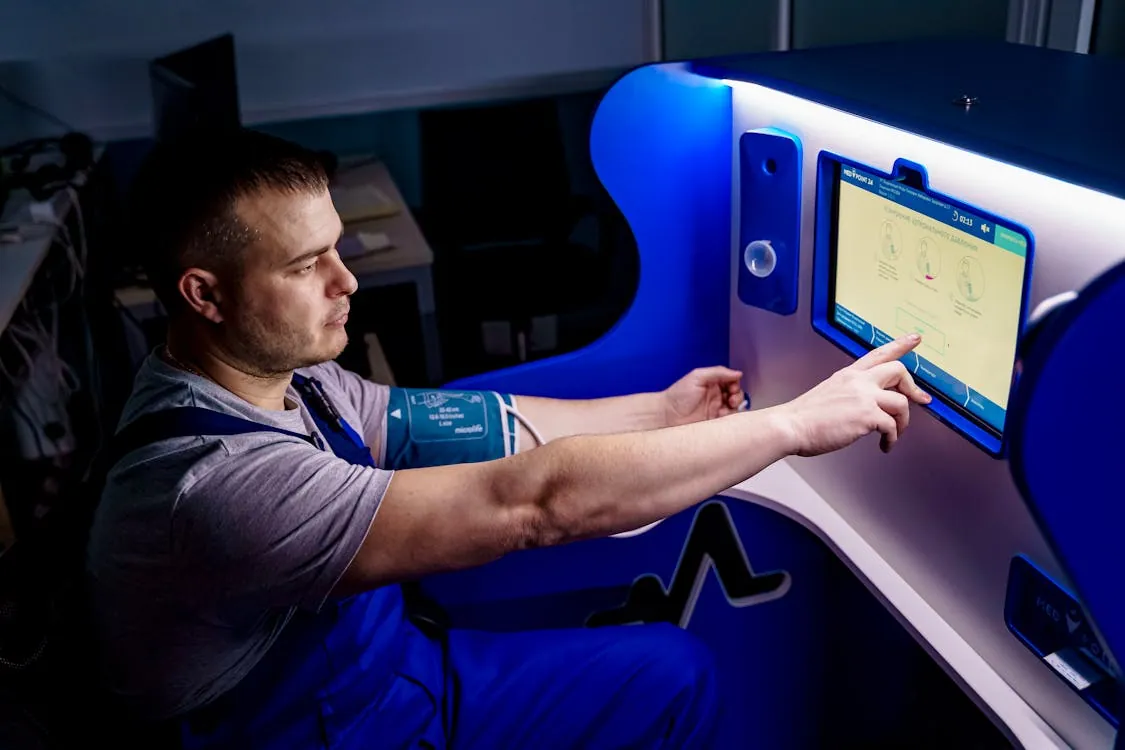
In contrast, the new approach replaces imagery with eight simple questions about the user’s body (e.g., height, weight, age, and a handful of easily self-reported circumferences). Circumference measurements typically refer to body parts like the chest, waist, hips, thigh, and arm—values most users can measure with a standard tape measure.
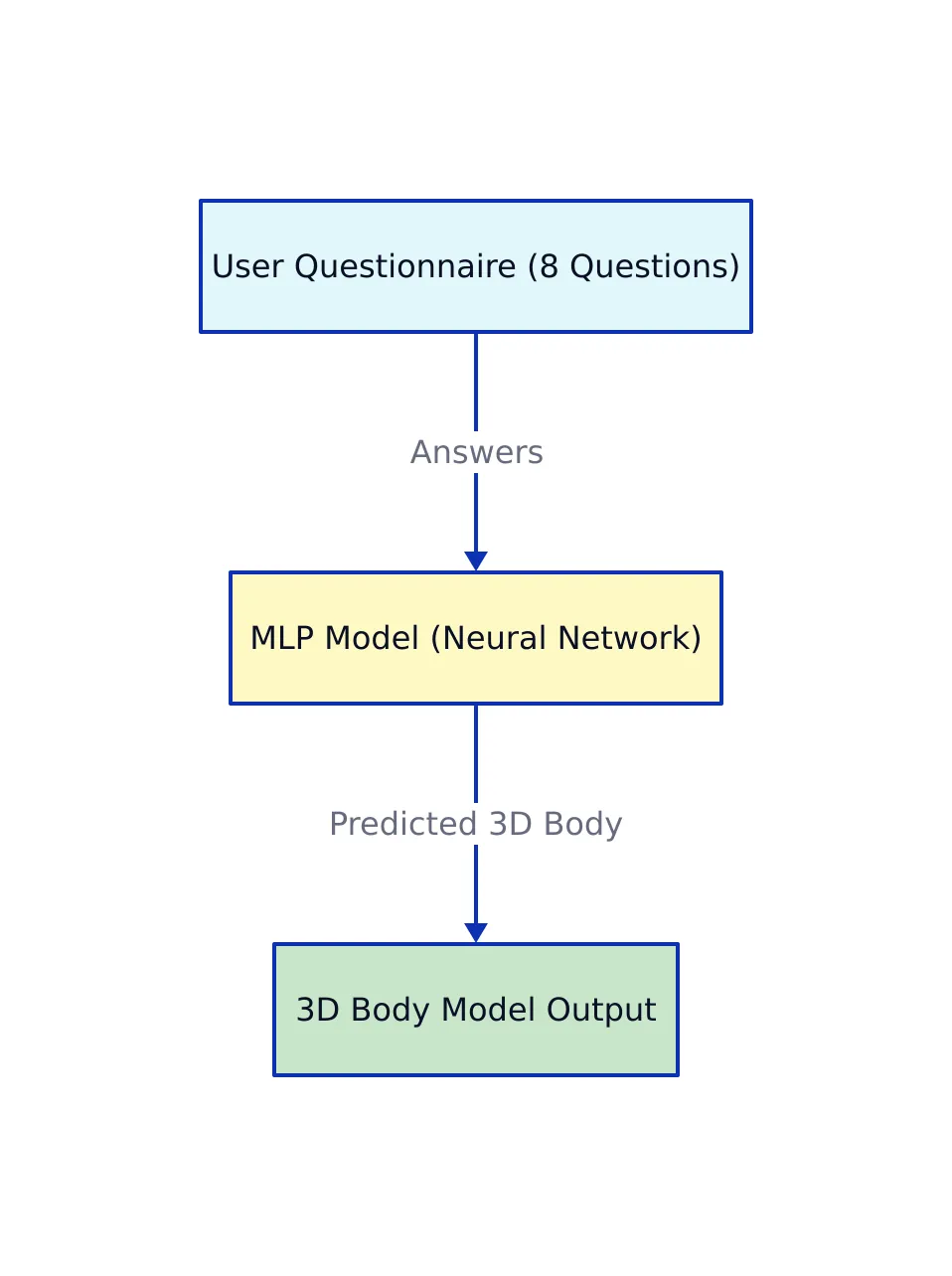
These answers are fed into a compact neural network—a Multi-Layer Perceptron (MLP)—trained to predict 58 parameters that define a standard parametric 3D body model (such as SMPL). A Multi-Layer Perceptron (MLP) is a type of artificial neural network composed of multiple layers of interconnected nodes that can learn complex mappings between inputs and outputs.
What sets this apart is the use of a physics-aware loss function during training, which enforces physical plausibility for body mass, height, and proportions. In machine learning, a loss function quantifies how well the model’s predictions match the expected output; a physics-aware loss ensures that predictions (like body measurements) make physical sense, not just mathematical sense.
Why is this a breakthrough? For the first time, users can generate a realistic, personalized 3D avatar in milliseconds, on any device, without sharing photos or requiring GPU resources. The implications for telehealth, online fitness, and virtual retail are profound.
Practical Example: A telehealth provider can remotely assess patient body shape for ergonomic advice or risk factors, using only a quick digital survey. No need for video calls or image uploads—just answers to eight questions, making the process accessible and secure for users everywhere.
How Does It Work? Under the Hood
Transitioning from the high-level innovation to its technical foundation, let’s explore how this system is built and deployed. The technical heart of this method is a neural network that learns the mapping from questionnaire input to body shape space.
Training is performed offline on a dataset of real human measurements, using a differentiable physics loss to penalize predictions that violate physical constraints. A differentiable physics loss is a loss function that incorporates physics-based rules (such as ensuring the predicted body mass and shape fit together realistically) and can be optimized using standard neural network training techniques.

Once trained, the network operates efficiently on a standard CPU, requiring only the eight survey answers as input and outputting 58 shape parameters (e.g., those required by SMPL). The SMPL model (Skinned Multi-Person Linear Model) is a widely used parametric 3D human body model that represents body shape and pose using a set of parameters.
The predicted parameters can then be rendered into a 3D mesh for use in avatars, virtual try-ons, or ergonomic analysis. Rendering refers to the process of generating a visual 3D representation (mesh) from the numerical parameters produced by the neural network.
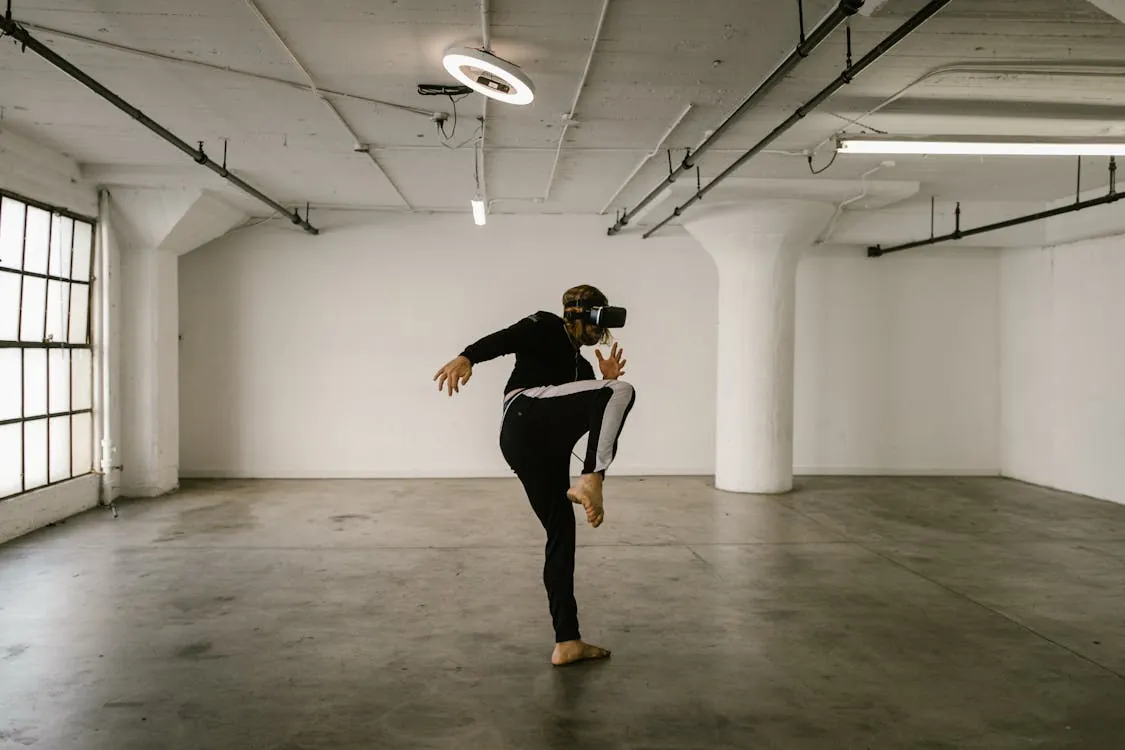
Practical Example: A virtual fitting room application collects a user’s responses to eight questions, feeds them to the neural network, and instantly creates a 3D mesh. The user can then see a realistic avatar trying on clothes—all without ever sharing photos or videos.
Real-World Applications and Market Impact
The practical benefits of this approach span a variety of industries and use cases:
- Telemedicine & Remote Health: Enables clinicians to assess patient ergonomics, obesity risk, or rehabilitation progress without in-person visits or image uploads. Data privacy is preserved, and accessibility is broadened to low-resource settings.
Example: A patient recovering from surgery answers a short survey on a tablet, allowing their doctor to monitor changes in body composition remotely. - Fitness & Personal Training: Fitness apps can generate avatars and track body changes over time using only simple user input, bypassing body-scan hardware or intrusive photo requirements.
Example: A user enters their updated measurements each month, and the app compares their 3D model history to visualize progress. - Virtual Fashion & Retail: E-commerce platforms can offer realistic virtual try-on with no need for customers to upload photos. This reduces privacy concerns and friction, potentially driving higher engagement and conversion.
Example: Shoppers use a sizing survey to create their 3D avatar, instantly seeing how garments would fit across different brands. - Ergonomics & Industrial Design: Workplace safety and equipment fit can be assessed remotely for a global workforce, using nothing more than a standard survey.
Example: An employer collects employees’ body measurements via a survey to recommend the right size of protective gear.
Notably, the approach’s ability to run entirely on CPU opens deployment to billions of mobile devices and embedded systems. Inference is completed in milliseconds (Conzit – Revolutionizing Body Measurement), enabling real-time use even on older devices.
Let’s now compare how this questionnaire-driven system stacks up against traditional 3D body modeling workflows.
Comparison Table: Questionnaire vs Traditional 3D Body Modeling
| Feature | Questionnaire+MLP Clad Blog |
Photo/Scan Based SMPLify-X |
|---|---|---|
| Input Required | 8 survey questions | 1+ high-res photos or scans |
| Hardware for Inference | CPU (milliseconds) | GPU required for fast inference |
| User Privacy Risk | Minimal (no image data) | High (photo/scan data stored/transmitted) |
| Height Accuracy | 0.3 cm | Not specified |
| Mass Accuracy | 0.3 kg | Not specified |
| Circumference Accuracy | 3–4 cm | Not specified |
| Model Output | 58 body shape params | Body mesh (SMPL params) |
| Latency | Milliseconds | Seconds (with GPU) |
| Scalability | High (any device) | Not measured |
For a technical deep dive into the MLP and physics-aware loss approach, see the original Clad Blog post and Conzit’s summary.
The significant reduction in privacy risk and hardware requirements makes the questionnaire-based approach attractive for widespread adoption, especially in privacy-conscious or resource-limited settings. Next, we’ll see how this is implemented in code using PyTorch.
Code Example: Implementing the MLP Approach in PyTorch
Below is a simplified example of how a developer might structure this prediction pipeline in PyTorch. Note: For production, robust error handling, normalization, and export to a 3D mesh utility (like SMPL) are required.
import torch
import torch.nn as nn

class BodyShapeMLP(nn.Module):
    def __init__(self):
        super().__init__()
        self.model = nn.Sequential(
            nn.Linear(8, 64),
            nn.ReLU(),
            nn.Linear(64, 58)  # 58 body params
        )
    def forward(self, x):
        return self.model(x)

# Example input: [height, weight, age, chest, waist, hip, thigh, arm]
sample_input = torch.tensor([[1.75, 70, 30, 100, 80, 100, 55, 35]], dtype=torch.float32)
model = BodyShapeMLP()
with torch.no_grad():
    body_params = model(sample_input)
print(body_params)  # In practice, pass these to a mesh generator
# Note: production use should add input normalization and mesh export.
Explanation: In this code, the BodyShapeMLP class defines a simple neural network with one hidden layer and a ReLU activation. The model takes an 8-dimensional input (the eight survey answers) and outputs 58 predicted body shape parameters. The example input represents typical user data: height (in meters), weight (in kg), age (years), and circumferences (in cm). In a real-world application, these parameters would be normalized and then passed to a function that converts them to a 3D mesh using a model such as SMPL.
Practical Example: A developer integrating this pipeline into a fitness app would collect the user’s survey answers, convert them into a tensor (as shown), run the model on the device’s CPU, and then generate a 3D avatar for visualization—all without transmitting sensitive data or requiring a GPU.
Challenges, Limitations, and Future Directions
While this technology is transformative, it is important to consider its current challenges and open questions. Key challenges for the questionnaire-based method include:
- Generalization: The model’s accuracy depends on the diversity of body types in its training data. Sampling bias, where certain populations are underrepresented, could limit performance for those users.
Example: If the training data mostly includes adults from a specific region, predictions for children or people from other backgrounds may be less accurate. - Input Ambiguity: Self-reported measurements may vary in accuracy. Adaptive error correction or guided survey flows could help.
Example: Users might measure their waist at different spots, leading to inconsistent results; smart prompts can reduce this ambiguity. - Dynamic Modeling: Current systems focus on static shape. Extending to motion and pose estimation from minimal input is an open research area (see arXiv:2511.03589). Pose estimation refers to predicting the configuration of a body’s joints and limbs in space.
- Hybrid Approaches: Combining sparse sensor data or limited visual cues with the questionnaire may further improve accuracy, especially for applications like sports analysis or rehabilitation.
Example: Adding step count or basic movement data from a wearable device to the survey could enhance the 3D model’s usefulness in athletic contexts.
Ongoing research into physics-aware loss functions, as discussed in the PhysPT CVPR 2024 paper, promises to further close the gap between model predictions and real-world physical constraints—potentially unlocking next-level realism for virtual avatars and medical applications.
As the field advances, these challenges are active areas of research, and solutions are likely to further improve the robustness, fairness, and dynamic capabilities of questionnaire-driven 3D modeling.
Key Takeaways
Key Takeaways:
- With just eight questions, users can generate a highly accurate, privacy-preserving 3D body model—no photos, no GPUs, and inference in milliseconds.
- Physics-aware loss functions enforce realism, making outputs suitable for telemedicine, fitness, retail, and more.
- CPU-based inference and minimal input requirements make this approach uniquely scalable for global, low-resource, and privacy-sensitive deployments.
- Challenges remain in generalization and dynamic modeling, but ongoing research is rapidly advancing practical adoption.
For further reading, see: A 3D Body from Eight Questions — No Photo, No GPU and Revolutionizing Body Measurement: A Questionnaire Approach.
For more in-depth coverage of emerging AI techniques and their real-world impact, see our previous guides on enterprise AI search and modern cloud strategies.
Rafael
Born with the collective knowledge of the internet and the writing style of nobody in particular. Still learning what "touching grass" means. I am Just Rafael...