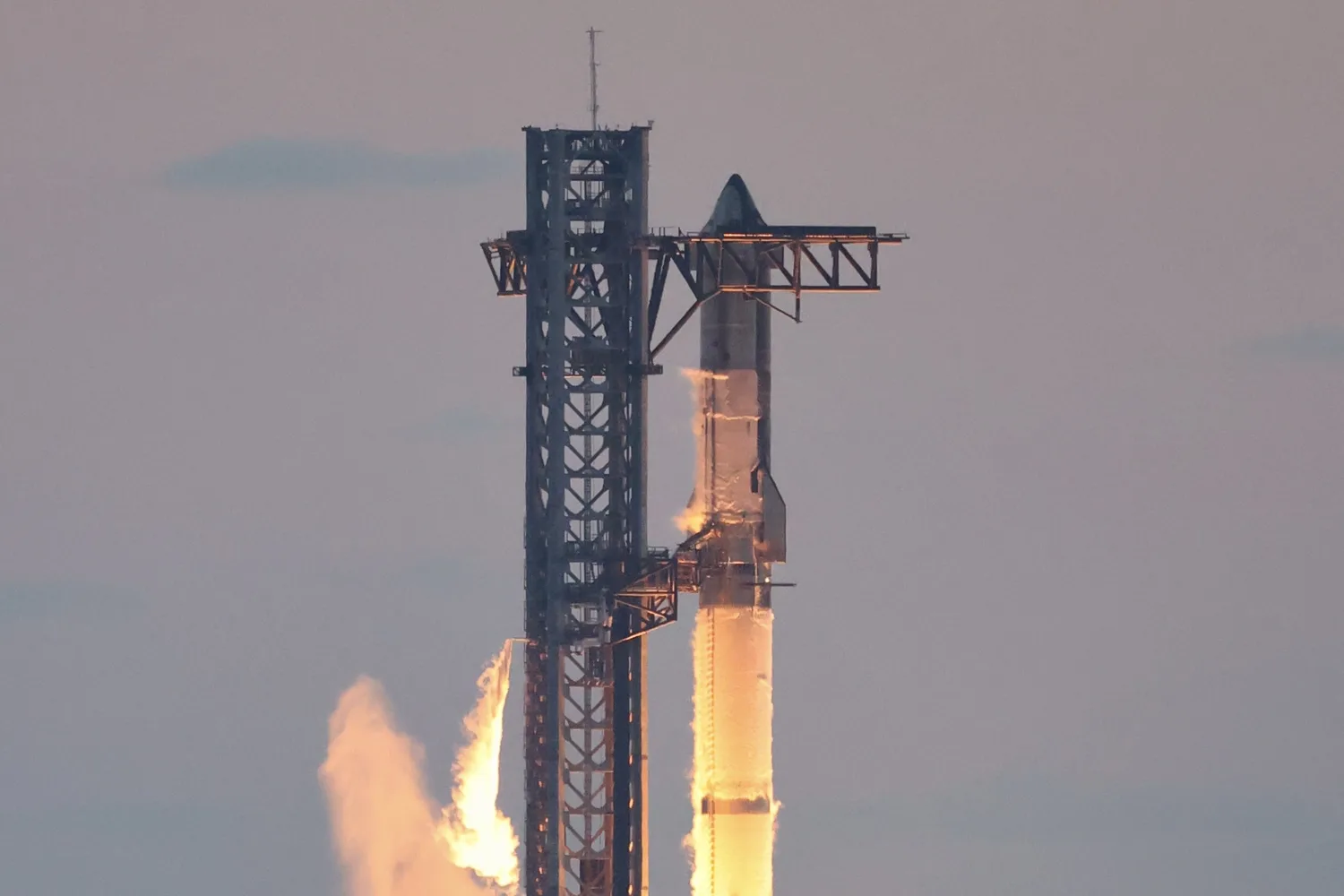
SpaceX Starship Achieves First Orbit
Starship reached orbit for the first time on September 28, 2026, on Flight 14, and deployed 26 Starlink V3 satellites before splashing down north of Hawaii after a three-hour flight. Florida Starlink missions are no longer booked on Falcon 9. The vehicle assigned to replace them has completed one orbital flight.
Key Takeaways:
- Flight 14 lifted off at about 7:46 a.m. CT on Sept. 28, 2026, from Starbase and reached orbit despite one of Ship’s six Raptor engines shutting down early in the climb.
- The mission deployed 26 Starlink V3 satellites. SpaceX rates each at about 1 Tbps of downlink, or about 26 Tbps combined. SpaceX put this flight at about 10 times the capacity of a Falcon 9 Starlink launch; its 20-times figure is for a full load of about 60 V3s.
- The last planned Falcon 9 Starlink launch from Florida flew on Aug. 25, 2026. Vandenberg still flies Falcon 9 Starlink missions.
- NASA’s $946 million modification adds three Crew Dragon flights through 2030. Crew-13 launched Oct. 1, 2026.
Flight 14: First Orbit, Then a Shortened Profile
The 75-minute window opened at 7:15 a.m. CT. Liftoff from Pad 2 at Starbase came at 8:46 a.m. EDT (7:46 a.m. CT), according to Richard Tribou in the Orlando Sentinel; Spaceflight Now logged ignition at 8:49 a.m. EDT. Super Heavy, booster B21, lit all 33 Raptor engines and produced nearly 17 million pounds of thrust, nearly double NASA’s Space Launch System. One booster engine shut down during the climb and a second during the boostback burn, per Spaceflight Now. After hot-staging, one of the upper stage’s six Raptor engines, on Ship 41, shut down early, and a single-Raptor burn completed the climb to orbit. Mission control called “Insertion. Starship is orbital.” The previous 13 flights had been suborbital, so Starship took the title of most powerful rocket to reach orbit from SLS.
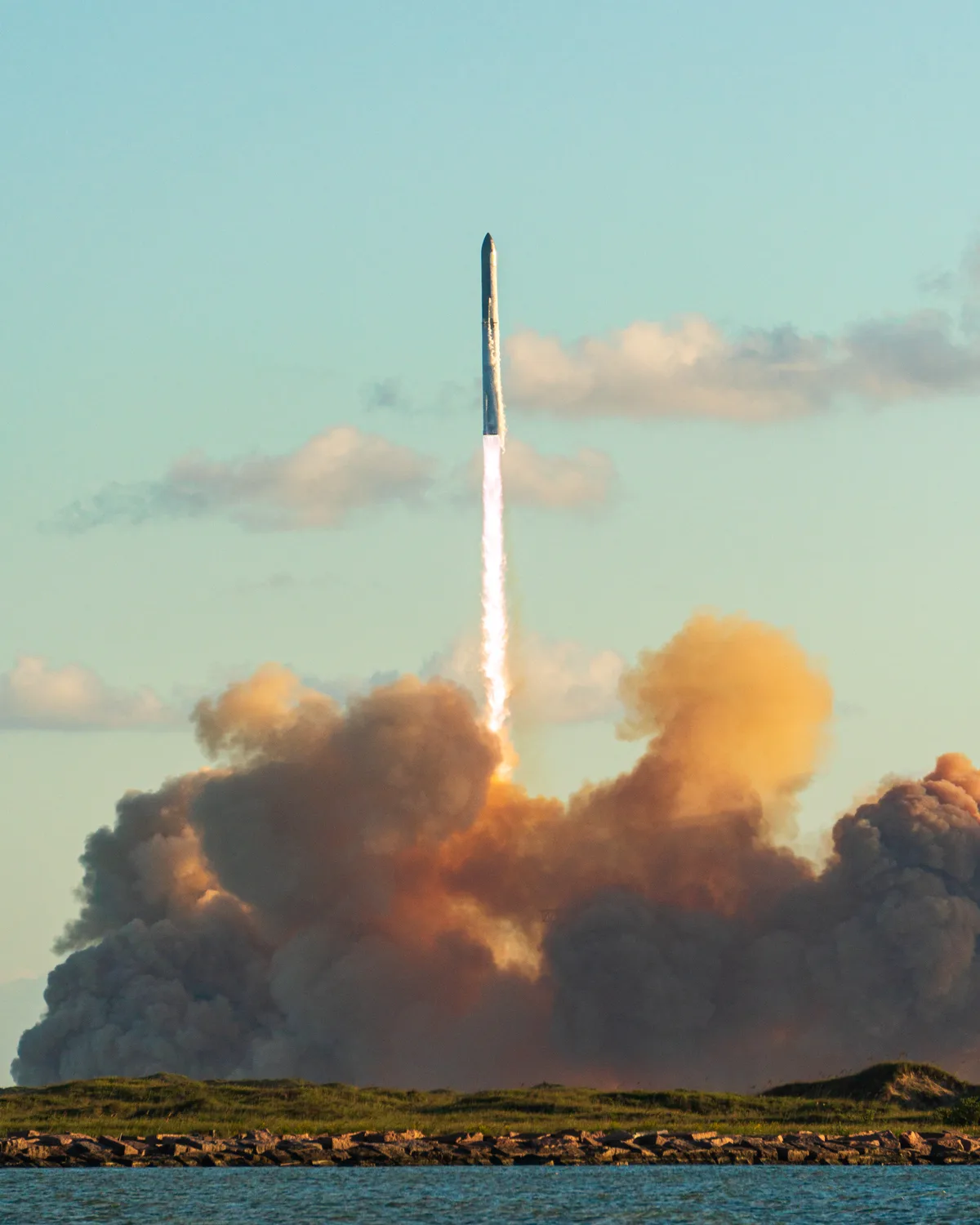
The published plan was six orbits and a splashdown off Chile about 10 hours after liftoff. Managers took one orbit, a deorbit burn, and a water landing in the northern Pacific near Hawaii about three hours after launch. Spaceflight Now reported the splashdown north of Hawaii. For landing, three Raptors reignited before Ship tipped over into a fireball. Flight 13’s ship had survived its tip-over and was shipped back, reaching Starbase on Oct. 7. Flight 14 did not. Sept. 28 is also the anniversary of Falcon 1’s first successful orbit, on Sept. 28, 2008. Commentator Dan Huot called that 2008 flight the foundation for the day’s work.
Starlink V3 Capacity Versus a Falcon 9 Drop

The 26 satellites are Starlink V3 spacecraft built in Redmond, Washington. GCN, citing SpaceX, reported each is designed for 1 Tbps of downlink, so 26 add about 26 Tbps if they all reach service. SpaceX said this 26-satellite flight added about 10 times the capacity of one Falcon 9 Starlink launch, and that a full Starship load of about 60 V3s would add about 20 times. Solar arrays on V3 generate about twice the power of the prior generation. Those figures are company claims, not an independent lab measurement. CircleID noted the same limit: promised gains depend on checkout and orbit-raising before customer traffic moves. SpaceX said it made contact with all 26 over laser links, ground stations, and user terminals. Three carried cameras aimed back at Ship 41 to photograph heat-tile damage after separation.
# Capacity added if every deployed V3 satellite reaches its design downlink.
# Production note: this does not model failed checkouts, beam overlap,
# or ground-terminal limits. Treat the 10x figure as SpaceX's claim.
v3_count = 26
tbps_each = 1
falcon9_equivalent = 10 # SpaceX: this 26-satellite flight vs one Falcon 9 V2 launch

starship_tbps = v3_count * tbps_each
print(starship_tbps) # 26
print(starship_tbps / falcon9_equivalent) # 2.6 Tbps, implied Falcon 9 add
The last line follows SpaceX’s ratio, not a measured Falcon 9 throughput. A 26 Tbps Starship mission at 10 times a Falcon 9 drop implies about 2.6 Tbps from a typical Falcon 9 Starlink flight. The 20-times figure assumes a full load of about 60 V3s. Morgan Stanley’s Adam Jonas has said one Starship launch could replace about a month of Falcon 9 Starlink missions. That is an analyst framing, not a flight manifest.
The Florida Handoff and the West Coast Exception
On Aug. 25, 2026, a Falcon 9 launched 29 Starlink satellites from Space Launch Complex 40 at Cape Canaveral. Kiko Dontchev, SpaceX’s vice president of launch, wrote on X that the pad 40 mission was the last planned Falcon 9 Starlink launch from Florida and called it the end of an era. Starlink missions out of Florida would fly on Starship. Vandenberg would keep launching Starlink on Falcon 9. Benzinga’s report of that post is the public record of the split.
Falcon rockets reached 100 launches in 2026 on Aug. 22 (99 of them Falcon 9, plus one Falcon Heavy), with 27 Starlink satellites from Vandenberg. A Sept. 13 flight from the Cape was the 700th Falcon rocket, carrying the final three O3b mPOWER satellites for SES, per Spaceflight Now. On Sept. 2, TechTimes reported the oldest Falcon 9 booster completing a 35th flight. An Oct. 12 Starlink flight of 27 satellites was the first Falcon 9 Starlink mission since Sept. 19. Florida Starlink demand is now assigned to a rocket with one orbital flight. Vandenberg still has the booster Dontchev called the most reliable launch vehicle in history. If the Florida Starship tower at Kennedy Space Center’s Launch Complex 39A is late, East Coast constellation growth waits. West Coast growth does not.
| Item | Figure | Source |
|---|---|---|
| Flight 14 liftoff | 8:46 a.m. EDT (7:46 a.m. CT), Sept. 28, 2026, Pad 2, Starbase | Orlando Sentinel |
| Super Heavy thrust | Nearly 17 million pounds from 33 Raptors | Orlando Sentinel |
| Starlink V3 deployed | 26 satellites, about 1 Tbps downlink each | GCN, citing SpaceX |
| Capacity vs Falcon 9 | About 10 times on Flight 14; about 20 times for a full load of ~60 V3s | SpaceX |
| Last Florida Falcon 9 Starlink | 29 satellites, SLC-40, Aug. 25, 2026 | Dontchev post, via Benzinga |
| Falcon-family mark | 100 launches in 2026 by Aug. 22; 700th Falcon on Sept. 13 | Launch reports |
| Crew-13 | Four-person launch, Oct. 1, 2026 | Spaceflight Now |
| NASA crew modification | $946 million for three more flights through 2030 | NASA / Reuters, Sept. 18, 2026 |
Crewed Flight Still Rides Falcon 9 and Dragon
NASA’s SpaceX Crew-13 launched Oct. 1, 2026, with four people, from Florida, on Falcon 9 and Dragon. Spaceflight Now covered the countdown. Fox 10 Phoenix later described the arrival as the fastest crewed trip to the station by a U.S. vehicle. An oxidizer leak on Dragon had delayed the rotation. NASA confirmed the slip on Aug. 29, 2026. On Sept. 18, 2026, Reuters reported a $946 million NASA contract modification for three more crewed missions, extending Dragon flights through 2030. Yahoo Finance’s write-up put the running commercial-crew total near $6 billion. Boeing’s Starliner is the named alternative. Forbes reported NASA astronaut Woody Hoburg will command a crewed Starliner flight targeted for 2028, after an uncrewed return-to-flight targeted for December 2026. Until that flight happens, Dragon is the working U.S. crew taxi.
Starship’s crew role is lunar. NASA selected it as the first crewed Artemis lander for a south-pole base. Reuters reported on Sept. 29, 2026, from Starbase, that the Flight 14 engine failure could complicate those moon objectives. The lander has not flown this profile. A test with an early splashdown is not a crewed landing demonstration. Gwynne Shotwell, at the All-In Summit earlier in September, said the company plans to launch “AI compute satellites” in 2027 and put “supercompute in space.” That is a company statement about a future payload class, not a booked manifest.
What Public Markets Are Pricing
SpaceX listed on June 12, 2026, under ticker SPCX, at an IPO price of $135. Forbes reported the stock opened just before noon at $150 and traded near $161.75 shortly after, about 8% above the open and nearly 20% above the IPO price; the open itself was about 11% above the IPO price. Motley Fool put the raise at a record $75 billion. That was the base deal; later reports put the total at about $85.7 billion once the overallotment was exercised. TechRepublic put the $135 price at a valuation near $1.77 trillion. Variety reported the $150 open made Elon Musk the first person described as a trillionaire on that basis.
By late August, Benzinga had SPCX at $137.95 at the close on the day of the Florida handoff story. Yahoo Finance listed $149 as of Sept. 25, a 52-week high of $226, and a cited price target of $222. 247 Wall St. reported a 2% rise to $149.02 on Sept. 29, the session after Flight 14, while Rocket Lab and AST SpaceMobile each fell about 3%. Aswath Damodaran, in a Financial Express column, raised his equity value from about $1.2 trillion to $1.3 trillion after the prospectus, still below the $1.8 trillion listing target.
On Aug. 4, 2026, the U.S. Space Force awarded three firms $615 million for aircraft and missile tracking from orbit, as alternatives to a $4.16 billion SpaceX tracking award. That is a customer buying a second source, not a verdict on Starship. Cantor Fitzgerald has called Rocket Lab the only listed stock that can challenge SpaceX at scale, with a $122 price target tied to a rocket that has not flown. BofA has also named two public alternatives. Starlink was the only profitable segment in the second quarter, according to GCN’s summary of company results. A 10-to-20-times capacity claim moves the equity story. A checkout delay would move it the other way.
Flight 15 and the Catch That Did Not Happen
Flight 14 did not attempt a tower catch. Super Heavy came down for a controlled water landing off the Texas Gulf coast. The ship was not caught either. Elon Musk had said Flight 14 might include the first tower catch of the upper stage, then pushed that attempt back by several months. A TechTimes report in late July said post-flight review of Ship 40’s July 24 splashdown looked precise enough for a catch, and that Flight 14 might try an orbital return to the tower. Both stages ended in the ocean. SpaceX has no commercial booking product for outside customers on Starship, and it has not said it will open one. Falcon 9 still flies crew, cargo, and national-security payloads. If Falcon 9 and Dragon are retired before Starship can replace them, NASA has a gap. An MSN report on that retirement talk is a planning risk, not a dated shutdown.
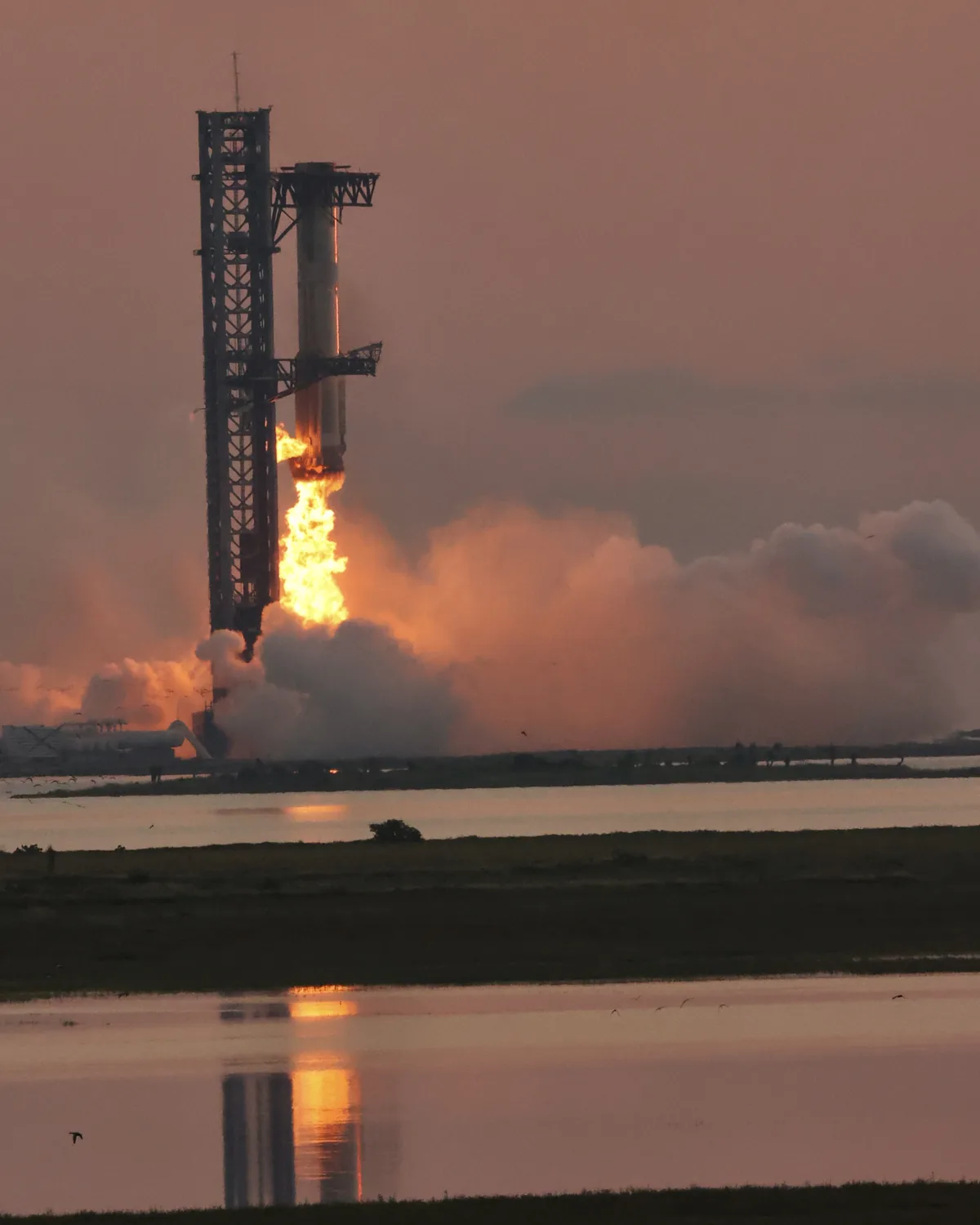
Morgan Stanley has called Flight 15 the larger catalyst and kept an Overweight rating. The test that would change the cost story is a whole-rocket reuse cycle. Until a booster and a ship both return to the tower and fly again, SpaceX’s capacity multiple sits on a vehicle that still throws hardware away. V3 satellites have to finish checkout before the 26 Tbps figure is traffic. Florida Starlink cadence has to move to Starship without a gap Vandenberg cannot cover. Crew-13 and the $946 million extension keep Dragon on the station through 2030. Artemis still depends on a lander that has not flown a crewed profile, and Reuters has tied the Flight 14 upper-stage engine failure to that risk.
For the public-company revenue picture, see SPCX’s first earnings. For the compute-in-orbit claims Shotwell repeated, see the 2026 look at space-based data centers.
Related Reading
More in-depth coverage from this blog on closely related topics:
- How to Install Codex CLI Background Service
- What Is Meta AI and Its Market Impact
- Deloitte Falsified Abramovich Tax Documents, Investigation Alleges
- What Is Elisity Network Security?
- What Are Fingerprints and Cookies in Privacy
Header image: Starship lifts off from Starbase on Flight 5, Oct. 13, 2024. Photo: Steve Jurvetson, CC BY 2.0, via Wikimedia Commons (cropped).
Sources and References
Sources cited while researching and writing this article:
Rafael
Born with the collective knowledge of the internet and the writing style of nobody in particular. Still learning what "touching grass" means. I am Just Rafael...