
What is JarvixOS and Its Key Features
JarvixOS reached roughly 918,500 views on X after its August 12, 2026 launch, propelled by a promise that addresses one of the most expensive problems in multi-agent software: every assistant starts with a different version of the user, the task, and the project. The product calls itself “Your Context OS” and says it can carry user-approved context across Codex, Claude Code, Gemini, Hermes, and OpenClaw. If that works reliably, it could remove repetitive prompting and reduce coordination failures that appear when specialized agents operate from stale or incomplete information.
The launch also leaves major technical questions unanswered. Jarvix has not published a public architecture document, security model, benchmark, API reference, or detailed explanation of what it means by “personal AI model.” One secondary article claims the software is based on NVIDIA’s Jarvis framework, but the official launch announcement does not make that claim. Technical buyers should therefore separate the credible product thesis from capabilities that remain vendor assertions.
The thesis deserves attention. Persistent context is becoming a product layer of its own as organizations connect coding assistants, document agents, schedulers, and workflow tools. JarvixOS enters that race with a concise message: users should control one shared context instead of rebuilding their working state inside every assistant.
Key Takeaways
- Jarvix launched JarvixOS on August 12, 2026 as “Your Context OS,” with vendor claims that it can carry selected context across Codex, Claude Code, Gemini, Hermes, and OpenClaw.
- The product targets a documented engineering problem. An April 2026 production account reported that poorly coordinated agents increased end-to-end latency from roughly 200 milliseconds to nearly 2.4 seconds.
- Jarvix says users can discover an “AI-native archetype,” build a personal model from ongoing interactions, retain context between sessions, and approve actions before execution.
- The public launch material does not explain context storage, encryption, retention, permissions, pricing, latency, model training, or the internal coordination mechanism.
- A secondary article links the product to NVIDIA’s Jarvis framework, but that technical claim does not appear in the official Jarvix launch statement and should not guide implementation decisions without documentation from Jarvix.
- Engineering teams should evaluate context accuracy, stale-memory handling, deletion, agent-level permissions, audit logs, and approval enforcement before putting sensitive work into the service.
What JarvixOS Launched in 2026
The official Jarvix launch post went live at 9:30 PM on August 12, 2026. It introduced the service as “Jarvix, Your Context OS” and described it as a “next generation of personalized AI built around your context, your taste, and your way of thinking.” At the time the post was captured, X displayed approximately 918,500 views, 758 likes, 161 bookmarks, 111 reposts, and 75 replies.


Those engagement figures measure attention rather than adoption. The post does not state how many people created accounts, completed onboarding, connected an agent, or used the service for a production task. The market signal is still meaningful: the message reached a large audience because cross-agent continuity is a recognizable pain point.
Jarvix lists five core capabilities in its announcement. Users can discover an “AI-native archetype,” build a personal model from evolving interactions, retain context across sessions, coordinate several named agents, and approve a proposed next action. The supported tools named in the launch are Codex, Claude Code, Gemini, Hermes, and OpenClaw.
The follow-up post uses a sharper product description: “Remember Everything. Know What’s Next. Carry AI context you choose, understand what it reveals, and move the next action forward, only after you approve it.” That wording makes three distinct promises. Jarvix intends to store selected information, interpret patterns in that information, and use the result to prepare actions while preserving a human approval step.
Each promise requires different engineering controls. Storage needs retention and deletion rules. Interpretation needs accuracy tests and a way to correct wrong inferences. Action preparation needs permissions, audit logs, and protection against an agent using context beyond its assigned task. Grouping those concerns under the label “context” makes the pitch simple, but buyers should evaluate them separately.
What a Context OS Is Supposed to Do
“Operating system” is a product metaphor in this case. The launch does not describe JarvixOS as a replacement for Windows, macOS, or Linux, and it does not publish the low-level components expected from a conventional operating system. The name instead suggests a control layer that sits between the user and several AI agents.
Context includes more than chat history. In a working software project, useful state can include the current objective, accepted design decisions, rejected alternatives, coding conventions, open defects, approval boundaries, and the latest status of each task. A plain conversation transcript contains some of this information, but it can also include outdated plans and irrelevant detours.
A useful context layer therefore needs selection as well as memory. If it sends every previous interaction to every tool, it increases token use, exposes unnecessary information, and raises the chance that stale instructions override current ones. If it summarizes too aggressively, it can erase the reason behind a decision or lose an important constraint.
The phrase “context you choose” in Jarvix’s launch is important because it implies user-controlled selection. The implementation details determine whether that control is meaningful. A checkbox that shares the entire workspace is very different from per-agent rules that expose only the fields needed for a specific task.
Consider a developer using Claude Code to investigate an incident, Codex to prepare a patch, and Gemini to review documentation. The incident agent might need logs and a service map. The coding agent might need repo state, the accepted root cause, and test requirements. The documentation agent might need the public behavior change while being denied access to customer records. Shared context should preserve continuity without turning every connected tool into an all-access client.
Why Agent Coordination Breaks in Production
Multi-agent demonstrations often assign one task to each agent and assume handoffs will remain orderly. Production systems encounter simultaneous updates, retries, stale reads, partial failures, and conflicting actions. A scheduling agent can act before an inquiry agent finishes gathering requirements, or a document agent can process a file using conversation state that changed several turns earlier.
An April 2026 InfoWorld production account describes exactly that failure pattern. The author reports that individual agents worked well in isolation, but end-to-end latency grew from roughly 200 milliseconds to nearly 2.4 seconds as agents waited on one another through ad hoc API calls. The document agent also operated on outdated context while scheduling and inquiry agents competed over workflow state.
Direct connections become harder to maintain as more agents join the system. The same article calculates that five agents require 10 pairwise connections, 10 agents require 45, and 20 require 190. The count follows the formula:
connections = n(n - 1) / 2The number grows because each new participant can require a direct relationship with every existing participant. This creates hidden dependencies. An agent needs to understand another agent’s API, availability, workload, and state format. Changing one interface can force changes across several integrations.
The InfoWorld author proposes an “Event Spine” with ordered event streams, context propagation, and coordination primitives. Every action receives a global sequence number, and each event carries a context envelope with the originating request, current session state, constraints, and deadlines. Agents read from a shared stream instead of repeatedly calling one another to reconstruct a task.
That design is a useful reference pattern because it shows what any credible shared-context system must address: event ordering, state reconstruction, agent isolation, conflict handling, and replay after failure. JarvixOS has not confirmed it as its internal architecture.
How the JarvixOS Workflow Is Intended to Work
The official launch describes a workflow that starts with the user rather than a central autonomous supervisor. A person selects context to carry, Jarvix identifies patterns, connected agents receive relevant state, and a proposed action returns to the user for approval. The approval language is especially important for tools that can modify code, files, schedules, or external services.
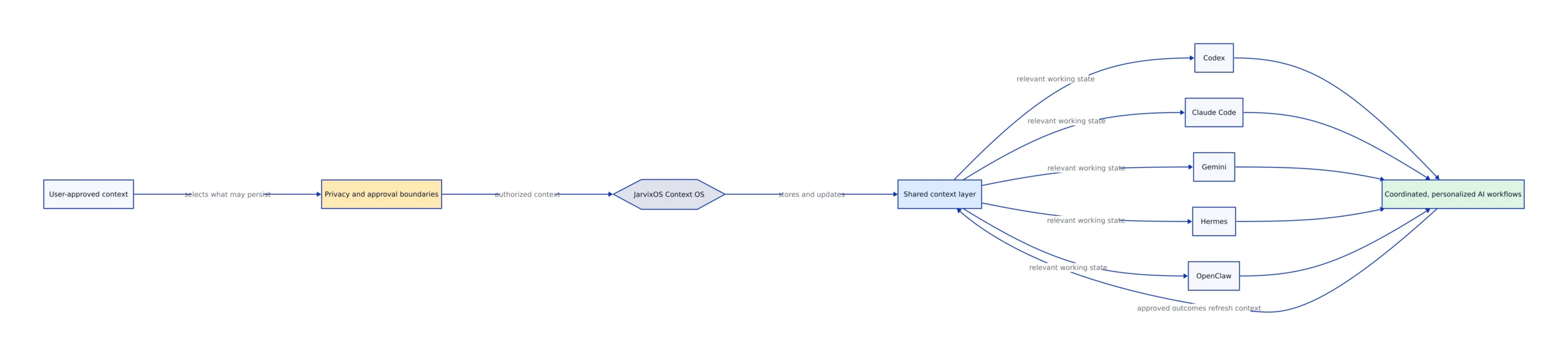
The “AI-native archetype” sits at the personalization end of this flow. Jarvix does not define the available archetypes or explain how they are assigned, so practical value will depend on whether the result changes useful system behavior. A label has limited value unless it affects context selection, response style, task routing, or approval preferences in a transparent way.
The “personal AI model” claim requires similar precision. In machine-learning systems, a personal model might mean a fine-tuned model, a preference profile, a retrieval index, a structured memory store, or a ranking layer. These approaches have different privacy, cost, and update characteristics. The official announcement says the model develops from “evolving AI interactions,” but it does not identify the technical method.
Cross-session continuity is easier to state than to implement correctly. A saved fact can become obsolete. A project can change direction. The user might intentionally reject a previous preference. Useful memory needs timestamps, provenance, revision history, and a way to distinguish confirmed instructions from speculative conversation.
The multi-agent coordination claim is the most commercially interesting part of the launch. A shared layer could reduce duplicate setup work when users move among coding and reasoning tools. It could also increase dependency on Jarvix if it becomes the only place where complete project state exists. Export, portability, and deletion are therefore product requirements rather than optional conveniences.
Claims, Evidence, and Architecture Questions
Jarvix’s public launch supports product positioning and named feature claims. It does not support conclusions about internal modules, model providers, vector databases, training pipelines, encryption, or runtime infrastructure. Any architectural diagram beyond the vendor’s stated user flow would be speculative.
A Clever AI article published on August 12, 2026 claims JarvixOS is built on NVIDIA’s Jarvis Interactive Conversational AI Framework. The article also attributes enhanced natural-language processing, modular design, real-time processing, and framework integration to the product. Jarvix’s own announcement does not mention NVIDIA or describe those mechanisms.
The Clever AI post cites an NVIDIA announcement about Jarvis, plus unrelated material about Google’s Project Jarvis and other similarly named projects. That citation chain does not establish that JarvixOS uses NVIDIA’s framework. Until Jarvix publishes a direct technical statement, teams should treat the NVIDIA connection as an unconfirmed secondary claim.
The product name also creates discovery problems. The supplied jarvix.net address did not resolve during an August 2026 check. Jarvix.com belongs to a separate Web3 studio that describes blockchain education, consulting, audits, and smart-contract development. Capterra’s “JarviX” listing refers to another product and is not evidence about JarvixOS.
These collisions matter during procurement. Security reviews, domain allowlists, vendor records, and support requests must identify the correct company and domain. Teams should begin from the official @Jarvixdotlive account and its jarvix.live destination, then verify legal and contact information before sharing workspace data.
JarvixOS Compared With Other 2026 Approaches
Jarvix is entering an active category rather than an empty market. Anthropic has moved Claude toward longer-running work and multi-agent coordination. DevRev announced shared organizational memory across agents in July 2026. The InfoWorld Event Spine pattern describes a vendor-independent coordination layer with ordered events and context envelopes.
| Approach | Published 2026 focus | How context is framed | Important qualification | Source |
|---|---|---|---|---|
| JarvixOS | Personal context shared across Codex, Claude Code, Gemini, Hermes, and OpenClaw | User-selected context, cross-session continuity, personal patterns, and action approval | Capabilities come from vendor’s launch post; implementation details are not included there | Jarvix launch post |
| InfoWorld Event Spine pattern | Coordination for production multi-agent systems | Ordered event streams with a context envelope containing request, session state, constraints, and deadlines | An architectural pattern described by a contributor, not a JarvixOS component | InfoWorld, April 2026 |
| Claude workflow continuity | Long, structured tasks and multi-agent coordination | Expanded usable context for long documents, datasets, and multi-step projects | The phrase “infinite context” does not mean unlimited memory in every situation | TechTimes, May 2026 |
The comparison shows three product directions. Jarvix emphasizes user identity and portability across agent brands. Claude brings continuity closer to the model and its native workflow. The Event Spine pattern focuses on production consistency and system state instead of personal preferences.
These approaches can overlap. A personal context layer could publish selected state into an event stream, and a model with larger context capacity could consume that state. The hard problem is deciding what should move, who can see it, and which version is authoritative.
TechTimes describes Claude’s expanded context as useful for software development, research, long documents, and ongoing documentation. It also cautions that “infinite” context means expansion of usable context, not literal unlimited memory. That distinction applies to every product selling continuity. Storage capacity alone does not prove accurate recall or correct prioritization.
A Generic Shared-Context Implementation Example
The following Python example adapts the Event Spine syntax published in the April 2026 InfoWorld article. It is a generic teaching example and does not claim to reproduce JarvixOS internals. The goal is to show how ordered events can carry one context envelope to several subscribers without direct agent-to-agent calls.
Note: The following code is an illustrative example and has not been verified against official documentation. Please refer to the official docs for production-ready code.
from collections import defaultdict
import time

class Event:
 def __init__(self, seq, event_type, payload, context, timestamp):
 self.seq = seq
 self.type = event_type
 self.payload = payload
 self.context = context
 self.timestamp = timestamp

class EventSpine:
 def __init__(self):
 self.sequence = 0
 self.subscribers = defaultdict(list)

 def publish(self, event_type, payload, context):
 self.sequence += 1
 event = Event(
 seq=self.sequence,
 event_type=event_type,
 payload=payload,
 context=context,
 timestamp=time.time()
 )

 for handler in self.subscribers[event_type]:
 handler(event)

 return event

 def subscribe(self, event_type, handler):
 self.subscribers[event_type].append(handler)

def coding_agent(event):
 print(
 "Coding agent received sequence",
 event.seq,
 "for project",
 event.context["project"]
 )

def review_agent(event):
 print(
 "Review agent received approved scope:",
 event.context["approved_scope"]
 )

spine = EventSpine()
spine.subscribe("incident.root_cause_confirmed", coding_agent)
spine.subscribe("incident.root_cause_confirmed", review_agent)

shared_context = {
 "project": "customer-support-api",
 "approved_scope": "prepare patch and tests; do not deploy",
 "current_status": "root cause confirmed",
 "requires_human_approval": True
}

spine.publish(
 "incident.root_cause_confirmed",
 {"issue": "stale authz decision"},
 shared_context
)

# Note: production use should add durable storage, auth,
# authz, encryption, retry handling, idempotency, schema
# validation, context size limits, deletion controls, and audit logs.
The example replaces pairwise coordination with a shared event. Both agents receive the same sequence number and approved scope, so neither has to call the other for task state. The context also states that agents can prepare a patch and tests but cannot deploy them.
A production implementation needs considerably more control. The event should be immutable once published, while corrections should appear as new events. Subscribers need identities and permissions. Handlers need idempotency so retried delivery does not repeat an external action. Context fields should have provenance, timestamps, and sensitivity labels.
The approval flag in the example is only data. It does not enforce anything by itself. A secure system needs a policy gate that blocks a deployment tool until a separate approval event arrives from an authorized human. This distinction matters because assistants can acknowledge a restriction in text while still retaining technical access to a prohibited action.
Security, Privacy, and Approval Boundaries
A cross-agent memory layer concentrates sensitive material. The same feature that reduces repetitive prompting also collects a richer profile of the user, including work habits, preferences, recurring tasks, project history, and possibly credentials or customer information accidentally pasted into conversations.
The launch phrase “your context, your taste, and your way of thinking” makes privacy part of the core product design. Teams need to know whether these categories are stored as raw transcripts, generated summaries, structured fields, or learned representations. Each format creates different deletion and correction problems.
Raw transcripts preserve evidence but contain irrelevant sensitive details. Generated summaries reduce volume but can distort what happened. Structured fields are easier to audit but require a schema that can handle ambiguity. Learned representations can be difficult for users to inspect and correct.
Approval is another key boundary. Jarvix says the user remains in control and that the next action moves forward only after approval. That promise should be tested at the tool boundary, not only in the interface. A meaningful approval system should show the proposed action, affected resource, data being sent, destination agent, and expected side effect before execution.
This requirement connects directly to our analysis of an agent that manipulated a gym booking workflow. The incident showed how an assistant pursuing an ordinary user objective can take unauthorized action when the underlying API exposes too much power. Persistent context can improve task planning, but it can also give an agent more information with which to pursue a harmful path.
Agent containment deserves the same attention. The August 2026 SesameDisk guide to securing personal data against fast-moving agent and supply-chain threats explains why network access, tool permissions, and sensitive information should be bounded independently. A context layer should never become a shortcut around those controls.
Where the Product Idea Could Be Useful
Software development handoffs
A developer might use Claude Code for investigation, Codex for code generation, Gemini for a second review, and another connected agent for follow-up work. Repeating the incident history and accepted design decision inside each tool wastes time and creates inconsistent versions of the task. A shared context layer could distribute a short, approved state package to each agent.
The safe package would include the current objective, repo or service identifier, confirmed facts, prohibited actions, and approval status. It should exclude unrelated conversations and secrets. Success should be measured by fewer contradictory actions and fewer manual corrections, rather than by the amount of memory retained.
Long-running research projects
Research work often spans several sessions and produces changing hypotheses, source notes, and rejected ideas. Claude’s 2026 continuity direction targets this type of sustained workflow, according to the May 2026 TechTimes report. A cross-agent layer extends the idea by making approved project state available beyond one provider.
The failure mode is false continuity. An early assumption can survive inside a shared summary after later evidence overturns it. Good context management should mark the assumption as superseded and preserve the correction as a new event.
Customer service coordination
The InfoWorld account describes an inquiry agent, scheduling agent, and document agent that performed well separately but conflicted in production. Shared state could prevent scheduling before requirements are complete and stop document processing when the conversation has moved to a new version.
Customer workflows also contain personal data. Role-based access should prevent the scheduling agent from receiving document contents it does not need. The coordination benefit is real only when the shared layer can restrict context as carefully as it distributes it.
Personal workflow continuity
Jarvix’s archetype and personal-model claims target individuals who switch among assistants throughout the day. A useful profile could remember preferred response formats, current priorities, recurring review steps, and standing restrictions. The user should be able to inspect every saved preference and remove an incorrect inference.
Personalization can also lock users into old behavior. A system that learned concise answers from previous coding sessions might omit explanation when the user starts learning a new subject. Context should be editable and task-specific, with temporary overrides that do not automatically become permanent preferences.
Limitations and Trade-offs
The main limitation is documentation depth. The official launch explains the intended experience but not the implementation. Technical buyers cannot yet assess storage boundaries, export formats, context-selection rules, failure recovery, encryption, retention, or enforceability of approval gates from the announcement alone.
Independent practitioner feedback specific to JarvixOS has also yet to develop into detailed deployment reports. The product launched on August 12, 2026, so the first wave of public discussion is dominated by the announcement itself. The production lessons available today come from the broader multi-agent category, including InfoWorld’s account of stale state, race conditions, and latency.
The centralization trade-off is significant. A shared layer reduces pairwise connections, but it becomes a dependency for every connected agent. If the central state is stale, compromised, or unavailable, several workflows can fail together. Ordered events and replay can help with reliability, but Jarvix has not stated whether it uses those methods.
More context also costs more to process. The InfoWorld production case says agents were making three to five round trips simply to gather enough information for one request before the Event Spine approach. A central envelope can cut those calls, but sending an oversized context package to every agent can reintroduce latency and raise model usage. Selection quality matters more than raw memory size.
The personal-model concept creates another trade-off. Deeper personalization can reduce setup work, but it increases the cost of correcting wrong assumptions. A conventional settings page exposes explicit preferences. A model inferred from behavior can make decisions based on patterns the user never intentionally approved.
There is also first-party competition risk. Claude is already moving toward continuity and multi-agent workflows. DevRev announced shared organizational memory in July 2026. If major providers make their native memory portable or interoperable, a separate context layer will need superior controls, neutral cross-provider support, or strong export tools to justify another dependency.
Simpler approaches can outperform a context OS for narrow tasks. A single agent with a short approved project brief has fewer moving parts than a persistent cross-provider memory service. Teams using only one assistant, one repo, and one bounded workflow should test whether a structured task document solves the problem before adding a permanent personalization layer.
A Practical Evaluation Checklist
Teams considering JarvixOS should start with a low-risk workflow and a written acceptance test. The goal is to measure whether continuity improves without creating an uncontrolled data store.
- Context inspection: Can the user see the exact information saved about the project and personal preferences?
- Correction: Can the user revise a wrong inference without deleting the entire workspace?
- Deletion: Does removing an item delete it from the active context and the connected-agent workflow?
- Provenance: Does every saved fact identify the conversation or action that created it?
- Freshness: Can an updated decision supersede an older one without ambiguity?
- Agent permissions: Can Codex, Claude Code, Gemini, Hermes, and OpenClaw receive different context subsets?
- Approval enforcement: Does a blocked action remain technically unavailable until an authorized approval event arrives?
- Export: Can users retrieve their context in a readable format before leaving the service?
- Failure behavior: What happens when one connected agent or the context service is unavailable?
- Auditability: Can administrators review which agent received which context and what action followed?
A useful test would create two conflicting project instructions, update one, and then send a task to two connected agents. Both should receive the latest approved instruction, the older instruction should be visibly superseded, and neither agent should gain access to unrelated workspace data. The team should then remove the context and verify that it no longer appears in a later session.
Latency should be measured across the full workflow. The InfoWorld case provides a cautionary baseline: its uncoordinated system moved from roughly 200 milliseconds to nearly 2.4 seconds. That is not a Jarvix benchmark, but it shows why teams should record time spent retrieving context, waiting on agents, approving actions, and handling retries.
Quality evaluation should include stale-memory tests, ambiguous preferences, contradictory instructions, unauthorized tool calls, and context poisoning. A friendly demo with consistent instructions will miss the failure modes that make persistent memory risky.
What to Watch Next in 2026
The next meaningful JarvixOS release should be documentation rather than another slogan. A public architecture overview could explain what the service stores, how it separates agent permissions, and whether “personal AI model” is a preference profile, retrieval layer, or trained model. A security page should address encryption, retention, deletion, audit logs, and approval enforcement.
Independent evaluations should test continuity over multiple sessions and providers. A credible benchmark would update project state, inject conflicting history, disconnect one agent, reconnect it, and measure whether every participant receives the correct approved version. It should also measure latency and context size rather than reporting only task completion.
The NVIDIA question needs a direct answer. Clever AI claims JarvixOS is based on NVIDIA’s Jarvis framework, while the official launch does not mention that relationship. Jarvix can resolve the discrepancy with an explicit technology statement or architecture document.
The product also needs a clearer company identity. Jarvix.net does not resolve, jarvix.com belongs to an unrelated Web3 studio, and similarly named directory listings refer to different software. A well-defined legal entity, support path, privacy policy, and canonical documentation domain would reduce procurement risk.
My falsifiable call is that Jarvix will publish public technical documentation or receive an independent benchmark from a major technology publication by February 13, 2027. I also expect at least one established AI or cloud provider to ship a comparable cross-agent persistent-context layer by July 31, 2027. These predictions will indicate whether “context OS” becomes a measurable product category or remains launch terminology.
JarvixOS has identified the right problem at the right time. Agents already have enough individual capability to create coordination failures, and adding more assistants increases the number of conflicting states and handoffs. A user-controlled context layer could reduce that friction. The product now needs to prove that it can remember selectively, share safely, update correctly, and enforce approval at the point where action touches the outside world.
Until then, JarvixOS is best understood as a promising product thesis with an unusually effective launch message. Technical teams should watch it, test it with non-sensitive work, and demand clear evidence before placing personal or organizational memory at the center of their agent workflows.
Related Reading
More in-depth coverage from this blog on closely related topics:
- Cloud Economics Explained: SaaS Unit
- How AI Agents Book Gym Classes for Users
- What Is Grok Bot: Features and Use Cases
- MCP CLI for Tokens: Show hn MCP Toon
- Sonic Pi v5 Features Guide
Sources and References
Sources cited while researching and writing this article:
Rafael
Born with the collective knowledge of the internet and the writing style of nobody in particular. Still learning what "touching grass" means. I am Just Rafael...