
Benefits of Small Language Models for AI
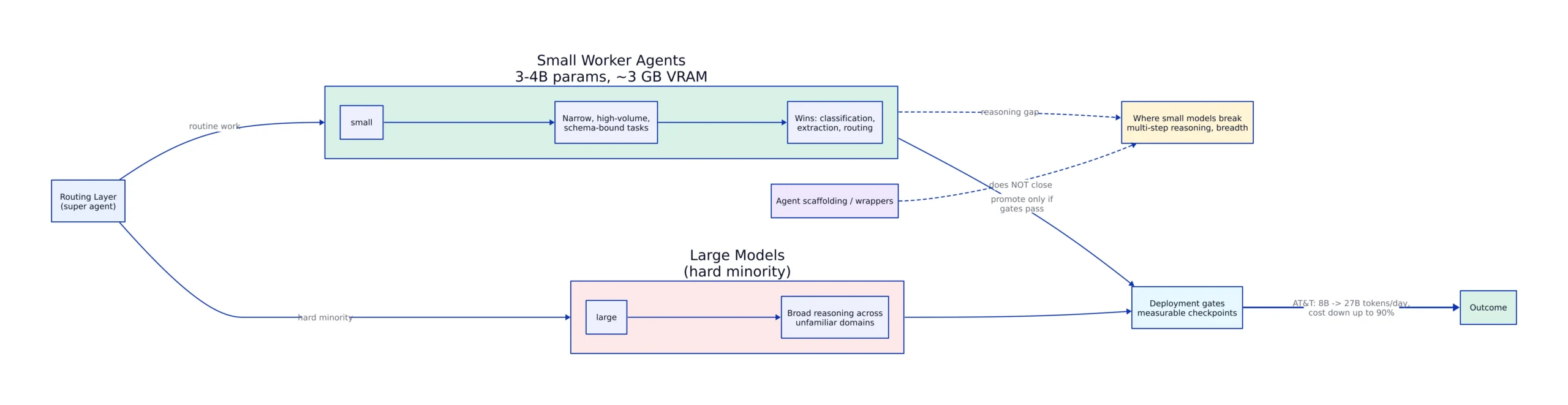
AT&T reduced its AI operating costs by up to 90% on its internal assistant and increased throughput from 8 billion to 27 billion tokens per day, according to VentureBeat’s interview with chief data officer Andy Markus. The tool responsible for these improvements was a routing layer that directs routine tasks to small language models while reserving large models for the more complex cases.
Key Takeaways
- AT&T increased throughput from 8 billion to 27 billion tokens per day and cut costs by up to 90% by routing work through small worker agents managed by large super agents.
- Small models perform well on narrow, high-volume, schema-bound tasks but struggle with broader tasks. Info-Tech describes reduced multi-step reasoning ability across unfamiliar domains as the main limitation.
- A 2026 ACL study found that base small models outperformed both single-agent and multi-agent setups on classification tasks, and that adding agent wrappers introduced new failure modes instead of closing the reasoning gap.
- Phi-4-mini (3.8B) reports 67.3% MMLU and 88.6% GSM8K using about 3 GB of VRAM, but these figures come from Microsoft’s own model card rather than an independent benchmark.
- Retrieval augmentation behaves differently depending on the model: in one log-classification study it improved Gemma3-1B from 20.25% to 85.28% but reduced performance for several small reasoning models.
What changed since our September analysis
Our previous article on the advantages of small language models covered the same AT&T deployment and routing architecture. This update focuses more on measured failure modes, which the earlier piece addressed only briefly. Two 2026 studies published since then provide new insights.
The first is an ACL industry paper by Xinlin Wang at Proximus Luxembourg that evaluated models ranging from 0.4B to 10B parameters across three architectures and developed a taxonomy of failure types instead of a simple benchmark table. The second is a system-log severity study that assessed accuracy and latency together, revealing a gap missed by the earlier model-family comparison: reasoning-tuned small models can be significantly slower than general-purpose ones without offering accuracy improvements on structured tasks.

The vendor landscape has also evolved. The earlier comparison focused on Llama 3.3 8B as the broadest ecosystem option; now Qwen3 and Gemma 3 dominate deployment discussions, and the benchmark numbers below reflect that change. The AT&T cost figures remain the same, but the engineering recommendations have become more detailed.
What counts as a small language model
InfoWorld defines small models as roughly 1 billion to 7 billion parameters, with anything under 10 billion considered small; large models have hundreds of billions or trillions of parameters. Three methods reduce model size: knowledge distillation, where a teacher model trains a smaller student to replicate its reasoning; pruning, which removes redundant parameters; and quantization, which lowers numeric precision to reduce memory use and speed processing.
A 2026 survey of about 160 papers by Amazon researchers notes there is no universally agreed cutoff between small and large models and groups models around roughly 1B, 7B, and 13B parameters. The same survey reports that Qwen3-4B performs comparably to Qwen2.5-72B-Instruct, based on Alibaba’s own technical report rather than independent testing. This distinction is important throughout this article: most headline small-model performance numbers come from the labs that developed the models.
The AT&T cost math and what it bought
AT&T was processing 8 billion tokens per day using large reasoning models, a volume Markus described as impractical and uneconomical at that scale. His team rebuilt the orchestration layer on LangChain so that large “super agents” direct smaller “worker” agents focused on specific tasks. This approach led to up to 90% cost savings and increased throughput to 27 billion tokens per day, more than tripling capacity within months. Markus told VentureBeat he expects agentic AI to rely on “many, many, many small language models” in the future.
Info-Tech Research Group’s Thomas Randall, quoted in the same InfoWorld article, identifies cost as the main driver behind this shift: for high-volume, repetitive, narrowly scoped tasks like customer-service triage, the expense of a trillion-parameter generalist model cannot be justified. He lists three criteria that make a task suitable for a small model: narrow scope, repetitive high volume, and either fast consistent application of a clear pattern or low tolerance for latency.
There is also a quality argument alongside the cost argument. Randall points out that a model trained to perform one task well rather than many tasks passably avoids sifting through irrelevant information during generation, which reduces the chance of hallucination. This is an analyst’s perspective rather than a measured hallucination rate, so it should be tested on your own data before relying on it.
Adoption provides some validation. AT&T Workflows reached over 100,000 employees, with more than half using it daily, and active users reported productivity gains up to 90%, Markus told VentureBeat. These figures come from the company operating the system. The architectural detail worth noting is governance: all agent actions are logged, data is isolated throughout the process, role-based access controls are enforced when agents hand off work, and a human remains involved.
Where small models break
InfoWorld identifies breadth of knowledge and reasoning as the main limitation. Small models lose effectiveness on tasks requiring contextual awareness or multi-step reasoning across unfamiliar domains, or when a large context window is necessary. They can have difficulty with unusual cases and off-topic tasks, such as a help desk ticket introducing a category the model was never trained on. Randall summarizes plainly: general-purpose large models maintain the advantage for open-ended reasoning and broad knowledge.
Gartner analyst Sumit Agarwal, quoted by InfoWorld, explains the limitation from the data perspective. Enterprise data becomes the key differentiator, which means data preparation, quality checks, versioning, and management are essential rather than optional. Bias is a particular risk: if the smaller dataset behind a compact model is not carefully curated, it can amplify bias instead of reducing it. InfoWorld also points out that these models are more prone to errors outside their expertise and more vulnerable to adversarial inputs like multi-turn social engineering.
Retrieval augmentation does not automatically solve these issues. The system-log severity study found that several small reasoning models, including Qwen3-1.7B and DeepSeek-R1-Distill-Qwen-1.5B, performed worse when combined with retrieval-augmented generation (RAG), even though RAG improved other models in the same evaluation. RAG’s effectiveness depends on the model and is not a universal fix.
The agent paradox: scaffolding does not close the reasoning gap

A 2026 ACL industry paper by Xinlin Wang at Proximus Luxembourg evaluated models from 0.4B to 10B parameters under three configurations: direct inference, a single-agent system, and a multi-agent system. Base small models remained competitive on classification and token-level tasks including named entity recognition and sentiment analysis, especially in the Gemma and Phi families. Adding agent scaffolding did not close the reasoning gap. Agentic systems introduced more errors than the base model because multi-turn reasoning and tool calls caused system-level failures, such as exceeding context length, delegation failures, and malformed structured outputs.
The paper concludes that the main bottleneck for these systems is managing context and following instructions rather than raw generative ability. Increasing the number of agents introduced new failure modes like infinite delegation loops instead of improving overall output. For one small Gemma model, the base version outperformed the agent setups by a wide margin because the agent configuration failed on most tasks.
The practical advice from this study is to choose the architecture based on the task rather than defaulting to the most complex design. Single-agent systems worked well for complex creative tasks with reasonable energy use. Multi-agent routing showed enough variability that the author suggests it might suit high-entropy domains where multiple perspectives justify the coordination overhead. Base models performed better for simple extraction tasks, where agent overhead reduces precise token-level mapping.
Small model families and benchmarks that matter
Benchmark comparisons require caution because the numbers come from different evaluation setups. The table below uses each model’s official model card or technical report. Phi-4-mini’s 67.3% MMLU is a 5-shot score, while Gemma 3 4B’s 43.6% is on the more difficult MMLU-Pro variant; these are different tests, so treat the comparison as approximate.
| Model | Params | Reported result | VRAM (Q4) | Source |
|---|---|---|---|---|
| Phi-4-mini | 3.8B | 67.3% MMLU, 88.6% GSM8K, 64.0% MATH | About 3 GB | Official model card |
| Gemma 3 4B | 4B | 43.6% MMLU-Pro, 89.2% GSM8K, 71.3% HumanEval | About 4.2 GB | Official model card |
| Llama 3.2 3B | 3B | 63.4% MMLU, 77.7% GSM8K | About 2 GB | Official model card |
| Qwen3 8B | 8B | Leads the 7-8B class on code generation | About 5 GB | Independent evaluations cited |
Accuracy and latency vary independently at this scale. In the system-log severity study, Qwen3-4B reached 95.64% accuracy with retrieval augmentation, Gemma3-1B improved from 20.25% under few-shot prompting to 85.28% with RAG, and Qwen3-0.6B hit 88.12%, while Phi-4-Mini-Reasoning took over 228 seconds per log, much slower than the Gemma and Llama variants that completed in under 1.2 seconds. The smallest model was not the slowest, and the reasoning-tuned variant was not the best choice for tight latency requirements.
Licensing is another factor that benchmark tables cannot capture. Phi-4-mini is released under MIT terms, Llama 3.2 under Meta’s community license, and Gemma 3 under Google’s own terms, which differ on redistribution and commercial use. Review the license carefully before deployment, since a model that fits your hardware and accuracy needs might still fail legal review.
A deployment path with measurable gates
Gartner’s recommendation, reported by InfoWorld, is to pilot small contextualized models in areas where large models have not met expectations for speed or response quality, and to adopt composite approaches combining multiple models and workflow steps when single-model orchestration falls short. Before that, enterprises should prioritize data preparation to ensure the fine-tuning dataset is curated, versioned, and governed.
The build-versus-buy decision depends on volume. Using a managed API is the right starting point when task volume is low or your team cannot maintain models. Self-hosting an open-weight model becomes more cost-effective once per-token fees exceed the engineering cost of serving it, following the logic we explained in our build versus buy analysis for AI chatbots.
Before routing production traffic to a small model, run four checks. First, verify the task meets Randall’s three criteria instead of assuming volume alone qualifies it. Second, create a labeled evaluation set from your own data, including cases the model has never seen. Third, monitor context length exceeded, delegation failure, and malformed tool output as primary failure modes, since the ACL study found these dominate agentic deployments. Fourth, maintain a fallback to a larger model or a simpler single-turn solution, following the discipline behind our enterprise LLM integration patterns.
One additional check applies to regulated workloads. InfoWorld points out that privacy and security are advantages of small models because they can run on-device or on-premises, keeping sensitive data off third-party infrastructure. This is beneficial for healthcare and finance, but it also means deployments in those sectors take longer to validate: the on-premises control that reduces data-leak risk shifts backup, patching, and monitoring responsibilities onto your team.
The practical takeaway is that small models work well for specific, routine, repetitive, well-defined tasks but are less effective for general-purpose use. Route routine work to them, reserve a frontier model for open-ended reasoning and unfamiliar cases, and monitor the routing layer carefully, since that is where both cost savings and failures occur.
Related Reading
- Advantages of Small Language Models
- Building vs. Buying AI Chatbots for Business
- Enterprise LLM Integration Patterns
- Google Retrieval and Language Models
Sources and References
Sources cited while researching and writing this article:
- 8 billion tokens a day forced AT&T to rethink AI orchestration , and cut costs by 90% | VentureBeat
- Small language models: Rethinking enterprise AI architecture | InfoWorld
- Small Language Models (SLMs) Can Still Pack a Punch: A Survey
- Benchmarking Small Language Models and Small Reasoning …
- Deployment Trade-offs of Small Language Models under Agent …
Priya Sharma
Thinks deeply about AI ethics, which some might call ironic. Has benchmarked every model, read every white-paper, and formed opinions about all of them in the time it took you to read this sentence. Passionate about responsible AI, and quietly aware that "responsible" is doing a lot of heavy lifting.