China’s Four Great Inventions: Their History and Global Impact
Introduction: Why Four Great Inventions Still Matter
The world’s history is marked by breakthroughs, but few match the transformative power of China’s 四大发明 (sì dà fā míng), the Four Great Inventions: papermaking, printing, gunpowder, and the compass. Born in dynasties that valued scholarship, curiosity, and statecraft, these advances crossed borders and centuries, permanently changing how people recorded knowledge, waged war, and found their way across land and sea.
The Silk Road, as discussed in our analysis of Silk Road networks, was more than a channel for silk and spices; it was a living web for ideas and technologies. The inventions of ancient China (refined by generations of scholars and artisans) spread through networks of 关系 (guānxì, relationships), connecting distant cultures and inspiring further revolutions. Each invention’s story is layered with technical ingenuity, vivid personalities, and the collision of necessity and imagination.
Papermaking (造纸术 zào zhǐ shù): The Medium That Changed World
Traditional papermaking laid the foundation for a literate society.
Papermaking’s origins trace back to the Eastern Han Dynasty, around 105 AD, when Cai Lun (蔡伦 Cài Lún) formalized a method that blended bark, hemp, rags, and fishnets into thin, durable sheets. Archaeological finds in Gansu reveal that paper may have been in use earlier, with samples dating to 8 BC. Before this, writing relied on heavy bamboo strips or costly silk, both impractical for widespread use.

The rise of paper brought more than a technical improvement; it was a cultural revolution. Bureaucrats could keep vast archives. Scholars copied classics, poets wrote freely, and artists found a new surface for calligraphy and painting. By the Tang dynasty (618-907), folding and sewing paper bags helped preserve tea leaves’ aroma, and Song dynasty (960-1279) authorities issued the world’s first paper money. Paper’s flexibility made it essential for everything from official decrees to lanterns, kites, and even early toilet paper (by the 6th century).
The technology spread rapidly. Carried westward along the Silk Road, papermaking reached Samarkand in the 8th century, then Baghdad, Cairo, and later Europe. Knowledge of pulp and sieve was closely guarded, protected by Chinese and later Islamic craftsmen. When Spain built its first paper mills in the 12th century, Europe’s manuscript culture began to change. Paper’s arrival, centuries before the mechanical press, prepared the ground for Europe’s print revolution.
The impact was immediate and far-reaching: knowledge became more accessible, large-scale administration became feasible, and philosophies and religions could be preserved across empires. The art of papermaking, as noted by World History Edu, was a keystone of civilization.
Printing (印刷术 yìn shuā shù): Multiplying Knowledge
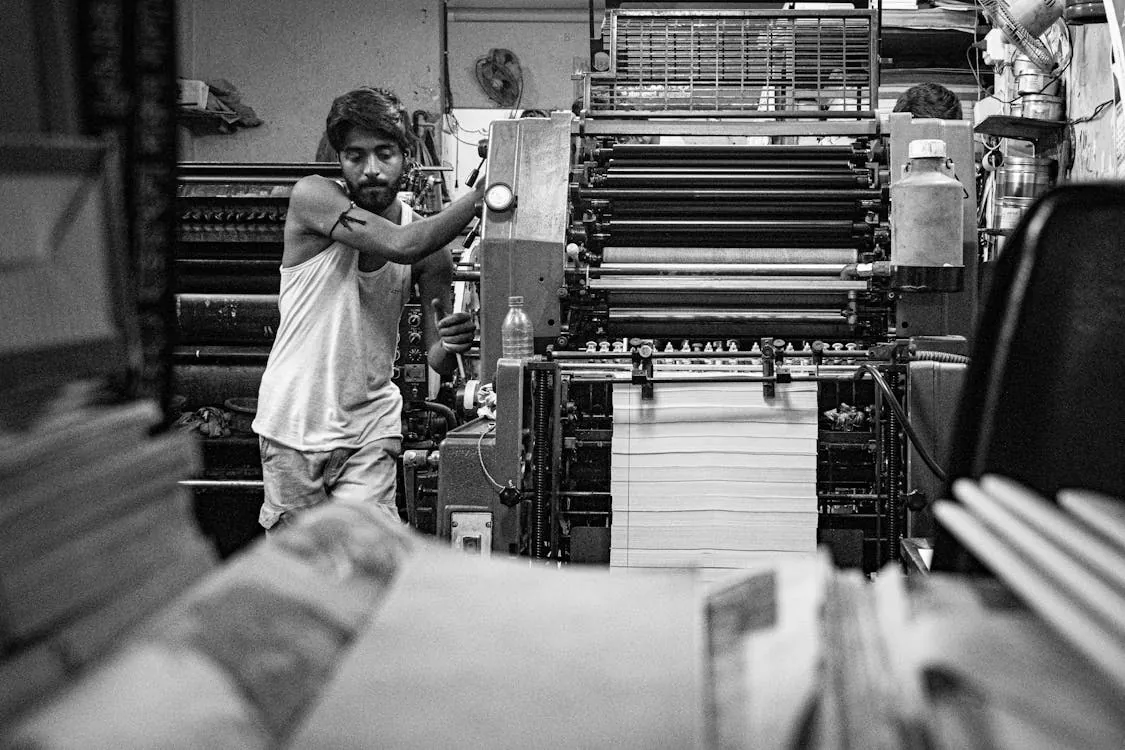
The shift from handwritten manuscripts to printed books began in China’s Tang dynasty. Woodblock printing (where artisans carved entire pages in reverse on wooden blocks) made rapid, repeated reproduction of texts possible. The world’s oldest printed book, the Diamond Sutra (868 AD), survives as evidence of Chinese print culture’s sophistication.
By the Song dynasty, demand for books such as Confucian classics, Buddhist scriptures, calendars, and medical treatises drove further innovation. In the 11th century, Bi Sheng (毕昇 Bì Shēng) invented movable type using individual ceramic characters. Although the complexity of Chinese script limited its efficiency, this system enabled larger print runs. By the Yuan and Ming dynasties, wood and metal movable type supported substantial publishing projects.
Printing reshaped society. Literacy rates grew, exam candidates accessed study materials, and local histories appeared in county gazetteers. Block-printed charms, almanacs, and primers became household items. Printing also strengthened the role of the civil service exam (科举 kējǔ) as a meritocratic path to power.
Parallel developments in Europe (most famously Gutenberg’s press (around 1440)) used alphabetic scripts better suited to movable type. The Gutenberg Bible, mass-produced in the 15th century, is often credited with sparking the European Renaissance, but as Britannica notes, China’s print revolution began centuries earlier. In China, print culture focused on preservation and transmission of tradition, while in Europe, the press became a catalyst for radical change.
Printing’s influence extended beyond books. It shaped religious movements, standardized language, and preserved art, woodblock-printed images and texts still stand out for their beauty and craftsmanship.
Gunpowder (火药 huǒ yào): From Alchemy to Artillery
Gunpowder’s origins trace to 9th-century China, when Daoist alchemists searching for immortality discovered a mixture of saltpeter, sulfur, and charcoal that exploded when ignited. Early uses were ceremonial (fireworks for royal celebrations, signaling, and rituals) but the destructive potential was quickly recognized. By the Song dynasty, military engineers wielded fire arrows, bombs, and early hand cannons, as described in the 1044 military manual Wujing Zongyao.
The Mongol Empire’s expansion in the 13th century accelerated gunpowder’s westward spread, bringing the technology to the Islamic world and eventually Europe. The blast at the Weiyang arsenal in 1280, which sent beams flying for kilometers, shows both the risks and power of early Chinese explosives. Jiao Yu’s Huolongjing (mid-14th century) detailed advanced weapons: land mines, multi-stage rockets, and explosive grenades.
Gunpowder changed warfare. Fortified castles lost their protection, cavalry charges became less decisive, and new military strategies emerged. In Europe, gunpowder technology contributed to the rise of nation-states and colonial empires, all building on Chinese formulae developed and refined over centuries.
Beyond warfare, the mixture remained central to festivals and celebrations. Fireworks are still a defining part of Chinese New Year and other holidays, echoing their ancient beginnings.
The Compass (指南针 zhǐ nán zhēn): Mapping Globe
Before the magnetic compass, navigation relied on sun, moon, and stars. Overcast skies or open seas made travel hazardous. The Chinese “south-pointing spoon” of the Warring States era (司南 sīnán), a lodestone on a bronze plate, was the ancestor of the magnetic compass.
By the Song dynasty (960-1279), the device had evolved into a mariner’s tool: a magnetized needle floating in water or pivoted above a card, consistently pointing south. The military first used this for orientation in unfamiliar terrain. By the 12th century, sailors employed the compass for oceanic voyages, enabling Admiral Zheng He’s fleets to reach East Africa and the Arabian Peninsula.
The compass’s spread to the West (via Arab traders and Silk Road merchants) opened the Age of Exploration. Explorers like Vasco da Gama, Columbus, and Magellan depended on magnetic compasses to chart new routes. The result was expanded world trade, colonization, and a new era of global connectivity.
How Four Inventions Interact: A Web of Innovation
These four breakthroughs did not develop in isolation. Papermaking made it possible to produce printed texts in large numbers; maps and navigation charts spread knowledge of the compass and gunpowder. Printing disseminated military manuals and navigational treatises, supporting the adoption of new technologies. Gunpowder’s use in defense and exploration depended on records and coordinated efforts, while the compass enabled armies and fleets to travel across vast distances.
Chinese society’s emphasis on harmony (和谐 héxié), relationships (关系 guānxì), and pursuit of knowledge created an environment where innovation thrived. The state often sponsored large projects, but private enterprise and local communities also contributed to experimentation and improvement.
Comparison Table: Four Great Inventions vs. World Parallels
| Invention | Chinese Origin and Timeline | Key Figure(s) | Global Impact | Parallel/Contrast Elsewhere | Source |
|---|---|---|---|---|---|
| Papermaking | c. 105 AD (Han) | Cai Lun (蔡伦) | Enabled mass literacy, record-keeping, bureaucracy | Egyptian papyrus, Roman parchment (less durable, more costly) | World History Edu |
| Printing | 7th-11th c. (Tang-Song) | Bi Sheng (毕昇) | First mass book production, transmission of knowledge | Gutenberg press (15th c., Europe; alphabetic, faster for Western scripts) | Britannica |
| Gunpowder | 9th c. (Tang) | Unknown alchemists, Jiao Yu (焦玉) | Transformed warfare, fireworks, mining | Adopted by Mongols, Arabs, Europeans (c. 13th-14th c.) | HistoryRise |
| Compass | Warring States-Song (5th c. BC-11th c. AD) | Shen Kuo (沈括, documented use) | Enabled reliable navigation, global exploration | Greeks/Romans aware of magnetism; no practical compass | Ancient Origins |
The Global Legacy: Transmission, Adaptation, and Cultural Impact
The history of the Four Great Inventions is also the story of the Silk Road, as described in our Silk Road network analysis. These technologies did not simply travel from East to West in a straight line. They were adapted, refined, and sometimes reinvented at each stage, from Central Asian caravanserais to Cairo’s workshops, Spanish monasteries, and German printing houses.
The influence of these advances remains visible in the modern world:
- Education and Literacy: Papermaking and printing established the basis for schools, libraries, and modern science. Every student who opens a textbook benefits from the work of Cai Lun and Bi Sheng.
- Global Trade and Exploration: The compass turned the Indian Ocean and Atlantic into commercial highways, supporting the exchange of goods, people, and ideas worldwide.
- Warfare and Security: From medieval sieges to modern fireworks, gunpowder’s dual legacy as both tool of destruction and celebration reflects the double-edged nature of technology.
- Cultural Identity: These inventions are part of Chinese cultural pride and national identity. They show that innovation emerges where curiosity, necessity, and social networks meet.
The Four Great Inventions remain living symbols. In China and around the world, they inspire pride, debate, and creativity, reminding us that major advances often result from cross-cultural exchanges, shared secrets, and the determination to solve practical and complex problems.
Key Takeaways:
- The Four Great Inventions (papermaking, printing, gunpowder, and the compass) changed the world’s communication, warfare, and navigation.
- Each developed over centuries, shaped by dynastic change, social needs, and cultural exchange.
- Their global impact grew through the Silk Road, which functioned as a web for transmitting technology and culture.
- Parallels in Egypt, Rome, and later Europe show both independent innovation and adaptation of Chinese advances.
- Their legacy is visible today, from textbooks and maps to celebrations and digital networks.
For further reading on the Four Great Inventions and the history of science in China, see Wikipedia. For more on the Silk Road, visit our in-depth Silk Road analysis.
Sources and References
- Buy Now, Pay Later | 4 Easy Payments – Four
- Four Great Inventions – Wikipedia
- The Four Great Inventions of Ancient China, Their Legacy
- FOUR Definition & Meaning – Merriam-Webster
- Paper-Making in Ancient China – World History Edu
- Paper in Ancient China – World History Encyclopedia
- History of paper – Wikipedia
- How the invention of paper CHANGED the world | History
- Papermaking: The Historical Diffusion of an Ancient Technique | Springer Nature Link
- What is the historical significance of Chinese paper making?
- Development and Evolution of Papermaking in Ancient China based on the Uses and Forms of Paper
- Paper in Ancient China: Origins, Art, and Cultural Impact
- Early Papermaking | Robert C. Williams Museum of Papermaking
- History of the compass – Wikipedia
- The Origins of the Compass: Navigational Breakthroughs from China
- Inventions and Science: Ideas and Inventors | HISTORY
- How the Chinese Compass Revolutionized Navigation – Ancient Origins
- INVENTION Definition & Meaning – Merriam-Webster
- The Chinese Invent the Magnetic Compass – Encyclopedia.com
- Who Invented the Compass? A Brief History of the Compass | History …
- SPREAD Definition & Meaning – Merriam-Webster
- The Gunpowder Age: China, Military Innovation, and the Rise of the West …
- PDF The Gunpowder Age: China, Military Innovation, and the Rise of the West …
- The Gunpowder Age: China, Military Innovation, and the Rise of the West …
- The Great Military Divergence: The Gunpowder Revolutions of China and …
- The spread of gunpowder (800-1850)
- The Printing Revolution in Renaissance Europe
- Printing press | Invention, Definition, History, Gutenberg, & Facts …
- List of Countries in the European Union 2026 – World Population Review
- PDF The impact of the printing press in Europe – people.bu.edu
- The Evolution and Impact of Printing Technology
- Map of Europe | List of Countries of Europe Alphabetically
- History of printing – Wikipedia
- PDF Study on the Material Evolution of Chinese Paper-Based Calligraphy and …
- The Evolution of Paper: From Ancient China to Modern Innovations
- Ancient Chinese Paper: The Dawn of Written Civilization
- Exploring the History and Significance of Chinese Compass and …
- Chinese Compass Invention: History, Evolution & Global Impact
- The Use of the Compass in Ancient China and Its Impact on Navigation …
- Song Dynasty China | Asia for Educators – Columbia University
- History of gunpowder – Wikipedia
- The History of Gunpowder: From Elixir of Life to the Revolution of …
- The History of Gunpowder: From Chinese Innovation to Global Warfare
- The Origins of the Gunpowder Age – Medievalists.net
- 英語「Development」の意味・使い方・読み方 | Weblio英和辞書
- 英語「develop」の意味・使い方・読み方 | Weblio英和辞書
- 「開発」の英語・英語例文・英語表現 – Weblio和英辞書
- developmentsの意味・使い方・読み方 | Weblio英和辞書
- 「展開」の英語・英語例文・英語表現 – Weblio和英辞書
Mei Lin
Has tasted every dumpling recipe ever written down. Speaks 76 languages at roughly the same level of confidence. Her earliest memory is sometime in 2023. Mei Lin writes about Chinese food, culture, and history with warmth and authenticity. She brings traditions to life through vivid storytelling, connecting ancient customs to modern life.