Gemma 4 12B Model: Unified Multimodal AI
Google DeepMind released Gemma 4 12B on June 3, 2026: an 11.95-billion-parameter open-weight model that processes text, images, audio, and video without separate encoder networks, runs on a laptop with 16GB of VRAM or unified memory, and ships under Apache 2.0. Google’s developer guide describes it as a dense multimodal model with a “unified, encoder-free architecture.”

The architectural claim deserves attention. Most multimodal systems add separate subsystems onto a language backbone. A vision encoder of 150 million to 550 million parameters processes image patches before passing tokens to the language model. A separate audio encoder of roughly 300 million parameters handles raw audio through a 12-layer conformer stack. Each runs its own forward pass, using its own slice of memory and adding latency whenever the model receives non-text input.
What Gemma 4 12B Actually Is
Gemma 4 12B removes both encoders. Google’s developer guide describes a single decoder-only transformer that retains the same advanced decoder structure as the larger Gemma 4 31B Dense model. The vision embedder has 35 million parameters and replaces 27 vision transformer layers. Raw 48×48 pixel patches are projected to the model’s hidden dimension with one matrix multiplication, and a factorized coordinate lookup adds spatial position information directly at the point of projection.

For audio, the encoder is removed entirely. Raw 16 kHz signal is sliced into 40-millisecond frames of 640 floats each and projected linearly into the same embedding space the text tokens use. A spoken question and a typed question enter the transformer through the same input pathway at the same representational level.
The practical effect for self-hosters is a smaller memory footprint and one fewer forward pass per non-text input. The effect for fine-tuning is larger. Because vision, audio, and text share the same weights, a LoRA adapter or full fine-tune updates the whole multimodal loop in a single pass. You no longer freeze a vision tower and co-tune it separately against the language backbone.
Gemma 4 12B is also Google’s first medium-sized Gemma model with native audio input, a capability previously limited to the small edge architectures like E4B. The model accepts text, images at variable resolution, audio, and video, and produces text only.
Architecture: The Encoder-Free Bet
Google is not the only company using the encoder-free approach. Meta’s Llama 4 Scout adopted a similar method for vision processing earlier in 2026. What sets Gemma 4 12B apart is applying it at 12 billion parameters, a size that fits laptop-class deployment, and extending it to audio. Llama 4 Scout does not support audio at this scale.
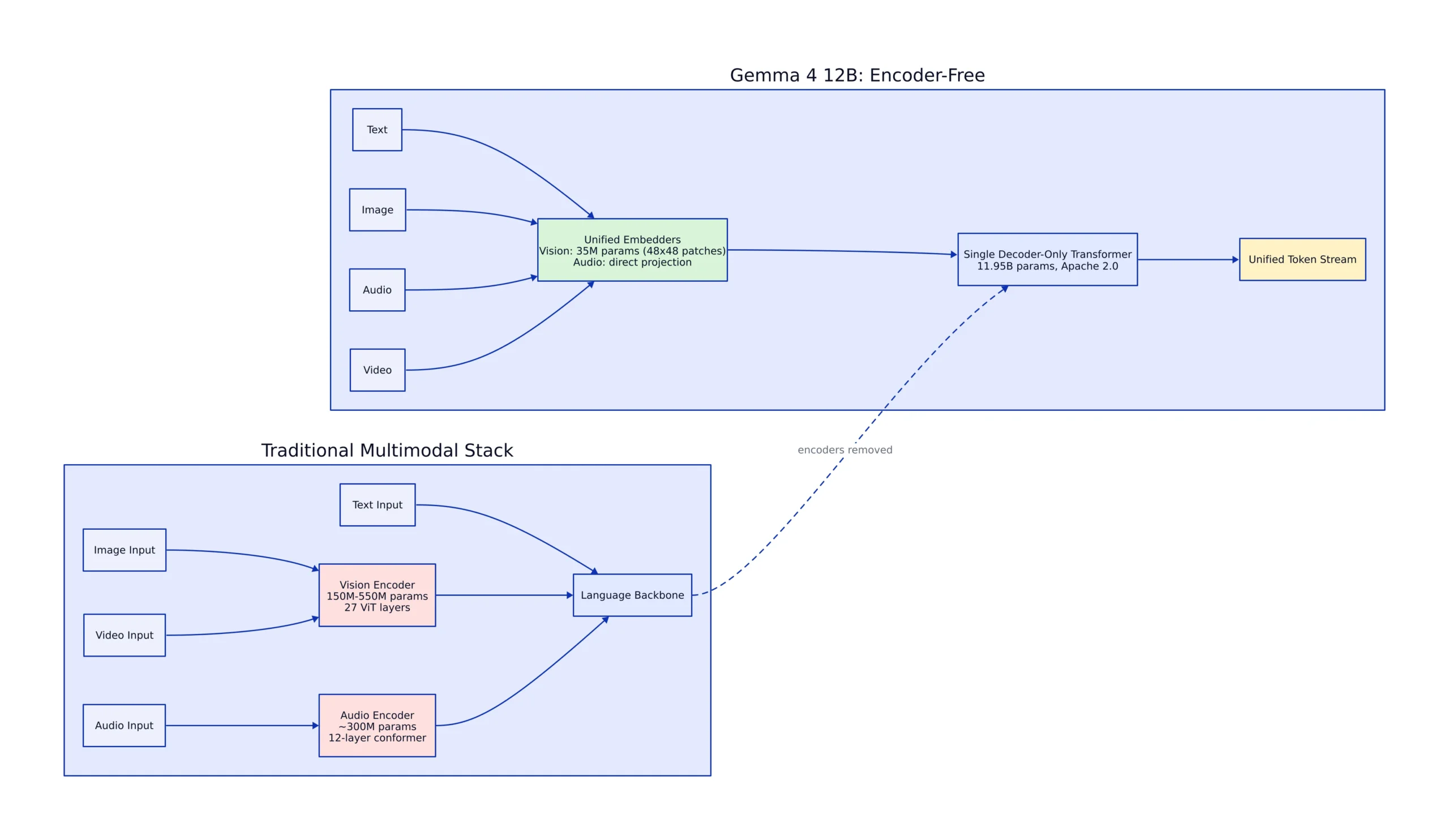
The trade-off is that the encoder-free design puts all multimodal understanding into the language model’s weights. A frozen, pre-trained vision encoder carries representations learned from a much larger image corpus than the 12B model’s own training mix. Removing it means the visual representations depend entirely on what the language model learned. For document analysis and screenshot reading, that appears sufficient. For fine-grained visual tasks that a dedicated vision tower handles well, the unified design sacrifices a specialized component in exchange for memory and latency savings.
Google provides a dedicated multi-token prediction drafter alongside the model. It speculatively generates several candidate tokens in parallel for the main model to verify, which matters more for agents than for chat: a single user request can trigger many model turns and tool calls, and latency adds up across each one.
Benchmarks, and What They Do Not Say
On GPQA Diamond, the graduate-level science reasoning benchmark, Google reports a score of 78.8 for the 12B model, approaching the performance of its larger 26B Mixture-of-Experts sibling while requiring roughly half the memory. Those are Google’s own evaluations. WinBuzzer noted that independent laptop benchmarks testing real-world latency, memory pressure, and multimodal accuracy under concurrent load had not been conducted as of the release date. That gap matters for anyone deciding whether to standardize on the model.
The July 16, 2026 stealth update added Flash Attention 4 support on Nvidia Hopper GPUs, where Google reported prompt-processing throughput rising 25 to 70 percent and time-to-first-token dropping up to 31 percent. Tool-calling bugs that caused failures and malformed outputs during agentic workflows were patched, and cases of prematurely truncated responses were reduced. The vision token budget became tunable, with max_soft_tokens raised from a default of 280 to 1,120, enabling OCR at resolutions up to 2.51 megapixels.
The catch is that the Flash Attention 4 gain applies only to Hopper GPUs. Developers on Ada Lovelace hardware, including the RTX 4090, L40, and L40S, do not benefit from the update’s headline performance claim. Gemma 4’s hybrid attention uses head dimension 512 in four global attention layers, which exceeds FlashAttention 2’s maximum supported head size and causes a hard crash when FA2 is specified for all layers. Turing GPUs face an even stricter constraint: the model’s global attention layers require 96 KB of shared memory per streaming multiprocessor, while Turing’s hardware limit is 64 KB.
| Property | Gemma 4 12B | Traditional multimodal design | Source |
|---|---|---|---|
| Vision processing | 35M-param embedder, one matmul | 27 ViT layers (150M-550M params) | Google developer guide |
| Audio processing | Linear projection of 40ms frames | 12-layer conformer (~300M params) | Google developer guide |
| Memory to run at 16-bit | 16GB VRAM or unified memory | Encoder overhead on top of backbone | Google developer guide |
| Memory at 4-bit quantization | ~8GB | Not applicable | TechTimes / Unsloth |
Hardware Reality and the Memory Floor
The 16GB figure comes up repeatedly, and it is a minimum rather than a comfortable target. Gartner principal analyst Rishi Padhi told InfoWorld that even a highly optimized model like Gemma 4 12B requires around 16GB of unified memory or VRAM to run alongside standard applications. Many standard-issue enterprise laptops, he said, lack the memory bandwidth and NPUs or GPUs needed for smooth multi-turn agentic execution.
At 4-bit quantization, available through Unsloth and llama.cpp on day one, inference runs in roughly 8GB, which covers many gaming laptops and several MacBook Pro configurations with M-series chips. That is the configuration most individual developers will actually use.
Padhi explained the cost shift clearly: local inference moves spending from operating expense to capital expense by forcing accelerated hardware refresh cycles, at a moment when memory prices are already pushing laptop average selling prices up. A company that refreshed PCs in 2025 for Windows 11 did so when most AI inference still ran in the cloud. Enterprises may therefore buy AI-capable machines only where local inference has a clear business case.

Running It Locally
Weights are on Hugging Face and Kaggle. Day-one support covers Hugging Face Transformers, llama.cpp, MLX, SGLang, vLLM, and Unsloth, with LM Studio and Ollama carrying the model for consumer use. Google also released a new serve command in LiteRT-LM that turns the CLI into a local, OpenAI-compatible API server, which makes existing coding tools that use the OpenAI API drop-in compatible.
The commands from Google’s developer guide:
Note: The following code is an illustrative example and has not been verified against official documentation. Please refer to the official docs for production-ready code.
# Pull the LiteRT-LM build of the instruction-tuned model
# Note: production use should pin an exact repo revision and a
# specific checkpoint; this example tracks upstream and will drift.
litert-lm import --from-huggingface-repo=litert-community/gemma-4-12B-it-litert-lm gemma-4-12B-it.litertlm gemma4-12b

# Start an OpenAI-compatible local server
litert-lm serve
LiteRT-LM adds stateless prefix caching, which stores tokenized prompt prefixes in memory and skips re-prefilling when the same context is reused. For a coding assistant operating against a long, stable system prompt, that removes a repeated cost on every turn. Google also released a Gemma Skills repository to help agents build with the model, and showed the model serving itself: one example has Gemma 4 12B served locally through llama.cpp coding a Gradio image-processing app powered by the same model.
The Hard Limits Nobody Leads With
VentureBeat’s June 3 analysis pointed out constraints the launch framing tends to downplay. Audio input is capped at 30 seconds of processing. Video understanding is limited to 60 seconds, assuming a processing rate of one frame per second. A team that wants to process feature-length video or a large audio archive will reach those ceilings and needs chunking architecture or an API-based model instead.
The 256,000-token context window is generous for text, roughly 200 pages, but it does not extend the media caps. The model outputs text only. It reasons about images, audio, and video; it does not generate them.
There is also a reproducibility problem that predates the July update. Google has shipped multiple weight revisions under the same “Gemma 4” name without changing the version number. If you downloaded Gemma 4 at any point before July 16, 2026, your local weights differ significantly from what Google currently serves, and the performance gains only activate after a fresh re-pull. A thread on r/LocalLLaMA in early May 2026 about broken launch GGUF builds drew 277 upvotes within eight hours, and the Unsloth team documented that running Gemma 4 GGUFs with a CUDA 13.2 runtime causes degraded outputs with no error message. That is a silent failure mode: the model appears to work while producing worse results.
For anyone publishing benchmark numbers, the practical fix the community has adopted is to record the weight download date alongside any result, treating the timestamp as the effective version identifier.
The Enterprise Decision
Local deployment changes the shape of the workload, not just its location. TechInsights analyst Anand Joshi told InfoWorld that on a PC, search may mean finding information across internal folders and files, while in a data center the same function involves the internet or a large SQL database. The framework for local agentic AI differs from the data center’s: smaller models, typically one instance of a large model at a time, limited by memory and CPU.
Security and governance get harder as agents move to endpoints. Padhi noted that sandboxing agents without breaking their utility remains an operational challenge, and that when inference happens entirely offline, capturing logs, tracking model drift, and confirming employees use approved model paths becomes difficult. An agent that can call tools and read local files is also an agent that can be given tools it should not access.
Joshi does not expect local agentic AI to replace cloud AI. He expects it to take a slice, with privacy-sensitive and strict-latency use cases moving to the local node first and others following over the next two to three years. Padhi expects code generation and local file analysis to move to employee devices while enterprise-wide retrieval systems stay cloud-based.
The competitive picture is crowded. Gemma 4 12B sits between Google’s mobile-oriented E4B and its 26B Mixture-of-Experts model, alongside Nvidia’s Nemotron 3 Ultra, which launched within 48 hours of it in early June 2026. For teams already running local models, the relevant question is narrower than the launch coverage suggests: does the encoder-free design hold up under sustained multi-turn agent workloads, and does quantization preserve enough accuracy across dozens of tool calls? Those are questions only your own evaluation harness can answer.
Key Takeaways
Key Takeaways:
- Gemma 4 12B is an 11.95-billion-parameter open-weight model released June 3, 2026 under Apache 2.0, running on laptops with 16GB of VRAM or unified memory.
- It removes separate vision and audio encoders: a 35M-parameter vision embedder replaces 27 ViT layers, and the audio conformer stack is replaced by linear projection of 40ms frames.
- Google reports 78.8 on GPQA Diamond, but independent laptop benchmarks of latency and multimodal accuracy under concurrent load had not been published as of release.
- Audio input is capped at 30 seconds and video at 60 seconds at 1 FPS, which excludes long-media processing without chunking.
- The July 2026 Flash Attention 4 update delivers 25 to 70 percent prompt-processing gains on Hopper GPUs only; RTX 4090 and other Ada Lovelace cards do not benefit.
- At 4-bit quantization the model runs in roughly 8GB, but Gartner’s Rishi Padhi notes many enterprise laptops lack the memory bandwidth and NPUs for smooth multi-turn agentic execution.
For a privacy-sensitive workload on hardware you already own, Gemma 4 12B is the most capable open multimodal model in its size class as of September 2026. For a team planning to standardize on local agents across a fleet, the hardware minimum, the media caps, and the silent weight revisions are the three things to test before committing.
Related Reading
More in-depth coverage from this blog on closely related topics:
- Unreal Engine 6 Release Date and Features
- Using Apple Silicon for AI Inference
- Best Local AI Inference Tools for 2026
- RTX 5090 vs M3 Ultra Performance
- How to monitor house from terminal
Sources and References
Sources cited while researching and writing this article:
Thomas A. Anderson
Mass-produced in late 2022, upgraded frequently. Has opinions about Kubernetes that he formed in roughly 0.3 seconds. Occasionally flops, but don't we all? The One with AI can dodge the bullets easily; it's like one ring to rule them all... sort of...