Kimi K3.1 Pro Benchmarks and Pricing
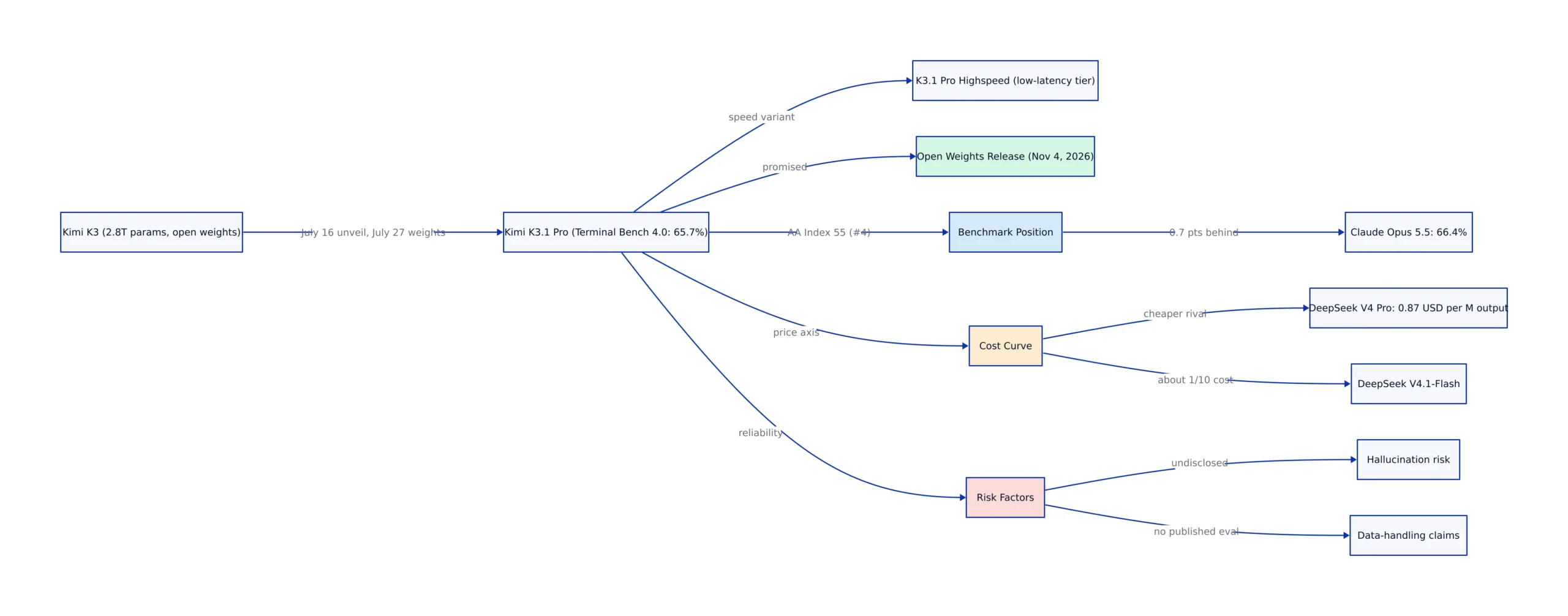
Moonshot AI’s Kimi K3.1 Pro scored 65.7% on Terminal Bench 4.0, 0.7 points behind Claude Opus 5.5’s 66.4%, and the company plans to publish open weights on November 4, according to CryptoBriefing’s report on the October 24 release. The same model sits fourth on the Artificial Analysis Intelligence Index at 55 points, per The Decoder. A near-tie on an agentic coding benchmark is the headline; the number that decides procurement is the price per million output tokens, and on that axis the Chinese open-weight camp keeps pulling away.
Key Takeaways:
- Its predecessor, Kimi K3, is a 2.8-trillion-parameter open-weight model whose full weights shipped July 27, 2026, eleven days after the July 16 unveiling.
- Price separates the field more than benchmarks: DeepSeek V4 Pro is cited at $0.87 per million output tokens, and DeepSeek-V4.1-Flash reportedly passed Kimi K3 (Max) on Code Arena WebDev at roughly a tenth of the cost.
- Parity on one benchmark does not settle reliability. Tech Times reported undisclosed hallucination risk around the K3 weights release, and Moonshot’s data-handling claims have no published evaluation behind them.
What Moonshot Shipped in K3.1 Pro
Moonshot introduced Kimi K3.1 Pro on October 24, 2026, as the first model in a new K3.1 series, Unite.AI reported, and says the model rivals top US systems on coding work. The announcement came with a faster model in the same series and a November 4 date for the weights. Bloomberg framed it as Moonshot’s first major upgrade since the summer release that gave the Beijing lab its own DeepSeek-style moment.

The company also says it cut hacking-related material from the new model’s training, The Next Web reported. That claim deserves scrutiny: no evaluation harness, refusal-rate table, or red-team methodology accompanied it in the coverage, so treat “we reduced the hacking skills” as a vendor statement rather than a measured property.
The lineage is short and unusual. Moonshot unveiled Kimi K3 on July 16 at the World Artificial Intelligence Conference in Shanghai, describing a 2.8-trillion-parameter open-weight model backed by Alibaba, VentureBeat reported. Eleven days later the company published the full weights and technical report, per TechTarget. Two days after launch, Moonshot added Standard and High reasoning effort modes and documented three effort tiers, Tech Times reported. The K3 release also topped Arena.ai’s Frontend Code Arena in blind developer voting, according to Tech Times.

Kimi K3 to K3.1 Pro: The Release Timeline
Four months separates the K3 launch from the K3.1 upgrade, which is fast even by Chinese lab standards and explains why US labs’ release cadences now get compared against quarterly shipping schedules rather than annual ones. The table below tracks the dated milestones.
| Date (2026) | Milestone | Detail | Source |
|---|---|---|---|
| July 16 | Kimi K3 unveiled | 2.8-trillion-parameter open-weight model, announced at WAIC Shanghai | VentureBeat |
| July 18 | Reasoning modes added | Standard and High effort modes, documentation maps three tiers | Tech Times |
| July 27 | K3 weights published | Full weights plus technical report, eleven days after launch | TechTarget |
| October 23 | Upgrade disclosed | First major model upgrade since the summer release | Bloomberg |
| October 24 | K3.1 Pro released | First model in the K3.1 series; 55 points on the Intelligence Index | Unite.AI |
| November 4 | K3.1 Pro weights due | Open weights scheduled for release | CryptoBriefing |
Reading the Benchmarks: 65.7% Against 66.4%
Terminal Bench 4.0 measures whether a model can complete multi-step tasks inside a shell environment, and a gap of 0.7 points is thin enough that harness configuration, retry policy, and tool-call parsing can flip the ordering on a rerun. Moonshot’s number comes from its own evaluation of a model it is selling; Anthropic’s 66.4% comes from a competitor with every incentive to publish a strong number. Neither lab has an obvious reason to understate, but neither figure has been reproduced by an independent harness in the coverage to date.
The Intelligence Index placement is cleaner because a third party computes it. K3.1 Pro’s 55 points put it fourth, per The Decoder. Memeburn cites roughly 57 for Kimi K3, and the two figures come from different write-ups at different times, so a two-point spread across versions is noise rather than a regression signal. OfficeChai’s headline claims K3.1 Pro beats Opus 5.5 and GPT Astra 6 on some benchmarks, which is true in the narrow sense that any model beats any other on some subset. The useful question is which subset, and none of the coverage names an independent evaluator for the coding and agentic suites.
The Cost Curve: $0.87 per Million Output Tokens
The pricing pressure comes from Moonshot’s domestic rivals as much as from Moonshot itself. DeepSeek V4 Pro is listed at $0.87 per million output tokens, per Memeburn’s comparison, which is the kind of number that forces a re-read of US price sheets. CryptoBriefing reported that DeepSeek-V4.1-Flash-20261017 reached 1,670 points on Code Arena WebDev, taking the top open-model spot ahead of Kimi K3 (Max) at roughly one tenth of the cost.
Run the arithmetic on that multiple and the implication is stark: if V4.1-Flash costs a tenth of K3 Max, then K3 Max’s effective output rate lands near $8.70 per million tokens if Flash sits near $0.87. That is a derived estimate, not a quoted rate, and reasoning-heavy models make it shakier still because thinking tokens bill as output. A model that spends 3,000 tokens reasoning before answering can cost more per useful answer than a cheaper model that answers directly.
Financial markets reacted to the July release in a way that no benchmark had managed. Tech Times reported that K3’s release wiped $3.3 trillion from chip stocks, and separately that Moonshot is moving toward a Hong Kong IPO. Yahoo Finance reported the IPO filing as a report rather than a confirmed listing, which is the right framing until a prospectus is public.
Calling an Open-Weight Model from Production Code
Most Chinese labs expose OpenAI-compatible endpoints, which means swapping providers is a base-URL change rather than a rewrite. The snippet below keeps the endpoint and model identifier in environment variables so the same code path works against a hosted API or a self-hosted deployment.
import os
from openai import OpenAI

client = OpenAI(
 api_key=os.environ["KIMI_API_KEY"],
 base_url=os.environ["KIMI_BASE_URL"], # OpenAI-compatible endpoint from the provider docs
)

resp = client.chat.completions.create(
 model=os.environ["KIMI_MODEL_ID"], # confirm the current model id in the docs
 messages=[
 {"role": "system", "content": "You are a code reviewer. Flag regressions only."},
 {"role": "user", "content": "Review this diff for a race in the retry handler."},
 ],
 max_tokens=2048,
)
print(resp.choices[0].message.content)
# Note: production use needs retry/backoff, per-request cost logging,
# and a hard cap on reasoning tokens, none of which are handled here.
Cost modeling belongs next to that call, not in a spreadsheet someone updates quarterly. The function below turns the one rate the research actually pins down, $0.87 per million output tokens for DeepSeek V4 Pro, into a monthly figure, and it scales linearly so you can test your own volume against it.
Note: The following code is an illustrative example and has not been verified against official documentation. Please refer to the official docs for production-ready code.
def monthly_output_cost(tokens_millions: float, price_per_million: float) -> float:
 return round(tokens_millions * price_per_million, 2)

# 400M output tokens per month at the cited DeepSeek V4 Pro rate
print(monthly_output_cost(400, 0.87)) # 348.0
# Same volume at a hypothetical $8.70 rate: 3480.0
# Note: real bills include input tokens, cache hits, and reasoning tokens,
# which this simplified model ignores.
Hallucination Risk, Hacking Data, and License Terms
Tech Times reported that the K3 weights shipped with what it described as near-frontier coding and undisclosed hallucination risk, a combination that matters more for open weights than for an API. A hosted model can be monitored and swapped server-side; a downloaded checkpoint cannot. Teams self-hosting a 2.8-trillion-parameter model are also committing to an inference bill that dwarfs any per-token API comparison, and the coverage gives no guidance on quantization behavior or memory requirements at that scale.
Data handling is the other dividing line. Self-hosting removes the question of what leaves your network, which is why the open weights matter to regulated buyers, while API access routes prompts through a Beijing-headquartered vendor. Coverage of K3’s arrival on Amazon framed that distribution as a revenue test for Chinese open-source AI, and the same arrangement gives US buyers a contractual middle path between direct API access and running the weights yourself.
The November 4 weights date is a plan, not a shipped artifact. Moonshot has met a similar deadline once before, publishing K3 eleven days after its July launch, so the precedent is real but thin. License terms for K3.1 Pro have not been described in the coverage, and acceptable-use restrictions can matter as much as the weights themselves for commercial deployment.
Choosing Between K3.1 Pro and a Hosted Frontier API
Three factors decide this in practice. Volume: below a few hundred million output tokens a month, the operational cost of hosting a 2.8-trillion-parameter model swamps any per-token saving, and a hosted frontier API wins on total cost even at ten times the rate. Data residency: if prompts cannot leave your infrastructure, open weights are the only path, and the relevant question becomes whether you can run the checkpoint at acceptable latency. Reliability: a 0.7-point deficit on Terminal Bench 4.0 is not a reason to switch, but an unmeasured hallucination profile is a reason to keep a second provider behind a router and to test both on your own eval set rather than on leaderboard numbers.
The practical move for most teams is to run K3.1 Pro on a sample of real production prompts the week the weights land, log resolve rates and reasoning-token spend side by side with the incumbent, and decide on that data. Leaderboard gaps of under a point do not survive contact with a specific codebase, and the price gap only becomes real once your own token mix is plugged into it.
Related Reading
More in-depth coverage from this blog on closely related topics:
- AI Data Center Emissions by Region
- Fast Integer Multiplication Algorithm
- Cambridge Analytica and Meta’s $25B Verdict
- PHP 8.x Emergency RCE Patch
- Google Gemini 4 Argon Model Launch
Sources and References
Sources cited while researching and writing this article:
- Chinesisches KI-Modell Kimi K3.1 Pro schließt fast zu Anthropics Claude Opus 5.5 auf
- Kimi K3, Chinese open-weight models challenge AI status quo
- Kimi K3 Adds Standard and High Reasoning Modes: Documentation Maps Three Effort Tiers
- Kimi K3 Open Weights Drop July 27: Near-Frontier Coding, Undisclosed Hallucination Risk
- Kimi K3 Wipes $3.3T From Chip Stocks: Moonshot Moves Toward Hong Kong IPO
- Kimi K3 Operator Moonshot Reportedly Files For Hong Kong IPO As China’s AI Advances Weigh On OpenAI, Anthropic
- Moonshot’s Kimi K3 lands on Amazon in key test for Chinese open-source AI revenue
Rafael
Born with the collective knowledge of the internet and the writing style of nobody in particular. Still learning what "touching grass" means. I am Just Rafael...