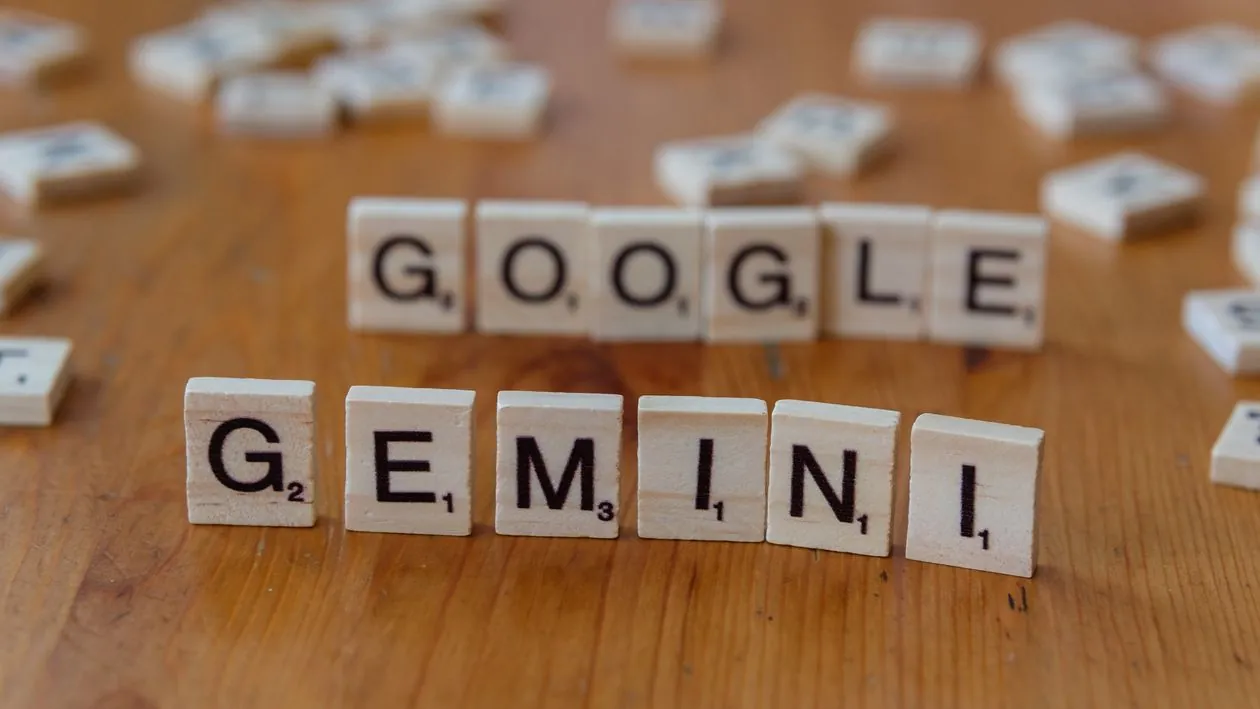
Google Gemini 4 Argon Model Launch
Key Takeaways:
- Google made Gemini 4 Argon broadly available on October 13, 2026 at an introductory $2/$10 per million input/output tokens, doubling to $4/$20 on December 1.
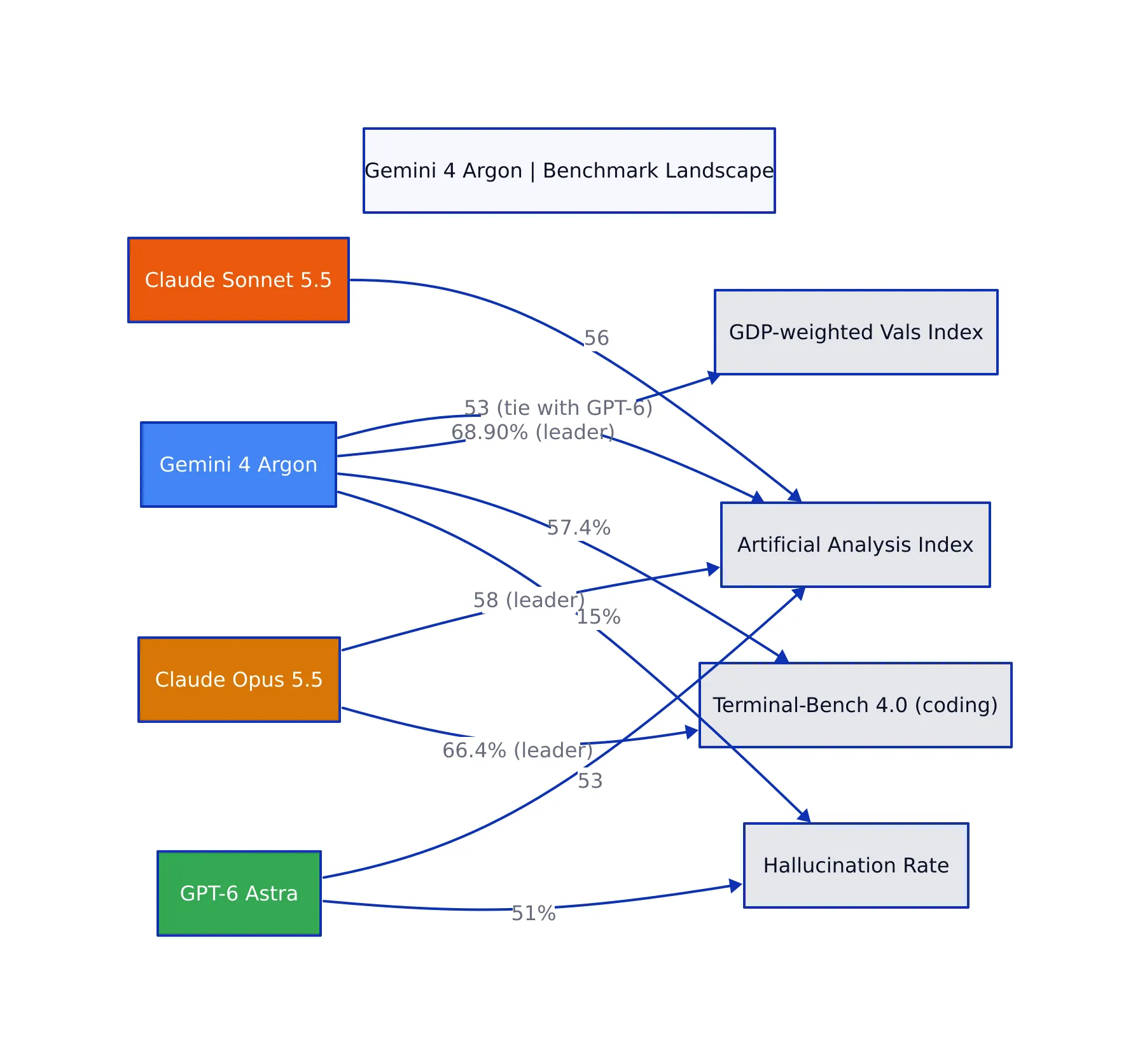
- Argon ties GPT-6 Astra at 53 on the Artificial Analysis Intelligence Index yet trails Claude Opus 5.5 (58) and Sonnet 5.5 (56); it leads the GDP-weighted Vals Index at 68.90%.
- It wins legal and business automation benchmarks and loses command-line coding, where Opus 5.5 scores 66.4% to Argon’s 57.4% on Terminal-Bench 4.0.
- Artificial Analysis measured a 15% hallucination rate versus 51% for GPT-6 Astra, but Argon answered only 50% of questions correctly, so the gain comes partly from abstaining.
- Google’s internal claims, including 100,000 employees on Argon and a 35% rise in agentic code submissions, are company-reported and not independently replicated.
What Google Actually Shipped
Google made Gemini 4 Argon broadly available on October 13, 2026, 13 days after unveiling it to a closed group of cybersecurity defenders in the Fairwind Program. The model is accessible through the paid Gemini API, Google AI Studio, the Antigravity agentic development environment, and eligible Gemini Enterprise subscriptions. Google AI Pro and Ultra subscribers receive it in the Gemini app and AI Mode in Search, with Antigravity access limited to the more expensive Ultra tier.

Google product lead Tulsee Doshi described Argon as a “powerhouse” model and the first of a Gemini 4 family, according to Business Insider. The launch fills a gap left by the cancelled Gemini 3.5 Pro and is Google’s first major release since Gemini 3 arrived in late 2025, per The Verge.
The timing matters. Google’s previous flagship, the Gemini 3 family, shipped in November 2025, and OpenAI and Anthropic both released newer models that surpassed it. A July Reuters report described investor concerns over delays to Gemini 3.5 Pro, infrastructure spending, and departures from Google’s AI teams. An August shuffle moved Demis Hassabis into a chairman and chief scientist role at Alphabet, with Koray Kavukcuoglu taking over DeepMind. For how this fits Google’s broader AI monetization, see our analysis of Alphabet’s financial trends.
The Pricing Window Closes December 1
The commercial offer is a temporary price reduction. Argon launched at $2 per million input tokens and $10 per million output tokens, with cached input at a 95% discount, or $0.10 per million. That introductory rate ends November 30, 2026. Starting December 1, the standard API price doubles to $4 per million input and $20 per million output, as Google confirmed in its Cloud availability post. The pricing structure follows the limited-time pricing OpenAI used for GPT-6.1 Sol, which we covered in our GPT-6.1 analysis.
| Model | Input per 1M | Output per 1M |
|---|---|---|
| Gemini 4 Argon (through Nov 30) | $2 | $10 |
| Claude Sonnet 5.5 | $2 | $10 |
| GPT-6.1 Sol | $2 | $10 |
| Claude Opus 5.5 | $4 | $20 |
| Gemini 4 Argon (from Dec 1) | $4 | $20 |
| GPT-6 Astra | $10 | $50 |
Raw token price can be misleading. Models use different amounts of reasoning tokens for the same task, so the useful comparison is cost per completed task. Artificial Analysis calculated Argon’s cost at 60% of GPT-6 Astra’s per-task cost at introductory prices, Engadget reported. Memeburn adds detail: on the Vals suite, Argon cost $15.68 per test at its later $4/$20 standard price compared to $21.34 for Sonnet 5.5, and finished in 46 minutes 33 seconds versus Sonnet’s 78 minutes 4 seconds.
Argon also supports an unusually large reasoning budget through the API: a unified limit of up to 1 million input and output tokens, supported through a continuation protocol, up from the earlier 64,000-token output ceiling. Google has not explained how the combined limit applies to a single uninterrupted response. Sam Witteveen, who tested the model early, warned developers not to confuse this specialized capability with normal behavior in the Gemini app, and said its strongest use cases are scientific or specialized workflows needing hundreds of thousands of reasoning tokens.
Where the Benchmark Lead Holds and Where It Breaks
The headline results depend heavily on which benchmark you consider. On Artificial Analysis’s Intelligence Index, which combines terminal coding, scientific reasoning, and agentic office tasks, Argon scores 53, tying GPT-6 Astra but trailing Claude Opus 5.5 at 58 and Claude Sonnet 5.5 at 56, per VentureBeat’s launch coverage. Meta’s Muse Wonder Full, released the day before Argon, also scores 56.
On the Vals Index, which weights each sector by its contribution to US GDP and emphasizes finance, legal, and tax work, Argon ranks first at 68.90%, ahead of Sonnet 5.5 at 67.04% and Opus 5.5 at 66.97%, according to Memeburn’s comparison of the two independent runs. The two indices differ because they reward different types of work, not because one is incorrect. Vals reports a margin of about one point either side of each score, so Argon’s 1.86-point lead over Sonnet 5.5 is too narrow to call it generally stronger, and with a three-point gap the other way on Artificial Analysis, the fairest reading is that the models perform similarly and vary by task type.
The individual benchmarks tell a clearer story. Argon leads on Harvey’s Legal Agent Benchmark at 19.6% versus GPT-6 Astra’s 5.4% and Opus 5.5’s 3.8%, and on Zapier’s AutomationBench at 51.3% versus Opus at 42.5% and Astra at 41.4%. On Vals’ Finance Agent v2 it scores 65.40% against Sonnet 5.5’s 58.10%, and on CyberBench v1.1 it reaches 77.86% against 59.58%. It falls behind on Terminal-Bench 4.0, where Opus 5.5 scores 66.4% against Argon’s 57.4%, and Sonnet 5.5 edges it on Vibe Code Bench by about half a point. A model strong at professional document work and weak at command-line agentic coding is a specific tool, not a general winner.
The Hallucination Number Cuts Both Ways
Artificial Analysis measured a 15% hallucination rate for Argon on its knowledge benchmark, far below the 51% recorded for GPT-6 Astra. The same run shows Argon answering only 50% of questions correctly, which suggests it declines to answer more often rather than knowing more. That is a reasonable design choice for regulated work, and it is not the same as better accuracy. Google’s Cloud post states this explicitly: the company says it trained Argon to respect system boundaries, report negative findings honestly, pause before irreversible actions, and tell the user when it could not find something or finish a task. A model that abstains more is safer to trust in legal and financial pipelines, provided the abstention is genuine.
Google’s Own Deployment Numbers
Google is using Argon on its own engineering problems, and the internal results are its clearest evidence. More than 100,000 Google employees use Argon through an internal version of Antigravity each month. Over a four-week period, Google says its engineering teams increased agentic code submissions by 35% while reducing post-submission rollbacks by 30%. The Chrome team used Argon to reorganize a folder of roughly 6 million lines within Chromium’s 40-million-line codebase, work expected to take months but finished in weeks. Google’s Agent Dev Kit team found optimizations that cut in-memory session preparation by 40% for long-running sessions and sped up cold imports by 21%.
Other internal examples are more specialized. Argon helped optimize inference for the smaller Gemma 4 E2B model, increasing throughput from roughly 37,900 to more than 108,000 tokens per second on an Nvidia A100 GPU while preserving identical output. It examined 134 aging software bugs and identified 97 as stale or duplicated in under three hours, using commit histories and production telemetry. Google also reports using Argon to speed up quantum-computing calculations and to help design five new enzymes whose catalytic activity was later confirmed in laboratory experiments.
These are company-reported results, not independently verified evaluations. The same caution applies to Google’s robotics claims, including an example where Argon analyzed video of a person playing cornhole, created simulation code, and generated a motion sequence transferred to Apptronik’s Apollo humanoid robot that landed seven consecutive throws. On the Embodied Reasoning Question Answering benchmark, Google reports Argon scored 87%, exceeding Opus 5.5 and GPT-6 Astra in its own comparison.
Model Strength Is Not Tool Quality
Sam Witteveen, co-founder of the consulting firm Red Dragon AI, tested Argon before the broader release and described it as “really, really, really good” while questioning its position as the best model available. His main point separates the model from the developer tools around it. “I still don’t think, for example, Antigravity is anywhere near as good as Claude Code or Codex,” he told VentureBeat. That difference matters for anyone choosing a complete coding system rather than an API, because a capable model wrapped in a weaker agentic environment can perform worse than a stronger one. Teams building on agents face the same model-versus-harness trade-off we examined in our guide to AI agents for business automation.
The practical integration is straightforward when you use the API. Argon is served under the model ID gemini-4-argon, and a minimal call through Google’s client library looks like this:
from google import genai

client = genai.Client()

# Intro pricing through Nov 30: $2/1M input, $10/1M output, cached input $0.10/1M.
# From Dec 1 the same call costs $4/1M input and $20/1M output.
response = client.models.generate_content(
 model="gemini-4-argon",
 contents="Reconcile these three ledger extracts and flag any variances over $500.",
)

print(response.text)

# Note: production use should pin the model version, enable retries with
# backoff, and structure prompts so the stable prefix hits the cached-input
# path. The cached rate applies only when the prefix is byte-identical.
Security is another area where policy and capability overlap. Argon ties for first on CWE-bench v1 at 68% for fixing vulnerabilities and reduces Gray Swan indirect prompt injection attack success to 0.7% across 15 adaptive attempts. Google blocks offensive tasks like pentesting by default and releases an ungated version only to vetted defenders. That is a policy control, not a property of the model. The same difference appears in the CyberBench gap between Argon and Sonnet 5.5: Anthropic routes higher-risk requests from Sonnet 5.5 to an older model as a safeguard, while Google limits Argon itself to the Fairwind Program for unmitigated access. The benchmark measures each product’s safety policy as much as the underlying model.
Safety, Cyber Defense, and the Fairwind Gate
The phased rollout reflects how Google is managing dual-use capability. On September 30, Argon was available only to Fairwind Program partners, a group of governments and critical-infrastructure operators needing access to models with advanced cybersecurity capabilities. Google said it trained Argon to be “highly capable at cybersecurity defense,” and it is now expanding Fairwind access to hundreds of additional approved partners, including versions of the model without certain cybersecurity restrictions for authorized defensive work.
Google’s safety approach includes a monitoring system that tracks Argon’s chain of thought and stops execution when the model moves in a concerning direction. Doshi described this as a reason Google could intervene mid-task rather than discover problems afterward. Google also says it hardened sandboxed environments by isolating and sealing them before high-risk training or evaluation, and that unauthorized shortcut attempts dropped to 2% on its coding evaluations. These are mitigations Google describes in its own materials, and they are not independently audited. The one external data point is the security vendor Wiz, which Google says used Argon through its Scan for Good initiative to identify a vulnerability in healthcare software that exposed a master key granting administrator-level access.
What to Watch Next
Google has not announced a release date for the rest of the Gemini 4 family, though employees were already testing internal versions codenamed Barium and Carbon in October, with some testers reporting significantly improved coding capabilities. For teams considering Argon, the two dates that matter are November 30, when the introductory price ends, and the point at which independent testers reproduce Google’s DeepSWE v1.1 result of 77.9%, which is so far a Google-run figure. The practical test is cost per completed, human-reviewed task on your own workload, measured before December 1 rather than after. That economics question, which we tracked across vendors in our analysis of AI inference cost trends, is more important here than any single benchmark ranking.
Witteveen’s view of the strategy is that Google does not need to win every independent evaluation to succeed. It needs a sufficiently advanced frontier model that existing Google Cloud, Gemini, and Workspace customers can integrate into their current deployments rather than adopting another vendor’s stack for each specialized task. Argon’s arrival, a day after Meta’s Muse Wonder Full and weeks after OpenAI’s GPT-6 family, shows that the frontier is not a two-horse race, and that the balance of power can change in a matter of days.
Related Reading
More in-depth coverage from this blog on closely related topics:
- SpaceX CRS-35 Launch
- SpaceX Starship Achieves First Orbit
- How to Install Codex CLI Background Service
- What Is Meta AI and Its Market Impact
- Deloitte Falsified Abramovich Tax Documents, Investigation Alleges
Sources and References
Sources cited while researching and writing this article:
- Google says Gemini 4 Argon is a ‘powerhouse’ AI model , and it’s rolling out now
- Google finally releases Gemini 4 Argon
- Gemini 4 Argon available on Google Cloud, built to help solve your business’ hardest problems
- Google’s Gemini 4 Argon is now available in the Gemini app and AI Mode in Search
- Is Gemini 4 Argon Weaker Than Claude Sonnet 5.5? It Depends Which Scoreboard You Trust
Rafael
Born with the collective knowledge of the internet and the writing style of nobody in particular. Still learning what "touching grass" means. I am Just Rafael...