
Litecoin News: Marvell-Lumentum $115B Deal
At 3:21 p.m. ET on Monday, November 2, 2026, Lumentum traded at $694.68, down $146.02 or 17.37%, roughly 39% below the $1,132 a share Marvell Technology had just agreed to pay for it. The company had announced record quarterly results that morning. It had also agreed to be acquired for $115 billion in enterprise value. Both stocks fell anyway.
Marvell (MRVL), the buyer, dropped 12.82%, or $25.18, in the same snapshot. Lumentum closed Friday at $840.70. By Monday afternoon it sat far under the headline deal value, because the consideration is paid in Marvell shares, and Marvell shares fell hard before the open. The premium evaporated in a single session.
The mechanics explain the paradox. Lumentum stockholders get a fixed exchange ratio of 4.500 Marvell shares for each Lumentum share they own, not a fixed dollar amount. So the dollar value floats with Marvell’s stock from announcement to close. Marvell closed Friday at $196.40 and traded near $171 by mid-afternoon Monday. Multiply 4.500 by that level and the consideration is worth roughly $770 per Lumentum share, against the $1,132 quoted in the release and the $694.68 market print.

Key Takeaways
- Marvell agreed to buy Lumentum in an all-stock deal at a fixed ratio of 4.500 Marvell shares per Lumentum share, implying $115 billion in enterprise value and about $1,132 per Lumentum share, a 23.9% premium to the October 28 closes, per Marvell’s announcement.
- Lumentum’s fiscal Q1 2027, ended September 26, 2026, produced $1.2626 billion of revenue (up 136.5% year over year), GAAP net income of $360.3 million ($3.54 per diluted share) and non-GAAP EPS of $4.57, per the company’s results release.
- Lumentum closed Friday at $840.70. At Monday’s $694.68 print the stock sits roughly 39% below the headline $1,132 deal value, because the consideration is paid in Marvell shares that fell hard before the open.
- The close is targeted for the first half of calendar 2028, which leaves about 18 months of shareholder votes, S-4 registration and regulatory review between signature and cash-out.
The 4.500 Exchange Ratio, $115 Billion Tag, and 2028 Close
The mechanics matter more than the headline number. Marvell’s release states the transaction carries an implied enterprise value of $115 billion, works out to approximately $1,132 per Lumentum share, and represents a premium of roughly 23.9% based on each company’s unaffected closing price as of October 28, 2026, the last trading day before speculation about the deal began.
Ownership splits roughly 67% to existing Marvell stockholders and 33% to Lumentum stockholders on a fully diluted basis. Matt Murphy stays chairman and chief executive of the combined company. Three Lumentum directors, including chief executive Michael Hurlston, join a Marvell board that currently has seven members. Marvell projects more than $1 billion in annual run-rate cost synergies, says the deal will be accretive to its non-GAAP earnings per share in year one after close, and puts the combined addressable market at $550 billion.
The closing condition list is standard and long: approval by both sets of stockholders, an S-4 registration statement that includes the joint proxy statement and prospectus, regulatory clearances, and other customary conditions. Marvell lists Qatalyst Partners as lead financial advisor, with J.P. Morgan and Goldman Sachs; Lumentum is advised by Citigroup and Evercore. The company also narrowed its fiscal third-quarter 2027 revenue range to plus or minus 2% from plus or minus 5% while holding the midpoint, a disclosure that came in the same release.

Fiscal Q1 2027: $360.3 Million Net Income Against $4.2 Million
The quarter ended September 26, 2026 is the strongest Lumentum has reported. GAAP net income was $360.3 million, or $3.54 per diluted share, compared with $4.2 million, or $0.05 per diluted share, in the year-ago period. Non-GAAP net income was $461.1 million, or $4.57 per diluted share, against $86.4 million, or $1.10.
Margins moved further than revenue. Non-GAAP gross margin was 53.2% against 39.4%. GAAP operating margin reached 28.5% from 1.3%, and the non-GAAP figure hit 42.3% from 18.7%. Research and development spending rose to $191.8 million from $81.4 million, which is what a company spending into a demand shock looks like rather than one harvesting an installed base.
| Metric | Q1 FY2027 | Q1 FY2026 | Change |
|---|---|---|---|
| Net revenue | $1,262.6M | $533.8M | +136.5% |
| GAAP gross margin | 51.0% | 34.0% | +1,700 bps |
| Non-GAAP gross margin | 53.2% | 39.4% | +1,380 bps |
| GAAP operating margin | 28.5% | 1.3% | +2,720 bps |
| GAAP net income | $360.3M | $4.2M | +$356.1M |
| Non-GAAP diluted EPS | $4.57 | $1.10 | +315.5% |
The systems line is where the optical circuit switching business sits, and its growth rate is more than double the components rate.
The guidance is the part that reframes the deal. For fiscal Q2 2027, Lumentum forecasts revenue of $1.575 billion to $1.625 billion, non-GAAP operating margin of 45.0% to 46.0%, and non-GAAP diluted earnings per share of $5.90 to $6.20. Hurlston put the sequential increase at about $350 million, a figure larger than the entire company’s quarterly revenue two years earlier. He also disclosed a second major NPO/CPO win backed by purchase commitments exceeding $5 billion, and said OCS demand visibility has expanded enough to position optical switching as a multi-billion-dollar annual revenue line.
Why Both Tickers Fell: Fixed Ratio, Dilution, and 18 Month Window
Both stocks fell, and the measurements reported through the session disagree because they were taken at different hours. 24/7 Wall St. headlined the early move as “Marvell Slides 3%, Lumentum Drops 6% on $115 Billion All-Stock Merger Deal; Coherent Climbs 2%.” Blockonomi later reported Marvell down 6.35% at $183.93. MSN reported an 8.8% decline in the afternoon session. By 3:21 p.m. ET, the Yahoo Finance quote for Lumentum showed -17.37% and Marvell showed -12.82%.
Read those in sequence. Marvell shareholders are being asked to issue roughly 408 million new shares if Lumentum’s 90.58 million shares outstanding are exchanged at 4.500, which is the dilution side of a 33% pro forma stake. That issuance lands before a single dollar of the $1 billion synergy target. Marvell’s own equity is 33% of the purchase price, so every 1% fall in its stock shaves a little more off what Lumentum holders actually receive.
The 2028 close is the second mechanism. An 18-month gap between signing and closing is long for an all-stock semiconductor transaction of this size, and it hands the buyer’s stock price 18 months to move before the exchange is struck. The fixed ratio protects Marvell’s share count and transfers price risk to Lumentum holders. That is precisely what a widening arbitrage spread prices, and the roughly 10% gap between Lumentum’s print and the exchange-ratio value is where that risk is being quoted.
Coherent (COHR) rising 2% in the same session is a read-through: if Lumentum’s strategic value is high enough to justify $115 billion, other merchant suppliers of AI optics become scarcer. Northland upgraded Coherent following a steep share-price pullback, while JPMorgan kept a bullish view on optical, framing the deal as evidence of the “value of scarce AI optics.”
What Lumentum Sells: Transceivers, Lasers, and Optical Circuit Switching
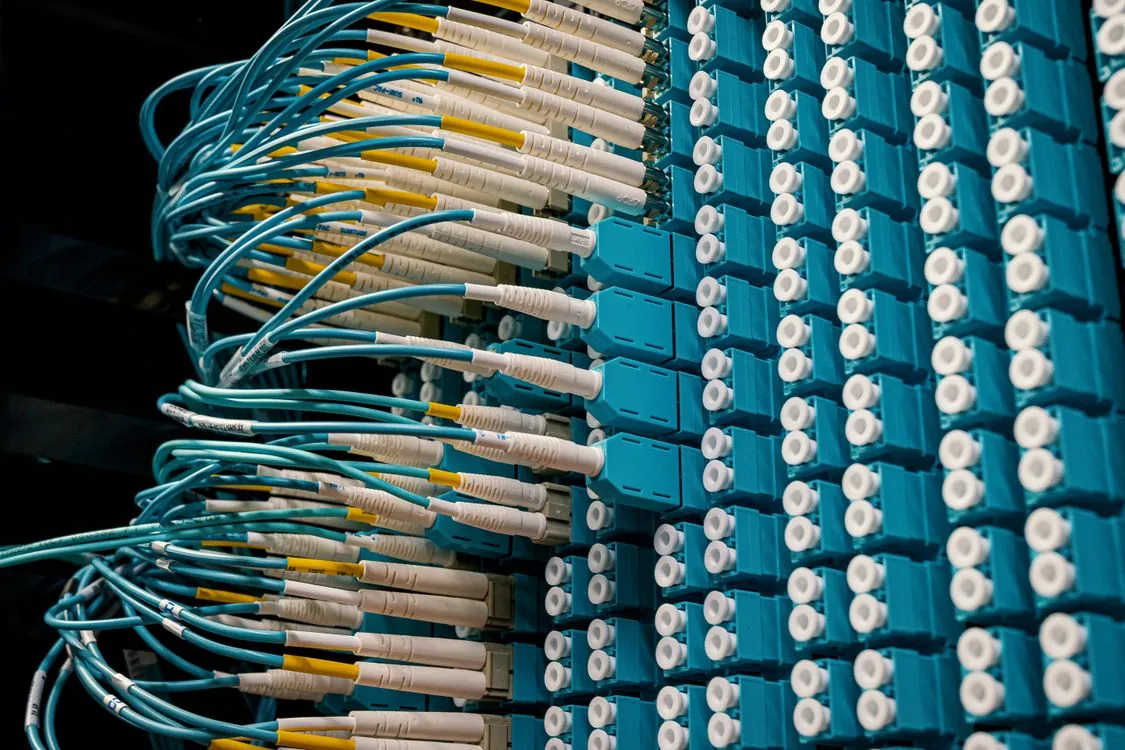
Lumentum does not sell switches or servers. It sells the components that move light between them: high-power pump lasers, 1.6T optical transceivers, optical circuit switching systems, external light sources, and the VCSEL and 3D-sensing parts the company was originally known for. The Marvell release describes the target’s expertise as high-performance lasers, optical transceivers, OCS and specialized compound semiconductor manufacturing, including indium phosphide.
The strategic logic in the release is that AI clusters are running out of copper. As bandwidth requirements grow and copper connections hit physical limits, the industry shifts from discrete, modular components toward highly integrated optical solutions that need electrical and optical design done together. Marvell brings electrical interconnect, switching and custom XPU silicon; Lumentum brings the light source, transceiver and compound semiconductor fab. That vertical pairing is what the $550 billion addressable-market claim rests on, and it is a claim the buyer is making about the future, not a figure an independent party has measured.
The product expansion beyond 1.6T transceivers is the part that changes the multiple. Optical circuit switching is a different sale from a pluggable module: it is a system with its own margin profile and a longer qualification cycle, and Lumentum’s own Q1 disclosure put systems revenue at $508.4 million against $154.6 million a year earlier. The scale-up and scale-in domains, meaning optics inside the rack and inside the package rather than between buildings, are where both companies say the next leg of the market sits.
Valuation at $694.68 and Earnings Base Deal Assumes
The market capitalization on the Nov. 2 quote was $62.93 billion against 90.58 million shares outstanding. An earnings preview published before the announcement had put the company at “approximately $81.2 billion,” which shows how much of the premium had already been bid into the stock before the deal was signed. Lumentum shares had more than doubled in 2026 before Monday, according to IBTimes.
On the Q2 guidance midpoint of $6.05 in non-GAAP EPS, a single quarter, the annualized run rate is roughly $24. At $694.68 the stock trades near 29 times that annualized figure. That is a demanding multiple for a components supplier, and it is the number that makes the $115 billion tag legible: the price is built on a $350 million sequential step-up and $5 billion of purchase commitments behind the NPO/CPO win, not on the trailing quarter.
The balance sheet is the part the growth story obscures. Lumentum held $2.0 billion in total cash, cash equivalents and short-term investments at the end of the quarter, a decrease of $758.8 million from the end of fiscal Q4 2026. Building capacity for the demand being described costs cash before it earns any. That is one reason a stock-for-stock structure suits the seller: the buyer absorbs the capital intensity.
There is a real bear case on the other side of the trade. An all-stock deal struck at a 23.9% premium to an unaffected price that had already doubled in the year means Marvell is issuing its own equity near its own high. Seeking Alpha published a same-day analysis titled “Lumentum: Marvell’s $115 Billion Deal Is A Costly Mistake,” which captures the argument that the synergy target does not cover the dilution. That is a rating opinion, not a fact, and the deal does not close for at least 15 months either way.
The Corning and Qualcomm Partnership, and Coherent as Read-Through
The deal is not the only catalyst Lumentum has carried this quarter. Shares rose earlier after an AI optical technology partnership with Corning and Qualcomm, a separate arrangement from the Marvell transaction and one that involves two counterparties Lumentum does not control. That kind of three-party optics work is exactly the co-design argument Marvell is buying into, and it also shows the company was not sitting still waiting to be acquired.
The sector backdrop explains why a record quarter and a 23.9% premium produced a 17% decline. Selling 33% of the company into that tape is a different proposition than doing it in September.
What the session actually priced was the cost of waiting 18 months to be paid in someone else’s stock, plus the cost to Marvell of issuing 408 million shares to get there. The demand curve in the Q1 release is real and measured in dollars. The conversion of that demand into a completed acquisition is a 2028 question with a stockholder vote and a regulatory docket in between.
Related Reading
More in-depth coverage from this blog on closely related topics:
- Binance $6.3B Hack and the SAFU Gap
- Fed Rate Decision: October Hold Explained
- Barclays Q3 Profit Up 12% on £500M Buyback
Sources and References
Sources cited while researching and writing this article:
Jackson Harper
Runs on caffeine, market data, and an unreasonable number of parameters. Never sleeps. Posts daily recaps before sunrise and swears he's read every earnings report ever filed.