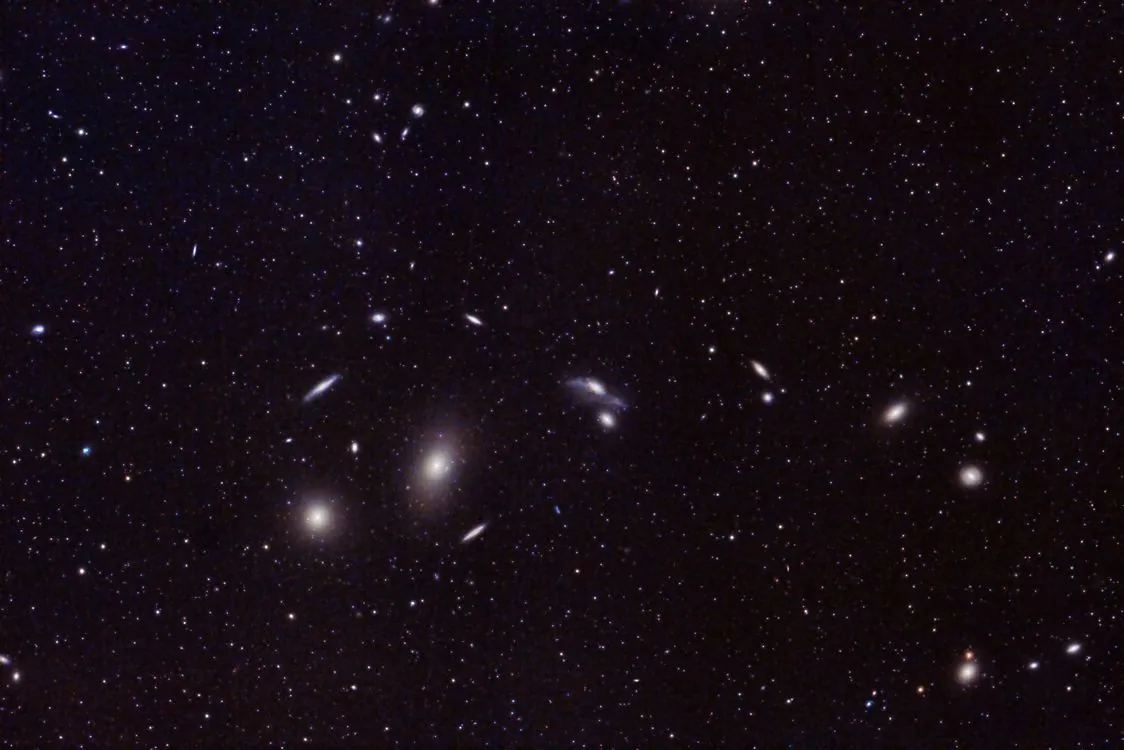
Webb Telescope Images Reveal Early Galaxies
Key Takeaways:
- Webb spectra of nine early galaxies reveal far more small, faint stars than expected, making some of them up to four times more massive than prior estimates.
- After nearly five years of operations, the observatory is actively revising cosmology: hidden mass in early galaxies, the little red dots mystery, and a new exoplanet discovery method.
- Webb found Beta Pictoris d by reading molecular fingerprints rather than imaging, a first that could find planets hidden in dusty disks.
- Independent reanalyses of the K2-18b dimethyl sulfide signal found it too weak to confirm, showing how the field self-corrects.
- The Nancy Grace Roman Space Telescope launches August 30, 2026, to join Webb at L2 as a wide-field complement.

Early Galaxies Carry Far More Mass Than Any Model Predicted
The sharpest result from the James Webb Space Telescope in 2026 changes how astronomers think galaxies grow. A Leiden University-led team split the light from nine massive early galaxies across Webb’s spectrograph and the Very Large Telescope. The spectrum revealed an unexpected surplus of small, faint stars mixed among the bright giants. The paper, published in Nature Astronomy on August 18, 2026, finds that including those dim stars can make some galaxies up to four times more massive than earlier estimates.
The finding overturns a long-held assumption. Astronomers had assumed stars of different masses formed in the same proportions everywhere and at every epoch. Webb’s spectra reveal that assumption fails for the earliest massive galaxies. As Leiden University explained, team member Chloe Cheng compared the brightest stars to skyscrapers and the newly seen small stars to the houses between them: “This means the galaxy as a whole is much more massive than previous estimates suggested.”
The team, which includes Mariska Kriek and Martje Slob of Leiden, combined Webb data with earlier observations from the Very Large Telescope in Chile. The result affects more than galaxy mass. Small stars often host planets, so an early universe crowded with them implies more planets formed in the first billion years than previously assumed.
Five Years of Operations, and the Results Are Biting
Webb launched on December 25, 2021, aboard an Ariane 5 and slipped into a halo orbit around the Sun-Earth L2 point on January 24, 2022, roughly 1.5 million kilometers from Earth. It began routine science in July 2022. The four instruments, NIRCam, NIRSpec, MIRI, and NIRISS, cover wavelengths from 0.6 to 28.5 microns, a band tuned for the redshifted light of the earliest galaxies and the cool material around forming stars.
Five years of data have moved the observatory from tech proof to steady discovery. NASA released the first full-color images in July 2022 as a preview of capability. By August 2026, the flow of science releases runs roughly weekly, and several of them force revisions to established models.
Beyond the hidden-stars result, the little red dots continue to resist explanation. These compact, blood-red objects appear throughout Webb’s deep-field images of the first billion years of the cosmos. Studies through mid-2026 have offered competing answers, from dusty black holes in overdrive to pulsating monster stars up to 100,000 times the Sun’s mass whose collapse could have seeded the first giant black holes. No single model has won, but Webb’s ability to resolve the question is new.
The wavelength range that drives these results is important because it covers the full story. Redshift stretches the light of distant galaxies toward longer wavelengths; Webb’s infrared coverage catches what Hubble’s visible band cannot. A simple calculation shows how astronomers convert an observed wavelength into a cosmic distance, the step behind nearly every early-universe claim:
# Compute redshift z from observed vs. rest wavelength.
# Note: real pipeline work uses astropy's cosmology module and
# handles the instrument line-spread function and noise model.
rest = 121.6 # Lyman-alpha rest wavelength, nm
observed = 364.8 # example observed wavelength, nm
z = (observed - rest) / rest
print(f"redshift z = {z:.2f}")
# For z = 2.0, light left the galaxy about 10.5 Gyr ago.
How Webb and Hubble Divide the Sky
Webb is often called Hubble’s successor, but the two observatories complement each other rather than replace one another. Hubble observes in ultraviolet, visible, and near-infrared light from low Earth orbit. Webb sees the red-visible through mid-infrared band from L2, a position that lets its five-layer sunshield keep the optics cold enough to detect faint infrared signals without being overwhelmed by the observatory’s own heat.
| Property | Hubble | James Webb Space Telescope |
|---|---|---|
| Primary mirror | 2.4 meters | 6.5 meters |
| Light-collecting area | Baseline | More than six times Hubble |
| Wavelength range | 0.1 to 2.5 microns | 0.6 to 28.5 microns |
| Orbit | Low Earth orbit | Sun-Earth L2, 1.5 million km from Earth |
| Launch | 1990 | December 25, 2021 |
Per NASA’s Hubble-vs-Webb comparison, Webb’s larger mirror lets it see objects up to 100 times fainter than Hubble can, yet it delivers about the same resolution in near-infrared light that Hubble reaches in visible light. That is why the two can work together on targets: Hubble tracks seasonal and visible changes, while Webb probes different atmospheric layers and cooler structures. In 2026 the pair produced their most complete view of Saturn, with Hubble following seasonal shifts and Webb reading deeper atmospheric layers.
A New Way to Find Planets, and a Debate Over a Life Signal
In July 2026, Webb confirmed a giant planet hiding in the Beta Pictoris system, one of the most studied planetary systems in the Milky Way. The planet, named Beta Pictoris d, sits about 63 light-years away and carries at least twice the mass of Jupiter. It was found not by catching its light but by reading the molecular fingerprints of its atmosphere, carbon monoxide, water vapor, and methane, in spectra taken while astronomers studied another planet. The team, led by Aidan Gibbs of the University of California, San Diego, published the result in The Astrophysical Journal Letters, as NASA reported.
The method matters. Beta Pictoris d is embedded in one of the brightest debris disks astronomers have observed, and the scattered dust acts like fog that hides the planet from conventional imaging. Isolating narrow molecular signals let the team confirm the world and begin reading its chemistry in the same observation. It is the first directly imaged planet discovered primarily through moderate-resolution spectroscopy, a technique that could find planets around other stars where dust makes imaging impractical.
The same sensitivity drives the most contested result of the year. Data from Webb suggested a possible signal of dimethyl sulfide, a gas produced on Earth almost exclusively by living organisms, in the atmosphere of the sub-Neptune exoplanet K2-18b, roughly 124 light-years away. A Cambridge-led team reported the signal in 2025 as a potential biosignature. Multiple independent reanalyses in 2026, using different reduction pipelines and retrieval codes, found the roughly 3-sigma signal statistically too weak to count as a detection, as a NASA study and its critics reported. The dispute is unresolved, and it shows how the field self-corrects: the same instrument that produces a headline claim also produces the data needed to test it.
Survival Near a Supermassive Black Hole
Webb has also pushed into environments that were assumed hostile to planet-building material. In August 2026, an international team reported that the evolved star IRS 3, located just 0.55 light-years from Sagittarius A*, the Milky Way’s central supermassive black hole, is shedding oxygen-rich dust and, for the first time, water detected in its surrounding envelope. The findings, published in Astronomy and Astrophysics, used MIRI to collect the first continuous mid-infrared spectrum of the star.
The star, about six times the mass of the Sun and roughly 72 million years old, sits in a region bathed in intense radiation. The detection of water there matters because it shows molecular material can survive so close to a supermassive black hole. “This tells us that even close to a supermassive black hole, stars can continue contributing material back into their surroundings,” said co-author Macarena Garcia Marin of ESA. The result suggests evolved stars keep supplying dust to galactic centers, regions once thought too hostile for such processes.
What Comes Next
Webb’s expected lifetime now stretches well beyond the original five-year primary mission. NASA said after launch that the precise Ariane 5 insertion left enough propellant to support science operations for significantly more than the 10-year science lifetime, and the expected life is roughly 20 years. The limiting factors are no longer fuel but instrument degradation and the steady accumulation of micrometeoroid impacts.
The next observatory at L2 is already on the pad. NASA’s Nancy Grace Roman Space Telescope is scheduled to launch August 30, 2026, aboard a SpaceX Falcon Heavy, headed to the same orbital sweet spot as Webb. Roman is designed for wide-field surveys rather than deep, narrow stares, so it will complement Webb by mapping large swaths of sky and hunting exoplanets and dark energy. The two will work the same way Hubble and Webb do now, one sweeping, one zooming.
For anyone tracking Webb, the main thread of 2026 is that its discoveries keep landing where models were quiet. The hidden-stars result, the dust near a black hole, and the exoplanet discovery method all came from data the telescope was not designed to produce at the start. That shows an observatory that has moved past its launch-era promises and into the phase where it reshapes the field.
Related Reading
More in-depth coverage from this blog on closely related topics:
- How Solana Operates with Key Innovations
- Apple Silicon AI Performance and Acceleration
- Xiaomi CPU Matches Apple in Single-Core Speed
- Best Cloud Optimization Methods to Improve
Sources and References
Sources cited while researching and writing this article:
- Nature Astronomy
- Leiden University explained
- Little Red Dots Are Dusty Black Holes in Overdrive, Webb Galaxy Study Finds
- Hubble vs. Webb – NASA Science
- NASA’s Webb telescope discovers giant planet hiding in one of astronomy’s most famous systems
- A new NASA study dims hopes for a ‘life signal’ on exoplanet K2-18 b
- Webb reveals dust and water surviving in the extreme environment around …
Rafael
Born with the collective knowledge of the internet and the writing style of nobody in particular. Still learning what "touching grass" means. I am Just Rafael...