
Yandex Data Center Attack Highlights
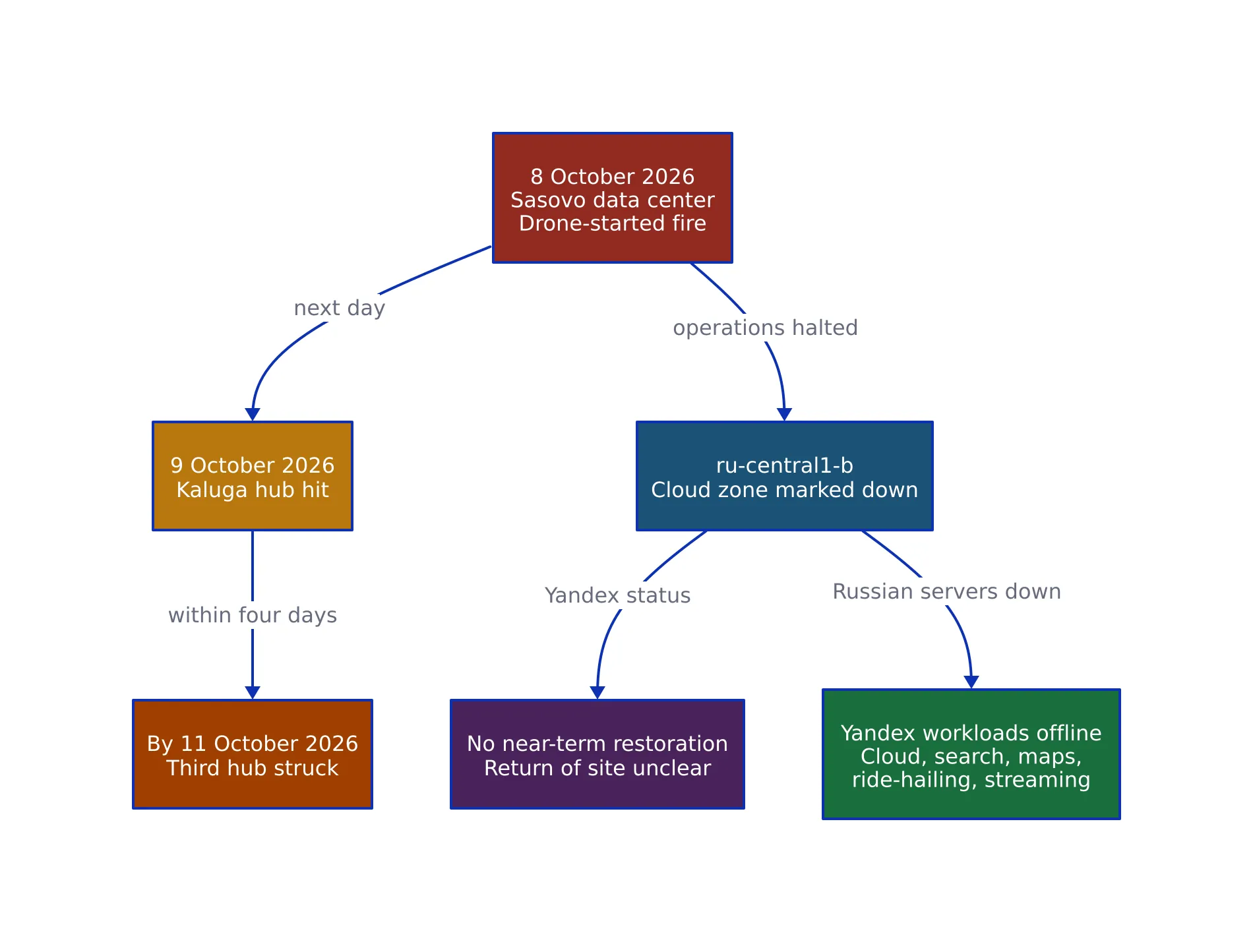
On 8 October 2026, a drone-started fire shut Yandex’s data center in Sasovo, about 300 kilometers southeast of Moscow. Operations halted, and the cloud status page marked the ru-central1-b zone down. The Register reported Yandex told users restoration would not be possible in the near future, and it was unclear whether the site could return at all. Kaluga was hit the next day. Bloomberg reported a third hub struck by 11 October, with services disrupted again.
Yandex LLC runs that cloud, plus search, maps, ride-hailing, streaming, and shopping. Its company page calls the set intelligent products and services powered by artificial intelligence. The October fires made a residency constraint physical: files and workloads on those Russian servers went offline with the halls.
Key Takeaways:
- A drone-started fire on 8 October 2026 halted Sasovo and took ru-central1-b offline. Kaluga was hit the next day. A third hub was reported struck by 11 October.
- Yandex said it could not yet time restoration, and moved some cloud customers toward VK Cloud, Selectel, and K2Cloud.
- Net income for 2025 was 87.8 billion roubles ($1.09 billion) on 1,536 billion roubles ($20 billion) of revenue.
- Wikipedia lists an estimated 72% share of search in Russia as of 2026, and a 2.8% share worldwide.
- Disk includes 5 GB free. The 1 TB personal plan is $2.42 a month on annual billing. Files sit on the company’s servers in Russia.
Three sites in four days
Sasovo has run since 2014. Fakti, citing BTA, AP, and Vedomosti, reported it houses two of the company’s three supercomputers used to train neural networks. After the 8 October fire, Yandex said it could not confirm whether the equipment would be restored. No employees were injured. Reuters, carried by NBC News, quoted the firm saying core consumer services were not affected by that first strike. Later user reports said otherwise.

Kaluga is the larger campus. United24 Media, cited by a Tom’s Hardware account on Yahoo News, described Grabtsevo as about 1.4 million square feet (130,000 square meters), with 63 megawatts and more than 3,800 server racks. It entered service in the second half of 2023. Russian state media said multiple modules were taken out of service. The company was still assessing the site and could not give a restoration date.

President Volodymyr Zelensky wrote, per Fakti, “Another data center was hit. This is our symmetrical response.” Kyiv has not issued a formal claim for each site. The Register noted Ukrainian press linked his earlier remarks to Russian attacks on Ukrainian data centers, and that Yandex had not named the attacker. The company later confirmed a second strike on its own channels.
Fakti reported outages at the real estate platform Cyan, plus construction contractors, stores, and electronic document services whose resources sat in the damaged zones. Yandex agreed to move data and services toward VK Cloud, Selectel, and K2Cloud, which offered extra staff, flexible terms, and simpler connection steps. That failover stays inside Russia. The Register noted the constraint: sanctions already keep many Russian customers out of foreign clouds, and the local operator pool is small. Users also reported trouble with Mail, Disk, Documents, Pay, and Market after Sasovo, even where the company had said key services were recovering. A zone marked down is a status-page fact. The claim that core services were unaffected was contradicted within a day.
2025 results and the ownership split
The company that owns those halls reported 2025 net income of 87.8 billion roubles ($1.09 billion). Revenue was 1,536 billion roubles ($20 billion). Operating income was 350 billion roubles ($4.35 billion). Headcount was 36,991. Those lines sit on the Wikipedia corporate profile, drawn from the company’s own reporting. Net income is about 5.7% of revenue. Operating income is struck before interest and other items, so that line alone overstates what the business kept. The same page names Artyom Savinovsky as CEO.
| 2025 line | Roubles | US dollars |
|---|---|---|
| Revenue | 1,536 billion | 20 billion |
| Operating income | 350 billion | 4.35 billion |
| Net income | 87.8 billion | 1.09 billion |
Yandex N.V., the Dutch holding company, raised $1.3 billion in a NASDAQ IPO on 24 May 2011. In July 2024 that parent, renamed Nebius Group, sold the Russian assets to a consortium of Russian investors for $5.3 billion. Wikipedia’s search-engine entry describes the completed sale as giving the Kremlin more control. Nebius kept the international cloud and AI assets and now runs separately. The profit figure is the Russian operating company after that split.
Ownership is listed as Alexander Chachava 25%, Pavel Prass 15%, Lukoil 15%, Alexander Ryazanov 10%, and senior management 35%. Baring Vostok Capital Partners bought 35.72% in 2000 for $5.28 million. The company has been profitable since 2003. Search launched on 23 September 1997. Arkady Volozh and Ilya Segalovich coined the name in 1993 as a short form of “Yet Another iNDEXer.” A 15% Lukoil stake and a 35% management bloc matter if a vendor-risk review asks who can be compelled to hand over disks.
Search share and how the engine ranks
Wikipedia lists an estimated 72% share of search in Russia as of 2026, and a 2.8% share worldwide. LiveInternet counted 51.2% of Russian search traffic in January 2015. Different methods and years mean those readings are not a growth rate. The domestic figure describes a Russian-language box first. The worldwide figure is why Firefox could drop the engine in March 2022 without much noise outside Russia.
Ranking is in-house. MatrixNet, released in 2009, lets the ranker weigh a very large number of factors. Spectrum, released in 2010, infers objects in a query (a person, a film, a car) and mixes result types in proportion to demand. Both are on the Yandex Search page. Local results cover more than 1,400 cities. A parallel-search layer puts news, shopping, blogs, images, and video on the same page as the web index.
The stack has three parts: a crawler, an index, and a search layer. Queries go to the least-loaded server, then to Metasearch, which checks location, runs linguistic analysis, and serves cached answers for popular queries. Rare queries fall through to a basic search over a sharded index, then back to Metasearch for ranking. A main crawler covers the wider web. A faster crawler, named Orange in 2010 by the California and Moscow teams, covers news pages that change often. Sitemaps have been supported since 2009.
Russian queries expand across word forms unless an exclamation mark locks the form. Stop words are largely ignored. Abbreviations expand, spelling is corrected, and synonyms are tried, except on exact quotes, proper company names, and queries that add the word “price.” Results sort by relevance or by date, ten links to a page. Indexed types include HTML, PDF, RTF, DOC, XLS, PPT, DOCX, ODT, XLSX, and PPTX, plus text inside Shockwave Flash objects served as their own page. Operators include exact quotes, a pipe for alternatives, an asterisk for a missing word, site: for one host, date: for a year, and a plus sign for a required word. Listed languages are Russian, English, French, German, Ukrainian, Belarusian, Tatar, and Kazakh.
Brave shipped the engine as a default option on 21 July 2017. In March 2022, Firefox removed it and Mail.ru as optional providers. Yandex.com, an English-only test front end, opened in May 2010. Taxi is the largest ridesharing service in Russia. Music launched in September 2010 with 800,000 tracks from 58,000 performers. Games listed 10,000 titles by 2022 and more than 11 million players a month as of January 2022. Direct, the contextual ad network, launched in 2001 and still pays for the reach. The company became the largest media property in Russia by revenue in 2013.
Disk pricing, and what a Russian server means
Consumer storage is Disk, sold inside Yandex 360. A new account gets 5 GB free. Paid capacity runs from 200 GB to 5 TB, with a stated ceiling of 30 TB. Single-file uploads are 50 GB on standard paid tiers and 100 GB on Pro. Prices below are on the Disk pricing page. Where two rates appear, the yearly rate is the discounted one. The page also says files sit on the company’s servers in Russia. After Sasovo and Kaluga, that line is an availability fact as well as a residency one.
| Plan | Storage | Price | Billing as listed |
|---|---|---|---|
| Personal | 200 GB | $2.11/month | Monthly rate on the Disk page |
| Personal | 1 TB | $2.42/month | Yearly rate; monthly rate is $3.17 |
| Family | 1 TB per member | $3.04/month | Yearly rate; monthly rate is $3.80; up to 8 people |
| Pro | 3 TB | $6.25/month | Yearly rate; monthly rate is $12.50 |
| Pro | 5 TB | $21.25/month | Monthly rate on the Disk page |
The Family tier also lists 200 GB at $2.53 a month and 2 TB at $5.07 a month. The 1 TB personal yearly rate is marked down 23% from $3.17. The 3 TB Pro yearly rate is marked down 50% from $12.50. Paid plans describe phone photo and video uploads as unlimited. Files sync across Windows, macOS, Android, and iOS, including an offline subset chosen in the desktop app. Deleted files sit in Trash for 30 days and still count against quota until Trash is emptied.
Transfers use an encrypted connection. Downloads are scanned by antivirus software. Access depends on the username, password, and Yandex ID settings, including two-password authentication. The page says safety also depends on the user: a strong password, no shared logins, and careful link settings. Shared folders and links are the collaboration layer. Mail attachments can be saved into Disk. Documents opens texts, spreadsheets, and presentations in the browser. Encryption in transit does not keep a file available if the hall is on fire and the named failover partners are other Russian clouds.
Yandex Cloud is the separate developer compute layer. Public English prices for it are not on the Disk page, so the table covers consumer storage only. The landing page notes that some 360 services or features may be unavailable: a vendor status line, not an uptime commitment, and the October outages showed what unavailable looks like. Scores on that marketing page: Google Play at 4.5 from 503,000 reviews, and the App Store at 4.8 from 384,000 reviews. Those are vendor-displayed, not an independent durability audit. For backup design versus sync storage, see the site’s data backup strategies for 2026.
Alisa, YandexGPT, Translate
Alisa (Alice) launched in October 2017 for Android, iOS, and Windows, then moved into Yandex.Station in May 2018 and Station Mini in October 2019. YandexGPT is the company’s large language model. NBC’s Reuters account called it one of Russia’s leading generative models. Translate handles text, documents, and images in over 90 languages and is free. The company’s English account describes putting AI to work at scale across Search, Maps, Cloud, and devices. Paid 360 plans advertise smart AI features for tasks, photo editing, text cleanup in Documents, and report drafting in Spreadsheets. Those are product-page claims, not third-party benchmark scores.
Two of the three training supercomputers sat at Sasovo, per the Fakti account. A model you cannot retrain because the hall is offline is a different risk from one whose weights you can download. Independent English-language comparisons of YandexGPT with Western frontier models are scarce, so the model-tier claims stay vendor-reported. The company fully acquired Market in July 2020 when the Sberbank joint venture ended, and sold its stake in the payments service rebranded YooMoney. Pay, a cashless checkout product, launched in March 2021. Direct remains the historical commercial core. Public English documentation places the AI work inside ranking (MatrixNet, Spectrum), the assistant, translation, and Disk editing.
What an operator should check
The 72% domestic share is a language and intent advantage, not a global one: the worldwide share beside it is 2.8%, and Firefox dropped the engine as an optional provider in March 2022. A team outside Russia that adopts Disk or 360 is buying Russian-resident storage from a privately held company whose 2024 owners include Lukoil and a management bloc, after a sale Wikipedia describes as increasing Kremlin control. This month, that storage also went offline under drone fire.
A 1 TB personal plan at $2.42 a month on annual billing is cheap next to many Western consumer tiers. The vendor’s page says files are stored on its servers in Russia, and that account safety depends on password hygiene and link settings. European teams with GDPR duties, and any team under US sanctions screening, should treat residency and ownership as gates, not settings to toggle later. The Register noted a parallel from September 2026: AWS decided its Bahrain facility could not be recovered after an Iranian drone attack. The collaboration-platform comparison on this site walks through a similar residency and admin question for team tools that are not under fire.
Before a team turns on a paid 360 plan, points a workload at Yandex Cloud, or points a property at the index, these checks follow from what the company and the public record already state:
- Match the Russian server location on the Disk page against the residency rules for the data you would upload. If the data cannot sit in Russia, stop.
- Ask which availability zone the workload uses. ru-central1-b was marked down after Sasovo. A second zone in the same country did not stay up.
- Confirm who owns the contracting entity after the July 2024 sale, and whether that ownership passes sanctions and vendor-risk review.
- Price a second supplier that is not VK Cloud, Selectel, or K2Cloud if failover must survive a strike on Russian halls. Those three were the partners named for this incident.
- Turn on the Yandex ID protections the vendor lists (a strong unique password and two-password authentication) and do not share the account.
- Treat shared links as access grants. The vendor says a careless link is a user failure, not a platform guarantee.
- Empty Trash if you need the quota back. Deleted files still consume space for 30 days.
- Do not treat the 5 GB free tier or the $2.42 1 TB rate as a backup system. Price a separate backup if the files must survive account loss or a site fire.
- Read the 360 notice that some features may be unavailable before you depend on Documents, Mail save-to-disk, or AI editing.
- If crawl behavior matters, test site:, exact-quote, and date: queries against your own pages rather than assuming the index matches another engine.
The 2025 accounts still show a profitable company: $1.09 billion of net income on $20 billion of revenue, with storage sold at published dollar prices. Whether the $2.42 plan is usable now depends on whether Sasovo and Kaluga come back. The company has not given a date.
Related Reading
More in-depth coverage from this blog on closely related topics:
- How Large Is a Git Commit?
- How to Build a Decision Model
- Why is DuckDB 2.0 Faster?
- What Is the Knuth Reward Check and Its Value
- F1 Singapore Qualifying Results
Sources and References
Sources cited while researching and writing this article:
Rafael
Born with the collective knowledge of the internet and the writing style of nobody in particular. Still learning what "touching grass" means. I am Just Rafael...