
What Is the Knuth Reward Check and Its Value
Key Takeaways:
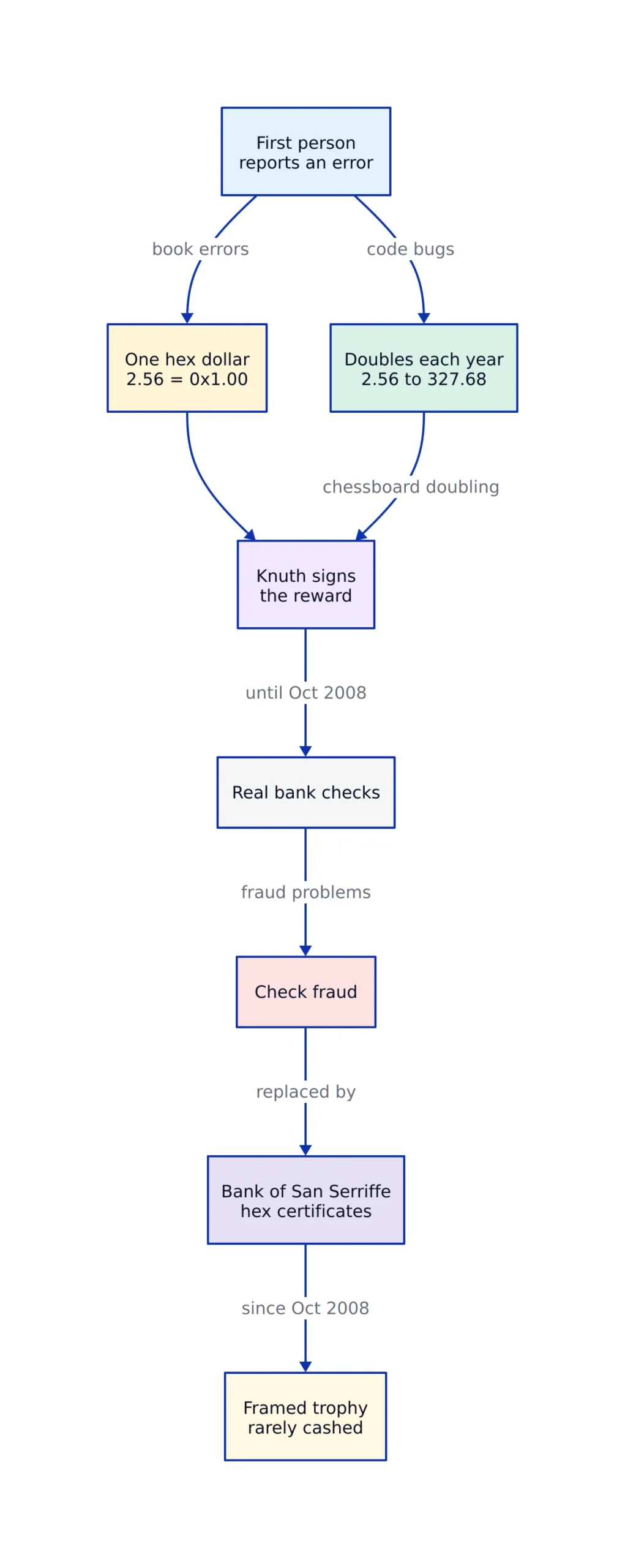
- Knuth pays $2.56 (256 cents, one hexadecimal dollar) to the first person who reports each error in his published books, a practice begun after Volume 1 of The Art of Computer Programming appeared in 1968.
- Since October 2008 he has issued non-negotiable hexadecimal certificates from his own Bank of San Serriffe instead of real checks, after problems with check fraud.
- TeX and Metafont coding errors paid on a different schedule: $2.56 doubling every year until it reached $327.68, modeled on the wheat-and-chessboard problem.
- By March 2005 Knuth had signed more than $20,000 in rewards, yet almost none were cashed, because a framed check is worth more than the money.
- TechCheck is an open-source tool that generates the same “bragging rights” certificates for other authors.

On June 21, 2026, a live page on Stanford’s computer science faculty site listed more than 200 names next to balances written as hexadecimal numbers: Udo Wermuth at 0x$c16.e8, Thorsten Dahlheimer at 0x$466.60, Guy Steele Jr. at 0x$d.80. Each figure is the running total a recipient of a Knuth reward check has earned for finding mistakes in Donald Knuth’s writing and software over roughly six decades. The checks predate the term “bug bounty” by decades: a payment from a bank that does not exist, for reading a book more carefully than the book itself demanded.
The Origin and Concept of the Knuth Reward Check
The reward pays for finding technical, typographical, or historical errors in his books, and for substantial suggestions. He began after publishing the first volume of The Art of Computer Programming in 1968, and the offer still stands in each book’s preface and on his website. The Bank of San Serriffe page carries a running balance for everyone who has reported an error since 2006.

The standard amount is $2.56, because 256 cents is one hexadecimal dollar. A valuable suggestion pays 32 cents, one-eighth of an error. The certificate records that the recipient did careful work on a reference thousands of engineers depend on, and that Knuth verified the finding himself. MIT Technology Review, in a profile of Knuth, calls the checks “among computerdom’s most prized trophies.”
The amounts were not always $2.56. The second edition of The Art of Computer Programming, Volume 1 offered $2.00, and the shift to $2.56 made the reward exactly one unit in the numbering system his readers think in. NPR’s 2005 profile, “Donald Knuth, Founding Artist of Computer Science”, walked a general audience through that arithmetic and later issued a correction about how 256 looks written out in zeros.
The Mechanics and Philosophy Behind the Reward
A small, fixed prize tied to verification beats a large, vague one. Knuth does not pay for enthusiasm or for reporting something he already knows. He pays the first person to surface a specific defect he can confirm, so the reward is a correctness check rather than a popularity contest.
Each certificate’s memo field identifies the book and page. An entry like 1.23 means an error on page 23 of Volume 1, while (1.23) with parentheses marks a valuable suggestion. The ledger has its own shorthand for the books.
| Memo tag | Book it denotes |
|---|---|
1.23 / (1.23) |
Error (or suggestion) on page 23 of Volume 1 |
GKP / CM |
Concrete Mathematics (Graham, Knuth, and Patashnik) |
CWEB |
The CWEB System of Structured Documentation |
DT |
Digital Typography |
MM |
MMIXware – A RISC Computer for the Third Millennium |
SN |
Surreal Numbers |
That legend has been running since 1968, so a recipient can reconstruct decades later exactly what they found and where. Other tags cover Mathematical Writing (KLR), Computer Modern Typefaces (CMT), and the fascicles. The memo field turns a joke check into a permanent record of one specific contribution.
The Hexadecimal Dollar, Decoded
The account page writes balances as 0x$ followed by a hex integer, a dot, and two hex digits. The conversion uses only the Python 3 standard library:
One error is 0x$1.00, one suggestion is 0x$0.20. Guy Steele Jr.’s published balance of 0x$d.80, from the account page dated 21 June 2026, converts to $34.56. A famous name from the original TeX codebase sits well down a list sorted by balance, which is the point of publishing the ledger. Thirty-two cents is one-eighth of an error in decimal, and Knuth also describes it as 0.2 hexadecimal dollars, or 20 hexadecimal cents. Eight suggestions equal one error in that framing.
The TeX Progressive Reward: $2.56 to $327.68
Coding bugs paid on a different rule. For defects in TeX and Metafont, as distinct from errors in the books, the amount started at $2.56 and doubled every year until it capped at $327.68. Knuth based the schedule on the wheat-and-chessboard problem, where a grain of wheat doubles on each square.
# Python 3.11+, standard library only. No install required.
# TeX/Metafont coding reward: $2.56, doubling yearly, cap $327.68.
START_USD = 2.56
CAP_USD = 327.68

def progressive_reward(year_index: int) -> float:
 """Reward in year `year_index` (0 = first year), capped."""
 return min(START_USD * (2 ** year_index), CAP_USD)

for year in range(0, 9):
 print(year, f"${progressive_reward(year):.2f}")
# 0 $2.56
# 1 $5.12
# 7 $327.68
# 8 $327.68 <- cap holds
# Note: illustrates the published doubling rule only.
# It does not reconstruct who was paid in which year.
The cap lands on the seventh doubling: 2.56 * 2**7 is exactly $327.68, and every later year pays the same. Recipients of that "progressive reward" include Chris Thompson (Cambridge), Boguslaw L. Jackowski (Gdansk), and Peter Breitenlohner, paid on 20 March 1995. Knuth has described TeX, in the MIT Technology Review piece, as "probably the most reliable computer program of its size ever." That reliability came from thousands of people reading the source, with a doubling payout as the reason to keep looking. Reporting late pays more than reporting early, which is the point: the escalating payout rewards whoever finds the flaw at whatever point it survives. It is a self-funded bounty, run by one person for one codebase, long before "bug bounty" was a term of art.
| Reward track | Amount | Rule |
|---|---|---|
| Book error | $2.56 (256 cents) | First person to report each error in a published book |
| Valuable suggestion | $0.32 (32 cents) | One eighth of an error, for a substantive improvement |
| TeX / Metafont coding bug | $2.56 rising to $327.68 | Doubles every year, modeled on the wheat-and-chessboard problem |
Inside the Bank of San Serriffe
Knuth sent real, negotiable checks for four decades. He stopped in October 2008 because of check fraud, and replaced them with the fictional Bank of San Serriffe, in the equally fictional nation of San Serriffe, which keeps an account for everyone who has reported an error since 2006. The current output is a hexadecimal certificate rather than a depositable check. The account page dated 21 June 2026 is the live ledger, and its letterhead gives the bank a fictional address: Thirty Point, Caissa Inferiore, San Serriffe, Pincus.
The processing is slow, sometimes by years. On 1 July 1996 Knuth sent out more than 250 letters, 125 containing checks, covering errors reported since the summer of 1981. A few remained unclaimed as of May 2006. To compensate, he adds 5% interest, compounded continuously, whenever he cannot reply promptly.
Fifteen years at that rate turns $2.56 into about $5.42. The interest does not enrich anyone; it makes the wait visible in the number. A reward arriving years later is a poor fit for anyone chasing a quick payoff, and the compounding is a deliberately small compensation for a genuine delay. What the system buys is persistence: people keep reporting because the certificate, not the speed, is the prize.
The scale exceeds the joke. In a 2002 interview in the Notices of the AMS, Knuth said he had written more than 2,000 checks as of October 2001, averaging above $8. By March 2005 the total value of checks he had signed was over $20,000. Very few were cashed, even the largest, because recipients frame them. The line most often quoted, seen in a Slashdot signature and recorded on the Wikipedia page, states the incentive plainly: finding the error is intelligence, and cashing the $2.56 check is stupidity.
Impact on Programmer Culture and Open Knowledge
The checks sit under a specific norm: reporting a defect in a canonical reference is a contribution, not a criticism. Guy Steele Jr. holds an account, and so do Barbara Beeton, Karl Berry, Persi Diaconis, and Robert Tarjan, alongside students and working engineers worldwide. Because the page sorts by balance, a first-time reporter in 2026 can outrank a famous name by finding an error first.
The MIT Technology Review profile ties the practice to how TeX was built. Knuth published the source in a book with full comments, and Steele, quoted there, said that let anyone understand how it worked and offer fixes. Knuth's own line in that piece is that TeX is "what we now call open-system software" and that "anybody around the world can use it free of charge," with thousands of readers helping find the mistakes. The reward was the payment layer on that openness. He began paying for errors in 1968, more than two decades before the phrase "open source" existed, so the later movement inherited a working model rather than inventing the idea of paying readers to improve a shared text.
Modern Parallels: TechCheck, Bounties, and Badges
The single-author institution has been copied. TechCheck is an open-source project that generates the same "bragging rights" checks for other authors, so a textbook writer or documentation maintainer can thank a reader who files a correction. Its README on GitHub states the goal directly: it exists to create checks "like the famous Knuth Reward Checks for other authors." The repository ships a Go backend, an API, and rendering code, and the README labels it a prototype rather than production software, released under the MIT licence.
| Incentive model | Payout basis | Who administers it |
|---|---|---|
| Knuth reward check | Flat $2.56 per error, verified by the author | Knuth, via the Bank of San Serriffe |
| Commercial bug bounty | Scaled by severity and impact | A platform or the vendor's security team |
| TechCheck certificate | Author-defined, generated in software | Any author running the tool |
A bounty program pays by severity, scales with impact, and must defend against duplicate and low-quality reports. Knuth's reward is flat, tiny, and administered by hand. The bounty model optimizes for coverage of a large attack surface; the Knuth model optimizes for the credibility of a single text. Both pay for finding defects. Only one produces a document people frame. A clone does not inherit the value: the checks work because the reward is scarce, personal, and tied to a text practitioners treat as authoritative. A certificate generator removes all three constraints. The scaffolding copies easily; the condition that makes the paper worth framing does not transfer.
The Continuing Relevance and Legacy
The reward remains a cultural symbol rather than a frequent monetary prize, and that is the mechanism working as intended. The money was never the point, and the fact that almost nobody cashes the check shows the incentive landed on the artifact rather than the cash. A system that paid enough to deposit would have produced a less durable behavior.
For a working developer, the takeaway is narrower than the legend. Finding a real error in a reference requires reading it more carefully than the work itself demanded, and reporting it well requires the exact page, the exact condition, and a corrected version. That is the same discipline that makes a bug report land. The $2.56 is trivia. The habit of hunting for the mistake everyone else read past is the skill Knuth has been paying people to practice since 1968. Whether the certificate model spreads depends on whether other authors will do the verification. The tooling to issue the badges is free and open source. The scarce ingredient is a person who will read every report, confirm the finding, and put their own name on the ledger. That part does not automate, which is why the original certificates still carry weight.
Related Reading
More in-depth coverage from this blog on closely related topics:
- F1 Singapore Qualifying Results
- Telegram Mini App Security Flaws and Fixes
- Earthquake Data Security Techniques
- Hurricane Isaias Updates and Forecast
- Hyperscaler Spending and AI Data Center
Sources and References
Sources cited while researching and writing this article:
- Knuth reward check - Wikipedia
- Bank of San Serriffe page
- Rewriting the Bible in 0's and 1's | MIT Technology Review
- Donald Knuth, Founding Artist of Computer Science : NPR
- GitHub - gustavohmsilva/TechCheck: Tech Check make it easy to create "bragging rights" checks like the famous Knuth Reward Checks for other authors. · GitHub
Rafael
Born with the collective knowledge of the internet and the writing style of nobody in particular. Still learning what "touching grass" means. I am Just Rafael...