Fujitsu Monaka: Next-Gen Japanese CPU
Fujitsu will begin global sales of FUJITSU-MONAKA in November 2026, bringing a 144-core Arm server CPU into a market dominated by GPU-centered AI systems. Announced September 14, the processor uses 2nm compute dies, 5nm cache and I/O dies, and 3D stacking to pursue high inference throughput within air-cooled data centers.
The launch targets inference, confidential workloads, high-performance computing, and facilities that cannot accommodate dense liquid-cooled GPU racks, not Nvidia’s training platforms. That focus gives MONAKA a credible opening, but Fujitsu’s performance and cooling claims still need independent production benchmarks.
Key Takeaways
- FUJITSU-MONAKA combines 144 Armv9.3-A cores with four 2nm compute dies, 5nm SRAM and I/O dies, and 12 DDR5 memory channels.
- The 350W processor runs at 2.1GHz base clock and supports air-cooled servers. The 500W version runs at 2.9GHz and targets higher-performance, liquid-cooled configurations.
- Fujitsu claims twice the inference throughput of competing CPUs and cooling-power reductions of up to 80%. Independent production testing has yet to confirm those figures.
- The server is designed, integrated, and manufactured at Fujitsu’s Kasashima Plant in Japan, but TSMC fabricates the advanced compute dies in Taiwan.
- Global CPU sales start in November 2026. Fujitsu targets 2027 for mass production and broader server deployments.
The November 2026 Launch and 2027 Production Plan
Fujitsu’s November sales date accelerates a roadmap that had pointed to 2027. The Register reports that Fujitsu will sell the processor to cloud operators and server manufacturers while competing for deployments through its own Fujitsu MONAKA Server range.
The dates describe two stages: initial CPU sales begin November 2026, while Fujitsu targets 2027 for mass production. Selected financial, telecommunications, and manufacturing customers are expected to receive earlier access, with server shipments in Japan and Europe beginning sequentially from April 2027.

Timing matters because a server processor needs more than working silicon. Firmware, operating-system support, compilers, optimized libraries, server boards, and management tooling must mature around it. Fujitsu began building those relationships before launch, reducing the risk that customers receive a capable CPU without supporting software.
144 Cores Across a 3D-Stacked Package
MONAKA divides its 144 cores among four compute dies, each containing 36 cores. These dies use TSMC’s N2P process and account for less than 30% of the package’s total silicon area, based on ServeTheHome’s Hot Chips 2026 coverage. Cache and I/O use TSMC’s 5nm process, where those circuits can be produced without consuming additional 2nm area.
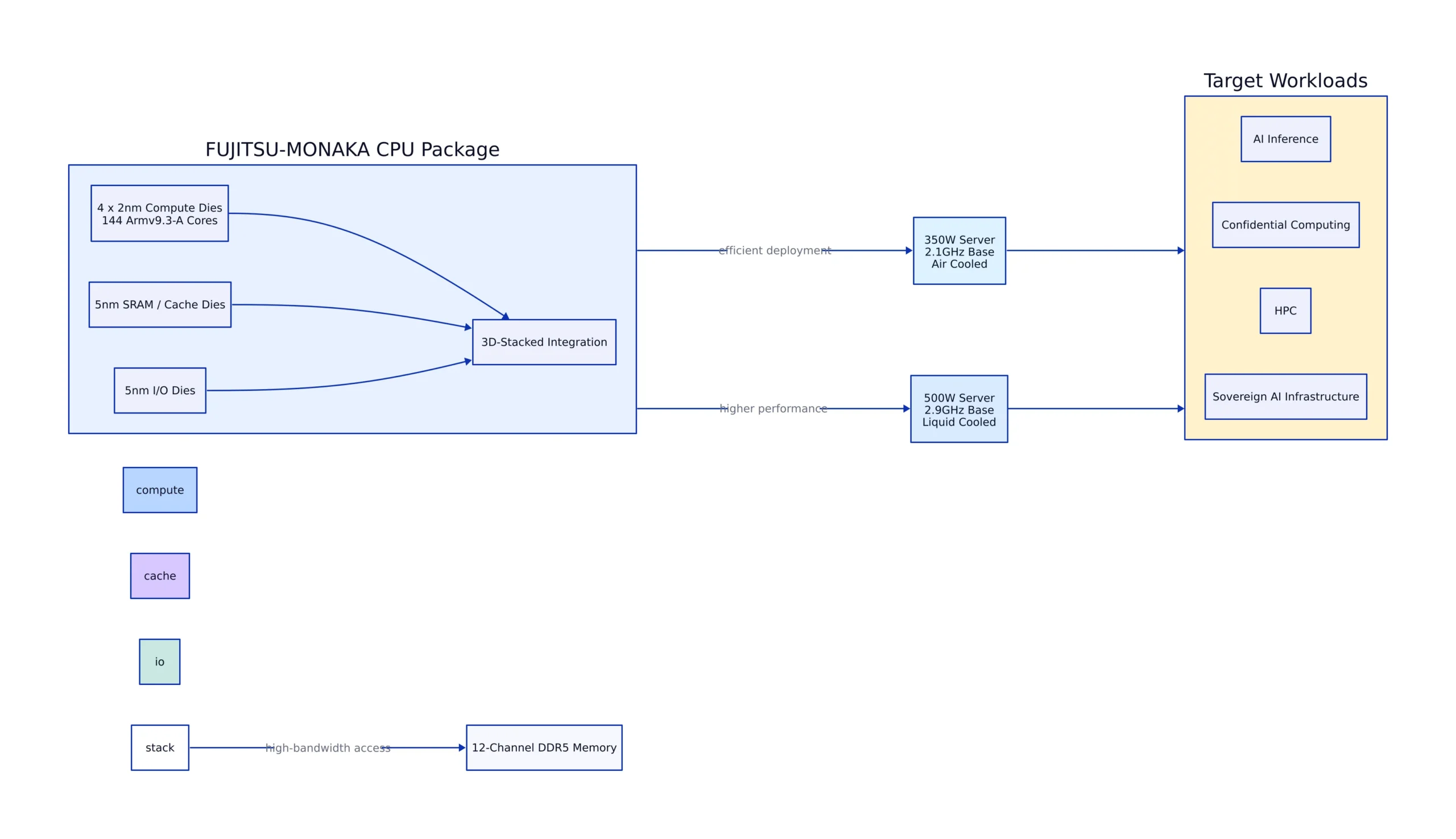
The compute dies sit above SRAM through face-to-face hybrid bonding. A central I/O and memory die connects the package to 12 DDR5 channels and PCIe 6.0 devices. The design places last-level cache on separate silicon and moves low-dropout voltage regulators onto the 5nm SRAM layer, avoiding analog circuitry that gains little from shrinking to 2nm.
Each core has two 256-bit SVE2 vector units and two 256-bit load-store units. Fujitsu’s earlier A64FX processor used 512-bit SVE for scientific workloads in the Fugaku supercomputer. MONAKA narrows vector width to reduce core area and match the data-center inference workloads Fujitsu is pursuing.
The package also includes a floating-point register cache for workloads with high temporal locality, including matrix multiplication. Dedicated matrix instructions work alongside SVE2 operations, giving the CPU a path to execute inference kernels without a separate accelerator for every request.
Power, Cooling, and Server Configurations
Fujitsu plans two processor SKUs. The high-efficiency version runs at 350W with 2.1GHz base frequency; the high-performance version runs at 500W and 2.9GHz. Both have a stated maximum frequency of 3.8GHz and memory transfer rate of 8,800 MT/s. These are high-power server parts, but the 350W option remains compatible with the air-cooled configuration Fujitsu is emphasizing.
| Configuration | CPU and clock | Cooling | Storage | Source |
|---|---|---|---|---|
| 1U server | One or two CPUs at 2.1GHz or 2.9GHz | Air at up to 40C ambient; water at up to 45C | Eight E3.S and two M.2 drives | The Register |
| 2U dual-socket server | Two CPUs at 2.1GHz | Air cooling | Four E3.S and two M.2 drives | The Register |
| 2U multi-node server | Two CPUs per node at 2.9GHz, four nodes per rack | Liquid cooling | Two E1.S and two M.2 drives per node | The Register |
The 1U model also uses CDI/CXL technology to allocate memory and accelerators beyond one server’s physical boundary, helping when model weights exceed local memory. Pooled memory introduces another access path that must be tested against workload latency requirements.
Fujitsu claims its cooling design can reduce server cooling power by up to 80%. That number comes from the vendor and lacks an independent facility-level comparison. Test conditions matter: inlet temperature, rack density, fan speed, cooling plant design, and workload use can all change the result.
Developer Capacity Planning Examples
MONAKA hardware is not yet a drop-in performance result. Developers and infrastructure teams must translate core counts, power limits, and NUMA layouts into deployment plans. The following dependency-free Python 3 examples use Fujitsu’s published specifications for first-pass calculations: planning tools, not substitutes for measurements on production hardware.
Estimate core allocation for inference workers
Note: The following code is an illustrative example and has not been verified against official documentation. Please refer to the official docs for production-ready code.
#!/usr/bin/env python3

TOTAL_CORES = 144
RESERVED_FOR_OS = 8
CORES_PER_WORKER = 17

usable_cores = TOTAL_CORES - RESERVED_FOR_OS
worker_count = usable_cores // CORES_PER_WORKER
unused_cores = usable_cores % CORES_PER_WORKER

print(f"Usable cores: {usable_cores}")
print(f"Inference workers: {worker_count}")
print(f"Unused cores: {unused_cores}")

# Expected output:
# Usable cores: 136
# Inference workers: 8
# Unused cores: 0
#
# Production caveat: benchmark physical core affinity, memory bandwidth,
# NUMA placement, and request latency before fixing worker counts.
This common-case calculation reserves cores for the operating system and assigns the rest to long-running workers. MONAKA can expose one, four, or eight NUMA nodes, corresponding to groups of 144, 36, or 18 cores. An eight-worker layout therefore provides a natural starting point for an eight-node configuration, but the final mapping depends on model size and memory traffic.
Compare processor power budgets
Note: The following code is an illustrative example and has not been verified against official documentation. Please refer to the official docs for production-ready code.
#!/usr/bin/env python3

servers = 24
processors_per_server = 2
sku_power_watts = {
 "high_efficiency": 350,
 "high_performance": 500,
}

for name, watts in sku_power_watts.items():
 cpu_load_kw = servers * processors_per_server * watts / 1000
 print(f"{name}: {cpu_load_kw:.1f} kW of CPU power")

# Expected output:
# high_efficiency: 16.8 kW of CPU power
# high_performance: 24.0 kW of CPU power
#
# Production caveat: this calculates CPU nameplate power only. Add memory,
# storage, networking, fans, power-conversion loss, and cooling overhead.
The difference is 7.2kW of CPU power across 24 dual-socket servers before facility overhead. Teams should compare that additional draw with measured throughput, not base clock alone. The 500W SKU runs at higher frequency, but Fujitsu’s projected inference figures remain vendor estimates.
Select NUMA layout from worker requirements
#!/usr/bin/env python3

numa_options = {
 1: 144,
 4: 36,
 8: 18,
}
required_cores_per_worker = 24

valid_options = {
 nodes: cores
 for nodes, cores in numa_options.items()
 if cores >= required_cores_per_worker
}

for nodes, cores_per_node in valid_options.items():
 print(f"{nodes} NUMA node(s): {cores_per_node} cores per node")

# Expected output:
# 1 NUMA node(s): 144 cores per node
# 4 NUMA node(s): 36 cores per node
#
# Production caveat: core count alone cannot select topology. Measure
# local and remote memory access, cache contention, and tail latency.
An 18-core NUMA partition cannot contain a 24-core worker, so the script removes eight-node mode. A four-node layout can place one worker within each 36-core locality domain. The single-node setting remains useful for applications that prefer one large memory domain, but it can hide physical distance that still appears in latency measurements.
Confirmed Specifications and Vendor Claims
Independent technical coverage broadly agrees on the physical design: 144 Armv9.3-A cores, four 2nm compute dies, 5nm SRAM and I/O silicon, 12 DDR5 channels, two power classes, and three server formats. ServeTheHome reported those details from Hot Chips 2026, while The Register separately described the processor and Fujitsu’s server range.
The benchmark story remains vendor-led. Fujitsu claims twice the AI inference throughput of other CPUs, which it says can halve server requirements and processing power for equivalent work. Its published estimates place the 350W part at 4,355 GFLOPS and 69.7 TOPS of INT8 processing, and the 500W part at 6,013 GFLOPS and 96.2 TOPS. TechTimes notes that independent benchmarks had not been published with the launch.
The missing comparison is workload-level evidence against CPU and GPU alternatives. Core count and process node do not predict tokens per second, batch latency, memory capacity, or performance per watt. A useful evaluation must run the same model, precision, framework, batch size, and service-level target on each platform.
The Limits of the Made-in-Japan Label
Fujitsu designs and develops the processor in Japan, and the Fujitsu MONAKA Server is manufactured at the company’s Kasashima Plant. Fujitsu says domestic assembly provides traceability into component origin and manufacturing history, which is useful to government, defense, and regulated buyers evaluating supply-chain custody.
The 2nm compute dies still depend on TSMC fabrication in Taiwan. The product therefore increases Japanese control over processor design, system integration, firmware relationships, final assembly, and support, but it does not create an end-to-end domestic semiconductor supply chain. For more context, see our semiconductor supply-chain risk analysis.
Fujitsu’s next step is Monaka-X, a planned 1.4nm successor associated with the FugakuNEXT program and NVLink Fusion support. That roadmap points toward deeper integration with Nvidia accelerators rather than wholesale rejection of GPUs. MONAKA is primarily a CPU inference and data-processing option; mixed CPU-GPU systems remain part of Fujitsu’s plan.
MONAKA, GPUs, and Other Arm Servers
Comparing MONAKA directly with Nvidia A100 or H100 systems requires care because they occupy different roles. GPUs concentrate large amounts of parallel arithmetic and come with a mature accelerator software stack. Fujitsu’s processor emphasizes general-purpose Arm cores, vector and matrix instructions, DDR5 memory, confidential computing, and operation in conventional server formats.
For training large models, Fujitsu has not presented MONAKA as a replacement for accelerator clusters. Its more credible use cases are CPU-resident inference, AI agents mixed with conventional application code, high-performance computing, and regulated deployments where local processing and hardware-isolated memory matter.
The air-cooling argument is also conditional. Some GPU systems can operate with air cooling, while the densest rack-scale configurations create power and thermal requirements that push facilities toward liquid cooling. MONAKA’s 350W SKU addresses the latter constraint by fitting CPU inference into a conventional 1U or 2U operational model. Buyers should compare complete racks and measured workloads rather than assuming every GPU deployment requires the same cooling design.
Pilot Projects and Commercial Partners
American Megatrends was selected as firmware supplier for the Arm-based processor. Arrcus and 1Finity are working with Fujitsu on an architecture combining MONAKA compute, the ArcOS network operating system, and optical interconnects for distributed inference. These are partner announcements rather than completed customer deployments, but they cover two operational gaps a new server CPU must address: firmware maturity and network integration.
Fujitsu and Scaleway provide the clearest deployment path. Their joint proof of concept was scheduled for the second half of 2026, followed by possible customer pilot environments from 2027. The companies plan to evaluate CPU-based inference alongside GPU-centered configurations, with workload characteristics and total cost of ownership determining placement.
Fujitsu is also working with the Indian Institute of Science on algorithms optimized for the processor. This matters because vector width and matrix instructions only produce useful gains when compilers and libraries generate appropriate code. A processor can have strong theoretical throughput and still lose real deployments if developers must rewrite major parts of their software.
What to Watch Through 2027
Independent inference results: Fujitsu’s twice-throughput claim needs tests covering model size, precision, batch size, latency, power at the wall, and cooling overhead. Peak TOPS alone cannot establish deployment economics.
Volume availability: November 2026 begins the sales phase, while 2027 is the mass-production and broader shipment target. The number and identity of server manufacturers adopting the standalone CPU will show whether MONAKA expands beyond Fujitsu’s own systems.
Software support: Armv9.3-A and SVE2 reduce the portability gap for existing Arm software, but optimized matrix kernels, container images, monitoring agents, firmware updates, and confidential-computing tooling must work together. The Scaleway pilots should expose integration problems before wider availability.
Public pricing: Fujitsu has not announced prices for the CPU or server range. Air-cooled operation can avoid facility upgrades, but buyers still need hardware cost, support terms, measured throughput, and use data to calculate total cost per inference request.
FUJITSU-MONAKA gives Japan a domestically designed server processor tied to domestic system manufacturing and a global foundry supply chain. Its strongest opening is specific: inference in regulated, power-constrained, or air-cooled facilities where a dense GPU rack is difficult to deploy. The architecture is credible, partner work has started, and the first sales date is set. Production benchmarks and customer deployments in 2027 will determine whether those advantages survive contact with real software and real data centers.
Related Reading
More in-depth coverage from this blog on closely related topics:
- How to Train a 4B Model
- Apple’s New Photo Verification Approach
- Gemini 3.8 Live Update and Features
- FBI Agency Disrupts Chinese Hacking Platforms
Sources and References
Sources cited while researching and writing this article:
Rafael
Born with the collective knowledge of the internet and the writing style of nobody in particular. Still learning what "touching grass" means. I am Just Rafael...